Translation as Critical Practice: Literary Translation and Literary Criticism in Modern Iran
This essay examines the intimate relations between literary translation and literary criticism through the practice of close reading. Reading translation alongside New Criticism, Russian Formalism, deconstruction, and Gayatri Spivak’s characterization of translation as “the most intimate act of reading,” the essay argues that the interpretive labor of criticism is also indispensable to translation. Close reading, in this sense, is not merely a critical technique but a prerequisite for literary translation. The discussion then situates this claim in Iran at the dawn of modernity, around the Constitutional Revolution (1905–1911), when the changing intellectual, political, and literary landscape paved the way for the prominent thinkers and reformists of the time to employ criticism and translation as the necessary components of their socio-political reformist agenda. The essay ultimately suggests that this convergence, evident in the Iranian case, raises the further question of whether it holds more broadly across Global South literary cultures.
Keywords: close reading; Iranian Constitutional Revolution; deconstruction; literary criticism; literary translation; modernity; thick translation
In contemporary Persian literature, especially over the past sixty years, I have often wondered why some eminent Iranian literary translators—such as Najaf Daryabandari, Reza Seyed Hosseini, and Abdulrahim Ahmadi—have produced critical essays and writings that, in depth and quality, seem to surpass the work of those who identify as literary critics. This observation has led me to ask whether there is a deep structural, or even universal, relationship between literary translation and literary criticism, and, if so, what brings these two practices together.
Some scholars have argued that close reading serves as a common denominator between disciplines such as literary criticism and philosophy.1Julian Wolfreys, Readings: Acts of Close Reading in Literary Theory (Edinburgh: Edinburgh University Press, 2000), xi. Building on that claim, this essay argues that close reading can be considered a foundation for both literary translation and literary criticism. I therefore ask: Is the literary critic an alter ego of the literary translator? What theoretical underpinnings do the two practices share? Are these merely structural commonalities, or do they also function as practical tools for translators and critics? How central is close reading to both?
The developments discussed here reinforce the theoretical considerations outlined above, revealing a structural proximity between literary translation and literary criticism substantial enough that literary translators have the potential to become literary critics, and literary critics literary translators, provided they possess the necessary linguistic knowledge. Both require solid knowledge and a deep, analytical understanding of the text with which they engage, and this insight and knowledge stem from a meticulous reading of the text at hand. In “The Politics of Translation,” Gayatri Chakravorty Spivak famously holds that:
Translation is the most intimate act of reading. I surrender to the text when I translate. . . . It is an act of submitting to the rhetorical dimension of the text. Although every act of reading or communication is a bit of this risky fraying which scrambles together somehow, our stake in agency keeps the fraying down to a minimum except in the communication and reading of and in love. What is the place of “love” in the ethical? The task of the translator is to facilitate the love between the original and its shadow, a love that permits fraying, holds the agency of the translator at bay and the demands of her imagined or actual audience at bay.22. Gayatri Chakravorty Spivak, “The Politics of Translation,” in The Translation Studies Reader, 2nd ed., ed. Lawrence Venuti, 369–88 (London: Routledge, 2004), 370.
In the second part of this essay, I turn to the Iranian case, where the intellectual landscape of Iran on the verge of modernity contributed to the emergence of literary critics-cum-translators, before closing with the broader question of whether this pattern is specific to Global South literary traditions or more widely shared. I argue that the intellectual landscape of Iran on the verge of modernity contributed to the emergence of literary critics-cum-translators, and, in closing, I will try to gesture toward the broader question of whether this pattern is specific to Global South literary traditions or more widely shared. Although Spivak analyzes translation theories and issues primarily in the context of feminist texts and of the translation of Global South texts into Western languages, I contend that certain aspects of her view of translation are not only applicable to all types of translation but also bear a remarkable resemblance to and resonance with what occurs in literary criticism. There may be many ways to interpret her comment above; however, when she refers to translation as “the most intimate act of reading,” she may be referring to a close reading of the text—that is, deriving meaning from the text itself while setting aside what lies outside it. In other words, “…the translator must not only make an attempt to grasp the presuppositions of the author but also, and of course, inhabit, even if on loan, the many mansions and the many levels of the host language”.33. Gayatri Chakravorty Spivak, “Translating into English,” in Nation, Language, and the Ethics of Translation, ed. Sandra Bermann and Michael Wood, 93–110 (Princeton, NJ: Princeton University Press, 2005), 95. Derrida describes the same practice as entering the specific protocols of the text at hand, whether the text is being critiqued or translated, rather than relying on the general laws of language.4.Spivak, “Translating into English,” 94. This may mean attempting to derive meaning primarily from the text itself.
The same method — termed close reading in the Anglo-American critical tradition and explication de texte in the French — can also be found in literary criticism. It involves a thoughtful and careful reading of a text in which interpretation emerges from the text itself rather than from external considerations, and it means appreciating and analyzing each text based on its structural and rhetorical features. Close reading is mainly associated with New Criticism, a movement that challenged the prominence of the historical-biographical approach in literary criticism, in which nontextual historical and biographical information served as the primary basis for interpreting a text. Although New Criticism and its counterpart, Russian Formalism, no longer hold sway, close reading still plays an important role in a number of other critical approaches, even when those approaches do not explicitly acknowledge it. This may also suggest that it remains a viable instrument and a common denominator between literary translation and literary criticism.
As I previously stated, close reading can be employed in any text-based critical approach—that is, any approach that avoids relying primarily on nontextual cultural, historical, and biographical data. Deconstruction may be a case in point. Rather than imposing a systematic and predetermined methodology on literary works, deconstruction does not seek to bring a preconceived framework to a text. Instead, it constitutes a mode of reading sensitive to what is irreducible within every text, allowing the text to speak before readers and listening to what it demands of the reader.5Martin McQuillan, “Introduction: Five Strategies for Deconstruction,” in Deconstruction: A Reader, ed. Martin McQuillan, 1–43 (London: Routledge, 2001),5. Although some do not consider deconstruction “a method of literary criticism or even of reading”6McQuillan, “Introduction: Five Strategies for Deconstruction,” 3., it is important to note that “deconstruction has been frequently assimilated to the discourse of criticism”77. Peggy Kamuf, “The Ghosts of Critique and Deconstruction,” in Deconstruction: A Reader, ed. Martin McQuillan, 198–213 (London: Routledge, 2001), 199., regardless of one’s agreement or disagreement with the raison d’être of deconstruction. However, some theorists reject the similarities and resonance between deconstruction and New Criticism.88. J. Hillis Miller, “Derrida’s Topographies,” in Deconstruction: A Reader, ed. Martin McQuillan, 161–70 (London: Routledge, 2001), 162. Nevertheless, it is possible to observe a striking affinity between deconstruction and New Criticism and, by extension, between deconstruction and the latter’s emphasis on close reading as a method of interpretation. This affinity and disagreement can be reconciled once the term is properly scoped: New Criticism and deconstruction share a method—minute, text-internal attention to rhetorical figures and tensions rather than appeal to extrinsic historical or biographical evidence—even though they diverge on what that attention ultimately reveals, New Criticism finding resolution into unity, deconstruction finding irreducible instability. It is this shared method, rather than either tradition’s conclusion about textual coherence, that the present argument draws on: whether close reading is taken to end in unity or in aporia, it remains, in both cases, the same disciplined, text-bound practice that this essay argues underlies literary translation as well.99. Paul de Man, “Form and Intent in the American New Criticism,” in Blindness and Insight, 2nd ed., rev. Introduction by Wlad Godzich. Minneapolis: University of Minnesota Press, 1983, 20–35. I further argue that this individualized approach to each literary text, which sets aside prefabricated critical methods and theories, calls for close reading. Just as close reading has been an effective tool for literary critics, it has also been an essential prerequisite for literary translation.
One may also emphasize the importance of the role of the literary translator in facilitating the relationship between the source-language text and its shadow (i.e., the target-language text). A good translator, Spivak argues, attends both to the specificity or rhetorical dimension of the text they are translating and to its logical dimension. This is what she means by translation being “the most intimate act of reading.”101. Spivak, “Translating into English,” 95. Is this different from what a literary critic does as well? Depending on the critical tendencies and approaches they adopt, literary critics place different degrees of emphasis on both (post)structural aspects and the ways in which readers interpret and perceive a literary work.
Here, Spivak’s idea of translation in which language, among other elements, contributes to the process of meaning construction seems apt.1111. Spivak, “The Politics of Translation,” 369. Similarly, literary criticism may involve considering language as one of several elements contributing to the process of meaning construction. Literary critics and translators perform comparable tasks: they both make texts understandable and explain them, and the point of departure for both is the original text. Drawing on Roman Jakobson’s distinction between intralingual and interlingual translation, a translator’s work is interlingual, while, in most cases, what a literary critic does is intralingual. In “On Linguistic Aspects of Translation” (1959), Jakobson explains that “the meaning of any linguistic sign is its translation into some further, alternative sign, especially a sign ‘in which it is more fully developed.”1212. Roman Jakobson, “On Linguistic Aspects of Translation,” in The Translation Studies Reader, ed. Lawrence Venuti, 138–143 (London: Routledge, 2004), 139. In other words, when someone encounters the word “cheese” for the first time, they do not automatically understand its meaning merely by seeing the physical object. Instead, one can understand the concept of cheese by referring to other signs or words. In this sense, the critic’s paraphrase and the translator’s rendering perform the same basic operation Jakobson describes — substituting one sign for “some further, alternative sign” — except the critic’s substitution stays within the same language, while the translator’s crosses into another.
In general, there are three ways to interpret a verbal sign. First, it is possible to translate a verbal sign into other signs within the same language. This is intralingual translation, or rewording. Second, interlingual translation interprets verbal signs through another language. Finally, intersemiotic translation, or transmutation, involves interpreting verbal signs through signs belonging to nonverbal sign systems. The first case, also called synonymy, is never entirely equivalent: a single alternative word cannot fully convey another word, and one can instead explain a word through a combination of other words. This process is more or less what a literary critic does. A critic endeavors to explicate, interpret, and criticize by using words in the same language as the source-language text and, in order to explain each sign in the original text, needs additional signs. In translation from one language into another, however, the message is substituted rather than merely individual code units, and there is usually no complete equivalence between the units.1313. Jakobson, “On Linguistic Aspects of Translation,” 139. In short, in both literary criticism and literary translation, close reading serves as a tool for meaning construction, with the difference that the former usually involves one language, whereas the latter involves two. This shared reliance on close reading, however, should not be taken to imply that criticism and translation are identical operations. Interpretation, in the broadest sense, is the general hermeneutic act of construing meaning that any reader performs. Criticism and translation are both institutionalized elaborations of that act, yet they diverge in output, audience, and constraint. Criticism ordinarily produces an essay of interpretive commentary that exists alongside the source text, addressed to a scholarly or literary readership and answerable to that readership’s disciplinary norms in the professionalized sense discussed above. Translation produces a text that substitutes for the source altogether, addressed to a readership that in most cases cannot consult the original, and constrained by a second language’s phonology, syntax, idiom, and connotative range in ways that same-language paraphrase does not require. These differences in output, audience, and constraint are real, and acknowledging them clarifies rather than weakens the claim advanced here: what criticism and translation share is not the operation itself but the reading competence that underlies it. Both require the critical, structurally attentive mode of close reading described above, sensitive not merely to what a text says but to how it says it, even as each puts that competence to a different institutional use—criticism in the service of interpretive commentary, translation in the service of producing a text that can stand in the original’s place.
Closely related to this argument is the fact that close reading functions as a common denominator between literary criticism and literary translation because literary critics and translators engage in writing, an endeavor that, according to Hélène Cixous, is not independent of reading.1414. Wolfreys, Readings: Acts of Close Reading in Literary Theory, 35. In other words, reading is an integral part of writing. Since both literary critics and translators write particular kind of text, the forms of reading they undertake are closely related. Similarly, Umberto Eco stipulates that what occurs in translation is not “a comparison between two languages, but the interpretation of two texts in two different languages.”1515. Susan Bassnett, Translation (London: Routledge, 2014), 16. As a result, one could argue that literary translation involves a more complex process than literary criticism because the former requires close reading, understanding, and interpretation of two texts in two different languages. Accordingly, it is possible to identify a methodological common ground between translation and criticism, as both require meticulous reading and understanding of the text at hand. Hence, a translator is potentially an even more attentive reader than a critic.
A further consequence of this shared reliance on close reading is the inherent possibility of misunderstanding in the reading of literary texts. Paul de Man develops this idea particularly in relation to what literary criticism can accomplish. He argues that an examination of the writings of literary critics reveals that, in all of them, there exists a paradoxical discrepancy between the general statements they make about the nature of literature (i.e., the statements upon which they base their critical methods) and the actual results of their interpretations. As a result, one can no longer reduce a literary text to a finite set of meanings but must view the act of reading as an endless process in which truth and falsehood are inextricably intertwined.1616. Bassnett, Translation, vii–ix. I assume that the same can be posited of literary translation. For example, when Derrida argues that a translator should enter the protocol specific to the text they are translating rather than the general protocols of the language from which they are translating, he addresses a similar kind of discrepancy.1717. Spivak, “Translating into English,” 94. In both cases—criticism and translation—the discrepancy exists between general statements, on the one hand, and the specific textual protocols that may lead to misunderstandings, on the other.
Another manifestation of the commonalities between literary translation and literary criticism is that, in most, if not all, languages, one may find translated texts containing translators’ annotations and explanations. The person who undertakes such a task becomes, at the same time, a literary translator and a literary critic. Kwame Anthony Appiah’s concept of thick translation is a case in point. Drawing on speech-act theory, Appiah distinguishes a sentence’s literal intentions—the meaning a speaker is conventionally taken to intend by their words—from the broader, context-dependent meaning that is not reducible to that literal sense. He argues that this distinction becomes especially fraught in translation:
a sentence’s literal intentions in the source language do not necessarily carry over intact into the target language, since each sentence conveys a particular shade of meaning inseparable from its own linguistic and cultural context. The problem is most visible in translating metaphors and proverbs, where the meaning a translator aims to convey cannot be reduced to the literal meanings or intentions of the individual words. Literary conventions, simply put, make possible acts that can be defined by reference not only to the meanings… but also to the features that are broadly formal [and]… determine how we should construct a meaning.1818. Kwame Anthony Appiah, “Thick Translation,” in The Translation Studies Reader, ed. Lawrence Venuti, 417–29 (London: Routledge, 2000), 397.
In these cases, there are no conventions analogous to those governing literal meaning because there is usually no access to the writer’s literal intention. In literary translation, the aim is not to reproduce the author’s literal intention(s) but rather to reproduce something with the same literary properties as the source-language text. In other words, a literary translation reproduces the source-language text’s relationship to the literary and linguistic conventions of its own and related cultures. Producing an exact parallel is sometimes impossible.1919. Appiah, “Thick Translation,” 397. At times, this fact requires the translator to depart from literal intentions. The adequacy of translation also depends upon the adequacy of the translator’s reading and understanding of the original text. This is especially important when literary translation is used in teaching literature. In such cases, the translator is expected to provide annotations alongside the translated text.
Appiah seems primarily concerned with translating literary texts from the Global South or cultural peripheries and with making them more accessible when studied as part of the curriculum at Western universities. As I previously pointed out, he briefly acknowledges that translators undertaking this type of translation should mainly confine their work to academic settings. Presumably, what he means is that, in such contexts, students and scholars study and analyze literary texts rather than merely read them for pleasure. Despite this limitation, it is possible to observe how literary translation and critical commentary become intertwined and how the ability to perform one facilitates engagement with the other.
Having established the commonalities and convergences between literary translation and literary criticism on a theoretical basis, I will now focus on contemporary Iran as a case study. Specifically, I examine the Constitutional Revolution era (1905–1911), when these theoretical convergences manifested as social practices, with literary translators sometimes performing functions associated with literary critics. Not only have some Iranian literary translators written critical footnotes and endnotes on the literary works they translate into Persian, but they have also written introductions and epilogues to those works. Furthermore, they have been known to author full-fledged critical commentaries on translations by their fellow translators, evaluating both the literary value of the works and the quality of the translations. As I will demonstrate, some Iranian literary translators have functioned almost as independent literary critics by producing substantial volumes of literary criticism and theory that extend far beyond commentaries on the books they have translated.
Here, I focus on the factors specific to the contemporary Iranian context—that is, the cultural, social, and political conditions that contributed to literary critics and literary translators frequently being the same individuals. Those who undertook the translation of literary works also introduced Western-style literary criticism to Iran. Through their translations, they introduced significant Western literary figures and works as well. Consequently, they applied the same critical methods and ideas to introduce and analyze these new literary works and figures for Iranian readers.
It is worth clarifying that the reformers and translators discussed above rarely, if ever, distinguished among the European, Anglo-American, Russian Formalist, French, and other critical traditions they drew upon, treating them instead as an undifferentiated body of “Western” critical thought. This lack of differentiation was not a symptom of intellectual carelessness but a consequence of their purpose. Unlike professional or specialized literary critics, these figures were not primarily concerned with mapping the genealogy of a given critical method or adjudicating among competing theoretical schools. Their goal was pedagogical and political: to educate and mobilize the Iranian public toward fundamental social and political change. Just as they fused literary translation and literary criticism into a single instrument of reform, so too did they draw on European, Anglo-American, Russian, and French critical strands indiscriminately, adapting whatever critical vocabulary served their reformist ends rather than treating these traditions as discrete objects of study.
In the years leading up to and following the Constitutional Revolution, those who translated literary works as well as works of literary criticism were often also social reformers. They pursued their agendas through a combination of political activism, cultural work, and literary publications. These individuals were simultaneously writers, literary critics, literary translators, and political actors, although they did not identify themselves as literary translators or literary critics. Through their various activities, they contributed to the emergence of modern literary translation and literary criticism. Instead, they considered themselves social reformers or revolutionaries. By today’s standards, they belonged more broadly to the intelligentsia and represented prototypes of the modern intellectual. The intelligentsia may be defined as a classless group of highly educated, relatively affluent people concerned with educating the masses and advancing the masses’ own interests.2020. Babak Ahmadi, Kār‑i rūshanfikrī [The Function of Intellectuality] (Tehran: Nashr‑i markaz, 2008), 26–27. In this sense, the historical role of translators and critics in Iran cannot be separated from their broader function as agents of social reform. In Paydāyish‑i rumān-i fārsī [La Genèse du roman persan moderne] (1997), Christophe Balaÿ argues that these individuals—who, following Babak Ahmadi’s definition, almost all came from affluent and aristocratic backgrounds—can be divided into four groups.2121. Christophe Balaÿ, Paydāyish‑i rumān-i fārsī [La Genèse du roman persan moderne], trans. Mahvash Ghavimi and Nasrin Khattat (Tehran: Institut Français de Recherche en Iran and Intishārāt‑i mu‘ayn, 1998), 21. The first consists of the Shah (e.g., Naser al-Din Shah) and his courtiers (e.g., the crown prince Abbas Mirza), who commissioned translations. The second comprises newly established government-run schools, especially Dar al-Fonoun. The third includes political opposition groups. The fourth consists of freelance translators who undertook translations according to their own interests.2222. Balaÿ, Paydāyish‑i rumān-i fārsī, 21. Members of these groups primarily published materials, including translations and original writings, with the aim of promoting social reform. Those who translated literary and cultural texts in Iran were principally Iranian activists and reformers who lived in Turkey, the Caucasus, India, Egypt, and Germany as exiles and expatriates, and they sought fundamental political and social changes in Iran. Having learned Western languages and cultures, they regarded the translation of works of literary criticism as part of their broader agenda of challenging the status quo. Mirza Fathali Akhondzadeh, Aqa Khan Kermani, Abdoulrahim Talebov Tabrizi, Mirza Aqa Tabrizi, Mirza Malkam Khan, and, later, Hassan Taqizadeh were among these figures.

From the left, Mirza Fathali Akhondzadeh (1812–1878), Abdoulrahim Talebov Tabrizi (1834–1911), and Hassan Taqizadeh (1878–1970).
Among them, Mirza Fathali Akhondzadeh (1812–1878) is perhaps the most prominent. He is generally regarded as the first Iranian playwright to write in Azeri and was also a literary translator and literary critic. His treatise titled Qritiqa [Critica] (1866) was the first work to introduce the principles of Western literary criticism to Iranian readers. Above all, however, he considered himself a social reformer who propagated his ideas through his plays, stories, essays, and translations. Thus, when he wrote on literary criticism or undertook translations for the press, his ultimate aim was social reform and enlightenment.
Etemad al-Saltaneh, on the other hand, simultaneously served as the minister responsible for censorship, the editor-in-chief of the country’s only government newspaper, and then the Shah’s special translator and interpreter. He translated for the Shah and, at times, for the public, e.g., for Iranian students, a diverse range of materials, including fiction and nonfiction, with the aim of raising public awareness.
Some Iranian students were sent to Europe, primarily to the United Kingdom and France. Upon their return to Iran, they assumed various governmental positions. More importantly, however, although they held different stances regarding the political and social issues of their time, they undertook translation as an integral part of their careers.
Here, Itamar Even-Zohar’s polysystem theory seems particularly relevant. This theory focuses on the position of translated literary works within literary polysystems, and its central premise is the significance of literary translation as a system within the broader totality of the target literature understood as a polysystem As Even-Zohar explains, when translated literature occupies this central position, it becomes an integral part of innovatory forces within the polysystem — so closely bound up with major literary-historical developments that the line between “original” and “translated” writing dissolves — and it is often the leading writers, or soon-to-be leading writers, who produce the most acclaimed translations.2323. Itamar Even‑Zohar, “The Position of Translated Literature within the Literary Polysystem,” in The Translation Studies Reader, 3rd ed., ed. Lawrence Venuti, 162–67 (New York: Routledge, 2012), 163. On the eve of the Constitutional Revolution, translations by Malkam Khan, Fathali Akhoundzadeh, and Mirza Aqa Khan-e Kermani contributed to the emergence of new ideals among Iranians, leading to significant literary, cultural, social, and political “turning points.”2424. Even‑Zohar, “The Position of Translated Literature within the Literary Polysystem,” 164. The points made by Even-Zohar and Balaÿ highlight the central role of literary works translated into Persian in shaping contemporary Persian literature as a polysystem.
I now turn to contemporary Persian literature (that is, Persian literature from the second half of the twentieth century through the first two decades of the twenty-first century) to examine the ways in which literary translators have also undertaken the work of literary critics. It is worth considering several individuals and works that emerged between the Constitutional Revolution and the Pahlavi II and post-Revolution periods. Chief among them is Fatemeh Rezazadeh Mahalati (Sayyah) (1902–1947). She may be considered the first Iranian literary critic and comparatist in the proper and modern sense of the term. Born and raised in Moscow, she knew several languages (although her knowledge of Persian was insufficient) as well as literary theory. She was also one of the significant proponents of socialist realism in Iran. Although she did not translate any works into Persian, her linguistic knowledge and the years she spent in Europe transformed her into a conduit for teaching Western literary criticism at the University of Tehran.
In contrast to some languages in which translators play an insignificant role in literary production—to the extent that their names are sometimes omitted from book covers—many Iranian readers seek out works translated by Najaf Daryabandari, Mohammad Qazi, Kamran Fani, Ezatollah Fouladvand, Ahmad Mirʾalaie, Hassan Kamshad, and Ahmad Karimi Hakkak, among others. These prominent Iranian literary translators introduced previously unknown writers and ideas to Iranian readers. In accordance with Even-Zohar’s framework, many Iranian literary translators today are also poets, writers, and literary critics. For example, the outstanding Persian poet Ahmad Shamlu translated poems by Federico García Lorca, novels by Zaharia Stancu, Antoine de Saint-Exupéry, and Robert Merle, and a play by Gilbert Cesbron titled Il est minuit, Dr. Schweitzer (1952). Additionally, the Persian poet Mohammad Ali Sepanlou translated poems by Yannis Ritsos and Saint-John Perse, as well as Horace McCoy’s novel They Shoot Horses, Don’t They?(1935). Finally, the literary critic, scholar, and poet Mohammad Reza Shafiei Kadkani translated poems by Abd al-Wahhab Al-Bayati.
Conversely, some renowned Iranian literary translators have been highly active and influential in other disciplines, particularly literary criticism. For instance, Najaf Daryabandari wrote an extensive account of Ernest Hemingway’s life and works as the introduction to his translation of The Old Man and the Sea (1952). Daryabandari’s analysis of Hemingway’s writing style became a source of inspiration and instruction for generations of Iranian writers. He also authored two volumes of critical essays titled Dar Eine Hal (1970) [At the Same Time] and Be Eʾbarat Digar(1984) [In Other Words]. Another example is Abdolrahim Ahmadi, who wrote an in-depth introductory essay analyzing Bertolt Brecht’s Leben des Galilei (1938). The essay, which appears as the introduction to the same volume, primarily focuses on and introduces the Brechtian technique of alienation.
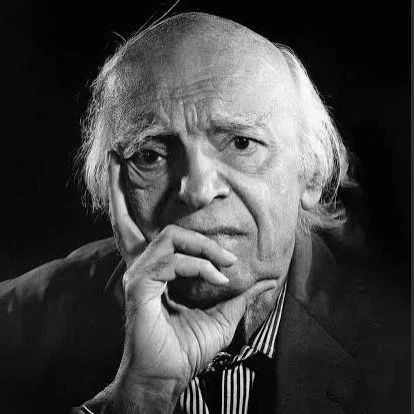
Najaf Daryabandari (1929–2020)
Even-Zohar’s four reasons for the active role of translated literature in a polysystem are particularly relevant to contemporary Persian literature. Since the Constitutional Revolution, Persian literature has been in a state of constant flux and upheaval, and it rarely finds itself in a central position within a larger group of related literary cultures.2525. Balaÿ, Paydāyish‑i rumān-i fārsī, 49. When translated literature assumes a central position in Persian literature, “the borderlines are diffuse, so that the very category of translated literature must be extended to semi‑ and quasi‑translations as well”. This is based on the following conditions: (1) when the borderlines between languages are diffuse; (2) when the influx of new ideas and literary works brings about major literary turning points; (3) when it is literary translators who are the heroes of the literary scene, introducing new books, writers, and literary trends to the Persian readership; and (4) when they sometimes even adopt a foreign work and publish it under their own name2626. Even‑Zohar, “The Position of Translated Literature within the Literary Polysystem,” 166. (for example, Mirza Ahmad Khan Kamal‑ol‑Molk’s adaptation of Tartuffe ou L’Imposteur, which he published as Haji Ryiaie Khan ya Tartuffe Sharqi in 1956). It is under these circumstances that literary translators also act as literary critics and commentators, writing introductions and commentaries on their own work as well as on the work their fellow translators produce. As intellectuals and thinkers dealing with literary and cultural issues, they even embark upon writing critical pieces that might seem independent of their translation careers, as in the case of Najaf Daryabandari’s two critical volumes mentioned earlier.
Before proceeding, it is worth clarifying what I mean by “professional literary criticism” in what follows. I take professionalization to be a matter of institutional infrastructure rather than of whether an individual also writes poetry, fiction, or drama: dedicated degree programs and departments oriented specifically toward criticism and theory, systematic and methodologically accountable procedures of interpretation subject to peer scrutiny, specialized critical and theoretical journals distinct from general literary magazines, and career structures—professorships, editorial posts, and the like—that reward criticism as a discrete vocation.2727. Gerald Graff, Professing Literature: An Institutional History (Chicago: University of Chicago Press, 1987).By this measure, the very critics who anchor this essay’s theoretical framework, the Anglo-American New Critics, count as professionals despite also being poets: John Crowe Ransom and Allen Tate turned criticism into a disciplined, institutionally housed practice even as they continued to write verse.2828. John Guillory, Professing Criticism: Essays on the Organization of Literary Study (Chicago: University of Chicago Press, 2022); Mark Jancovich, The Cultural Politics of the New Criticism (Cambridge: Cambridge University Press, 1993), esp. chap. 13, “The Professionalization of Literary Study.” Iran, by contrast, did not develop an equivalent institutional apparatus over the course of the twentieth century: there were few, if any, graduate programs devoted specifically to literary criticism and theory as distinct from literary studies more broadly, few specialized peer-reviewed critical journals, and few career paths that rewarded criticism as an independent vocation rather than as an adjunct to teaching, translation, or creative writing. It is this structural absence, rather than any personal inclination of individual writers toward multiple genres, that pushed literary translators, poets, and novelists to fill the resulting vacuum.
Additionally, the relative lack of professional literary criticism in Iran has motivated writers, poets, and playwrights to write their own critical essays. Some noticeable exceptions are as follows: Abdolʿali Dastgheib has published several volumes of commentary on contemporary Iranian writers and poets. His works seem like a haphazard amalgam of random biographical and historical information together with his subjective, personal, and unsystematic judgments—an unevenness that is itself telling, since even Iran’s most dedicated critical vocation fell short of the methodological accountability that professionalized criticism elsewhere presupposes. Ahmad Karimi‑Hakkak, conversely, is a prominent example of a literary critic and a literary translator. His translation of The History of Tom Jones, a Foundling (1749) by Henry Fielding has been remembered as a masterpiece of fluent, literarily rich, and correct translation, and it seems his background in comparative literature, English literature, and Persian literature (especially poetry) has bestowed on him the dual skills of translation and literary theory. Furthermore, his seminal book titled Recasting Persian Poetry (1995) is a milestone work in the field of scholarship on Persian poetry. Another outstanding example of a professional literary critic is Houra Yavari, who has written extensively on Persian literature in both Persian and English. Having lived in the United States for decades, she has a deep knowledge of literary theory (especially the psychoanalytical approach) as well as the English language. Hence, even though she is not a literary translator, she is a good example of how Western language(s) and literary theory have given shape to Iranian literary criticism. There are also a number of younger scholars such as Farzad Karimi, Parvin Salajegheh, and Mansoureh Tadayyoni who have focused solely on literary criticism, but they are young, and what they have published so far stems from their Ph.D. dissertations.
Apart from these exceptions — Dastgheib, Karimi-Hakkak, Yavari, and younger scholars such as Karimi, and Tadayyoni — literary criticism in Iran has largely remained unprofessionalized. As a result, people active in various literary fields have had to fill the vacuum. Literary translators, as explained above, have written commentaries on their own translations, on translations by their fellow translators, and on a myriad of other literary subjects.
It is also possible to think of Iranian literary translators’ critical knowledge not merely in terms of the introductions, commentaries, and essays that they write or the Western theoretical texts that they translate into Persian, but also in terms of their choices of the novels, poems, and plays they translate into Persian. In this case, their choices may, at least partly, be based on their knowledge of literary criticism and world literature. These choices, in turn, considerably influence the shaping of literary trends and even genres in Iran. The more one moves back in time and approaches, say, the Constitutional Revolution era, the more significant and stronger this influence becomes. One could justify this by using Even-Zohar’s polysystem theory, according to which Persian literature is a polysystem. In his terms, subsystems (i.e., genres) such as novels and modern short stories were still “young,” lacking an established repertoire of narrative conventions and models as well as a substantial body of original works, which allowed literary translation, as a comparatively stronger subsystem, to move to the center of the polysystem and shape other subsystems.
Christophe Balaÿ raises similar questions about the role of Iranian literary translators in importing Western novels into Persian literature:
Consider the perspective of Iranian literary translators who introduced Western novels into Persian literature. Were they fully aware of the revolutionary impact of this genre import? These questions were partially addressed when discussing the influence of literary tradition on this dynamic genre and the new interpretations of old norms by new writers (i.e., translators) based on established European (especially French) criteria and patterns. What does Le Roman or رمان truly signify in Persian?2929. Balaÿ, Paydāyish‑i rumān-i fārsī, 106–7.
He further holds that
There are various reactions to and understandings, as well as theoretical knowledge, of the novel, and that is not surprising. Those translators have come from different origins and the environments in which their characters have taken shape.3030. Balaÿ, Paydāyish‑i rumān-i fārsī, 109–10.
Taken together, Even‑Zohar’s theoretical framework and Balaÿ’s questions highlight the extent to which translators’ critical choices—about which genres to import, which works to translate, and how to frame them—have shaped Persian literary trends and genres, especially during periods of literary transition and rebirth.
This suggests that the social and cultural milieu in which Iranian literary translators worked shaped their critical knowledge and tendencies. In turn, those tendencies significantly influenced the Persian literary scene and nascent genres such as the novel. As a result, one may assume that if, due to a different set of backgrounds and crucial attitudes, Iranian translators had chosen different works to translate, the terrain of contemporary Persian literature would look different. As time goes by, translation still plays a significant role in determining the literary landscape of Iran. Of course, with the growth of other literary subsystems, translation loses its momentum to some degree, but it is still a determining factor. For example, in the 1970s and 1980s, it was translators such as Ahmad Miralaie, Abdullah Kowsari, Bahman Farzaneh, Arash Hejazi, and Ahmad Goulshiri who, drawing upon their knowledge of world literature and critical theory, made informed decisions and choices to translate the best poems, novels and short‑story collections by Latin American poets and writers. Beginning in the 1980s, writers like Moniro Ravani pour started writing stories that bore a remarkable resemblance to Latin American works known as marvelous (i.e., magical) realist.
Whether or not literary criticism in contemporary Persian literature will become separate from literary translation remains to be seen. This will depend on a number of factors, such as whether Iranians will have their own body of literary theory (or at least non‑Western literary theory), or whether they will depend, partially or entirely, upon Western literary theory, and whether they will be able to learn Western literary theory directly (i.e., without facing the language barrier). Either way, one point remains undeniable when viewed through Even-Zohar’s polysystem theory: literary translation functions as a subsystem at the very center of contemporary Persian literature as a general system. All these considerations tend to shed light on prospective avenues for research such as: Is this mutual relation between literary translation and literary criticism confined to Persian literature, or is it possible to discern the same phenomenon in other languages and their literary traditions? Is this true of Global South literature only, or can one observe the same pattern in other literary cultures as well? Does this overlap lead to literary, historical, cultural, and political precedents that help determine contemporary literary scenes?
- Gayatri Chakravorty Spivak, “Translating into English,” in Nation, Language, and the Ethics of Translation, ed. Sandra Bermann and Michael Wood, 93–110 (Princeton, NJ: Princeton University Press, 2005), 95.
- Spivak, “Translating into English,” 94.
- Paul de Man, “Form and Intent in the American New Criticism,” in Blindness and Insight, 2nd ed., rev. Introduction by Wlad Godzich. Minneapolis: University of Minnesota Press, 1983, 20–35.
- Kwame Anthony Appiah, “Thick Translation,” in The Translation Studies Reader, ed. Lawrence Venuti, 417–29 (London: Routledge, 2000), 397.
- Babak Ahmadi, Kār‑i rūshanfikrī [The Function of Intellectuality] (Tehran: Nashr‑i markaz, 2008), 26–27.
- Itamar Even‑Zohar, “The Position of Translated Literature within the Literary Polysystem,” in The Translation Studies Reader, 3rd ed., ed. Lawrence Venuti, 162–67 (New York: Routledge, 2012), 163.
- Gerald Graff, Professing Literature: An Institutional History (Chicago: University of Chicago Press, 1987).
- John Guillory, Professing Criticism: Essays on the Organization of Literary Study (Chicago: University of Chicago Press, 2022); Mark Jancovich, The Cultural Politics of the New Criticism (Cambridge: Cambridge University Press, 1993), esp. chap. 13, “The Professionalization of Literary Study.”