Leila Sadegh Beigi received her PhD in English literature from the University of Arkansas, where she is an instructor of literature. Her writing focuses on the intersection of gender, exile, and translation in contemporary Iranian women’s literature. Her recent publications include “Simin Daneshvar and Shahrnush Parsipur in Translation: The Risk of Erasure of Domestic Violence in Iranian Women’s Fiction” in the Journal of Middle East Women’s Studies (Duke University Press, 2020) and “Marjane Satrapi’s Persepolis and Embroideries: A Graphic Novelization of Sexual Revolution across Three Generations of Iranian Women” in the International Journal of Comic Art (John Lent, 2019).
Contemporary Iranian women writers create a voice of resistance in fiction by questioning and redefining gender roles, which are defined by culture, tradition, and state law in Iran. They narrate their stories of resistance in a state of exile, a condition rooted in marginalization independent of geographical location. In this article, I will examine and analyze The Complete Persepolis, written by Iranian writer, artist, and filmmaker Marjane Satrapi, as a transnational narrative written in exile. A transnational perspective challenges the binary division between the Eurocentric “First World/Third World” framework of modern global feminist analyses.[1] Satrapi’s narrative in The Complete Persepolis focuses on a gendered and discursive manifestation of women, culture, and identity, problematizing “a purely locational politics of global-local or core-periphery in favor of viewing the lines cutting across these locations.”[2] I argue that The Complete Persepolis expands the notion of exile through the visual representations of the author’s concerns about the status of women in exile at home and abroad. The portrayal of internal exile, or exile at home, relies on images of women struggling with gender discrimination, sexism, and censorship, all of which limit and marginalize them as female citizens. In the portrayal of external exile, or exile abroad, Satrapi offers images of women experiencing racism, stereotyping, and marginalization in the West.
The graphic representation of human emotions through the perspective of a young girl experiencing gender discrimination at home and racial discrimination abroad creates a space of empathy and understanding for readers. As Scott McCloud argues, “The wall of ignorance that prevents so many human beings from seeing each other clearly [can] only be breached by communication.”[3] Satrapi breaks the “wall of ignorance” through strong visual imagery unveiling the identity of Iranian women. As a transnational hero, the protagonist, Marji, breaks cultural, ideological, and geographical barriers, and calls for global solidarity, understanding, and equality for immigrants in exile. Of course, not all immigrants are exiled subjects. What lies at the heart of exile is the lack of choice. Edward Said writes: “Exile is not, after all, a matter of choice: you are born into it, or it happens to you.”[4] Exile, banishment, and stigmatization are described by Said as distinguishing factors and specific characteristics of exile.[5]
My argument is in line with two critical debates on the neccessity of reshaping transnationl feminism. The first is Chandra Mohanty’s model of transnational feminism in her articles “‘Under Western Eyes’ Revisited: Feminist Solidarity through Anticapitalist Struggles” (2003) and “Transnational Feminist Crossings: On Neoliberalism and Radical Critique” (2013). In “Under Western Eyes Revisited,” Mohanty suggests that “a transnational feminist practice depends on building feminist solidarities across the divisions of place, identity, class, work, belief, and so on.”[6] Mohanty calls for individual and conscious effort to use these differences to connect; “Under Western Eyes Revisited” focuses on “decolonizing feminism, a politics of difference and commonality, and specifying, historicizing, and connecting feminist struggles.”[7] A decade later, in “Transnational Feminist Crossings,” Mohanty emphasizes the importance of “re-commit[ting] to insurgent knowledges and the complex politics of antiracist, anti-imperialist feminisms.”[8] Mohanty writes: “I believe we need to return to the radical feminist politics of the contextual as both local and structural and to the collectivity that is being defined out of existence by privatization projects.”[9] She emphasizes the significance of a systematic analysis of power which depoliticizes the resistance and the social movements by the privatization of organizations and feminist antiracism in the neoliberal academic landscape. This is not about the risk of homogenization and stereotyping of differences of women in the Global South, which Mohanty discusses in an earlier article, “Under Western Eyes” (1986); this is a critique of the institutionalization of radical feminist antiracism, which aims to erase the race and class divisions which unite the voices of women locally and globally to preserve power.
The second critical debate, Nima Naghibi’s articulation of transnational feminism, discusses cross-cultural feminist misunderstandings in her book Rethinking Global Sisterhood: Western Feminism and Iran. Naghibi writes: “The problem of sisterhood remains, however, the inherent inequality between ‘sisters.’ Often using the veil as a marker of Persian women’s backwardness, Western and (unveiled) elite Iranian women represented themselves as enlightened and advanced.”[10] Like Mohanty, Naghibi calls for destabilizing and reinterrogating transnational feminism’s elimination of race and class divisions between “the civilized nations” and “rogue nations.”[11]
Satrapi’s Persepolis contributes to these debates on transnational feminism by portraying Iranian women’s struggle to manifest the powerful and thriving feminist voices of the nation. Satrapi’s discursive approach to diversity, oppression, and resistance is interwoven with culture and politics of local and global feminist discourse calling for unity and solidarity. The narrative criticizes gender discrimination in Iran, but it also questions racial discrimination in the West. Persepolis examines the visual representation of discrimination against women and gender-based violence in Iran, and it problematizes the demonized representation of Iran and Iranians in the West resulting in global marginalization of Iranian women. While the visual medium influences the writer’s ability and effort to push the boundaries of Iran’s traditional society in the narrative’s demands for a democratic space to include women, the medium also offers an antiracist reading of women from the Global South in the West.
The concept of exile is significant in understanding Persepolis as a transnational narrative because exile encapsulates the space for a transnational exchange of culture. Exiled subjects leave their homeland, and they build a diaspora community in their new country, operating as transnational identities to represent their homeland, culture, and literature. While both Iranian women and men in diaspora have contributed to the Iranian literary tradition, “women writers have been largely responsible for making Iran and the postrevolutionary immigrant experience visible in literature. Women writers of the Iranian diaspora especially appear to have comfortably left behind any concerns about adhering to the tradition of Iranian letters and have instead made writing one of the most important media for representing their particular experiences of exile, immigration, and identity.”[12] Although both diaspora and exiled writers inform transnational and intellectual identities, the exiles are particularly grounded in the notion of punishment due to their radical political views. Drawing on Said’s discussion of exile, I prefer to use the term exile in this article because exile is not always defined as the state of being away from home; rather, in the case of contemporary Iranian women writers, exile could also be defined as the state of being marginalized and alienated from the public in their own country due to their capabilities of writing about women’s limitations.
In the case of Satrapi, exile has provided a condition for her to visualize her memories, practicing her radical criticism of the political landscape locally and globally, which resonates with Said’s definition of intellectuals in exile who have obtained a “sharpened vision.”[13] For example, Satrapi problematizes Western media as representing Muslims as “terrorist[s],” and Iran’s media as “making anti-Western propaganda.”[14] This is an example of her fairness in criticizing both governments in their policies. Satrapi’s laser sharp focus on cultural and political representation in Persepolis perfectly illustrates that her narrative, as Said puts it, “provides a different set of lenses” to read her homeland.[15] Persepolis not only represents her sharp critical vision in exile, but it also provides an alternative lens through which to view Iranian women. Analyzing Persepolis as the first graphic novel in the Middle East written by an Iranian intellectual woman in exile offers a feminist version of exile challenging the conventional understanding of intellectual exile discussed by Said.
The subversive potential of female heroes in Iranian culture and literature is not censored or erased in Persepolis. Nevertheless, Satrapi’s commentary on the lack of freedom of artistic expression in Iran draws attention to one of the most important aspects of exile at home: artistic productions being subject to censorship under Islamic law. Despite her success in obtaining an art degree at the graphic school in Tehran, Satrapi suffers from a lack of freedom, this time as an artist in Iran. Censorship in art makes Satrapi ask herself, “where is my freedom of thought? Where is my freedom of speech? My life, is it livable?”[16] There are limitations for presenting women’s bodies not only in painting, but also in any other art form. To do so, an artist is required to obtain consent from the Ministry of Culture and Islamic Guidance. Marji resists these oppressive conditions in her brave objection to the female students’ dress code at the university. In a scene where the university has organized a lecture on the theme of “moral and religious conduct,” Marji opposes the lecturer’s views on the female dress code, saying that “you don’t hesitate to comment on us, but our brothers present here have all shapes and sizes of haircuts and clothes. Sometimes, they wear clothes so tight that we can see everything.”[17] She also questions the lack of freedom in drawing faces and bodies in the art studios (Figure 1).
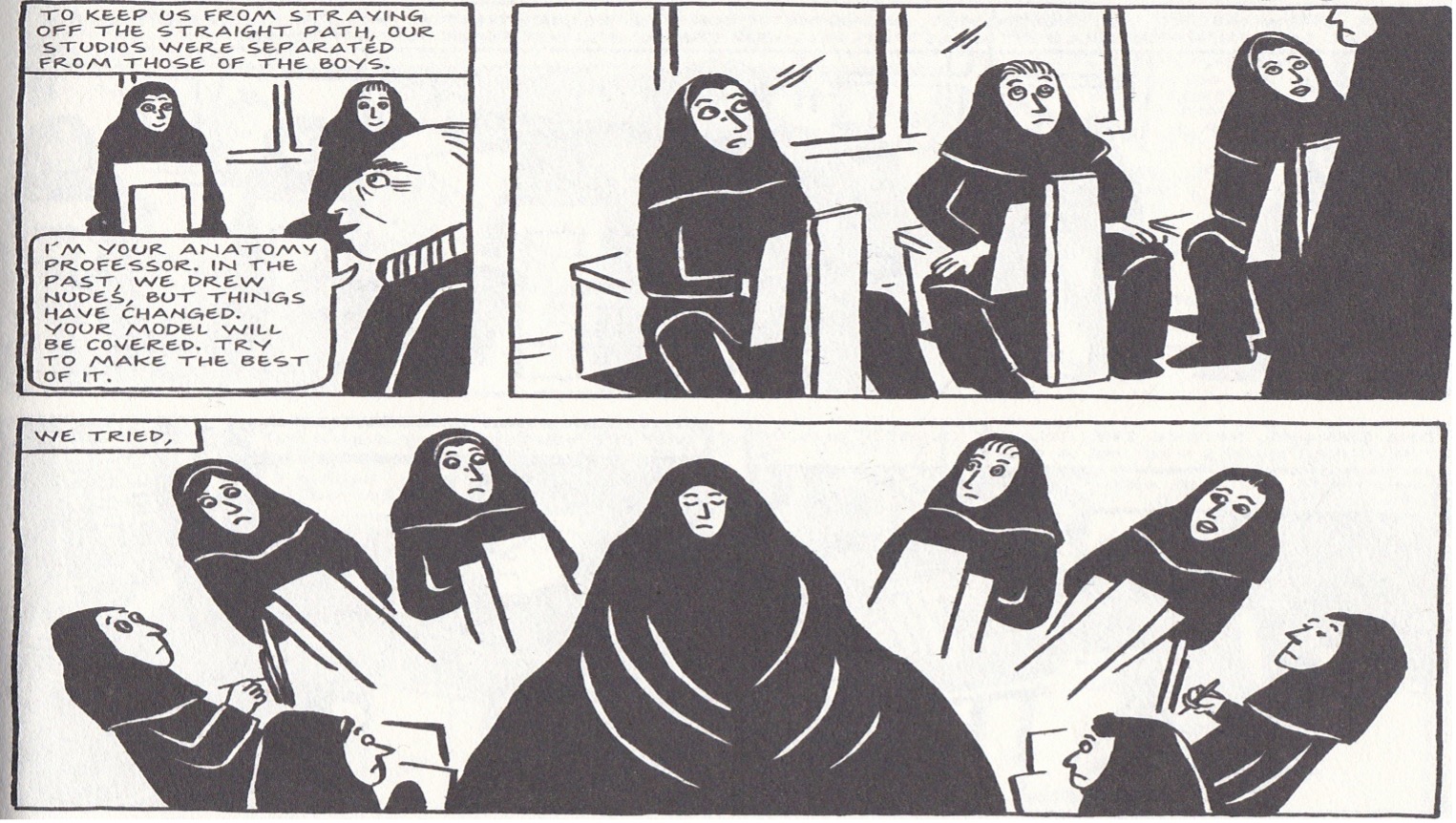
Figure 1. Satrapi, The Complete Persepolis, 299. Graphic Novel Excerpt from PERSEPOLIS 2: THE STORY OF A RETURN by Marjane Satrapi, translated by Anjali Singh, translation copyright © 2004 by Anjali Singh. Used by permission of Pantheon Books, an imprint of the Knopf Doubleday Publishing Group, a division of Penguin Random House LLC. All rights reserved.
She finally faces her double exile by leaving Iran for France to build her identity as a successful writer and artist in a country where she does not face restrictions or censorship in producing art and publishing her stories. Inspired by Satrapi’s living in exile, her performance in The Complete Persepolis is the embodiment of a discursive manifestation of women and culture.
Crossing the borders and breaking the barriers of thoughts and ideas enables writers in exile to see with a “different set of lenses” using “exile’s situation to practice criticism.”[18] While Satrapi’s graphic novel fits Said’s definition of being able to see problems in the West as well as in her own country, it also uses a gendered lens to show women intellectuals in exile. Satrapi is critical of the Eurocentric behavior she witnesses in Vienna at several points in the novel. For example, in a scene in the religious school she attends, Marji is punished for eating in the TV room. A nun tells her, “it’s true what they say about Iranians. They have no education.”[19]
Satrapi rediscovers her new Iranian identity in the West by acknowledging Third World–women’s struggle to survive, and she depicts women’s resistance, subversion, and rebellion to confront the restrictions on their appearance and behavior in public (Figure 2).
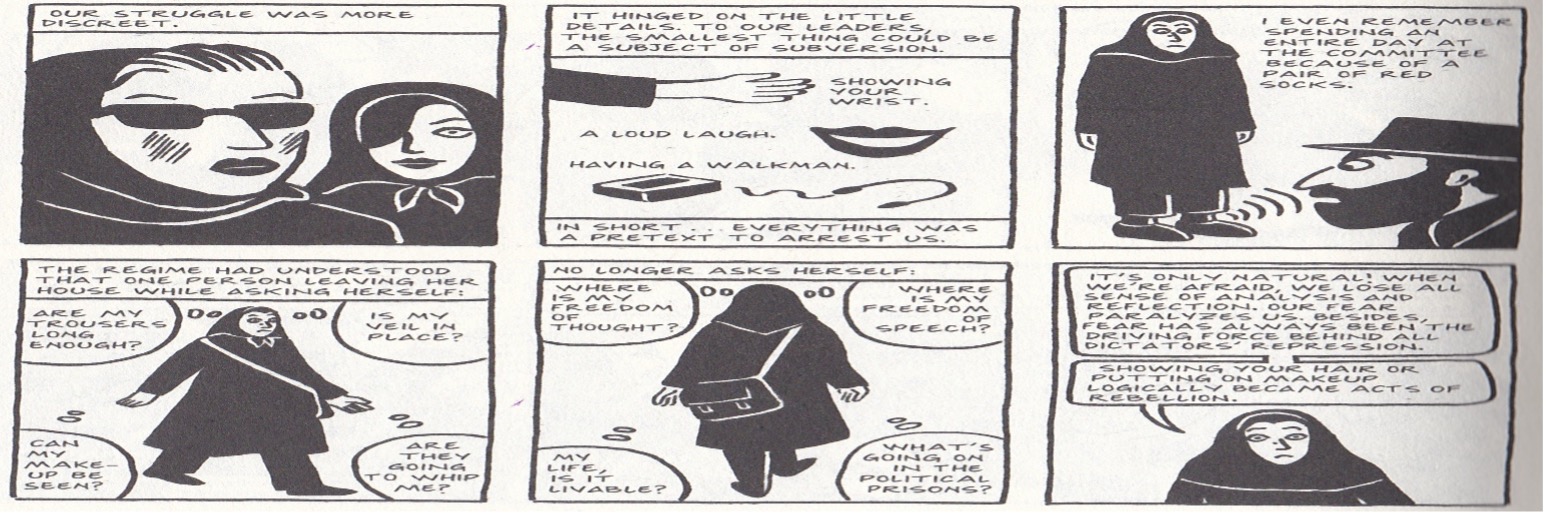
Figure 2. Satrapi, The Complete Persepolis, 302. Graphic Novel Excerpt from PERSEPOLIS 2: THE STORY OF A RETURN by Marjane Satrapi, translated by Anjali Singh, translation copyright © 2004 by Anjali Singh. Used by permission of Pantheon Books, an imprint of the Knopf Doubleday Publishing Group, a division of Penguin Random House LLC. All rights reserved.
Persepolis captures the nuances of Iranian society by depicting Iran as a dynamic nation and underscoring the significance of women’s resistance. While Satrapi’s approach to depicting women in Iran celebrates the vibrancy and power of Iranian women, her storytelling in Persepolis is inclusive, with its multi-perspective lens on culture, class, politics, faith, and gender in Iran.
The distance from home poses challenges for exiled writers, who risk creating “single story” narratives about their home country;[20] however, Satrapi’s inclusive narrative does not reflect a “single story” narrative about Iran. The Nigerian novelist Chimamanda Adichie discusses how culture is composed of multiple stories and the authenticity of depictions of culture depends on the representation of the multiple stories about it.[21] It is not possible to know in totality a culture without engaging with all possible stories about those people or places. Adichie observes that “the single story creates stereotypes, and the problem with stereotypes is not that they are not true, but that they are incomplete.”[22] Although it is not the job of one writer to represent a culture in its totality, it is the responsibility of a writer not to distort or misrepresent the culture. In this article, I discuss the multilayered representation of culture and women in Persepolis, highlighting its subversive narrative, which circulates to transnational audiences multiple representations of women’s resistance.
Satrapi responds to the political tensions between Iran and the West by creating Marji, her transnational hero. Marji narrates her observations of Iran, which has been less known to the West and Western audiences since the 1979 Iranian Revolution. Diego Maggi argues that Satrapi’s Persepolis “complicate[s] and challenge[s] binary divisions commonly related to the tensions amid the Occident and the Orient, such as East-West, Self-Other, civilized-barbarian and feminism-antifeminism.”[23] My argument in this article builds on Maggi’s argument about how Satrapi pushes the boundaries to bridge the gap between worlds. For example, Satrapi depicts the political turbulence through her childhood memories by opening the novel when she is only ten, and as a result of the 1979 Islamic Revolution, she is wearing the hijab while sitting in a sex-segregated school (Figure 3).
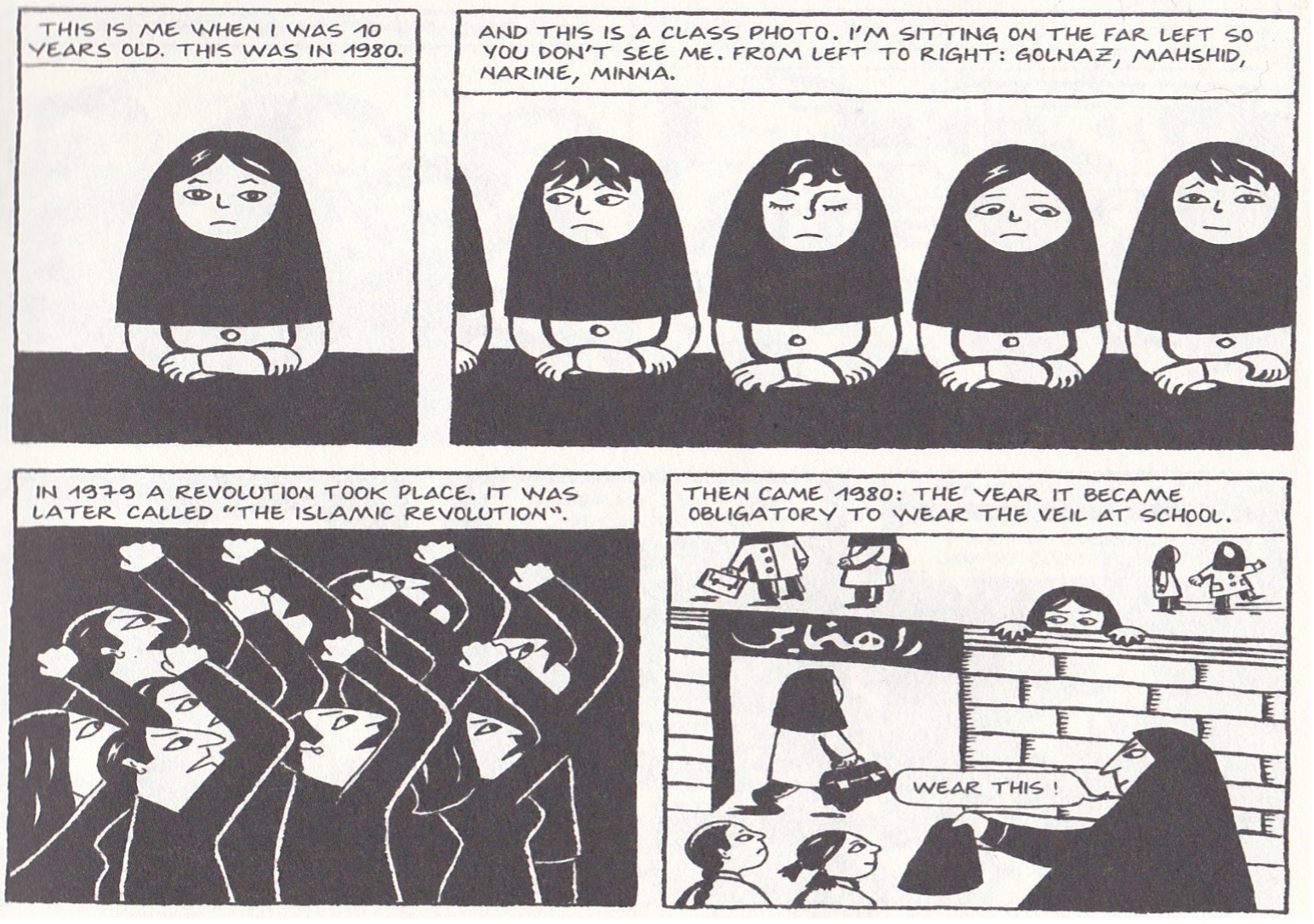
Figure 3. Satrapi, The Complete Persepolis, 3. Graphic Novel Excerpt from PERSEPOLIS: THE STORY OF A CHILDHOOD by Marjane Satrapi, translation copyright © 2003 by L’Association, Paris, France. Used by permission of Pantheon Books, an imprint of the Knopf Doubleday Publishing Group, a division of Penguin Random House LLC. All rights reserved.
In another scene, she reveals the ordinary life of people trying to survive under the strict Islamic regime, a difficulty which has become compounded by the country’s new restrictions on ordinary activities like dancing and throwing parties (Figure 4). She writes: “In spite of all the dangers, the parties went on. ‘Without them it wouldn’t be psychologically bearable,’ some said.”[24] Revealing a new version of reality through the portrayal of the private and public in her narrative, Satrapi tells the story of ordinary people, reminding Western readers that people are people, with common interests and ideas despite the cross-border differences in cultures.
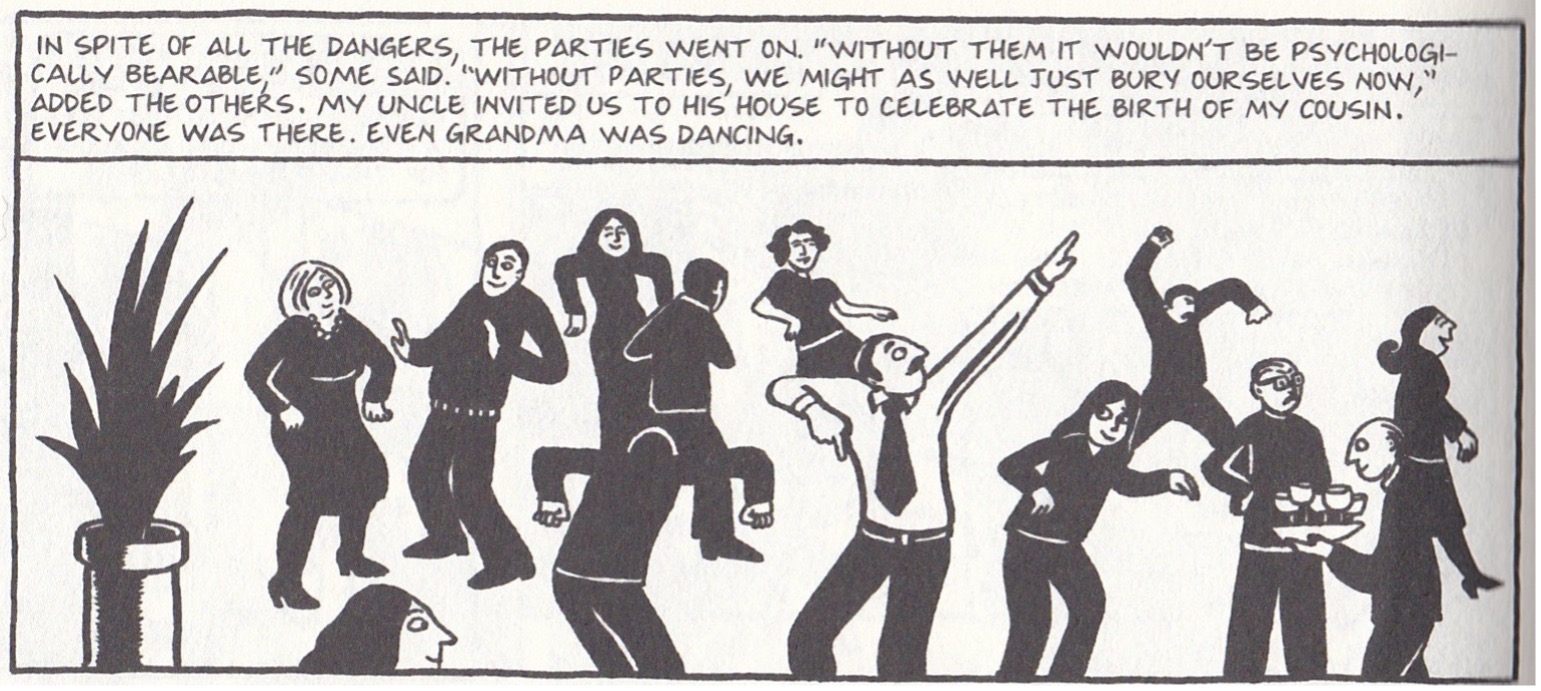
Figure 4. Satrapi, The Complete Persepolis, 106. Graphic Novel Excerpt from PERSEPOLIS: THE STORY OF A CHILDHOOD by Marjane Satrapi, translation copyright © 2003 by L’Association, Paris, France. Used by permission of Pantheon Books, an imprint of the Knopf Doubleday Publishing Group, a division of Penguin Random House LLC. All rights reserved.
Satrapi offers an understanding of the cultural and political complexities of Iranian society, and as an intellectual in exile, she consciously uses these differences to connect to the struggle of women globally. In her book, Women, Art, and Literature in the Iranian Diaspora, Mehraneh Ebrahimi discusses the creation of visual arts as well as graphic novels by diaspora writers and artists in the humanities as an essential factor to inform a global community and to combat xenophobia. By showing women’s struggle for freedom and peace in a local and global context, Persepolis decolonizes the narrative about Iran as evil Other and Iranian women as victims. Marji’s experience traveling across borders accounts for her hybrid identity and resists projecting a stereotypical representation of Iran and Iranian women as “Other.” For example, Marji draws attention to cross-cultural behaviors and attitudes when it comes to religious extremists, who exist in all societies. As mentioned earlier, there is a scene where Marji carries her food to the TV room to enjoy while watching a show in the religious school in Vienna (Figure 5). When she is told to watch her behavior by “the mother superior,” Marji says, “but here, everyone eats while watching TV.” The mother gets angry and says, “it’s true what they say about Iranians. They have no education.”[25] After this confrontation, the nuns decide to expel Marji from school, and Marji thinks, “in every religion, you find the same extremists.”[26]
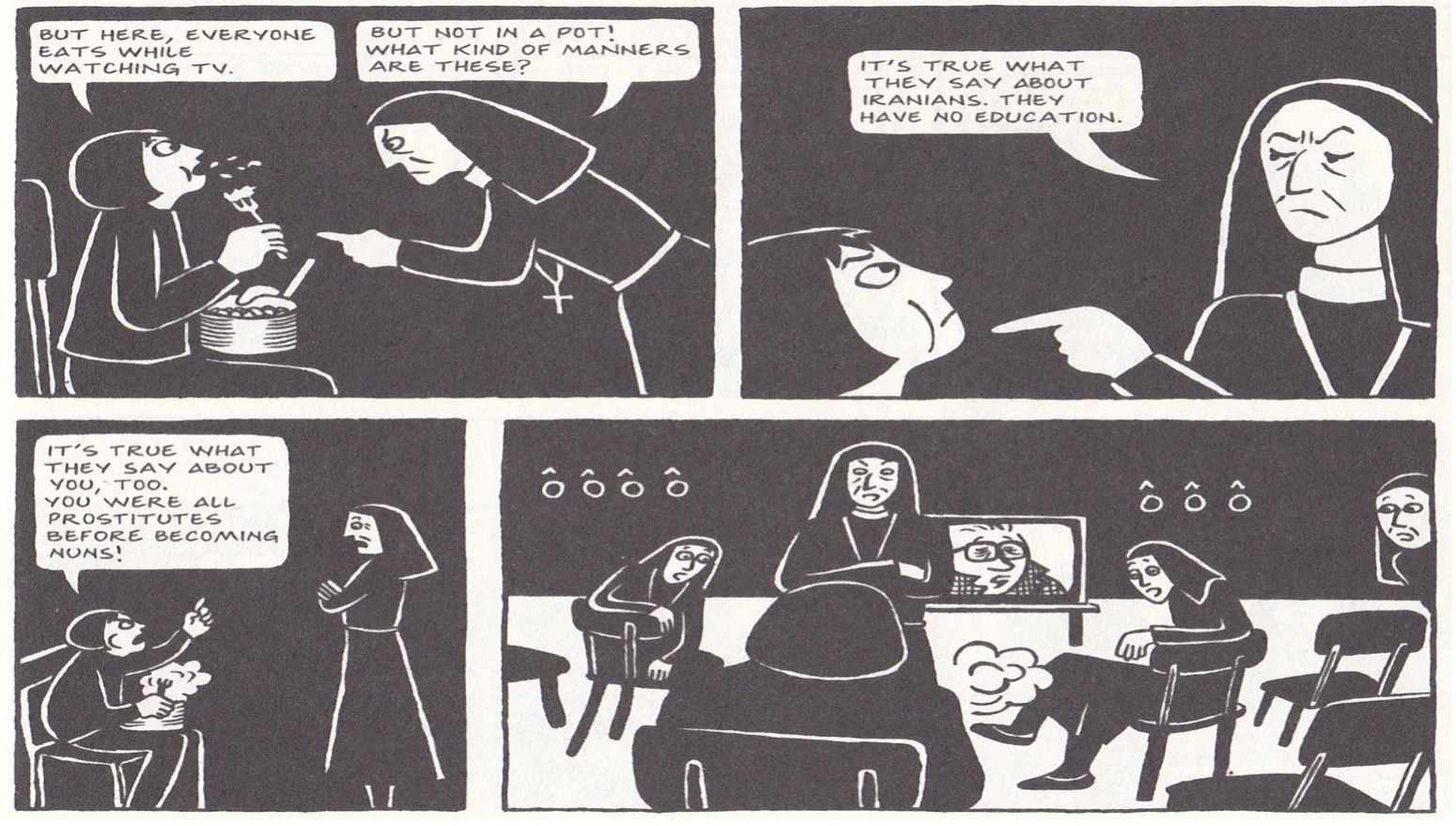
Figure 5. Satrapi, The Complete Persepolis, 177. Graphic Novel Excerpt from PERSEPOLIS 2: THE STORY OF A RETURN by Marjane Satrapi, translated by Anjali Singh, translation copyright © 2004 by Anjali Singh. Used by permission of Pantheon Books, an imprint of the Knopf Doubleday Publishing Group, a division of Penguin Random House LLC. All rights reserved.
Race, class, and gender differences rooted in sociocultural and political aspects are historicized in Persepolis for a Western audience. The narrative combats the West’s binary understanding of Iran and the West as black and white and instead offers an alternative image. The visual imagery in Persepolis unveils the culture and history of Iran and the identity of Iranian women for the Western audience. As an intellectual Iranian woman writer, Satrapi captures the key events from pre-revolution, post-revolution, and wartime, and their social problems to perfectly communicate with the audience through her privileged position as an elite. Although she tells the audience what life was like for a girl of her generation, class, and family background, her narrative does not suggest the life story of “all” Iranian girls during the years the book is set. For example, the stories of the girls who were terrified and traumatized by war and were forced to come to Tehran because their houses were destroyed are not included in Persepolis. These girls were misplaced in the schools in Tehran. While they had already faced the trauma of war in their hometowns, the atmosphere of the metropolitan capital intensified their repression. They faced struggles because of their accent, different skin color, and different appearance, but they still had to obey the strict rules for hijab at schools and in public.
A full and accurate representation of Iranian women requires a multilayered narrative that gives equal voice to women with different experiences and backgrounds. Many scholars discuss Satrapi’s narrative as being close to the facts in its portrayal of Iran and Iranian women. For example, Farzaneh Milani writes: “Marjane Satrapi celebrates the Iranian people’s history of resistance, subversion, and rebellion as much as she bears witness to the miseries and injustices caused by political and religious dogmatism.”[27] Women’s struggle of resistance is not lost in Persepolis; instead, the traumatic experience of the years after the Iranian Revolution and the Iran–Iraq War is part of the focus. Indeed, Satrapi responds to Iranian women’s literary tradition as a contributor to that tradition. Persepolis depicts three generations of female characters: Marji, her mother, and her grandmother are portrayed as women conscious of their rights and their identity in fighting back against oppression. These characters bring their unique perspectives on the sociocultural issues that affect women’s everyday life in Iran. For example, Marji’s mom joins the demonstration against compulsory veiling, Marji shouts at the two guardians of the revolution who stop her in the street and warn her not to run, and the grandma removes the stigma around divorce when Marji is full of fear and hesitation after her divorce.[28]
By expressing their sexual experiences, adventures, and concerns through the portrayal of their personal lives, these characters represent strong women with activist perspectives as active agents during the years the novel is set. The narrative provides the Western audience with a glimpse into the joy and pleasure in the lives of women amidst their constant struggle for peace and equality, creating empathy and understanding that transcends borders.
Satrapi’s Persepolis attempts to reflect the voices of Iranian women as being in resistance to oppression rather than as being submissive. The high rate of readership of this graphic novel among Western readers is due to Satrapi’s success in showing a compelling and alternative image of Iranian women. Women writers exiled abroad risk telling a “single story” narrative about Iran, but they may take a similar risk in representing their homeland by catering to Western preconceptions about it. Hamid Dabashi discusses this risk in his book Brown Skin, White Masks, demonstrating “how intellectuals who migrate to the Western side of their colonized imagination are prone to employment by the imperial power to inform on their home countries in a manner that confirms conclusions already drawn.”[29] Because Satrapi’s narrative is critical of both Iran and the places she lived in the West, I don’t find it problematic that Persepolis is written for a Western audience. Indeed, the dual nature of women’s resistance to the oppression is portrayed through the author’s double critique of Iranian fundamentalism and Western imperialism. While Persepolis depicts the conflict between democracy and dictatorship in the shah’s regime, it simultaneously problematizes democracy and fundamentalism under the Islamic Republic. In fact, by criticizing the pro-American shah, Satrapi criticizes imperialism and American and British interference in Iran.[30]
As a very popular form of storytelling in the West, the graphic novel integrates text with imagery. While the use of visuals helps to interpret the author’s imagination, those images are also open to readers’ interpretation. In Persepolis, Satrapi remembers her past through a “process of visualization,” which indicates the multiplicity of ways her culture can be interpreted.[31] It also speaks about her exilic perspective, providing her with a hybrid identity with multitudes of lenses. Satrapi’s combination of dialogue, interior monologue, and image promotes myriad ways to understand Iranian culture. Satrapi presents Iranian culture as complex and filled with strong female figures, including the protagonist herself.
Women’s common struggle connects Satrapi to the struggle of other Iranian women writers, her foremothers despite their differences in time, language, and genre. Iranian women writers have depicted women’s struggles against the patriarchal system, traditional gender roles, and limitations for women under the Pahlavi regime and Islamic Republic. The struggle of women through different historical periods in Iran reflects the type of struggle the female protagonists face in novels written by Iranian women. Marji’s radical thoughts and her criticism of the sociopolitical discourse of Iran, particularly in the 1990s, represents the evolving generation of women performing an alternative role as the symbol of change and innovation.
Satrapi contextualizes sisterhood in her narrative and brings migrant women to visibility by showing her observation of discrimination and marginalization as an immigrant woman in Vienna. In Persepolis, Satrapi fairly represents the disciplinary nature of fundamentalism and oppression for women both in Iran and in the West. For example, she represents two “Guardians of the Revolution” in the streets of Tehran, whose jobs were “to arrest women who were improperly veiled,” such as herself (Figure 6). Later, the nuns in the Viennese religious school try to control the girls’ behavior in public (Figure 6).
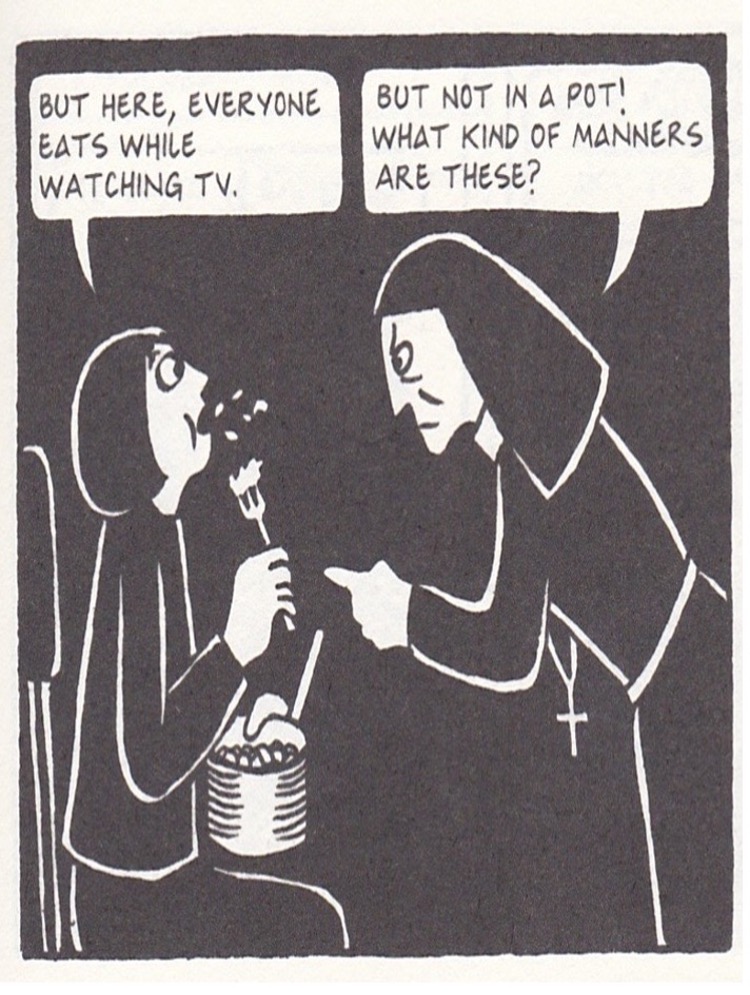
Figure 6. Satrapi, The Complete Persepolis, 133, 177. Graphic Novel Excerpt from PERSEPOLIS: THE STORY OF A CHILDHOOD by Marjane Satrapi, translation copyright © 2003 by L’Association, Paris, France. Used by permission of Pantheon Books, an imprint of the Knopf Doubleday Publishing Group, a division of Penguin Random House LLC. All rights reserved. Graphic Novel Excerpt from PERSEPOLIS 2: THE STORY OF A RETURN by Marjane Satrapi, translated by Anjali Singh, translation copyright © 2004 by Anjali Singh. Used by permission of Pantheon Books, an imprint of the Knopf Doubleday Publishing Group, a division of Penguin Random House LLC. All rights reserved.
By juxtaposing the visual imagery of Iranian and Austrian fundamentalists who are dressed in similar fashion, with head coverings and concealing clothing, Satrapi points out the similarities of religious fundamentalism, which oppresses women cross-culturally. This juxtaposition highlights the fact that while religious-based oppression occurs in Iran, similar oppression occurs in the West, though those living in the West often overlook the latter. This resonates with what Mohanty believes to be the importance of “cross-border feminist solidarities,” which are based on women’s struggles for emancipation in various parts of the world.[32] Though the religions are different, their power to oppress and subordinate women is grounds for alliance.
Satrapi’s struggle as a woman living in exile is portrayed through the moments that Marji faces racial discrimination in Vienna based on the stereotypes of women from the Global South. For example, Satrapi depicts her bitter experience when her Austrian boyfriend’s mom accuses Marji of “taking advantage” of her son; in Marji’s words, “She was saying that I was taking advantage of Markus and his situation to obtain an Austrian passport, that I was a witch” (Figure 7). When Marji is forced to leave her boyfriend’s house, she goes home and surprisingly finds similar aggression at her own house when her landlady calls her a prostitute (Figure 7). Later, her landlady accuses Marji of stealing her jewelry, saying that “I lost my brooch. I’m sure that you’re the one who took it.”[33] The narrative criticizes the condition of women in exile abroad in the West and the West’s treatment of immigrant women.
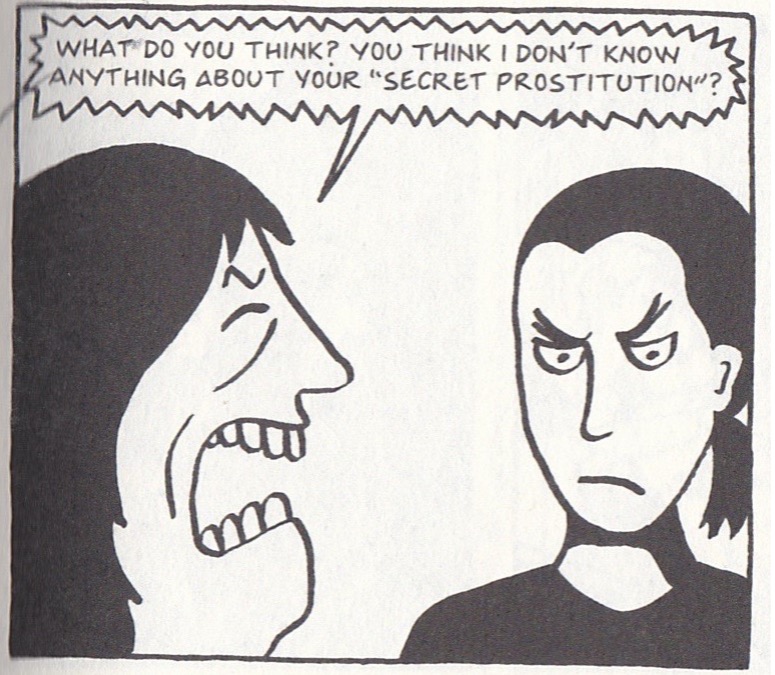
Figure 7. Satrapi, The Complete Persepolis, 220, 221. Graphic Novel Excerpt from PERSEPOLIS 2: THE STORY OF A RETURN by Marjane Satrapi, translated by Anjali Singh, translation copyright © 2004 by Anjali Singh. Used by permission of Pantheon Books, an imprint of the Knopf Doubleday Publishing Group, a division of Penguin Random House LLC. All rights reserved.
Persepolis is not aimed at vengeance for the author’s traumatic experience in the West; it is aimed at questioning the very idea of sisterhood through the book’s critical approach to women’s oppression in exile. Satrapi’s portrayal of racism resonates with Naghibi’s call for destabilizing and reinterrogating transnational feminism to eliminate race and class divisions between “the civilized nations” and “rogue nations.”[34] Persepolis calls for reconsideration both of sisterhood and of race as the foundation of transnational feminism, and urges its audience to not overlook the significance of an antiracist feminism anchored around women’s common force of resistance across the globe. Satrapi’s diverse and discursive manifestation of racial and cultural diversity through the black-and-white panels in Persepolis is in itself commentary on the reductive Western division of the world into black and white.
Iranian women’s unequal status at home, rooted in gender discrimination, and their marginalization in the West, rooted in Islamophobia and racial discrimination, is central to Satrapi’s model for change and reformation. Her critique of the representation of Iran and Iranian women in the West underscores how these misrepresentations create inequality between women of different cultures, which in turn problematizes sisterhood. Female bonding and friendship, which is portrayed at multiple points in her narrative both in Iran and in Vienna, is a direct reference to the significance of solidarity. Satrapi’s demand for inclusion and equality in Persepolis resonates with Naghibi’s argument on the significance of an “alternative model to sisterhood.”[35]
The power and importance of sisterhood in making peace and sharing pains and sorrows to resist oppression is portrayed at several points in Persepolis. For example, during the Iran–Iraq War (1980–88), Marji’s family host and support Mali’s family after their house is bombed during Iraq’s attack on the south of Iran. When Mali, a family friend, with her husband and two kids, knocks on the door of Marji’s family home in the middle of the night to seek shelter, Marji’s mom hugs Mali and says, “hey, it’ll be OK, calm down…you did the right thing to come here.”[36] They laugh and cry together to get through the devastation of wartime and to get Mali’s family back on their feet.[37] Later in Vienna, Marji’s classmate Julie introduces Marji to new friends with whom Marji feels loved and gains a sense of belonging, making her life more bearable.[38] Marji’s roommate, Lucia, noticing Marji’s loneliness before Christmas break, takes Marji to stay with her family in Tyrol for Christmas. After this trip, Marji loves Lucia like a sister (Figure 8).
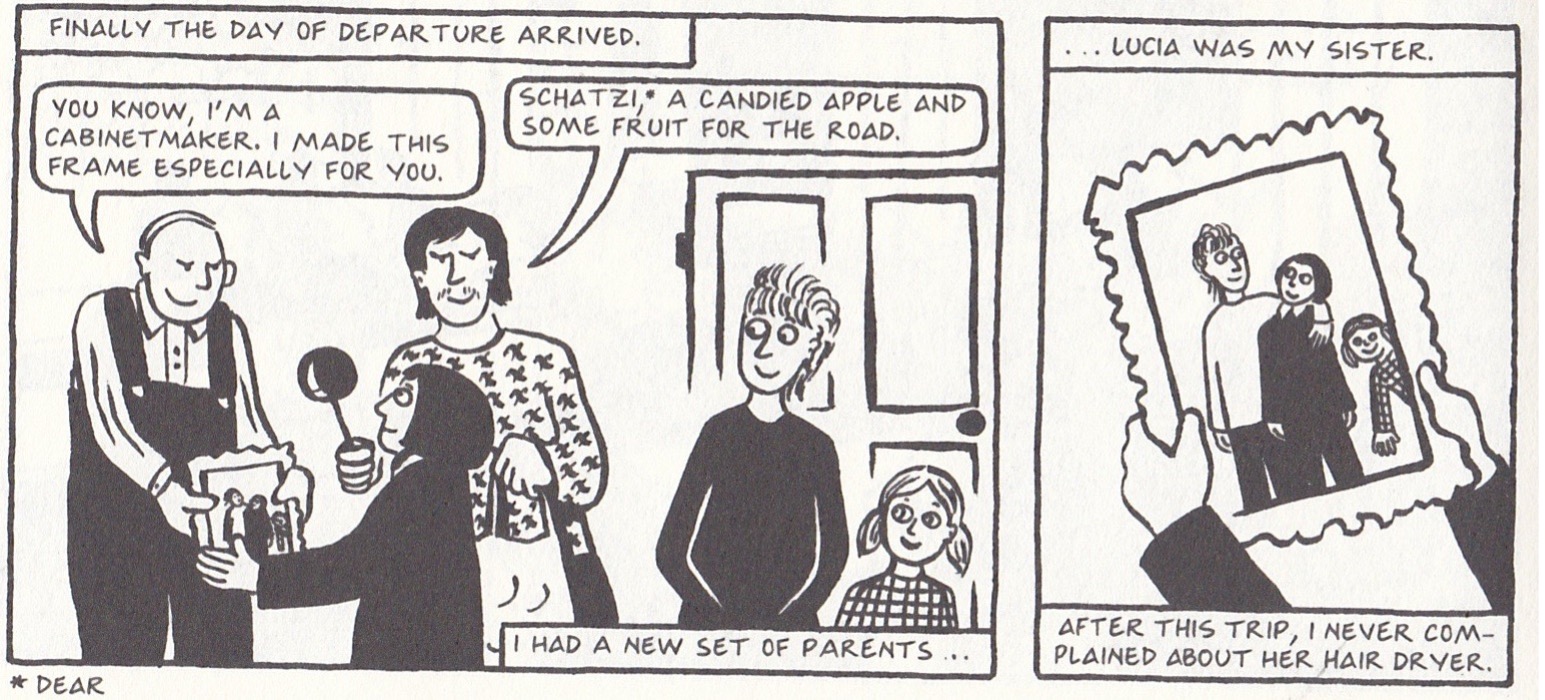
Figure 8. Satrapi, The Complete Persepolis, 172. Graphic Novel Excerpt from PERSEPOLIS 2: THE STORY OF A RETURN by Marjane Satrapi, translated by Anjali Singh, translation copyright © 2004 by Anjali Singh. Used by permission of Pantheon Books, an imprint of the Knopf Doubleday Publishing Group, a division of Penguin Random House LLC. All rights reserved.
My own perspective as an immigrant scholar who has experienced life and work in Iran and the United States has been shaped by Eurocentric behavior aimed at marginalizing me and people like me. With the presidency of Donald Trump and the growth of Islamophobia after he called Iran a “terrorist nation,” the situation grew worse. At that time, I was teaching Persepolis in my World Literature class at the University of Arkansas and observed firsthand the power of Persepolis to transcend borders. Persepolis was welcomed by the students, who were accustomed to hearing and thinking about Iran as a land of horror and evil. As my students experienced, Persepolis opens the audience’s eyes to the differences that are historically and politically constructed. Indeed, Satrapi problematizes both Western and Iranian media in using political frames to portray the enemy by demonizing and dehumanizing the whole nation.[39] This is an example of her fairness in criticizing both governments in their policies, a criticism that points to the politics of differences in a global context. Her narrative doesn’t promote Islamophobia and hatred; it questions the political framework between Iran and the West in representing the other side as evil.
The transnational circulation of people’s lives, ideas, events, and culture through the eyes of Marji plays a significant role in facilitating for the Western audience an understanding of Iran and what it means to be an Iranian woman. As Amy Malek argues, “Persepolis is an exemplary model of both memoir and Iranian exile culture in that it pushes the boundaries of both and that Satrapi’s position of liminality allows her to use a third space position from which to complete her cultural translation, in which she addresses issues of identity, exile and return.”[40] Mobilizing popular culture from the Middle East in the West for the first time, Persepolis draws attention to the relationship between the regions. This is in line with Mohanty’s argument on the necessity of uniting the voices of women in resistance around the world regardless of the divisions of race and class. Persepolis is a vivid picture of the Iranian sociocultural context concerning women’s issues during and after the Iranian Revolution.
The alternative representation of Iran that Satrapi provides without censorship invites the audience to rethink stereotypes of Muslim women as passive victims and of Iran as a backward and barbarian nation. The narrative is free from censorship and has not been co-opted to help the West to advance their agenda in the Middle East. Indeed, the transnational hero, Marji, breaks the barrier of ignorance and misunderstanding about the Middle East as Evil Other. By sharing her observation of events, women, and culture through images and words that communicate to the Western audience without the interference of governments, Marji enters the hearts and minds of readers around the globe. The oppression and struggle of Iranian women for equity and peace is a different struggle based on the specific sociopolitical atmosphere in Iran. However, what makes the narrative in Persepolis transnational and cross-border is its representation of women’s resistance and power during the political upheavals and wartime in Iran. Persepolis has great potential to shift the focus from understanding Iranian women as lacking agency, as they are presented in Western media or books like the bestseller Reading Lolita in Tehran. Persepolis marks the first time that Iran has been represented through images in a graphic novel created by a woman from the Middle East, and signifies the need for renewal and reshaping cultural exchange.
In conclusion, Persepolis’s representation of contemporary Iran offers interdisciplinary ways to know Iran for the new generation. It opens the space for discussion on how gender, religion, and politics work in Iran. The narrative shows that to find solidarity in sisterhood, we need to understand our differences and appreciate our commonalities. The divisions between class, race, religion, culture, and ethnicity as shown in the narrative point to, as Mohanty discusses, the “politics of difference and commonality, and specifying, historicizing, and connecting feminist struggles.”[41] Persepolis educates the Western audience on Iran as a different civilization to explore. Satrapi stresses the significance of self-education at several points in the novel, saying that “one must educate oneself.”[42] In the transnational world we live in, education is the key to expanding our vision across geographical boarders. Persepolis offers hope that the progress of women’s rights can be made through mutual understanding and support in solidarity with sisters across the world.
What lies beyond the race, class, and culture divisions in my argument is the significance of storytelling that reflects resistance in exile. I believe that Satrapi’s experience of exile at home and abroad, the traumatic condition of marginalization, provides a sharp focus in the creation of her narratives that question the status quo and depict women’s nuanced resistance to oppression. The cost of Satrapi’s resistance appears in the author’s exile. While throughout history exiles share similar “cross-cultural and transnational visions,” as Said argues,[43] Satrapi’s Persepolis is a byproduct of the West’s imperialism and Islamophobia alongside religious fundamentalism in the twenty-first century, and stresses the common force of oppression. Persepolis represents the author’s observation of the disciplinary nature of fundamentalism and oppression against women both in Iran and in the West, contributing to Valentine Moghadam’s argument in her book Globalization and Social Movements: The Populist Challenge and Democratic Alternatives. Moghadam argues that the mobilizing forces of uniting women at the “macro level” and “micro level” create a “collective identity” to overcome the differences across the globe.[44]
The visualization of the estrangement, alienation, and homelessness through the exiled hero, Marji, cultivates the imagination to move beyond the self and differences. Drawing on cross-continental conversations amongst people and in particular women from around the world, Persepolis focuses on solidarity in exile. The contemporary themes of emigration, Otherness, exile, and identity connect Satrapi’s transnational narrative to the stories written by women from other cultures like The Distance Between Us: A Memoir by the acclaimed Mexican writer Reyna Grande and Americanah by Adichie. The global intersections and parallels in exile literature connect human experience cross-culturally, and manipulate transcultural visions in storytelling which connects women and culture to find solidarity and seek healing and collaboration. Persepolis is a provocative account of the Iranian people’s everyday life and concerns, much like those of many other people in the world, who struggle with their belief systems and those of their governments. Persepolis suggests that in order to maintain collective identity, we need to subscribe to women’s emancipation and gender equality in all cultures and nations. Persepolis provides a stellar example of the creativity and power of Iranian women writers’ storytelling abilities.
[1]Susan A. Mann, Doing Feminist Theory: From Modernity to Postmodernity (New York: Oxford University Press, 2012), 362.
[2]Mann, Doing Feminist Theory, 363.
[3]Scott McCloud, Understanding Comics: The Invisible Art (New York: William Morrow, 1994), 198.
[4]Edward W. Said, Reflections on Exile and Other Essays (Cambridge, MA: Harvard University Press, 2000), 184.
[5]On the differences between exile, refugees, expatriates, and émigrés, see Said’s discussion in Reflections on Exile, 181: “Although it is true that anyone prevented from returning home is an exile, some distinctions can be made among exiles, refugees, expatriates, and émigrés. Exile originated in the age-old practice of banishment. Once banished, the exile lives an anomalous and miserable life, with the stigma of being an outsider. Refugees, on the other hand, are a creation of the twentieth-century state. The word ‘refugee’ has become a political one, suggesting large herds of innocent and bewildered people requiring urgent international assistance, whereas ‘exile’ carries with it, I think, a touch of solitude and spirituality. Expatriates voluntarily live in an alien country, usually for personal or social reasons. Hemingway and Fitzgerald were not forced to live in France. Expatriates may share in the solitude and estrangement of exile, but they do not suffer under its rigid proscriptions. Émigrés enjoy an ambiguous status. Technically an émigré is anyone who emigrates to a new country. Choice in the matter is certainly a possibility. Colonial officials, missionaries, technical experts, mercenaries, and military advisers on loan may in a sense live in exile, but they have not been banished. White settlers in Africa, parts of Asia and Australia may have been exiles, but as pioneers and nation-builders, they lost the label ‘exile.’”
[6]Chandra Talpade Mohanty, “‘Under Western Eyes’ Revisited: Feminist Solidarity through Anticapitalist Struggles,” Signs 28 (2003): 499–535. Quote on p. 530.
[7]Chandra Talpade Mohanty, “Transnational Feminist Crossings: On Neoliberalism and Radical Critique,” Signs 38 (2013): 967–91. Quote on p. 977.
[8]Mohanty, “Transnational Feminist,” 987.
[9]Mohanty, “Transnational Feminist,” 987.
[10]Nima Naghibi, Rethinking Global Sisterhood: Western Feminism and Iran (Minneapolis: University of Minnesota Press, 2007), xvii.
[11]Naghibi, Rethinking Global, 141–46.
[12]Persis M. Karim, “Reflections on Literature after the 1979 Revolution in Iran and in the Diaspora,” Radical History Review 105 (2009): 151–55. Quote on p. 152.
[13]Said, Reflections on Exile, xxxv.
[14]Marjane Satrapi, The Complete Persepolis (New York: Pantheon, 2004), 322.
[15]Said, Reflections on Exile, xxxv.
[16]Satrapi, Complete Persepolis, 302.
[17]Satrapi, Complete Persepolis, 297.
[18]Said, Reflections on Exile, xxxv.
[19]Satrapi, Complete Persepolis, 177.
[20]Chimamanda N. Adichie, “The Danger of a Single Story,” July 2009, Oxford, UK, TED, transcript, 18:33, www.ted.com/talks/chimamanda_adichie_the_danger_of_a_single_story.
[21]Adichie, “Danger of.”
[22]Adichie, “Danger of.”
[23]Diego Maggi, “Orientalism, Gender, and Nation Defied by an Iranian Woman: Feminist Orientalism and National Identity in Satrapi’s Persepolis and Persepolis 2,” Journal of International Women’s Studies, no. 1 (2020): 89–105. Quote on p. 89.
[24]Satrapi, Complete Persepolis, 106.
[25]Satrapi, Complete Persepolis, 177.
[26]Satrapi, Complete Persepolis, 178.
[27]Farzaneh Milani, Words Not Swords: Iranian Women Writers and the Freedom of Movement (New York: Syracuse University Press, 2011), 231.
[28]Satrapi, Complete Persepolis, 5, 301, 333.
[29]Hamid Dabashi, Brown Skin, White Masks (London: Pluto, 2011), 23.
[30]Satrapi, Complete Persepolis, 19, 20.
[31]Nima Naghibi, Women Write Iran: Nostalgia and Human Rights from the Diaspora (Minneapolis: University of Minnesota Press, 2016), 107.
[32]Mohanty, “Transnational Feminist,” 987.
[33]Satrapi, Complete Persepolis, 233.
[34]Naghibi, Rethinking Global, 141–46.
[35]Naghibi, Rethinking Global, 109.
[36]Satrapi, Complete Persepolis, 90.
[37]Satrapi, Complete Persepolis, 91, 92.
[38]Satrapi, Complete Persepolis, 166, 167.
[39]Satrapi, Complete Persepolis, 322.
[40]Amy Malek, “Memoir as Iranian Exile Cultural Production: A Case Study of Marjane Satrapi’s Persepolis Series,” Iranian Studies 39 (2006): 353–80. Quote on p. 369.
[41]Mohanty, “Transnational Feminist,” 977.
[42]Satrapi, Complete Persepolis, 327.
[43]Said, Reflections, 174.
[44]Valentine M. Moghadam, Globalization and Social Movements: The Populist Challenge and Democratic Alternatives (Lanham, MD: Rowman & Littlefield Publishers, 2020), 164.
Behrooz Moazami is Patrick G. O’Keefe Distinguished Professor of History at Loyola University New Orleans, and founder and director of the Middle East Peace Studies program. For more than two decades before joining academia, Moazami was a professional political activist and contributed to a number of Iranian dissident publications. While living in Paris in exile (1983–92), he co-founded and coedited Andisheye Rahai, a Persian review of politics, theory, and society. Moazami is a trustee of the Ardeshir Mohassess Trust, formed to preserve the legacy of the artist and to help gravely ill artists in need.
I have two goals here. The first is to provide a framework for understanding Iran’s interactions with its powerful neighbors beyond the more accepted analytical frameworks of “the Persian question,” “the Eastern question,” “the Great Game,” and their derivatives, such as “defensive developmentalism,” which look upon the political development of Iran and the Ottoman Empire as responses to the pressures of Western imperialism. The second is to look afresh at the process of state formation in non-European settings.
No doubt forces of Western imperialism were deeply involved in shaping the course of history in Iran and in the broader region, particularly by the end of the eighteenth century, but I am considering a more complicated framework by focusing on the long interactions among Iran, Russia, and the Ottomans and how they interacted with the Western forces as a system. The Western imperial forces intervened on a global scale, but they needed to interact with an existing system. It is the interactions of these two systems (Western and Euro-Asian) and their long-term impacts, rather than the international machinations, or responses of these individual powers to the changing global order, that interest me here.
Others have also implicitly or explicitly taken steps in a revisionist direction and treated the interaction of Iran with other forces not as a “one-way street.”[3] Yet I am articulating this interaction as a theoretical concept for the transformation in regional reconfiguration of power through the lens of what—using Janet Abu-Lughod’s idea[4]—could be called “systematic change.” By comparing the formative phase of a tribal dynasty in an agrarian society, its concept of sovereignty, and its practice of statehood with that of a hypothetical nation–state in an industrial setting, I am continuing my efforts at developing a state theory that is more appropriate in explaining political structures in non-European settings. Here, also, I am not alone. Others have done this for different non-European settings.
The historical, political, and social environments that gave rise to the Iranian, Russian, and Ottoman states, along with their frequent wars and interactions with Western powers, gradually transformed the extent of these states’ territories, power structures, and physiognomies. By absorbing or losing territories and people, these states redefined their scope of operation and resources and, to a certain extent, their religious orientations, and attempted to homogenize their subjects. In this process, the local and regional powers lost their relatively autonomous powers and became more dependent on the central rulers, or changed their loyalty before being absorbed by larger political entities.
As it is difficult to discuss the impact of this process under one rubric, I describe this transformation as gradual changes in a state’s capacity and strategy to rule, partly deliberate and partly as a result of the system’s evolution. In doing so, I treat the state as a political community that is exercising rule over a certain territory. While formation of a modern and centralized army became the main strategy of these powers, and they ended up developing traits similar to those of European nation–states, their evolution followed a different trajectory and outcome. Iran used the Ottoman and Russian models as the blueprint for its state-making strategy, rather than the European model. Ultimately, I argue that the geographical proximity of these Euro-Asian powers, their long history of interactions, and the lasting impact of the khanate system—a legacy of the Mongols—converged and transformed the structure and physiognomy of these states, despite differences in their political appearance and their own self-identification. They formed the basis of what could be called the Euro-Asian state system.[5]
Analytically, what I am discussing here could be viewed as the short-term impact of the restructuring of Euro-Asia in its regional and global interactions in the eighteenth and nineteenth centuries. In her seminal work, Before European Hegemony, Janet Abu-Lughod discusses the existence of a “world system” in the thirteenth century composed of “sub-systems,” none hegemonic over the others. The interaction among the units that later formed this world system stretches back to the time of the formation of the classical empires. The developments I discuss here are another restructuring of world history in longue durée, what Abu-Lughod calls “a systematic change.” This systematic change, she argues, “should be viewed as shifts in the direction and configuration of central trends.” In any systematic change, she argues further, “successive systems reorganize in a somewhat cumulative fashion, the lines and connections laid down in prior epochs tending to persist even though their significance and roles in the new system may be altered.”[6] Perhaps the chaotic world that we are witnessing now in Euro-Asia is another moment of this “restructuring.”
Historically, the process of the transformation of political structure that concerns me could be described as the incorporation of the khanate system of rules, as well as rules of fragmented tribal khans, beys, and local patriarchs, into a larger state ruling an extensive territory with diverse ethno-entities but similar religious affiliations. The Mongolian tradition of statehood based on the power of khanates reproduced itself and formed a different constellation of power than the ideal form in the Westphalian state system. In this process, the Euro-Asian states of the post-Mongolian period transformed, disintegrated, and evolved into a new system of states that were centralized and constitutionalized but still based on fragmented authorities. The Euro-Asian state evolved and restructured itself in several “systematic changes” in contrast to the ideal of a Westphalian state system, where centralized states have hegemony over means of coercion and freely exercise their power over a defined territorial domain.
State and Sovereignty
In this context, I am defining state as follows: a political community with formal and informal mechanisms of rule consisting of juridical traditions or institutions and loosely yet institutionally organized religious authorities ruling over a large inhabitable territory and a sizable population with a sustainable history of socioeconomic and cultural interactions. The degree of this political community’s inclusiveness and the extent of formality or informality of institutional and organizational development of its judiciary and religious apparatus and type of socioeconomic and cultural interaction defines “the stateness”[7]—its character and physiognomy—and its strategy of rule. However, it does not change the essence of a state’s rule, which is a mechanism and strategy of rule. This definition of state could also apply to a contested state or a colonial state. My theoretical articulation on the relationship of state and sovereignty is based on this definition of state and its implied logic.
While a state has physical manifestations with tangible organizational and institutional capacities, sovereignty is imaginary and ideal. “In the state,” Marx argues, “man is the imaginary member of an imaginary sovereignty, divested of his real, individual life, and infused with an unreal universality.”[8] Yet “this unreal universality” has its own power. Rationalization of state power means providing conditions for its acceptance by its subjects. Its internalization, though imaginative and subjective, implies certain retroactive interactions between the state and its subjects. Hence, sovereignty is a conceptual abstract and a social contract. The ambiguity inherent in the ideal of sovereignty is, indeed, its source of power.
Sovereignty, as a formal and informal social contract, oversees the expectations and interactions of different parts of a society toward the political authority. How this social contract is constructed, understood, and practiced is altered by various factors: the state’s geographic position; cultural boundaries and characteristics; the shape and size of the population; and changes in the nature of the social composition of society, the nature and extent of power, and the origin of its ruling elite.
Sovereignty in micropolitical entities such as tribal chiefdoms is limited to their internal domains, and sovereignty in a vassal state is defined by the nature of the relationship of the vassal with the larger state—most often, changing loyalty is an act of survival or a calculation for further empowerment of the ruling elite. Sovereignty in large centralized states that are based on fragmented authorities is the sum total of sovereignties of related but autonomous domains defined through long-term historical and geographical relations, and is negotiated with the central power through local power holders. Suzerainty in this case is articulated through the degree of loyalty of the local magnate to the central power. In short, the structure of state power and its strategy of rule determine the type of sovereignty and vice versa, yet their interaction takes place in a regional and global environment and is affected by that environment. While in theory state power is based on the state’s available internal resources, the power of sovereignty, its mobilizing capacity, changes throughout time and takes different forms.
To narrate the trajectory of the development of sovereignty and state in the early Qajar period, I start with the Persian–Russian wars of 1795–96, 1804–13, and 1826–28, and make some brief remarks about the Russian–Ottoman wars of 1806–12 and 1828–29. I analyze the meaning of territories lost and gained, discuss some of the major treaties, and sketch a rough portrait of their consequences in the development of the Qajar state. The Persian–Russian wars were essentially frontier wars over Caucasia and helped to define the extent of the Iranian and Russian states, their sovereignties, and the sovereignties of the Caucasian khanates. The same logic is applicable to the Persian–Ottoman war of 1821–23, and the Russian–Ottoman wars of 1806–12 and 1828–29.
The Qajar state (1796–1925) was formed after seventy years of anarchy, coinciding with a major offensive of Western powers globally and regionally. I am using the example of the Qajar state to develop ideas about the interaction of Euro-Asia with the larger world through war and state formation.
The Persian–Russian War of 1795–96
The formation of the Safavid Empire, which planned to revive the historic Iranian Empire, occurred at roughly the same time as the Ottomans’ Ghazi state transformed into an empire during the rule of Mehmed the Conqueror and Muscovite territory expanded during the rule of Ivan III, who proclaimed himself czar and “Ruler of all Rus” in 1503. These developments set the tone for the next three hundred years.
The Mongol invasion had already made different parts of Euro-Asia more connected, leading to a pattern of cooperation and conflict, and a synthesis of different cultural and political traditions and similar modes of operation. A system was already in place, and its transformation can be traced. These developments in Euro-Asia, coinciding with the European Age of Discovery, were the beginning of the restructuring of the regional and global order. The evolving empires of Euro-Asia all started the processes of forming a standing army, centralizing bureaucracy, and expanding territory before they had significant interactions with European powers.
The Safavid Dynasty emerged when followers of a small Sunni–Sufi order that had turned Shi’a operating in a predominantly Sunni region of northwestern Iran formed a coalition with the fighting forces of Qizilbash, an alliance of the Turkoman Shi‘a tribes of Anatolia, and declared themselves the first Iranian state since the Sassanids. Like the Sassanids, the Safavids adopted an official religion. While the Safavids were not originally Shi‘a and by all accounts Shi‘ism was not the religion of the majority of Iranians, it seems that adopting Shi‘ism as the official religion was one of the most efficient ways that the Safavids could establish a distinct identity and resist possible onslaught by the Ottomans. The state grew, and by 1576, Tahmasp I had secured almost the same borders as in the Sassanid period. At the height of Safavid power, Shah Abbas I officially ruled the territory called mamalek mahruse Iran, the Guarded Kingdoms/Domains of Iran. He transformed the state’s military, administrative, and fiscal structures by dismantling the Qizilbash tribal army and introducing an army based on Georgian and Circassian slaves and converting large tracts of land traditionally granted to tribal chiefs into crown lands that he taxed directly. The new state gradually mixed the Persian, Arabic–Islamic, and Mongol traditions of statehood, fusing them with Byzantine and Ottoman traditions.
By the mid-fifteenth century, the Ottomans had already started forming a centralized state and a standing army and were transforming themselves into an empire following the conquest of the Byzantine Empire. By the end of his reign, Mehmed the Conqueror had transformed from warrior sultan to emperor and was controlling two lands (Europe, Asia) and two seas (Black, Mediterranean). His death in 1481 brought instability, but soon Selim the Grim subdued revolts in Anatolia, fought with Safavid rivals at Chaldiran in 1514, and finally ended the Mamluks’ rule in Egypt, Syria, and Hijaz. In Cairo, Selim firmly established himself as the conqueror of the Arab lands and champion of the Islamic cause. The sharif of Mecca gave him the keys to the Grand Mosque in Mecca and the Prophet’s Mosque in Medina and bestowed on him the title of the Custodian of the Two Holy Mosques. Historians debate whether Selim or others after him assumed the title of caliph, though most agree that the first recent international recognition of the title appeared in the Treaty of Peace (Küçük Kaynarca) in 1774 following the Russian–Ottoman War of 1768–74, which recognized the sultan’s capacity as “Grand Caliph of Mahometanism, according to the precepts prescribed to them by their law.”[9]
After Ivan III became czar in 1503, he claimed that Russia was the successor state of the Roman Empire, a claim that was acknowledged if not invented by the Orthodox Church. Czar was in fact the Russian version of the title caesar. The formation of the Romanov Dynasty and Russia’s aggressive expansion further reinforced the idea that the czar also held some religious authority. Under Peter the Great, the state centralized, and bureaucracy and education were reformed. These transformations were sometimes hailed as the Europeanization and secularization of Russia, but they did not stop the trends of expansion, identification with the Orthodox Church, and Russification of the conquered territory. Peter the Great began calling himself the emperor in 1721.
In the midst of these three emerging powers lay Caucasia, which had diverse ethnic and religious groups dispersed over a vast territory with military and commercial strategic importance. Caucasia was the natural battlefield of these emerging powers, each claiming to defend a specific religious group and each administered by a number of small and medium-sized kingdoms, tribal chiefdoms, and khanates acting autonomously or as vassals of the bigger states. The Iranian and the Muscovite (later Russian) states were concerned with South Caucasia (the Russians call it Transcaucasia) and North Caucasia. Russia had already become Iran’s neighbor when it annexed the khanates of Kazan and Astrakhan on the shores of the Caspian Sea during the reign of Ivan IV.
The strategy of state building in the region that began in the sixteenth century included a number of wars that led to the formation of buffer states and vassal states, and the annexation of khanates into larger states. Expanding and securing the frontiers was symbolic of the power of these states, each identifying with a religion. Armenia and Georgia, being overwhelmingly Christian, were important to Russia, and Iran’s disintegration after the fall of the Safavids made Russian advances more possible.
The Qajars, possibly a blend of Tatar and Turkish tribes, traced their own descent to the Tatar Tamerlane, and through him to the Mongols. A relatively small tribe that constituted part of the Qizilbash forces that fought to establish the Safavid Dynasty, the Qajars hoped to revive the Iranian Empire. The formation of mamalek mahruse was their aim. Perhaps nothing more than timing and the manner of the coronation of Agha Mohammad Khan, the founder of the dynasty, can explain his continuation of the policy of securing contested borders as his state-building strategy. He set out to establish the Guarded Kingdoms/Domains of Iran before controlling the whole of Iran and crowning himself king using the ceremonial sword of the Safavid shahs.
Agha Mohammad Khan fought for ten years to gain control of northern, northeastern, central, and southern Iran. In 1783, Erekle II of Georgia, a former tributary state of the Safavids (and long before that a vassal state of the Sassanids), had shifted Georgia’s allegiance to Russia and was formally under the protection of the Russian empire. Noting that Catherine the Great was more focused on her European neighbors than on Iran, Agha Mohammad Khan mobilized a huge army and sacked Tiflis in 1795, reportedly massacring 100,000 Georgians and taking at least 15,000 men and women as slaves. It was only after securing the frontier that Agha Mohammad Khan crowned himself monarch in 1796. He opted to take the eastern part of Iran, still in the hands of his rivals, and planned to reclaim Herat in Afghanistan. As Avery suggests, “Iranian history may in fact be seen as alternating between attempts by a single paramount power to suppress Iran’s fragmentation and once again realize the dream of Empire.”[10]
Catherine II sent forces to avenge the sack of Tiflis and to consolidate Russian power in Caucasia, compelling Agha Mohammad Khan to abandon the plan of retaking Herat. The death of Catherine II in 1796 and the later assassination of Agha Mohammad Khan postponed the wars for the time being, but a large disputed region remained: “The disputed borderland extended from Georgia and Yerevan east to the Caspian Sea and from the southern slopes of the Caucasus to the Aras (Araxes) and Kura rivers, although along the coast the zone exceeded these limits in both directions, from Derbent in the north to Talesh in the south.”[11]
Before the narration of these wars over Caucasia continues, the meaning of mamalek mahruse needs to be considered. Why was it used—and it was used frequently—and what does that imply? The term consists of mamalek, the Arabic plural of molk (domain, estate, city, province, or country) and the Arabic mahruse (guarded, protected). When used together, the words denote an aggregation of different domains or kingdoms, highlighting the importance of a central power protecting the entire territory. Protection by a political authority is certainly suggested. The term can have a religious connotation as well, as in protection against certain evil. While the word domain can indicate the territory within borders, it can also have a more flexible meaning related to the extent of a political authority’s power. The term domain is used in Arabic, Turkish, and Persian with the same pronunciation and meaning. The Qajars and the Ottomans used it as the official title of their empires until their demise. Is mamalek mahruse, in fact, an epithet for an empire and its domain?
It should be noted that there is no Persian, Arabic, or Turkish word for emperor, though sometimes Ottoman sultans used the term to express their power. The term emperor was not used by the Achaemenids (550–330 BC), who created the world’s first empire 2,500 years ago, or the Sassanids, who coincided with the Roman and, later, Byzantine Empires. In Persian, the term shahanshah or shah shahan (king of kings) was used to indicate the centrality and empowerment of one ruler over less powerful rulers. In Arabic, the term used was malake al-muluk, meaning “king of kings,” and in Turkish, padishah (with a similar meaning), which was originally Persian. The point is not semantic here; it is political. These terms had similar connotations as emperor but denoted a different type of rule.
An empire’s domain in Persian has not always been called mamalek mahruse. According to Abbas Amanat, “For at least two and half millennia Iranians called their land Iran.” Further, he continues: “At least since the third century CE there was a well-defined political concept, an imperial entity with a centralized authority, called Iranshahr (Kingdom of Iran) and located it [sic] in Iranzamin (the land of Iran).”[12] The term mamalek mahruse was rarely used in Iran before the Mongolian period, and its usage developed only gradually in the post-Mongolian period. Mamalek mahruse should be read as a particular form of statehood based on a coalition of a small but armed and powerful tribal minority within the existing ruling bodies, a fusion of Mongolian–Turkish military power and previous forms of statehood. Mamalek mahruse Iran was the gradual reincarnation of the Iranian spirit and Iranian history in the form of political rule.
Despite the importance of the term mamalek mahruse and its frequent use, particularly during the Qajar period (it was also the official name of the Ottoman Empire[13]), I have not found much literature on the term’s origins, use, or implications. The only comprehensive study I have found is a short article in Persian by Bagher Sadri-Nia from 1995.[14] According to Sadri-Nia, the term first appeared during the Ilkhanid (1256–1335) period and then again during the reign of Tamerlane (1370–1405). First used in reference to cities and provinces, it gradually came to mean the larger territory under Mongol control, including Persia and a majority of khanates. The fusion of the term with the name of Iran seems to have occurred during the reign of Shah Abbas I (1587–1629). The Qajars adopted it as the official name of Iran and used it until their demise.
The Persian–Russian Wars of 1804–13 and 1826–28: Further Restructuring
The Persian–Russian wars of 1804–13 and 1826–28 were a continuation of the 1795–96 war, yet they unfolded in a different regional and international environment. The eighteenth century ended with Napoleon invading Egypt and Syria, and the nineteenth century started with the British and the Ottomans together defeating France. Russia was expanding and at war with France and Sweden and officially at war with Britain, though actually not fighting. The Ottomans were in retreat, and the Qajars were busy setting up a tribal state. The Persian–Russian War of 1804–13 became a part of the Napoleonic Wars, as did the Russian–Ottoman War of 1806–12. Iran officially entered the wars on the side of France before growing closer to Britain. The restructuring of Euro-Asia was the order of the day, and the wars fought among Iran, Russia, and the Ottomans were part of a larger transformation.
In December 1800, Czar Paul I annexed Georgia to Russia as competitors of Fath Ali Shah were challenging the rule of the new king in Iran. In 1804, Czar Alexander I continued this policy of Russian expansion by capturing Ganja and advancing toward Armenia in South and East Caucasia, beginning the Persian–Russian War of 1804–13. Russia had several advantages in its war against Iran. They included a mechanized professional army, Georgian forces providing continuous reinforcements, and the ability to capitalize on Christian–Muslim enmity. The Iranian army, mostly a seasonal army organized along tribal lines and that recruited soldiers through the buniche system—taxing villages in men, horses, and food—were no match for a European army in a long-term war. Although the French and British had assisted in training the Iranian army, almost all the existing accounts suggest that it remained inadequate because of a lack of infrastructure and organizational skills. According to Muriel Atkin, “By 1812 ‘Abbas had a European-trained army of about 13,000 infantry, cavalry, and artillery (of which most were infantry).”[15]
By the end of the nine-year war, Fath Ali Shah and his crown prince, Abbas Mirza, recognized the czar’s sovereignty over the contested territories of Georgia, Mingrelia, Abkhazia, Ganja, Qarabaq, Qobba, Darband, Baku, Dagestan, and Sakki under Article 3 of the Treaty of Golestan. The treaty reflected the changing power equation. It was dictated by the Russians and, in fact, written in Russian. Sir Gore Ouseley, the British ambassador to Iran, was heavily involved in drafting the text, and it was negotiated by Mirza Abolhassan Khan Shirazi, an Anglophile Iranian politician and the shah’s representative for the peace talks, at a time when Britain was an ally of Russia against France. Article 4 of the treaty gave Russia permission to intervene in the succession to Iran’s throne as “help and support” to maintain security. This article, which was a blueprint for Russian intervention in Iran, was similar to what the Russians were demanding in other victories. The basis of the Treaty of Golestan was status quo ad presentem, meaning that each side essentially kept the territory then under its control. This satisfied neither side. The Iranians had lost territory, and the Russians wanted more. This was a recipe for further war.
The Persian–Russian War of 1826–28 also arose from internal court conflict in Iran, British intrigue, and the activities of the usuli ulama,[16] who, representing the proto-orthodoxy of Shi‘ism, were drawing attention to Russian atrocities toward the Muslims of Caucasia as a pretext for jihad. (Most likely, the British had a hand in the ulamas’ agitation.) Abbas Mirza started the war in September 1826 by advancing toward Ganja and Sosa. The Russians fought back, and after some early Iranian victories, marched all the way to Tabriz, capturing the city in October 1827. By January 1828, they had taken over Ardabil, the first Safavid capital. This unprecedented defeat forced the Iranians to sign the Treaty of Turkmenchay.
The new treaty replaced the Treaty of Golestan. Iran recognized the sovereignty of Russia over the Erivan and Nakhchivan khanates (East Armenia) and the remainder of the Talesh khanate (northern Iran). The treaty also set Iranian frontiers, determining the Aras River and part of the Caspian Sea to be the natural border and giving Russia full rights to navigate all of the Caspian Sea. In addition, the treaty further expanded Russian interference in Iranian succession disputes and recognized Abbas Mirza as the crown prince, guaranteeing the continuation of his line of succession. Russian merchants were given the right to trade freely throughout Iran, and imports of Russian and Iranian goods were subject to a single 5 percent tax. As a result, Russia became Iran’s main economic partner until 1935.
The Persian–Russian War of 1826–28 and the Russian–Ottoman War of 1828–29 that followed further strengthened the Russian position in the Balkans and Caucasia. These wars changed the nature of war making and state making, and gradually transformed the regional and international political order, intensifying the ongoing restructuring. The new political configuration that was evolving after the Conference of Vienna has been characterized as the restoration of the ancient regimes. However, it was more than that. It was a prelude to further Russian expansion in Asia and Europe and, more importantly, to the ascendency of British hegemony in the new evolving world system based on industrial capitalism. In political terms, the Eastern question became a part of the Great Game that paved the way for British hegemony. Aggressive British trade policies that immediately followed these wars, such as the Anglo-Ottoman Treaty of 1838, which abolished all Ottoman trade monopolies, perhaps were a sign of this global transformation.
Conclusion
The internationalization of these regional conflicts did not homogenize the political transformation of the Euro-Asian states, casting them in the European model. Rather, it further shaped the Euro-Asian states as a distinct state system. Centralization of state power as an aggregate of a fragmented power structure continued. Many of the khanates and territories that were absorbed by Russia or the Ottomans maintained some of their power, which later became a basis for a claim of statehood or actual statehood.
Throughout the remainder of the nineteenth century, Russia continued to expand, and the Ottomans maintained their power. Until the end of the Qajar period, Iran called itself mamalek mahruse Iran. It built up its standing army on the model of the Russian Cossacks, and in fact, Russia led and paid for Iran’s army for much of the Qajar period. Iran’s state reforms were based on the Russian reforms and Tanzimat reforms (1839–76) of the Ottomans. In all three societies, a central power ruled over its periphery by negotiating and making alliances with the existing fragmented authorities. As the bureaucracy and laws of Iran, Russia, and Turkey developed, they incorporated many common features. All three states had a religious dogma as the basis of their governance. Even as Iran, Turkey, and Russia moved in different ideological directions under different political leadership following the disintegration of their empires, a similarity in their state structures remains apparent. None reproduced what has been seen as the ideal form of the Westphalian state system.
[1]This paper was first presented at the workshop “Dissections: New Approaches in Middle East and North African Studies,” The Graduate Center, City University of New York, on February 20, 2015. The aim of publishing the present version is to start a fresh debate on state theory and state formation in Iran as a part of Euro-Asia.
[2]Sabri Ates, Ottoman-Iranian Borderlands (New York: Cambridge University Press, 2013); Firoozeh Kashani-Sabet, Frontier Fictions: Shaping the Iranian Nation, 1804-1946 (Princeton, NJ: Princeton University Press, 1999); Alfred J. Rieber, Struggle for the Eurasian Borderlands: From the Rise of Early Modern Empires to the End of the First World War (New York: Cambridge University Press, 2014).
[3]Stephanie Cronin, ed., Iranian Studies: Iranian-Russian Encounters: Empires and Revolutions Since 1800 (Florence, KY: Routledge, 2012).
[4]Janet Abu-Lughod, Before European Hegemony: The World System A.D. 1250–1350 (New York: Oxford University Press, 1991).
[5]Ariel Salzmann, Tocqueville in the Ottoman Empire: Rival Paths to the Modern State (Leiden, Netherlands: Brill, 2003); Behrooz Moazami, “The Making of the State, Religion and the Islamic Revolution in Iran (1796–1979)” (PhD diss., The New School for Social Research, 2004); Behrooz Moazami, State, Religion and Revolution in Iran, 1796 to the Present (New York: Palgrave Macmillan, 2013).
[6]Abu-Lughod, Before European Hegemony, 368.
[7]J. P. Nettl, “The State as a Conceptual Variable,” World Politics 20 (1968): 559–92.
[8]Karl Marx, “On the Jewish Question,” Deutsch-Französische Jahrbücher (1844), ed. Andy Blunden, Matthew Grant, and Matthew Carmody (2008–9), www.marxists.org/archive/marx/works/1844/jewish-question/.
[9]Treaty of Peace (Küçük Kaynarca) (1774), Article 3, fass.nus.edu.sg/hist/eia/historical-texts-archive/.
[10]P. W. Avery, “Dream of Empire,” in War and Peace in Qajar Persia: Implications Past and Present, ed. Roxane Farmanfarmaian (Florence, KY: Routledge, 2008), 13–16. Quote on p. 16.
[11]Muriel Atkin, Russia and Iran, 1780–1828 (Minneapolis: University of Minnesota Press, 1980), 10.
[12]Abbas Amanat, “Iranian Identity Boundaries: A Historical Overview,” in Iran Facing Others: Identity Boundaries in a Historical Perspective, ed. Abbas Amanat and Farzin Vejdani (Basingstoke, UK: Palgrave Macmillan, 2012), 1–33. Quotation on p. 4.
[13]Selim Deringil, Well-Protected Domains: Ideology and the Legitimation of Power in the Ottoman Empire, 1876–1909 (London: I. B. Tauris, 1998).
[14]Bagher Sadri-Nia, “Pejoheshi dar bareh estelah mamaleke mahruse Iran” (“A Research on the Term of Protected Kingdom/Domain of Iran”), Iran Shenakht 1 (1995): 65–85,
www.ensani.ir/storage/Files/20120506081611-7012-11.pdf.
[15]Atkin, Russia and Iran, 145.
[16]The religious scholars of the Usuli school of Shiʿite jurisprudence, developed in contrast to the Akhbari (traditionalist) school. They argue for the primacy of the ulama as interpreters of Islamic law and prophetic and Imami traditions.
Soheila Torabi Farsani is an associate professor of history at Islamic Azad University, Najafabad Branch. Her research interests are the economic history at the time of the Constitutional Revolution, historical sociology, the social history of Iran, and women’s studies. Her publications include From Merchants Representatives Council to Iran Chamber of Commerce (Entesharat Majlis Shoraye Eslami, 2013) and Women in Transition from the Tradition to Modernity (Nashre Niloofar, 2018). Her Persian translation of a collection of essays by Ahmad Ashraf and Ali Banuazizi was published under the title Social Classes, State and Revolution in Iran (Nashre Niloofar, 2008).
Introduction
Up until the Constitutional Revolution, the presence of foreign competitors, who were strengthened in the so-called “concessions era,” was more and more evident due to political and economic shifts that changed the traditional fabric of commerce in Iran: social upheavals and a lack of social security, on one hand; and a lack of positive action on the part of the state to protect the interests of Iranian merchants against the intrusion of foreign capital, on the other. In the immediate decades prior to the Constitutional Revolution, these factors resulted in a shift in the process of commercial activities conducted by merchants. Thus, on top of engagement in diversified economic activities, merchants also tried to attain an independent social identity.
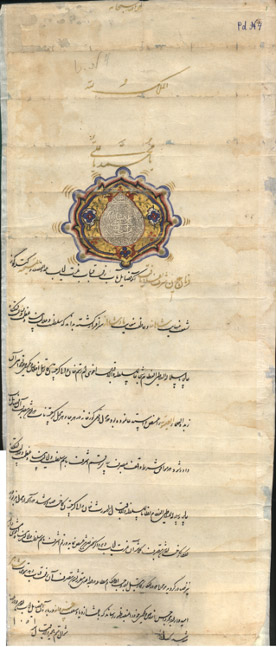
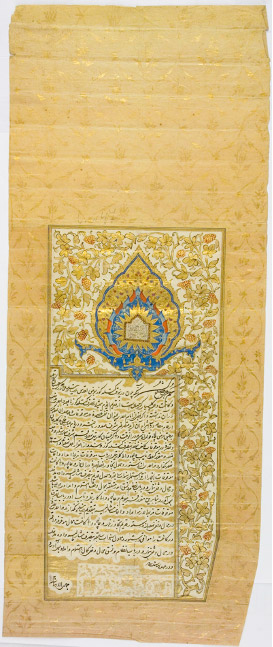
At the time, state bodies such as the Ministry of Trade had become a financial resource for the minister of trade, rather than a resource that would see to merchants’ pleas.[1] The Ministry of Trade charged every merchant a sum of money for every plea.[2] Because the position of minister of trade was attained by giving a large sum of money to the shah and his courtiers, that position was more like a resource to make money than a position designed to help merchants.[3] The minister, too, assigned the affairs of merchants in the provinces to minor officials in return for a sum of money as a “gift.”[4] Ultimately, when extortions on the part of the minister of trade became intolerable, merchants protested and sent a plea to Naseroldin Shah himself, demanding establishment of an independent body named Majlis-i Vokkalay-i Tojjar (Merchants’ Representatives Council), which was proclaimed by a royal decree in 1883.[5] This council was the first-ever merchants’ independent body in the Qajar era, and it was active in upholding the merchants’ mutual interests, preventing state officials from interfering in merchants’ internal affairs, and seeing to their pleas.
The idea behind such a council—composed of merchants’ representatives who would make decisions on merchants’ behalf and issue verdicts accepted by them—was to set up an institution that would act for the mutual benefit of merchants. This differed from the prevalent traditional ways of pleading to state bodies or the person of Reisoltojjar (head of the merchants’ guild). The council’s constitution clearly stated that one task of the council was to see to merchants’ pleas and arbitrate in the cases of their claims.[6] At this time, merchants had gained such social maturity that they had managed to set up an independent institution to solve their problems—a civil institution that would in due time help them not only to form their collective identity and thus solve their own problems, but also to organize a collective course of action in the face of state officials who would try to encroach on merchants’ interests.
This course of action was also followed after the constitutional movement began. Merchants had high hopes of the new political order and expected that the arbitration of the trade court would be in their favor and provide them with financial security. Therefore, the merchants’ association, one among many associations which had sprung up after the Constitutional Revolution, maintained relations with Majlis (parliament) deputies.[7] The merchants’ association had branches in provinces and also at overseas centers of commerce, and was actively engaged in protecting merchants’ interests. At the first Majlis, merchants participated actively and pursued their interests there, and the law pertaining to trade associations was discussed. However, that was the one and only occasion on which merchants’ demands were addressed at the Majlis.[8]
Many factors combined to provide a basis for the merchants to strengthen their internal class structure: the increase in violence in Iranian society, the culmination of anarchy and insecurity immediately after the victory of the Constitutional Revolution, and the bombardment of the Majlis and destruction of constitutional institutions; a decrease of merchants’ political influence in the second Majlis; the occurrence of World War I; and a culmination of political, social, and economic crises, widespread insecurity and strengthening of divergent social forces, and the weakness of the central government and incompetence of the Majlis. After the end of World War I, on the 12 Rabiolavval AH 1338/1920, the constitution of ‘Heiat-i Ettahadiye-i Tojjar (Merchants’ Union) was ratified, and the union was formally founded under Chair Haj Mohammad Hossein Aminolzarb. On top of its commercial and industrial goals, the Merchants’ Union aimed to solve commercial issues arising between merchants, and this was enshrined in its constitution.[9]
The union had a solid organizational structure with contacts all over Iran, and had its own internal regulatory mandates. Its solid organization and importance were particularly evident in the commercial skirmishes with the Soviet government over its trade restrictions on Iranian merchants, skirmishes that became known as Nahazat-i Eqtesad (Economic Movement). The collection of letters and announcements of the Economic Movement in protest to the Soviet government showed a similar and collective position on the part of merchants within a civil institution called the merchants’ union, which was separate from ‘Heiat-i Ettahadiye-i Tojjar.[10]
In the Pahlavi era, too, merchants were totally aware of the necessity for having and upholding trade associations. But as the centralizing Pahlavi state pursued initiatives to bring every sphere of social activity under its control, the Ministry of Public Works was called upon to found the Tehran Chamber of Commerce, according to a law ratified by the cabinet. In May 1926, the Tehran Chamber of Commerce was officially founded on the basis of an internal merchants’ election, and thus, the ‘Heiat-i Ettahadiye-i Tojjar was transformed from a non-governmental organization into a pseudo–state body which acted as the functioning arm of the Ministry of Public Works, and in effect as liaison to establish relations between the ministry and merchants. For this same reason, the Tehran Chamber of Commerce was financed by the government, and this financial setup may have caused the delay in founding other chambers of commerce.[11] After a while, the government announced that it could not afford to finance the Tehran Chamber of Commerce, and merchants themselves had to come up with financial resources for that purpose.[12] From then on, the chamber of commerce increasingly functioned as an executive agent and tended to pursue regulations made by the ministry.[13]
Prelude to the Foundation of the Bushehr Chamber of Commerce
In 1929, there were attempts to found chambers of commerce in large and middle-sized cities and Iran’s major commercial centers. On 2 October 1930, the law pertaining to founding chambers of commerce was passed; up to this time, merchants in every city and commercial center were organized in their respective unions and were totally out of the reach of state executive bodies, seeing to their own affairs in an autonomous manner and according to guild solidarity norms. The first article of this law stated that in order to found a chamber of commerce in a major commercial center, merchants first had to send an application letter to the Ministry of National Economy. But seemingly, merchants already organized in their unions did not show any real inclination to that effect. Thus, nearly a month after the ratification of the law, the Ministry of National Economy, in an October 1930 letter to the Ministry of the Interior, asked for assistance: “With all due respect, please ask provincial governors in every city and commercial center to invite the more established merchants and to inform them of regulations pertaining to chambers of commerce law [. . .] and persuade the gentlemen [. . .] to apply for foundation of the chamber of commerce in their respective cities [. . .] and ask the governors to send on the application letters, as soon as possible, through the interior ministry, or directly to this ministry.”[14]
Even so, it seemed that merchants were reluctant to disband their civil organizations and gather in a state-controlled or pseudo-governmental institution. Two months after the passing of the law and one month after the dispatch of the letter to the Ministry of the Interior, the fact that merchants would still not send up application letters to found chambers of commerce left the Ministry of National Economy no choice but to send yet another letter in November 1930 to the Ministry of the Interior. This second letter, while mentioning the previous letter, stated: “As up to this moment there is no clear sign of what steps respected governors have taken [. . .] please ask them to expedite their actions as to the effect, and get the application letters prepared immediately and dispatch them to the central offices.”[15]
In spite of reluctance and disregard on the part of merchants, ultimately chambers of commerce were founded in every city and major commercial center. Bushehr, a major port city and an important commercial center, saw its chamber of commerce founded as early as 1929. In a document dated September 1933 and listing cities where chambers of commerce had already been founded, Bushehr is listed as item number ten of thirty-six cities.[16]
Bushehr Chamber of Commerce and Its Various Functions
After the capitulation and occupation of Iran by the allies during World War II, which resulted in Reza Shah Pahlavi abdicating the throne, there commenced a twelve-year period beginning in September 1941 and ending in August 1953. This period entailed a process of increasing weakness on the part of the central government, and a proportionate prevalence of relative liberties in the country.
The more governmental executive bodies lost their power and centralizing function, the more autonomous agency in political, social, and economic spheres increased on the part of various social classes and layers. One group among these who tried hard to engage in autonomous action was the merchants. One example of this is an attempt by Bushehr merchants to supply wheat for the daily consumption of the Bushehr populace through the chamber of commerce. Beginning in February 1931, all commodities exported from or imported into Iran were required to have due government permits according to the act passed by the Majlis which effectively nationalized foreign trade. Prior to the arrival of the allied forces in Iran, the country saw a bad harvest in 1940 due to drought. After the occupation of the country, the need to feed foreign troops, the fact that Soviet forces tended to export Iranian wheat to their country, and the continuation of the drought, feeding the Iranian populace and supplying its main staple food—that is, bread—became a grave problem.
Bushehr, like all other cities in Iran, faced a bread shortage. Through the chamber of commerce and in an autonomous course of action without state officials’ involvement, Bushehr merchants got into direct negotiations with the British consulate general in Bushehr, to import wheat from India, then a British colony, to provide the populace with bread. According to a letter from the Bushehr Chamber of Commerce to the British consulate general,
the volume of wheat supplied by the Finance Economy Office to the bakers is not enough at all; thus, according to negotiations in an extraordinary session of the chamber of commerce on the subject of feeding the populace [. . .] it has been decided that merchants with the help of the consulate general import wheat from India to the effect of 1,500 tons. Thus referring to negotiations with the consul and his endorsement, please provide the permit to Bushehr merchants to import the said wheat from Karachi.[17]
In the meantime, as war and occupation had caused a sharp increase in the prices of staples and the expenses of haulage, the Bushehr Chamber of Commerce sent a letter to the Bushehr Office of the Finance Department stating that
as the populace finds it hard to provide themselves with staple bread due to a lack of wheat and are in great despair and face starvation, the chamber of commerce in an emergency session has decided to seek help from your office in order to make merchants able to import 1,500 tons of wheat [. . .] from India. To gain permission to that effect, there are already negotiations with the British consulate general in Bushehr underway and they too have agreed to the plan [. . .] please ask the Ministry of Finance to exempt the said wheat from customs tariffs.[18]
This shows that autonomous agency on the part of merchants allowed for the intervention of state bodies only where merchants asked for exemption from customs tariffs. Even so, state bodies, too, welcomed the move on the part of the chamber of commerce. The governor-general of Bushehr announced: “This move is totally according to my hearty blessings and hopefully the government will agree with the exemption of customs tariffs.” But he also signaled his unhappiness that merchants attempted to interact with the government on their own: “Now, for your information a copy of the decree number [. . .] issued by the Ministry of the Interior is enclosed [. . .] that from now on whatever demands and actions must be processed through the governor-general.”[19]
On the other hand, a year after the August 1953 coup, a totally different approach was taken by the Bushehr Chamber of Commerce when facing a commercial issue. After the coup, the state had once again maintained centralization in all spheres and had the final say in all matters. At this time, the new Shahpoor port was boosting with business, and as a result, older ports, including Bushehr, were facing a downturn in business. Thus, to boost business in Bushehr port, the Bushehr Chamber of Commerce decided to encourage shipping lines to more often frequent the port. But this time, contrary to the twelve-year period of 1941 to 1953, the chamber of commerce had to contact state bodies and refrain from any independent action.
Thus, the Bushehr Chamber of Commerce asked the governor-general to provide facilities for at least two ships to frequent Bushehr port on a monthly basis, to carry goods intended for exportation. In a letter to Bushehr’s governor-general, the Bushehr Chamber of Commerce stated:
Considering the enthusiasm on the part of merchants engaged in export trade to send their goods through Bushehr port, and as exportation from Bushehr is totally in their best interests, and to enhance trade and provide jobs in the Bushehr area, we thereby ask to have an order from the governor-general to oblige the [. . .] shipping lines to send at least two ships on a monthly basis to Bushehr in order to carry exporting goods. At this moment, a substantial amount of goods is already in depot in Bushehr and a substantial amount is also ready to be sent to Bushehr.[20]
Bushehr’s governor-general, in turn, informed the officials in the provincial government who, in a subsequent letter to the Ministry of the Interior, stated: “The copy of the letter sent by the Bushehr Chamber of Commerce is enclosed, whereby they have asked to have two ships to monthly frequent Bushehr port in order to carry exporting goods. Please inform us of your decision.”[21]
The Ministry of the Interior, in turn, referred the subject to yet another state body. A letter to the Ports and Shipping Department stated: “The copy of the letter by the Bushehr Chamber of Commerce concerning two ships frequenting Bushehr port in order to carry exporting goods has been received through the seventh province officials [. . .] Please inform the Ministry of the Interior of your decision.”[22]
The subject raised by the Bushehr Chamber of Commerce would have been resolved at once had it not been referred to multiple state bodies as a result of state centralization. This red tape was an excuse for state bodies to write and receive letters; and the Bushehr Chamber of Commerce, in the meantime, refrained from any autonomous action.
Internal Conflict in the Bushehr Chamber of Commerce
In the aftermath of the August 1953 coup and downfall of Prime Minister Mohammad Mossadeq, the new government attempted to, once again, establish its unrivalled authority, and to centralize all executive affairs in all spheres of social life. First in a series of actions to achieve this was to annul all laws passed during Mossadeq’s time in office. Furthermore, on 28 December 1954, a new law concerning the establishment of chambers of commerce was passed. Articles of this law were as follows:
After a few years, the Bureau of Chambers of Commerce was ceded from the Ministry of National Economy and put under the auspices of the Ministry of Trade.[24] The bureau’s duties were as follows:
As the aforementioned demonstrates, laws ratified by the government after the coup increasingly made chambers of commerce act like offices subordinate to government ministries. At this very moment in the Bushehr Chamber of Commerce, a conflict occurred between some merchants, on one hand, and the presidium of the chamber, on the other. Contrary to what normally would have been the case—that is, to let the aged and well-established members issue a verdict on the matter (Kadkhoda maneshi)—the course of the conflict took the shape of writing letters to the Ministry of National Economy, thereby getting a government body involved in the matter.
The conflict, at least on the surface, centered on the question of the continuation of the presidium’s term of office. Even after their term of office expired, the presidium—in particular, its head, a person called Zareii—did not hold a new round of elections and continued to hold office. In a letter to the Ministry of National Economy, a merchant called Poostchi stated:
At the Bushehr Chamber of Commerce, the term of office of the presidium has come to the end of its lawful term of office a year ago, and normally, and like all other chambers of commerce, has to abstain from all its activities, and its internal affairs should be governed under the auspices of the representative of the Ministry of National Economy [. . .] or under the auspices of the Bushehr governor-general, or under the auspices of a committee including the governor-general, attorney general, and head of the Finance Department. But, in defiance of the law, the present presidium [. . .] governs the chamber [. . .] the disbanded presidium which is the legacy of the imposed third round of elections does not have the right to sign documents and letters of the chamber [. . .] what reason and what cause is there to have the affairs of the chamber in the hands of the disbanded presidium [. . .] to do, arbitrarily, whatever they wish.[26]
Poostchi mentioned two issues: first, the fact that the presidium’s term of office had already expired, and second, that this presidium was running affairs in a way to profit from it and causing loss for the other merchants. In another letter to the Ministry of National Economy, two more merchants who were also protesting the issue stated:
The Bushehr Chamber of Commerce term of office has ended one and half a years ago, and the unlawful election of the previous round has finished, the one that imposed a number of unrighteous people as the presidium, and even so, those particular people are still holding office [. . .] the head of the chamber, Zareii, who in fact is really the previous head, says that he has spent bribe money at the National Economy Department of the Seventh Province, and also at the Ministry of National Economy itself, and thus has influence and connections there who would not allow his dismissal, and even if it takes thousands of years to hold new elections, he would still occupy his position. And it really seems to be the case.[27]
These two merchants repeated Poostchi’s claims and also added that the present head of the chamber had gained office not through free consensus of the merchants themselves, but rather through personal influence in state bodies. If true, this shows the high extent of involvement on the part of state bodies in the affairs of the Bushehr Chamber of Commerce, which seemingly was a civil institution. Naturally, when the influence and involvement of state bodies in the affairs of chambers of commerce is so pervasive, civil institutions cannot be expected to take any autonomous course of action.
In a letter to the Bureau of Chambers of Commerce, another merchant called Jamali spoke of “conflict and differences” among Bushehr merchants, and stated that the cause of the issue is that “Zareii, after nearly two years have passed since expiration of his term of office, and thus with no legality, still regards himself the head of the chamber.” Jamali added that Zareii says “he would not care about what orders may be issued in Tehran or Shiraz; his connections in those two cities would not let his dismissal occur.”[28]
Yet another merchant, Faghih Beladi, wrote a letter repeating the previously mentioned claims and calling Zareii a “smuggler.” He continued: “Zareii, in order to influence the head of Bank Melli by his position in the chamber and to get loans and impose promissory notes issued by Gulf Textile factory, where he is the chief executive officer,” would not leave office. On top of that, Beladi claimed that Zareii, “in compliance with the governor-general, head of Bank Melli, and the mayor, has received 200,000 tomans as a loan for Gulf Textile factory and thereby has taken advantage of his position at the chamber.” This merchant, too, stated that Zareii had said that “he has connections in the Ministry of National Economy, and thus he will be the head of the Bushehr Chamber of Commerce for life, whether it be lawful or otherwise.”[29]
In response to the protests by Bushehr merchants, Abdolrahim Jafari, director of the Bushehr Chamber of Commerce, stated in a letter to the head of the Office of Internal Trade at the Ministry of National Economy:
As a result of conflicts among merchants that have divided them into a few opposing groups, the situation at the chamber is unclear [. . .] as feuds are culminating, the merchants are willing to get the chamber itself involved too [. . .] please specify that at this period of recess of the chamber, who is the rightful person to take care of affairs at the chamber [. . .] in Bushehr, we are witnessing a strange and pitiful situation [. . .] and merchants are constantly writing conflicting letters and petitions to the Bushehr office, and even to offices in Shiraz.[30]
The director, in his letter, tried to show that the conflicts were among the merchants themselves, without mentioning any reasons, to imply that the presidium of the chamber was not involved in the feuds. Jafari also asked for a formal order to be issued by the authorities at the Ministry of National Economy to install a “caretaker” for the chamber of commerce during “the period of recess,” which is in itself a sign of the extent to which chambers of commerce were obliged to follow and obey the ministry’s orders. Following that, the National Economy Office of the Seventh Province, too, in a letter to the Office of Internal Trade at the Ministry of National Economy, implied that the whole affair was nothing but a conspiracy:
Lately, there have been many petitions against Mr. Zareii, head of the Bushehr Chamber of Commerce, with different signatures, but almost the same handwriting; it was understood that these petitions have to be groundless and based on the malicious self-interest of one particular person. Thus, the petitions were sent to the Bushehr branch of the Office of Internal Trade, who were asked to investigate the affair and to identify the petitioners. At present, we have received a copy of a letter from the Bushehr police department which confirms the viewpoint of this office.[31]
This formal letter implied that the petitioners were unknown, but that every letter had been signed by one of the protesting merchants, and that the police department had succeeded in solving a grave crime by “identifying” the petitioners. Seemingly, the affair had now grown from a case of pseudo-legal obeying by the Bushehr Chamber of Commerce toward state bodies, to ultra-legal actions taken by the Bushehr police department.
At last, in March 1955 new elections were held at the Bushehr Chamber of Commerce. The head of the Bushehr branch of Bank Melli was “elected” as the head of the Bushehr Chamber of Commerce. Zareii, too, was “elected” as the first assistant to the head of the chamber,[32] which was obviously a formality and actually a way to let him continue to govern the chamber’s affairs.
The internal conflicts in the Bushehr Chamber of Commerce in the 1950s are a clear sign of the fact that the more state centralization increases, the less merchants find the opportunity or the will to take autonomous actions, the more group solidarity decreases, and the more merchants as a social grouping are swept aside to the margins of the arena where political and social agency is played out.
Conclusion
The endeavors of merchants as a social class in their conflicts with the state in Iran fluctuated between autonomous agency, on one hand, and dependence and apathy, on the other. The different courses of action adopted by Bushehr merchants are a clear sign that whenever the state’s centralizing efforts decreased, merchants embraced autonomous agency and demonstrated their class and group independence in many different ways. And whenever the state succeeded in the process of centralization, merchants and other social classes alike became dependent on executive bodies of the state and deprived of any possibility of autonomous agency. In the aftermath of the August 1953 coup, when the state, after a twelve-year interval, once again gained a high degree of centralization, at the Bushehr Chamber of Commerce a conflict occurred among merchants on the matter of holding new elections. This time, state centralization and the increasing dependence of chambers of commerce on state bodies made protesting merchants pursue their petitions not in an internal manner, as they were used to, but through correspondence with state bodies. This particular affair and its ultimate conclusion was a clear sign of an end to any autonomous course of action on the part of Bushehr merchants and the chamber of commerce.
[1]Abbas Mirza Molkara, Biography, ed. Abdolhossein Navaei (Tehran: Babak, 1958), 168.
[2]Abdolah Mostofi, My Autobiography or Social and Administrative History of Qajar Era, vol. II (Tehran: Zavvar, 1991), 139.
[3]Mohammad Hassan Khan Etemadolsaltaneh, Diaries, ed. Iraj Afshar (Tehran: Amir Kabir, 1971), 308, 377.
[4]Molkara, Biography, 168–69.
[5]Mohammad Hasan Aminolzarb to Naseroldin Shah, AH 12 Shavval 1301/5 August 1884, Aminolzarb petitions to the shah files, private library of Dr. Hossein Mahdavi. The letter is mentioned in Ferydoon Adamiyat and Homa Nategh, Social and Political and Economic Ideas in Unpublished Texts from Qajar Era (Tehran: Aghah, 1977), 308–9.
[6]Adamiyat and Nategh, Social and Political and Economic Ideas, 335, 336–40.
[7]Habl al-Matin, Number 145, 19 Jumadi II AH 1325/30 July 1907, 3.
[8]Muzakirat-i Majlis, Dawrah 1, 5 Rabiolavval AH 1326/7 April 1908, 9 Rabiolavval AH 1326/11 April 1908, 16 Rabiolavval AH 1326/18 April 1908, 4 Rabialsani AH 1326/6 May 1908 (Tehran: Majlis Publications, 1946), particularly on 499, 505, 512, 537.
[9]“Constitution of Tehran Merchants’ Union,” 12 Rabiolavval AH 1338/14 April 1908, pp. 1–2, Merchants’ Union documents, private library of Dr. Hossein Mahdavi.
[10]For more information about the Economic Movement, see Soheila Torabi Farsani, “Iran–Soviet Trade Relations and the Organization of Economic Movement in Early Years of Pahlavi Era,” Isfahan University Literature and Humanities Faculty Magazine, no. 30–31 (2002): 143–72.
[11]“Mutafariqat,” Habl al-Matin, Sal 35, Number 14–15 (24 Ramadan AH 1345/29 March 1927), 30–32, particularly 30.
[12]Ministry of Finance to Ministry of Public Works, 30 Azar AH 1305/22 December 1926, Ministry of Finance, [240]/288/42(42), National Library and Archives of Iran, Tehran; Majlis to Chamber of Commerce, n.d., gh-115515, Bonyad Mostazafan Archives, Tehran.
[13]Premier office’s to Ministry of Public Works and Ministry of Trade, 4 Bahman AH 1307/24 January 1929, 9/104001, National Library and Archives of Iran; Premier’s office to Ministry of Trade and Ministry of Public Works, 8 Mehr AH 1308/17 September 1929, [240]/9/104001, National Library and Archives of Iran.
[14]Ministry of National Economy to Ministry of the Interior, 6 Aban AH 1309/28 October 1930, 8720/5468, National Library and Archives of Iran. All translations are mine.
[15]Ministry of National Economy to Ministry of the Interior, 8 Azar AH 1309/29 November 1930, 9890/11033, National Library and Archives of Iran.
[16]Ministry of Finance, “List of Cities Where There Are Chambers of Commerce,” 9 Shahrivar AH 1312/18 August 1933, 4618, National Library and Archives of Iran.
[17]Bushehr Chamber of Commerce to British consulate general at Bushehr, 16 Farvardin AH 1321/5 April 1942, 345, National Library and Archives of Iran.
[18]Bushehr Chamber of Commerce to Bushehr Office of the Finance Department, 16 Farvardin AH 1321/5 April 1942, 35, National Library and Archives of Iran.
[19]Governor-general of Bushehr to Bushehr Chamber of Commerce, 18 Farvardin AH 1321/7 April 1942, 441, National Library and Archives of Iran.
[20]Bushehr Chamber of Commerce to governor-general of Bushehr, 17 Azar AH 1335/8 December 1956, 516, National Library and Archives of Iran.
[21]Provincial government of the seventh province to Ministry of the Interior, 10 Bahman AH 1335/30 January 1957, 22270, National Library and Archives of Iran.
[22]Ministry of the Interior to the Ports and Shipping Department, 29 Bahman AH 1335/5 February 1957, 10371/89189, National Library and Archives of Iran.
[23]Ministry of Trade, law pertaining to founding of chambers of commerce passed on 7 Dey AH 1333/28 December 1954, National Library and Archives of Iran.
[24]Ministry of Trade, legal bill pertaining to founding of chambers of commerce, 16 Shahrivar AH 1338/8 September 1959, National Library and Archives of Iran.
[25]Ministry of National Economy, 23 Esfand AH 1333/14 March 1955, 39897, National Library and Archives of Iran.
[26]Abdolah Poostchi to Ministry of National Economy, 18 Aban AH 1333/9 November 1954, National Library and Archives of Iran.
[27]Seyed Mostafa Asghari and Foroozan Najafi to Ministry of National Economy, 20 Aban AH 1333/11 November 1954, National Library and Archives of Iran.
[28]Haj Abbas Jamali to Bureau of Chambers of Commerce, Ministry of National Economy, 9 Aban AH 1333/31 October 1954, 20580, Prime minister’s office documents, National Library and Archives of Iran.
[29]Faghih Beladi to Ministry of National Economy, 20 Azar AH 1333/11 December 1954, Prime minister’s office documents, National Library and Archives of Iran.
[30]Bushehr Chamber of Commerce to Office of Internal Trade at the Ministry of National Economy, 23 Azar AH 1333/14 December 1954, National Library and Archives of Iran.
[31]National Economy Office of the Seventh Province to Office of Internal Trade at the Ministry of National Economy, 27 Dey AH 1333/17 January 1955, 2803, Prime minister’s office documents, National Library and Archives of Iran.
[32]Bushehr Chamber of Commerce, 23 Farvardin AH 1334/13 April 1955, Prime minister’s office documents, National Library and Archives of Iran.
Amy Motlagh is the Bita Daryabari Presidential Chair in Persian Language and Literature, and an associate professor of comparative literature and Middle East/South Asia studies, at UC Davis. She is the author of Burying the Beloved: Gender, Fiction and Reform in Modern Iran (Stanford University Press, 2012) and articles on topics including Iranian cinema, literature, and gender and race in the Iranian diaspora. She is currently at work on a manuscript called “Translating Race: A Cultural History of Racial Thinking in Modern Iran and the Diaspora.”
Born in 1921 in Shiraz, eight years before the formal abolition of slavery by Reza Shah in 1929, writer, intellectual, and translator Simin Daneshvar later acknowledged that many of her stories came out of her childhood. An important “clearing center” for the Persian Gulf slave trade, the Shiraz of Daneshvar’s childhood is most extensively memorialized in her first major novel, Savushun (1969), which is set in World War II–era Shiraz.[2] Daneshvar attended a British missionary school in Shiraz that enabled her to learn English at a very high level of competency at a time when it was not common, even for affluent Iranians, to do so. She published her first collection of short stories, Atash-e khamush (Extinguished Fire) in 1948, but later insisted that it not be reissued; she was embarrassed by this early effort. She started work as a translator and writer of occasional pieces for newspapers and radio to earn money while she was a university student, and she would continue to be a prolific translator for the duration of her life: her translations include not only literary works such as The Scarlet Letter; Cry, the Beloved Country; and The Human Comedy, but also bestselling self-help works like Men Are from Mars, Women Are from Venus. She remained interested in the implications of translation as a profession and a practice in Iran throughout her life, but perhaps her most complicated negotiation with translation was her engagement with ideas of race between an American context and an Iranian one.
Daneshvar’s first self-conscious intellectual encounters with the concept of “race” seem to have occurred during the Fulbright year she spent at Stanford University in the United States in 1952–53. Daneshvar always acknowledged the important impact the Fulbright year had on her writing, and she indeed credited one of her teachers at Stanford, Wallace Stegner (1909–93), with changing the way she wrote entirely.[3] We can see the legacy of this fellowship period and Stegner’s influence in her fiction, not just in the explicit ways she attributed to Stegner, but also in her deployment of Blackness and whiteness in the first story collection she published after her Fulbright, A City like Paradise (Shahri chawn behesht, 1961).[4]
In Playing in the Dark, Toni Morrison suggests the ways in which Blackness functions as a foil for white masculinity in American fiction of the late nineteenth and the twentieth centuries.[5] For Daneshvar, the practice of racial thinking and interpretation of race in her writing may have been mediated not only through Stegner’s mentorship but also through her work as a translator. One of the first books she translated after her Fulbright year was William Saroyan’s The Human Comedy (Komedi-ye ensani, 1954).[6] Although she did not translate any of Stegner’s work, she was clearly influenced by his worldview and style, and continued to seek his patronage long after her Fulbright year ended.[7] Aside from her adoption of the by-now hackneyed phrase associated with the American “program year,” “show, don’t tell,” Daneshvar continued to correspond with Stegner for many years beyond the Fulbright and clearly regarded him as an important mentor.[8] Stegner’s most famous novel of the West (Angle of Repose, 1971) was yet to come, but he was already acknowledged by this time for a multitude of writings on the American West, including Big Rock Candy Mountain (1943). Among these were One Nation (1948), which generated an associated film focused on the “American Negro” section of that book and called by the same name. Shortly after Daneshvar’s Fulbright period, Stegner also contracted to work as a propagandist for what was then the Arabian American Oil Company (ARAMCO).[9]
Daneshvar would also go on to translate other American works, with Stegner’s encouragement, including The Scarlet Letter (Dagh-e nang, 1955). For Daneshvar, American literature’s predilection for the “power of blackness” that Morrison critiques in Playing in the Dark may have come to her in part through education during the Fulbright year, and in part through translation. Stegner and Saroyan were both important architects in the development of a masculine mythology of the New West, and Stegner’s work has been both celebrated and critiqued for its depiction of the American West and of white masculinity.[10]
Daneshvar’s observations in her letters to her husband, Jalal Al-e Ahmad, complicate some of the accepted views about this remarkable writer, and shed a different light on her political affiliations and impressions of coeval political movements.[11] Her engagement with race is of particular interest, not just because of contemporary debates and attention to race globally as a consequence of police brutality in the United States, but also because it has been so much overlooked in her work. The way that she saw (or didn’t see) race is notable—not because, as many Iranian scholars and scholars of Iran erroneously suggest, Iranians are effectively color blind, but because Daneshvar’s understanding of and engagement with race reflects an attempt to grapple with a different racial paradigm in the United States. There, she witnessed some of the aspects of life that gave rise to the Civil Rights Movement, and later witnessed some of the major protests involved with that movement. Also, Daneshvar herself dealt in her own writing with race in ways that are at times profoundly troubling.
Unfortunately, scholars of Iran to date have also not been able to fully face the complicated ways in which Iranian intellectuals have negotiated race and the legacy of slavery in Iran, either in terms of its connections to race or in terms of the way that they viewed racial thinking and slavery in other contexts, especially in the United States. In her dissertation, Seeing Race (2018), Beeta Baghoolizadeh suggests that the move to preemptively distance and separate Iran’s history of slavery from any association with other histories of slavery was in effect an attempt to whitewash Iran’s past.[12] As Baghoolizadeh shows, this was a self-conscious national effort during the Pahlavi period, but one which continues into the present, and with which Iranian scholars have to some extent collaborated.
This discomfort with the legacy of slavery in Iran’s past is evident in Behnaz Mirzai’s A History of Slavery and Emancipation in Iran 1800-1929 (2017).[13] The result of extensive archival research by Mirzai, this monograph nonetheless teleologically reads the story of slavery and its abolition as the inevitable triumph of the secular nation–state in Iran. Consequently, Mirzai spends little time considering the painful and enduring effects or consequences of the enslavement of Africans on their descendants. Moreover, Mirzai declines to engage the issue of racism, selectively citing the work of other scholars to insist on a distinction between the American history and experience of slavery and the history of slavery in the Islamic world.[14] Regrettably, this denial is a trope of the genre of Iranian writing on the history of slavery.
In a similar vein to Mirzai’s approach, Haleh Afshar’s uncomfortable essay “Age, Gender and Slavery in and out of the Persian Harem: A Different Story” (2000) remembers the “freed slave” who lived in the Afshar home, a woman who had originally been bought for the harem of Muzaffar al-Din Shah Qajar.[15] When she was “freed” (i.e., the harem could no longer support so many slaves), this woman, called only Sonbol Baji (Sister Hyacinth), became Afshar’s nanny.[16] Afshar uses what she says is a framework drawn from Audre Lorde’s notion of “bio-mythography,” and describes the impulse for this article as the desire to give voice to someone who never acquired the necessary literacy to write her own story. Yet Afshar struggles to reconcile this personal history of her family’s slaveholding with the liberal racial politics required of her in her adopted country (the United Kingdom). Instead, she relies on odd assertions that suggest Sonbol Baji found her time as a slave “empowering,”[17] and that “for Sonbol Baji her colour had been one of her major attractions. The king had wished for a beautiful ‘black’ girl in his entourage and had acquired Sonbol when she was a small child.”[18] Throughout the essay, Afshar deploys the words slave and black in quotation marks, and indicates that she finds these terms insufficient and possibly foreign to the context of Iran, even though the word commonly used in Persian to describe Afro-Iranians is siah (Black).[19]
An unintended visual critique of the history that Afshar offers comes in Pedram Khosronejad’s collection of Qajar photographs, Qajar African Nannies (2017), in which a photograph of Afshar and her brother Kamran with Sonbol Baji is published.[20] Although we cannot extrapolate too much from a single photograph, I believe we can see the photograph as a critique of Afshar’s characterization. The photo shows an Afro-Iranian woman holding a large Iranian boy, perhaps two years old; a plump little Iranian girl wearing a European dress and bow in her hair is posed in front of the woman, and a (white) doll is posed at the girl’s feet. The woman’s face is shadowed, but it is weary and expresses sadness, possibly even fear. As Khosronejad observes in his introduction to the volume, “The faces of all the Africans in the photographs of this collection confirm their deep sadness and the horror that encapsulated their entire lives.”[21]
The introduction aside, this volume does not attempt to interpret the photographs deeply. Khosronejad has indeed largely eschewed critical engagement with these photographs, saying that he sees his role largely as an archivist gathering material for others to interpret.[22] His discomfort with some aspects of this process is evident, and he has commented on the fact that these photographs of enslaved persons were taken without the consent of the subjects, but would theoretically belong to the descendants of the subjects, who, in his view, are impossible to locate owing to the destruction of documents related to their ancestors’ enslavement. Instead, the photographs have become the subject of dispute between different “owners”—the Qajar families, who claim them by right of inheritance, and the Iranian government, which confiscated them during the revolution.[23]
Other evidence also points to a discomfort with a critical scrutiny of the legacy of slavery, particularly enslavement of Africans, in Iran. Even a book ostensibly dedicated to the study of race, Reza Zia-Ebrahimi’s 2017 The Emergence of Iranian Nationalism: Race and the Politics of Dislocation,[24] which focuses on the development of an Aryanist-inflected Iranian nationalism, elides the way in which Aryanism was not simply staged at the expense of other “white” minorities in Iran, but also and in ironic ways, at the cost of effacing the history of slavery and its aftermath.[25] Anthony A. Lee, in a preface to his work recovering the history of the enslaved individual Fezzeh Khanom in nineteenth-century Shiraz, notes the results of the 1868 census, which showed that in Tehran, the population of Afro-Iranians was then 12%, a fact that has been ignored or glossed over in the historiography of the period.[26] In his portrait of Fezzeh Khanom, Lee draws on Bahai historiography, which constitutes one of the few sources to record even obliquely the lives of these slaves, but notes, “while it is commendable that the presence of these African slaves is acknowledged, their significance to history is ignored.”[27]
On the evidence presented by Daneshvar herself, her family likely enslaved people. Daneshvar never (to my knowledge) discussed this fact directly or put it in any explicit comparative framework with the legacy of slavery she saw in the United States. Yet she acknowledged that a character from the story “A City like Paradise” (“Shahri chawn behesht,” from the collection by the same name), Mehrangiz, was based on her own dadeh siah (Black nanny), an Afro-Iranian slave-cum-servant, who lived with her own family.[28] Elsewhere, I have argued that this figure of the freed-slave-cum-female-domestic functions in Daneshvar’s work, and in the imaginary of Iranian modernity, as a sign of a disjuncture, an irreconcilability.[29] In particular, I have focused on the way in which even as women’s rights and status came to the fore of public attention as important aspects of Iran’s modernization, neither reformist Iranians, including feminists like Daneshvar, nor the law itself could acknowledge female domestic servants (including former enslaved persons like Mehrangiz or Sonbol Baji) as women. Mehrangiz is perhaps the closest Daneshvar comes to showing real sympathy for a female domestic, and this attitude is clearly derived from Mehrangiz’s helpless abjection in the household.
Even for feminists, the personhood of servants existed outside the law, and the status of manumitted slaves who had become, perforce, domestic servants was particularly precarious. Yet in spite (or perhaps because) of this denial of their personhood, the figure of the servant persists in important ways in modern Iranian fiction. In my book, I argue that this trace in the literature is as important as any legal document. In literary texts as well as in political discourse, female domestic workers would increasingly become the Other to the imagination of a central, dominant Iranian womanhood, which defined itself not only in contrast to the traditional wife, but also to the household servants.
Many of Daneshvar’s short stories and novels prominently feature domestic servants, especially women, and Daneshvar often thematizes their position in the household in her stories. Only the eponymous story in A City like Paradise, however, thematizes the status of a former female Afro-Iranian slave. As alluded to above, this story follows the life and finally the death of Mehrangiz, who is now serving as a nanny, maid-of-all-work, and de facto concubine in the middle-class home of her former master’s daughter, to whom she was given as a wedding gift.[30] With the onset of modernity and Reza Shah’s reforms, which included land reforms and the Manumission Law of 1929, elite slaveholders saw a rearrangement of their fortunes. Here, we see that dramatized in the case of this married daughter, who cannot afford another person in her household, resents Mehrangiz’s sanctioned intimacy with her children (and unsanctioned intimacy with her husband), and treats her as subhuman and with immense cruelty. Although the story clearly evinces sympathy for Mehrangiz, the character portrayed as the true victim is Ali, the son of Mehrangiz’s mistress, who loves Mehrangiz more than he does his mother, and whose inability to achieve the signposts of manhood (e.g., employment, marriage) is obviously signaled as the true tragedy of the story, even though it concludes with Mehrangiz’s abject death.
If Daneshvar and other leftist and feminist intellectuals had difficulty seeing domestic servants as having souls—in other words, as “real” people[31]—we might also say that she had difficulty seeing the problems with the deployment of Blackness as abasement.[32] In the two additional stories in A City Like Paradise that also foreground race, “The Iranians’ New Year” (“‘Ayd-e iraniha”) and “The Playhouse” (“Suratkhaneh”), Daneshvar deploys the use of blackface in two Iranian cultural traditions to comment on the situation of the (non-Black) Iranian. “The Iranians’ New Year” tells the story of an American expatriate family living in Iran and their two young sons’ naïve fascination with a young man whose occupation is playing the Hajji Firuz character associated with the Persian New Year, Nowruz, while “The Playhouse” revolves around an actor playing the siah in a traditional theater.
In “The Iranians’ New Year,” the mediating sensibility is that of two American expatriate children in Iran in the 1950s, when Americans were beginning to be present in Iran in larger numbers, but the site of sympathy is the Iranian young man they patronize. The two children, Ted and John Michaelson, are fascinated by the blackface Hajji Firuz character, which is an important ritual aspect of the Nowruz holiday, and they become by extension fascinated by the young man living on the margins of their neighborhood who plays this character professionally. The boys adopt a charitable attitude toward the young man and his father, who is a shoeshiner, and build, unbidden, a kiosk shack for the men, decorating it with American symbols, such as the American flag and Mickey Mouse. When one day they find the shack abandoned and open to the rain and wind, which has destroyed their decorations, the younger boy first imagines that “red Indians” have attacked the place; then, when his brother pooh-poohs this idea, insists that it must have been “black men with masks” and that they must be “lynched.”[33] The story is very obviously a critique of American expatriates in Iran in the 1950s, when they had begun to look like representatives of a colonial presence, especially after the 1953 coup engineered by the CIA and MI6. The evocation of Blackness here comes in the form of the Hajji Firuz character, as well as in the comments made by the two boys in their mistaken understanding of what has happened in the kiosk. The young man’s father has died, and the boys do not understand the reasons for the poverty in which the young man and his father lived, or that their “help” does not in fact save a man who has spent his life shining shoes by the side of the road.
As in “A City like Paradise,” here it is not the plight of any Black person that is dramatized (or a critique of the strangeness of the Hajji Firuz blackface tradition), but rather, the abased condition of non-Black male Iranians. The boys are foolish (if naïve) white Americans, but in the story, they take on sinister qualities nonetheless: their innocence, which is protected by their whiteness and their privilege as Americans, enables them to feel self-satisfied at the pathetic help they offer impoverished members of a society whose language they don’t speak and whose customs they don’t understand. Yet Daneshvar does not attempt to unpack the Hajji Firuz tradition at all. Here, as in “The Playhouse,” she deploys blackface but does not interrogate it as a problematic or dehumanizing practice. Hajji Firuz, like Zwarte Piet in the Netherlands, is a historically mysterious and contested aspect of the Nowruz celebration. Explaining the origins of this figure has become part of an apologia related to contemporary Iranian negotiations of race.[34]
“The Playhouse” follows a few days in the life of Mehdi Siah (whose name essentially translates to “Mehdi the Black”), a blackface performer in the “low” dramatic tradition that was still popular at the time of the story’s creation. In this tradition, as the story confirms, the siah is the central character in the drama—the mediating character with whom audiences are invited to identify.[35] Mehdi Siah gets caught up in the tragedy of one of the other players, a young woman who has become pregnant out of wedlock and plans to ensnare the rich amateur who has recently joined the troop, wanting to “study” Mehdi Siah. Here, Mehdi Siah reluctantly chooses class solidarity by allowing the subterfuge and entrapment of the young man to progress without intervening. Here, too, as in “The Iranians’ New Year,” the reader’s sympathy is directed toward a disenfranchised Iranian male, whose condition of abasement is made manifest in both stories by wearing blackface.
Taken together, these stories suggest a significant change in Daneshvar’s sensibilities regarding race. Her previous writings show no such attention to race at all, suggesting that her time in the United States during the Fulbright fellowship radically changed her perspective on race (as well as on class). For this reason, I am suggesting the paradigm of translation to discuss Daneshvar’s negotiation of race. While translation has become so capacious a concept in contemporary scholarship that it risks the loss of any meaning at all, I believe it can be a useful metaphor here for thinking about the negotiation of “race” because it is so clearly a concept or idea that does not fully translate between languages.
Although Iranians began to go to the United States and Europe for education in large numbers in the 1960s and 1970s, Daneshvar was not part of that wave, by virtue of her age.[36] However, she was one of the first, if not the only, Iranians to record experiences of racial encounters during the height of the civil rights movement, and the language she uses is tentative and does not conform to any preconceived or prescribed vocabulary for discussing race.[37] Her letters suggest her fascination with race as an operative concept in the United States that structures relations between Black and white Americans. She struggles to see how she herself is understood within this paradigm, and refers to herself as “just a shade lighter” than the African Americans she meets. Against this uncertainty about where she falls in the American color continuum, we must also acknowledge the fact that Daneshvar and Al-e Ahmad, whose family was from northern Iran, clearly had a running private joke regarding her color. He sometimes refers to her in their letters as his “black girl from Shiraz” (dokhtar-e siah-e Shiraz) or “my black one” (siah sukhteh-ye man), and she frequently signs herself in the same way, or as “your black Simin” (Simin-e siah-e to).[38] On the other hand, Daneshvar is at times patronizing toward the Black Americans she meets: she seems confused and, at times, horrified or bemused at some of the situations racism in the United States engenders. She tells Al-e Ahmad the story of Dorothy, a young Black woman who lives in Daneshvar’s dormitory at Stanford and figures in the letters as someone who is remarkable for her beauty.[39] She answers a phone call intended for another girl, and when that girl is not available, the caller asks if he can take Dorothy out for a date. She accepts and waits for the caller in the dormitory’s lobby. When he arrives and discovers that she is Black, he berates her and says he won’t take her out. A female custodian for the dormitory, who is also Black and unnamed but frequently referred to, yells at the man and threatens him. Daneshvar ends the story by relating how she and another (white) friend intervene by coming home from the cinema and telling the custodian to stop, or she might be fired. Daneshvar sees herself as having helpfully intervened.[40]
Neda Maghbouleh’s important work on Iranian American racialization and racial thinking suggests some critical framework for Daneshvar’s difficulty placing herself on the color spectrum, and her ambivalent (dis)identification with Black Americans: “The specter of Iran was a racial hinge between white Europe and non-white Asia: a face, a body, a culture, and a concept that could open or close the door to whiteness as needed.”[41] Daneshvar’s descriptions of her interactions with Americans, as in the account above, show that her “blackness” is something she elects to participate in, but can step back from when she wants to do so, and take the position of whiteness.
Two comparatist Americanist scholars, Ebony Coletu and Ira Dworkin, have investigated some of the important but often overlooked moments of identification between contemporary Egyptian intellectuals, who selectively courted and rejected the idea of Egypt’s status as an African nation, and Black activism in the United States. In the article “A Complicated Embrace,” Coletu examines the reception and translation of Alex Haley’s novel Roots in the Arab world in the 1970s and 1980s, where it was enormously popular.[42] The plight of protagonist Kunta Kinte became a metaphor for the condition of Egyptians, especially Egyptians working in the Gulf, at the same time that Egypt was practicing racist policies directed at Sudanese refugees and Nubian Egyptians.[43] Coletu compares this use of Roots to Eve Troutt Powell’s powerful investigation of racial politics in Egypt during the period of the Sudanese condominium (1899–1956). Coletu comments that while the use of blackface in Egypt at that time was a way to “visualize stubborn resistance to the ‘civilizing mission’ of the British colonial project while reifying support for Egyptian cultural transformation under European influence [. . .] [t]he rhetorical plasticity of Kunta Kinte as a resistant figure and a slave marked by blackness resonates with this local history even as it conveys a distinct story about Atlantic slavery and diasporic survival in the United States.”[44] Coletu goes on to note that the use of Roots by Egyptian intellectuals such as Sonallah Ibrahim tended to exploit the metaphor of slavery elsewhere to explain the plight of intellectuals such as himself, rather than to shed light on contemporary practices of racism. She also points out that “legacies of slavery are also reworked over time and in Egypt, reference to slavery as debasement has been visually coded to blackness in the last century,”[45] a point echoed by Baghoolizadeh’s examination of racial artifacts and discourse in Iran in the nineteenth and early twentieth centuries.
Dworkin is concerned with the personal history and writings of Radwa Ashour (1946–2014).[46] Ashour, an Egyptian intellectual and writer married to prominent Palestinian poet, writer, and activist Mourid Barghouti, had long been interested in Black political movements before she began work on a doctoral degree in 1973 at the University of Massachusetts Amherst. Dworkin argues that it was her long association with Shirley Graham Du Bois, who lived in Cairo for many years, that led her to choose UM Amherst’s Department of English, where she specialized in African American literature and was closely associated with the Department of Afro-American Studies. Ashour’s dissertation discussed in depth the First International Congress of Negro Writers and Artists in September 1956, and specifically, the “applicability” of the “colonial thesis,” as put forward by writers like Aimé Césaire, to the situation in the United States. Dworkin uses Ashour’s 1983 autobiography and the later quasi-historical novel Siraaj: An Arab Tale (1992), which relates the tale of a slave rebellion on a fictional east African island, to argue that Ashour’s engagement of African American cultural politics influenced her fictional and autobiographical writing in Arabic in ways that had broader (but largely unexamined) consequences for the modern Arabic novel. Her profound interest in African American politics notwithstanding, Dworkin notes that Ashour was unable to endorse the critique made by her mentor and friend Du Bois of racism in contemporary Egypt. Dworkin also argues that—similar to Coletu’s findings regarding Roots in Egypt—“the particular appeal of African American culture [for Ashour] lies more in its broad-based engagement with colonial histories of oppression than with the particular contours of racism within the modern state.”[47]
Something similar is at work in Daneshvar’s engagement with the politics of race in the United States, and her attempt to translate what she sees for Al-e Ahmad. Daneshvar was not interested in opening a referendum on race in Iran, but she clearly did see the condition of Black intellectuals in the United States as having some parallel to the situation of intellectuals and artists in Pahlavi Iran, where any critique of the shah was censored and the author blacklisted or flagged for surveillance. However, insofar as Daneshvar did see the condition of Black Americans as a metaphor for some Iranian experiences, clearly Blackness for her meant degradation or abjection. While her writerly sympathies remained with the politically downtrodden, they did not always embrace those who were class or racially suppressed. Her representations of non-Persians (and specifically, Indians and Azeri Turks) in Savushun can be charitably described as “Othering,” and her treatment of lower-class woman, especially, was often contemptuous and deployed for satire.
In the summer of 1963, Daneshvar returned to the United States for a second extended stay, to participate in the Harvard International Seminar, and she would again record her impressions in letters to Al-e Ahmad. (The collection A City like Paradise had been published two years earlier, and while on her trip, she writes irritably to Al-e Ahmad of an unfavorable review of the book by a young man she doesn’t know.)[48] Notably, she writes on several occasions, and at length, about the civil rights movement in the United States, which was foregrounded in the seminar. The filmmaker Richard Leacock screened and discussed his documentary The Chair (1962), which follows the attempt to commute the death sentence for Paul Crump, who was convicted for his participation in the killing of a security guard during an armed robbery in Chicago. The participants were taken to a Boston “slum” (Daneshvar’s word) to see conditions of life there, and were offered social experiences in self-consciously integrated settings.[49] Daneshvar also records Ralph Ellison’s visit and presentation to the seminar, which was clearly an important part of her experience that summer.
Ellison, author of Invisible Man, made a profound impression on Daneshvar, and she speaks of his work with great respect and interest, recording quotations from his speech to the seminar, and observes that he is someone who has used literature to overcome the enormous obstacle of race, which “might otherwise have defined him.”[50] She describes to Al-e Ahmad how she has begun reading Ellison’s novel and is so impressed by it that she has ordered it for Al-e Ahmad in French (he could not read fluently in English).[51] She also discusses how Ellison, in spite of being made financially comfortable by the success of Invisible Man, continues to teach. She clearly sees him as a kind of comrade, viewing him as a model for herself and for Al-e Ahmad; later in the letters, having finished Invisible Man in its entirety, she indeed compares Ellison’s style to Al-e Ahmad’s.[52] In Ellison, the avowed engagé writer, Daneshvar recognizes a commonality.[53] She tries to explain how the struggle to deal with racism and the legacy of slavery in the United States is mirrored in their own struggle for greater freedoms in Iran, but falters.[54]
Daneshvar also comments on James Baldwin, whose work she had already come into contact with during her Fulbright year. On this later occasion, Jack Ludwig, whom she calls “our professor” at the Harvard Seminar, has given her a copy of The Atlantic. While Daneshvar doesn’t really care for Ludwig’s story, she admires a story by Baldwin in the issue (she doesn’t name it, but from her description and the date, it must be “This Morning, This Evening, So Soon,” 1960), calling it a “masterpiece” (shahkar).[55] Later, however, she compares him unfavorably to Ellison.[56] Again, both Daneshvar and Al-e Ahmad seem to admire what they see as Ellison’s desire to transcend race: Al-e Ahmad comments that while he will always be Black, he doesn’t have to always be a Black writer like Baldwin; he can just be a writer.[57] Both are snide and superior about Baldwin’s open homosexuality, and refer to Ellison as mardak (little man, a derogatory term in Persian), which can simply be a highly colloquial expression, but feels unusual in Daneshvar’s language (if not in Al-e Ahmad’s).[58]
Daneshvar’s comments also suggest a sense of being above, and separate from, what she saw as an American problem. Since a large part of the program at the Harvard Seminar was about racial conflict in the United States, Daneshvar reflects: “In summary, right now the most difficult political issue in America is the solution of the case between whites and blacks, and the Don Juans of the [American] universities and colleges are thick-necked blacks, and the white and blonde girls who don’t have a black friend have lost their chance. But my dear, I’m sure you’re weary of hearing my explanations. . .”[59] The casual racism in this comment is profoundly disturbing. Yet at the same time, and in spite of making light of the situation as she does above, Daneshvar cared enough about what was happening in the United States to attend (without Al-e Ahmad’s permission!) the March on Washington. As she records it in the letters, she wanted to “be part of history, be a witness to history.”[60] She goes on to say that it had a profound effect on her: the march was organized and peaceful, and the police, both Black and white, were helpful. She observes that “the Black race is truly a beautiful one,” and that the Black and white people participating in the march, to her surprise, “were kissing each other.”[61]
Daneshvar was a self-stated critic of the injustice she saw in the world around her, and her engagement with race, both in these letters and in her post-Fulbright collection of stories, presents some uncomfortable truths about the contradictions of the politics espoused by Daneshvar and the Iranian left in the Cold War period.[62] She did not attempt to connect or critique her own contact with practices of enslavement, or the practice of enslavement and its legacy in Iran more broadly, with what she witnessed in the United States. Rather, Daneshvar’s (and Al-e Ahmad’s) representations of Blackness in Iran and the United States were deployed as metaphors for the victimization of suppressed classes, including the suppression of Iranian intellectuals, at the hands of the Pahlavi state. However, their deployment of Blackness in their writing did not enable them to see or critique their own racial thinking. For Daneshvar, in both her letters and her fiction, Afro-Iranians, Africans, and Black Americans remain an Other that cannot be remediated through narration. Instead, they become a way of “playing in the dark,” deploying Blackness to clarify and critique the position of non-Black Iranians in the Pahlavi era.
[1]I wish to thank Fatemeh Shams and Ira Dworkin for their helpful comments on this essay. This essay is offered in honor of Dr. Ahmad Karimi-Hakkak, whose erudition and mentorship have guided so many of us.
[2]I am using Willem Floor’s expression “clearing center” from his Encyclopaedia Iranica article “BARDA and BARDA-DARI: From the Mongols to the Abolition of Slavery,” 2000, www.iranicaonline.org/articles/barda-iv.
[3]This is on page 33 of Honar va adabiyat-e emruz: goft o shenudi ba doktor Simin Daneshvar va Parviz Natel Khanlari (Contemporary Art and Literature: Interviews with Dr. Simin Daneshvar and Dr. Parviz Natel Khanlari), ed. Nasser Hariri (Babul, IR: Ketabsara-ye Babul, AH 1366/AD 1987).
[4]Simin Daneshvar, Shahri chawn behesht (Tehran: Kharzmi, AH 1381/AD 2002).
[5]Toni Morrison, Playing in the Dark: Whiteness and the Literary Imagination (New York: Vintage, 1993).
[6]William Saroyan, Payk-e marg va zendigi ya komedi-ye ensani (The Messenger of Life and Death, or, The Human Comedy), trans. Simin Daneshvar (Tehran: Ibn Sina, 1954).
[7]Daneshvar’s letters to Stegner are housed in the Stanford University Library. Daneshvar writes to Stegner while she is at the Harvard Seminar in 1963 to ask for his help in finding work in the United States. She also invites Stegner to visit Iran (which he does), and generally praises the positive influence he has had on her writing.
[8]See her letters in English to Stegner, which are part of the collection “Wallace Earle Stegner Creative Writing Program : correspondence and manuscripts, 1949-1992,” and which are held at the Department of Special Collections, Green Library, Stanford University.
[9]The story of Stegner’s association with ARAMCO is itself a fascinating story, as told by Robert Vitalis in “Wallace Stegner’s Arabian Discovery: Imperial Blind Spots in a Continental Vision,” Pacific Historical Review, no. 3 (August 2007): 405–38.
[10]Why I Can’t Read Wallace Stegner and Other Essays: A Tribal Voice (Madison: University of Wisconsin Press, 1996) by Elizabeth Cook-Lynn is one such work.
[11]Simin Daneshvar, Nameh-ha-ye Simin Daneshvar va Jalal Al-e Ahmad (The Letters of Simin Daneshvar and Jalal Al-e Ahmad), vols. 1 and 3, ed. Mas‘ud Ja‘fari Jazi (Tehran: Nilufar, AH 1385/AD 2006).
[12]Beeta Baghoolizadeh, “Seeing Race and Erasing Slavery: Media and the Construction of Blackness in Iran, 1830–1960” (PhD diss., University of Pennsylvania, 2018).
[13]Behnaz Mirzai, A History of Slavery and Emancipation in Iran 1800-1929 (Austin: University of Texas Press, 2017).
[14]Mirzai, History of Slavery, 19–25.
[15]Haleh Afshar, “Age, Gender and Slavery in and out of the Persian Harem: A Different Story,” Ethnic and Racial Studies, no. 5 (2000): 905–16.
[16]African slaves in Iran were often given the names of flowers or gems, possibly to connote value or beauty; these were not their birth names, which are most frequently erased from history. For a historical attestation to this practice, see Bahman Katiraˈi, “Yaddasht-hayi darbareh-ye Emsal o hekam (taˈlif ‘Ali Akbar Dehkhoda)” (“Some Notes on the Proverbs and Wise Sayings [Written by ‘Ali Akbar Dekhoda]),” in Miyan-e reshteh-ha: daneshkadeh-ye adabiyat va ‘olum-e ensani-ye daneshgah-e Tehran (Between Fields: The Faculty of Literature and Humanities of the University of Tehran), nos. 5–6 (AH 1347/AD 1968): 505–32.
[17]Afshar, “Age, Gender and Slavery,” 905.
[18]Afshar, “Age, Gender and Slavery,” 909. For a fuller discussion of how liberalism in the United States and Europe has been practiced as “racial liberalism,” see Charles Mills’s Black Rights/White Wrongs: The Critique of Racial Liberalism (Oxford: Oxford University Press, 2017).
[19]Many words are used in Persian for slave, but not all of them have the same historical connotation relating to enslavement of Africans. Some terms used to denote African slaves include bardeh, dadeh siah, kaka siah, gholam, and khvajeh. As in English, “I am your servant [slave]” (bandeh-ye shoma hastam) is a common polite expression, and bandeh is used as a polite personal pronoun in certain types of discourse. For one discussion in English of this form of discourse, see William O. Beeman’s useful (if now dated) Politics of Language and Status in Iran (Bloomington: Indiana University Press, 1986).
[20]Pedram Khosronejad, Qajar African Nannies (Stillwater: Dr. Ali Fazel Visual Archive, Media Collection and Digital Resources, University of Oklahoma, 2018). Exhibition catalog.
[21]Khosronejad, Qajar African Nannies, vi.
[22]Pedram Khosronejad (lecture associated with photo exhibition “Qajar African Nannies” at UC Davis Alumni Center, Davis, CA, 10 May 2018).
[23]Khosronejad, lecture.
[24]Reza Zia-Ebrahimi, The Emergence of Iranian Nationalism: Race and the Politics of Dislocation (New York: Columbia University Press, 2017).
[25]Akhundzadeh, a major focus of Zia-Ebrahimi’s study, was himself a person of partially African descent through his mother (H. Algar, “AKUNDZADA,” Encyclopaedia Iranica, 2011, www.iranicaonline.org/articles/akundzada-playwright).
[26]Anthony A. Lee, “Enslaved African Women in Nineteenth-Century Iran: The Life of Fezzeh Khanom of Shiraz,” Iranian Studies, no. 3 (2012): 417–37.
[27]Lee, “Enslaved African Women,” 429.
[28]Honar va adabiyat-e emruz, 11.
[29]Amy Motlagh, Burying the Beloved: Gender, Fiction and Reform in Modern Iran (Stanford, CA: Stanford University Press, 2012).
[30]Daneshvar acknowledged in several interviews that Mehrangiz was based on her own nanny. See, for example, p. 11 of her interview with Hariri.
[31]Manijeh Nasrabadi deploys the terminology of affect, as articulated by Deborah Gould, to discuss the complicated engagement of Iranian feminists in the pre-revolutionary educational diaspora with leftist politics. Of woman members of the Iranian Student Association (ISA) in the United States, she notes, “women in the ISA were deeply invested in human liberation, including their own” (131). Some of what she attributes to these activists in that movement can also be said of Daneshvar, who, by virtue of her age, was not part of the wave of student mobilization abroad but may have anticipated some of their experiences. Manijeh Nasrabadi, “‘Women Can Do Anything Men Can Do:’ Gender and the Affects of Solidarity in the U.S. Iranian Student Movement, 1961–1979,” WSQ: Women’s Studies Quarterly, nos. 3 & 4 (Fall/Winter 2014): 127–45.
[32]For an important reading of the notion of “abjection” in Black diaspora discourse, see Darieck Scott, Extravagant Abjection: Blackness, Power, and Sexuality in the African American Literary Imagination (New York: New York University Press, 2010).
[33]Simin Daneshvar, “The Iranians’ New Year” (“‘Ayd-e iraniha”), in Shahri chawn behesht (Tehran: Kharzmi, AH 1381/AD 2002): 37–44. Quote on p. 42. All translations are my own.
[34]Several scholars have insisted that Hajji Firuz’s blackened face has nothing to do with racial signaling, but is about the fading blackness of winter, since the Iranian New Year is the vernal equinox and many of its rituals have to do with banishing winter and welcoming spring (e.g., Chaharshanbeh suri, or “Burning Wednesday,” when celebrants jump over bonfires and shout “My yellowness for your redness,” meaning my jaundiced [yellow] color for your ruddy [red] color). Scholarship on this topic continues to attempt to distance its racial aspects from the history of enslavement of Africans in Iran; some scholars, indeed, make no note of this possible connection. See, for example, Niayesh Purhassan’s “Hajji Firuz: performans: barrassi va mo’arefi-ye ‘Hajji Firuz’ va negahiye- tatbighi beh namayeshgaran az manzar va didgah-e performans” (“Hajji Firuz: Performance: Research and Introduction to “Hajji Firuz” and a Comparative Look at the Performers/Actors from a Performance Perspective”), in Me’mari va honar (Architecture and Art): Namayesh, nos. 125–26 (AH 1388/AD 2009): 42–47. In contrast, and for an interesting discussion of the contemporary controversy in the Netherlands over Zwarte Piet and a comparison to the Hajji Nowruz tradition, see Angelita D. Reyes, “Performativity and Representation in Transnational Blackface: Mammy (USA), Zwarte Piet (Netherlands), and Haji Firuz (Iran),” Atlantic Studies, no. 4 (2018): 521–50.
[35]For discussion of this theatrical tradition, see Bahram Beyzai, Namayesh dar Iran (Drama in Iran) (Tehran: Chap-e Kaviyan, 1965); Baghoolizadeh, “Seeing Race”; and Maryam Khakipour’s 2010 film Siah Bazi: The Joymakers (New York: Icarus Films, 2010).
[36]See, in particular, Chapter 3 of Matthew K. Shannon, Losing Hearts and Minds: Iranian-American Relations and International Education during the Cold War (Ithaca, NY: Cornell University Press, 2017) for a fuller discussion of the Iranian student movement in the United States.
[37]The words historically used to discuss the practice of enslavement in Iran, bardegi; the people who were enslaved, bardeh, kaniz, gholam; and Afro-Iranians, siah, differ from the translations of terms used in the Iranian press to describe race, racism, or Black people when they occur elsewhere (nezhad, nezhad parasti/garayi, siah pustan). The latter terms have the quality of neologisms—they are not deployed in this way in historical documents (including literature) dealing with the trade in enslaved Africans or other peoples in Iran.
[38]See, for example, Daneshvar, Nameh-ha, vol. 3, 284, 286, 291, 318. See also Judith Butler’s reading of Nella Larsen’s Passing for an interesting comparison: the protagonist of Passing, Clare, is married to a racist white man who ostensibly does not know her ancestry, but calls her by the nickname “Nig” (Butler, Bodies That Matter [London: Routledge, 1993], 167–86). When I presented an early version of this work at UC Irvine in 2017, a participant in the seminar took me aside and told me that he had heard that Daneshvar herself had African ancestry, and that this would explain “the way she looked.” When I asked for evidence of this, the person promised to send it to me but did not. I mention this to suggest how Daneshvar has herself been racialized in ways that do not always make it into print.
[39]Black students did not matriculate at Stanford until ten years later, in 1962. Although there was not the violent hostility to Black matriculation that occurred at southern US universities, one student in this cohort, Sandra Drake, remembers, “Once a girl came up to me and said: ‘I’ve never talked to a Negro.’ We were ‘Negroes’ back then.” See Roy Johnson, “What It Was Like to Be an African-American Freshman in 1962,” Stanford Magazine, September 2017, stanfordmag.org/contents/what-it-was-like-to-be-an-african-american-freshman-in-1962.
[40]Daneshvar, Nameh-ha, vol. 1, 384–85.
[41]Neda Maghbouleh, The Limits of Whiteness: Iranian Americans and the Everyday Politics of Race (Palo Alto, CA: Stanford University Press, 2017).
[42]Ebony Coletu, “A Complicated Embrace,” Transition, no. 122 (2017): 138–49.
[43]Roots was published in a Persian translation by Alireza Farahmand in AH 1357/AD 1978 and has never been out of print. Recently, on the occasion of the publication of a new edition of the translation by Amir Kabir Press, Farahmand was interviewed by the newspaper Hamshahri. He mentions his own interest in the history of slavery in the United States, and how he had the opportunity to meet Alex Haley on two occasions; according to Farahmand, Haley was interested in him as a Muslim, since Haley had written The Autobiography of Malcolm X. “Farahmand: Risheh-ha yeki az hezaran ast,” interview with Alireza Farahmand, Hamshahri, AH Azar 1392/December 2013, www.hamshahrionline.ir/news/241770/%D9%81%D8%B1%D9%87%D9%85%D9%86%D8%AF-%D8%B1%DB%8C%D8%B4%D9%87-%D9%87%D8%A7-%DB%8C%DA%A9%DB%8C-%D8%A7%D8%B2-%D9%87%D8%B2%D8%A7%D8%B1%D8%A7%D9%86-%D8%A7%D8%B3%D8%AA.
[44]Coletu, “Complicated Embrace,” 143.
[45]Coletu, “Complicated Embrace,” 144.
[46]Ira Dworkin, “Radwa Ashour, African American Criticism, and the Production of Modern Arabic Literature,” Cambridge Journal of Postcolonial Literary Inquiry, no. 1 (2018): 1–19.
[47]Dworkin, “Radwa Ashour,” 6.
[48]Daneshvar, Nameh-ha, vol. 3, 257.
[49]Daneshvar, Nameh-ha, vol. 3, 396.
[50]Daneshvar, Nameh-ha, vol. 3, 381.
[51]Interestingly, Daneshvar never mentions the possibility of translating Invisible Man herself, though she did translate several other American novels, and Ellison’s novel has still not been translated into Persian, in spite of a flourishing translation industry in Iran that is not regulated by international copyright laws since Iran is not a signatory to the Berne Convention.
[52]Daneshvar, Nameh-ha, vol. 3, 395.
[53]An odd footnote to Daneshvar’s and Al-e Ahmad’s encounters with Ellison at the Harvard International Seminar is the fact that Ellison later dined with Mohammad Reza Pahlavi at the White House at the invitation of President Johnson. Arnold Rampersad, Ralph Ellison: A Biography (New York: Vintage, 2008), 447.
[54]On p. 395 of vol. 3 of their letters, Daneshvar tells Al-e Ahmad that she sees Ellison as a “serious” writer. She goes on to characterize Invisible Man as a work that is focused on the hopelessness and exhaustion of (American) intellectuals, who are worn down by the petty battles of right and left politics, implicitly reading their own situation onto that of the protagonist in Invisible Man, and eliding the racial component central to the novel. Al-e Ahmad later wrote a treatise on this theme, On the Service and Treachery of the Intellectuals (Tehran: Ravagh, AH 1343/AD 1964).
[55]Daneshvar, Nameh-ha, vol. 3, 366. Baldwin’s “This Morning, This Evening, So Soon” first appeared in The Atlantic in the September 1960 issue (pp. 37–44).
[56]Daneshvar, Nameh-ha, vol. 3, 374. Both Daneshvar and Al-e Ahmad refer to Baldwin as Jimmy at times rather than James—an informality which, like their use of mardak to describe Ellison, may be a linguistic marker of friendly familiarity or an affectation meant to mirror American slang, but in context, reads as a kind of belittling. When I presented this work at the seminar “Roads Not Taken: Literary Translation in Iran” at UC Irvine in December 2018, it was pointed out to me that mardak is not always a sign of disregard, and that Al-e Ahmad often used this term much as contemporary American parlance uses dude. While I take the point, this is a usage unusual for Daneshvar and remarkable in her letters.
[57]Daneshvar, Nameh-ha, vol. 3, 543–44. Al-e Ahmad would later write “The American Husband” (1966), the only short story of his to actively engage an American setting. In this story, much of the plot revolves around an Iranian woman’s discovery of her American husband’s actual profession as a gravedigger, which is depicted as shameful not only because of its contact with the dead—a taboo—but also because his fellow diggers are Black (p. 77). “The American Husband” (“Showhar-e amrikayi”), in Panj dastan (Tehran: Ravaaq, 1977), 67–82.
He would also write a series of ethnographies that included recording of racial aspects of the people of Kharg, an island in the Persian Gulf that was a major slave trading post. Dorr-e yatim-e khalij, jazireh-ye Khark (The Pearl of the Gulf, the Island of Khark) (Tehran: Majid, AH 1339/AD 1960).
[58]Al-e Ahmad would later meet Ellison when he himself participated in the Harvard International Seminar in 1965. Although Roy Mottahedeh mentions this meeting in passing (and more generally attributes Al-e Ahmad’s being chosen to his being one of the obvious intellectual leaders of Iran, rather than through his wife’s advocacy, which is clear to anyone who reads their correspondence), he does not, in my view, read Al-e Ahmad’s participation correctly and generally uses this to fit into his own view of Al-e Ahmad. Historical or biographical views of any individual may (indeed must) change over time, but I see Mottahedeh’s work as feeding into the hagiographical view of Al-e Ahmad, which sees him as a prefiguring martyr of the revolution. More recent research has sought to revise these views somewhat. Golnar Nikpour’s comparison of Al-e Ahmad’s hajj memoir Khasi dar miqat (published in English under the title Lost in the Crowd) with the account of Malcolm X’s hajj experience in The Autobiography of Malcolm X is an important comparative attempt, but misses out on Al-e Ahmad’s explicit engagement of Malcolm X’s ideas in his letters to Daneshvar and elsewhere. Golnar Nikpour, “Revolutionary Journeys, Revolutionary Practice: The Hajj Writings of Jalal Al-e Ahmad and Malcolm X,” Comparative Studies of South Asia, Africa, and the Middle East, no. 1 (2014): 67–85.
[59]Daneshvar, Nameh-ha, vol. 3, 385.
[60]Daneshvar, Nameh-ha, vol. 3, 428–29.
[61]Daneshvar, Nameh-ha, vol. 3, 428–29.
[62]One of the most interesting implications of observing these changes in Daneshvar’s work and tracing their possible sources is that it makes us look in different ways at the nativism that Al-e Ahmad came to espouse in his late work. Even before Gharbzadegi, it is clear that Daneshvar’s accounts of the United States and race had an impact on Al-e Ahmad.
Nahid Pirnazar <nahidpirnazar@gmail.com> earned her Ph.D. from UCLA in Iranian Studies, teaching the Habib Levy Visiting Professorship of Judeo-Persian Literature and The History of Iranian Jews at UCLA. Dr. Nahid Pirnazar is the founder and president of the academic research organization, “House of Judeo-Persian Manuscripts.” Dr. Pirnazar’s works have been featured in English and Persian in Academic publications including, Irano-Judaica, Irānshenāsi, Iran Nameh and Iran Namag. She is also a contributor to the Encyclopedia of Jews in the Islamic World as well as Encyclopedia Iranica and the guest editor of the quarterly of Iran Namag (Summer, 2016).
Prior to the nineteenth century, with few exceptions, voluntary conversion was an unknown phenomenon in Iranian Jewish history. In Islamic Iran, infrequent voluntary
conversions were mainly for socio-economic or cultural reasons. According to the Shi’ite interpretation of Koranic Sura IX, verse 28, Jews were characterized as “impure and non-beleivers.”[1] In this respect, Ephraim Neumark, a visitor from the Holy Land in late 19th century, reported: “In Iran, they do not purchase bread or other food stuffs from Jews, and should a Jewish to purchase from a Muslim, he must point to the product he wishes to purchase from a distance.[2]
Furthermore, dominated as “ahl al-Dhimma” meaning “under the protection of Islam,” Jews were prohibited from celebrating their identity. Thus, at the threshold of the nineteenth century, the deprived, humiliated, and hopeless members of the Iranian Jewish community—with the exception of a few educated and elite members—were left without self-esteem, dignity and pride, almost fading away from the consciousness of Western Jewry. Iranian Judaic traditions were outdated, as religious laws had remained untouched since Joseph Caro’s fifteenth century halakhic book, Shulhan Arukh, a guideline for Judaic traditions and laws.[3]
History has demonstrated that, while disasters and hardships may strengthen one’s religious ties, they may also draw an individual either to denial of faith or the search for a spiritual alternative. Mohammad Saeed Sarmad Kashani, a seventeenth century poet of Jewish descent, is an example of the latter, as he sought a spiritual alternative to voluntary conversion. He turned from Judaism to Islam, Hinduism, and mysticism, respectively, before ultimately being beheaded as an agnostic on the steps of Jame‘ Mosque in Delhi around 1661. Similar cases are noted the discourse of “Jewish Sooffees of Meshed and Bokhara in 1831,” as reported by Joseph Wolff, a Christian missionary, and the experience of the Jews of Kurdestan, who celebrated the Jewish festival of Simchat Torahwith Soofi type mystic dances of samā‘.[4] Upon review of the motives above, one can infer that the urge for religious conversion, as a solution, often speaks of a profound need for social change.
Image of Iranian Jews in the Nineteenth Century
Unlike some of the governing bodies in neighboring countries, the Qajar rulers (1779-1924) denied the Jews important economic roles. In addition to occupying low-income professions, Jews were nonetheless able to participate in businesses prohibited to Muslims.
Only in a few major cities did Jews have the opportunity to occupy higher social positions outside of the Jewish community, mainly as physicians for the royalty or for the public.[5] Reports from travelers and Christian missionaries such as Joseph Wolff, Henry Stern and other travelers including Benjamin II, who had visited Iran at the time, talk about the friendly attitude of royalty to such doctors; otherwise, the inferior social conditions of Iranian Jewry remained largely unnoticed through the first half of the nineteenth century. It was not until the famine in 1871 and the two visits of Nasser al-Din Shah Qajar ( 1848-1896) to Europe, in the years 1873 and 1889, that the attention of European Jews was drawn toward the Jews of Persia.[6]
At the time, the insecure social environment and weak legal system of the Qajars had allowed an alternative protective measure, the Capitulation Law, to be used by some affluent families including elite Jewish ones.[7] Those holding dual nationality were sheltered under the protection of their respective new countries’ jurisdiction.[8] While some Jews sent petitions pleading their legal and social cases to European Jewish organizations such as the Anglo-Jewish Association or the Alliance Israélite Universelle, most Jews did not have such access.[9] Under such circumstances, for unprivileged and unprotected Jews, change of faith offered an alternative, or even a remedy to improve or gain legal and social respect. Persian Jews waited for the arrival of Alliance schools as an expected liberator who would offer them education, protection, and self-esteem. Mr. Bassan, the Alliance representative to Kermanshah in 1904, described his arrival in the city by reporting that, “For the Muslims, I was a strange creature; for my fellow Jews, a person to be treated with the greatest respect and who had come to bring security and tranquility.” The memoirs and documents reflected in the bulletin of Alliance give testament to the community’s lack of self-esteem, pride, and security. Albert Confino, the first educator sent to Iran, reports the enthusiasm, emotions and the tears he received upon his arrival to Kashan and later Isfahan, “as if they were welcoming not the teachers or founders of school, but liberators in person”.[10]

Alliance Israélite Universelle, faculty and students,15th year anniversary of the boys school in Tehran Courtesty of www.7dorim.com

Alliance Israélite Universelle, girls’ school Kermanshah, 1950.
Iranian Jewish emancipation was facilitated as a result of the education provided by Alliance, the first school established in 1898, the limited civil rights provided by the constitution for all minorities in 1906, and the revival of the dream of Zionism, thanks to the Balfour Declaration, signed in 1917. Such privileges not only established a “national identity” for Jews, but also transformed the means for the fulfillment of respected social status and a gradual change to their social reputation and the rate of religious conversions of Iranian Jews.[11]
At this point, unlike the Sephardic Moranos of Spain, a number of the forced converts of Jews of Mashhad, named as Allah Dad (God Given) or Jadid al-Islam (New Muslims) returned to their original faith.
Conversion to Islam
In the unstable atmosphere of the nineteenth century, Jewish voluntary conversion to Islam, for the most affluent families, was stimulated by socio-economic or professional reasons. Prestigious positions such as private physician to the royal family—individuals like Hakim Haq Nazar and Hakim Nurmahmood, servicing the Qajars—or instances of intermarriage between prominent members of the two communities were the causes behind some conversions.[12] As for common people, the stigma of “impurity,” as well as mandatory observation of Jewish religious and legal restrictions were strong motives.[13] In that period of instability, financial and social issues were serious impetuses for conversion to Islam. Among the motivations for conversion to Islam were financial issues depriving Jews of legal and business rights for making transactions with Muslims. The Law of Apostasy allowed Muslim members of the family be the sole recipients of the family inheritance; among other incentives for conversion were exclusion from the larger Muslim community, obligation to wear certain attire and identification patches, and lack of protection by the authorities even toward physicians serving the royalty or the public in case of malpractice.[14]
A number of prosperous families adopted Islamic identities, at least by pretense, mainly duetothe restrictions imposed by laws of impurity which helped Jewish individuals avoid segregation, and to be allowed to establish social ties with Muslim neighbors and business partners. Aside from the very few cases of Capitulation Law, nominal conversions to Islam were employed as a legal strategy to protect the economic interests of privileged families. This practice was tolerated by both the Shi’a ‘ulama and the Jewish community, without incurring the usual demands from converts to publicly observe Islamic edicts such as mosque attendance.[15] Despite these alleged nominal, or covert conversions, such families, like that of Hakim Nurmahmood maintained their prominence in the Jewish community. In later years, some of their descendants such as Dr. Loghman Nehoray even served as Jewish representatives in the National Assembly without the potential stigma of covert conversion.[16]

Hakim Nurmahmood received patients at his home in 1880s
Courtesy Amnon Netzer, Padyavand III, 1999.
In other cases, however, publicly known conversions were mandatory. One such case occurred in the western city of Kermanshah in the late nineteenth century, when the daughter of a Muslim cleric fell in love with Isma‘il, the son of a prominent Jewish physician, Hakim Nassir. In in order to save the family’s honor, not only did the young man have to marry the daughter of the cleric, but also seventy of his family members were obligated to publicly convert to Islam. Later, in the post-constitution era, the newly converted groom, who was given the title of Mo‘azed al-Molk, (deputy administration) became the vice president of National Assembly in Tehran, and eventually the deputy Finance Minister in the national cabinet. Many descendants of the family, following the will of the Hakim Nassir, returned to Judaism once the political conditions allowed or when they migrated abroad.[17]

Hakim Nasir family from Kermanshah and his son Mo‘azed al-Molk years after conversion into Islam
Courtesy of Nina Harouni Springer (2017). See: Avraham Cohen, “The Jewish Community of Kermanshah (Iran) from the early 19th century to the Second World War,” Jerusalem 1992 (Heb) rights & permission: Noam Publishing, Jerusalem.

Courtesy of Mo‘azed family reporting about the Jewish heritage of
Nasir al-atebba’ and Mo‘azed al-Molk (2017)
For commoners, voluntary conversion had a dual cost. They had to cut ties with the Jewish community, while in the Muslim community, they still continued to bear the stigma of outsiders, carrying the name Jadid al–Islam (new convert). Such derogatory connotations haunted following generations as well, whereas conversion to other minority faiths did not carry any later tag.
Conversion to Christianity
Historically the Jews have lived in Iran about 900 years longer than Christians.[18] Nevertheless, all religious minorities in Iran, including Christians, Assyrians, Nestorians and Armenians, had not much conflict with the Jews, as all more or less shared the same experience in Islamic Iran.[19] However, beginning with the 19th century, various Christian outreach societies such as the London Missionary Society from England and the American Presbyterian Missionary from America undertook a vast policy of spreading Christianity among not only the Nestorian Assyrians in Northern Iran, but also among the Jewish communities throughout Iran and Central Asia. Although missionary activities were permitted for the purposes of attracting non-Muslims, the protocol was not always observed by the missionaries in their effort to convert some Muslims.[20]
For the Jews of Iran, conversion to Christianity was another means of escaping their living conditions. Though they were not very successful at first, the seeds of their work blossomed among the Jews through the latter part of the century. Ironically while leaders of European Jewry were negotiating with Nasser al-Din Shah regarding the establishment of Alliance schools, during his two trips to Europe, Western Christian missionaries had acted more swiftly and were already trying to promote their faith by offering hygiene, medical, and financial facilities in Iran. [21]
Among the many British evangelical missionaries to Iran in the early nineteenth century, Joseph Wolff and Henry Stern are particularly valuable historical resources thanks to their descriptions of Persian Jewish society.[22] Joseph Wolff (1795-1862), throughout his life made three missionary journeys to Iran.[23] His first journey (1821-1824) described in Missionary Journal and Memoirs of Revered Joseph Wolff; his second journey (1831-1834) was recorded in Researches and Missionary Labours Among the Jews, Mohammedans, and other Sects; and his third trip was reported in Narrative of a Mission to Bukhara to Ascertain the Fate of Colonel Stoddart and Captain Conolly.[24]
Joseph Wolff, on his three different trips to Iran reports on his numerous visits with the crown prince Abbass Mirza,[25] and speaks about the religious identity of the Jews of Mashhad even before the massacre of 1839. According to Wolff, by 1831 and before the Massacre of Mashhad, some Jews of Mashhad had dual religious identity, mainly for business and social reasons. Wolff describes “Mullah Levi Ben Meshiakh, a Mohammedan at Meshad, and a Jew whenever he goes to Sarakhs, while his wife and children still professing Jewish religion.”[26] He also describes the level of cultural assimilation of the Jews, finding them writing Hafez in Judeo-Persian, while not having many religious books such as the Talmud available.[27] He even writes about Jewish Suffees studying the Quran, led by a Muslim Morshed named Mohammad Ali, with the aim of finding confirmation of the validity of their Suffee systems.[28] As an evangelist, Wolff expresses his regret for seeing that “no attempt has ever been made in the way of converting these Jews,…who are ignorant on the subject of Christianity.”[29] Furthermore, it is in his book, Narrative on a Mission, that he speaks of the converts of Mashhad of 1839, referring to them as “Islam Jadeeda.”[30]
Henry Stern was another evangelical missionary who visited Iran twice in 1844 and 1852.[31] On his first trip in 1844, he traveled through Damascus and Baghdad. In Iran he first visited Kermanshah, and Hamadan, both in western Iran and later Shiraz in the south then going north towards Isfahan, with Tehran as his final destination. It is during this visit in Tehran that he most likely met with the Physicians of the Court of Mohammad Shah (1834-1848), including Ḥakim Ḥaqnaẓar and Ḥakim Moshe and their sons, the latter converts to Christianity. Stern indicated that the main outcome of this period was the creation of interest in the study of the books of the Christian Society and the eagerness to enter into discussion on the subject of Christianity.[32] One possible result of this connection is the later conversion of Mirza Nurollah, the son of Hakim Moshe.
On his second trip in 1852, which Stern reports in Dawnings of Light In the East, Stern considered traveling in Iran as perilous. On both trips Stern portrayed the misery and poverty of Jewish communities, blaming the Church for being so late and “unmindful of her duty and indifferent to the call of thousands of Jews, calling for help.”[33] He reported that, during his visit to Kermanshah, on a Shabbat morning dated Febuary 27, 1852, upon his entrance to a local synagogue in “an unhealthy part of the town, and amidst a few wretched hovels, which [were] striking proof of the misery of their occupants,” he is kindly received by a mulla [rabbi]. On his entrance, he is offered “an unoccupied seat on a mat,” and a talis, the prayer shall, which he politely refuses to wear, responding “ I did not require such implements in pouring out my feeling in prayer to God.” Upon the conclusion of the service which he finds “neither solemn nor devotional,” he is invited to the oratory, preaching to them of “the very Savior whom they ignorantly have so long despised and rejected,” attributing all the misery and suffering of the community to the sin of not having yet accepted Christ as the Savior. He further adds that:
One of the Rabbis, Mullah Aron, was evidently afraid of the effect discourse might have, and politely requested me to speak Hebrew, and not Persian; but I told him that since all were sinners, and stood in need of a Savior, it was my duty to declare the saving message in a language understood: ‘Why are we in the prison-bonds of the Ishmaelites, and treated as the dust under their feet? Why do the spoilers seize our property, and kidnap our daughters under their defiled roofs? Surely our sins and unbelief are the cause of this misery!’[34]
In general by the second half of the century, the misery and deprivation suffered by the Persian Jewish community had left it devoid of self-esteem and pride. The famine of 1871, poor hygiene due to squalid living conditons and various diseases, made the Jews desperate for any help that was offered to them.
However, during the twenty-five years of delay since the first approach of European Jews to Naser al-din Shah in 1873, until the establishment of the first Alliance Schools in 1898 , the first Christian missionary schools were established as early as 1876 in the ghetto of Tehran. Other schools that were established included those in Hamadan 1881, Isfahan in 1889 in and and Kermanshah in 1894. Having twenty to thirty Jewish children converted in the year 1891-2, the year was considered by the missionaries as the “year of spiritual harvest.”[35] To best connect with the Persians, the American missionaries provided evangelical, medical, and educational activities.[36] At stations in various cities, they offered hygiene and medical care, and, in the final quarter of the nineteenth century, opened separate schools for boys and girls. The key vehicle for their missionary activities, schools, were first established in Hamadan, and later in all major cities.[37]
Among the many different missionary societies mentioned that were involved in religious conversions were the Church Missionary Society of London, the London Society for the Jews and the American Presbyterian Missionary, all of whom worked in Iran on a cooperative basis.[38] The Reverend Robert Bruce from the Church Missionary Society of London was sent to Iran in 1869. He went to Jolfa, the Armenian suburb of Isfahan, with the intention of revising a Persian Bible which was accomplished by 1871. He also persuaded his Society to establish a mission in Iran named the Church Missionary Society. A number of Armenians of Jolfa became Protestants, and after 1900, medical and other work had begun in Isfahan. By 1935, missionaries were primarily in the four cities of Isfahan, Kerman, Yazd and Shiraz, with a commitment to cooperate and coordinate with each other.[39]
After having sent three missionaries in 1852 in response to the request of several converts from the leading Jews in Hamadan, the London Society of the Jews sent a missionary to that city in 1881 and another one in 1883 who remained in Iran only until 1884.[40] Among the first and most dramatic conversions influenced by this missionary are those of Mirza Nurollah, the son of the prominent Jewish physician of the royal court, Hakim Moshe. He was sent to England for training in 1884. Upon his return in 1888, in addition to his missionary work, Mirza Nurollah opened a school in Jubareh, the Jewish Ghetto of Isfahan which the Reverend J.L. Garland took charge of in 1897.[41]

London Society for Promotion of Christianity amongst Jewish Youth Courtesy of www.7dorim.com
By 1900, Mirza Jalinus, son of Hakim Shokrollah and the nephew of Mirza Nurollah, on his sister’s side, converted to Christianity.[42] Mirza Jalinus, being a physician as well, had a different impact on the Jewish community. Upon his death, another Jewish convert, the Reverend Iraj Mottahedeh, took over his mission.[43] The loyal services as native missionaries and educators of these new converts had a great impact on the life and education of the Iranian Jewish community.
Mirza Nurollah was later on appointed by the London Society to conduct two schools for Jewish children in Tehran, which were later taken over from the American Presbyterian Missionary.[44] The two schools were named Sedagat for boys in 1897 and Nur school for girls in 1898. Mirza Nurollah passed away in 1925 and his mission was continued by his daughter Gertrude, known as Miss Nurollah, and his nephew Mirza Jalinus, who had both been sent to England for education.[45] The school with two sections of boys and girls expanded with financial support from some Jewish community members, including a banker, Haj Eshagh Fahimian and a tailor, Yossef Darvish. The school gradually moved to different locations with larger space. By 1925, 200 boys and 150 girls were enrolled at the school with a faculty consisting of almost all new converts of Jewish descent.[46] The school was closed in 1937, but after WWII Miss Nurollah opened a new professional day school for girls .[47]

Graduation ceremony of Girls’ Nur school, 1962
Right to left: Mr. Soleyman Haim, Miss Nurollah the principal, unknown, Mirza Jalinus principal of boys Nur Sedaghat school, Hossein ‘Ala past prime minister and incombant minister of the royal court.
Courtesy of www.7dorim.com
As for Hamadan, the Station of London Society of the Jews was relinquished in 1904 and its work was transferred and continued by the American missionaries in that city.[48] Garland was put in charge of Isfahan in 1897 by the Anglican church [The London Society for Jews] to set up two schools, one [for boys] in Jubareh, the Jewish Ghetto, and one [for girls] in Jolfa, theArmenian section of the city.[49] Having Isfahan as his base, Garland sometimes visited the surrounding cities of Khonsar, Golpayegan, and Borujerd for his missionary purposes throughout his life.[50] In 1904, the boys’ school was transferred to Isfahan while the girls’ school continued in Jolfa until 1912. The boys’ school was later expanded and renamed Stuart Memorial College in memory of Bishop Stuart, the first missionary Bishop in Iran. In 1939 Stuart Memorial College was encorporated into the Iranian secondary educational system and was renamed Adab High School, from which many Jewish youth graduated.[51]
As Amnon Netzer reports, the school in Jubarheh was financially supported for years by Ishaq Sasson, a new Jewish convert. In spite of the existance of Alliance Israélite schools the Jubareh school survived, although with fewer and fewer students, until 1928. Reverend Garland passed away in Isfahan in 1932.[52]
The American Presbyterian Missionary, which had originally started its limited missionary work in Iran in 1834/35, was transferred to the Presbyterian Board of Foreign Missions in 1872. Under the new leadership, it followed the Church Missionary Society of London and the London Society for the Jews. The American group, under this new leadership, tried to reach the Iranians through the gates of evangelical, medical, and educational activities in the eastern and western parts of the country while the British focused on the southern regions.[53]
In 1887 an American school based on the US educational system was founded in Tehran by James Basset, who was later joined by Samuel Ward, another Presbyterian missionary. Mirza Nurroallah became the principal of this school in 1897.[54] However, probably the most appreciated educational activity of the American Presbyterian missionaries in Iran was the founding of two prominent schools for girls and boys which educated many Jewish and non-Jewish students. Their first girls’ school in Tehran, later named Iran Bethel School, was founded in 1874, with only 12 students. The school was located near the American Church, providing board and clothing, and was tuition-free. At the end of the first ten years, the school moved into a new location inside the mission premises. Jewish and Zoroastrian girls applied for admission since 1888, but no Moslem girl attended the school until much later. By 1898, the school turned into a day school with no further free tuition.[55] Miss Jane Doolittle took over as principal of the girl’s school in 1921. The name of the school was first changed to Nurbakhsh and by 1935 to Reza Shah Kabir.[56] Nevertheless, Miss Doolittle continued with another girls’ school which carried the name of Iran Bethel until the late 1960s, when the school was transferred to the Girls’ College of Damvand, headed by Dr. Francis Gray.[57] Many Iranian Jewish or non-Jewish girls attended that school to enhance their education.
The American College for boys, changed into Alborz College in 1935, was the most renowned achievement of the educational activities of Christian missionaries in Iran. It was founded in in 1873, almost two decades before Alliance Israélite, for the purpose of converting Iranian Jewish and Armenian boys. The school was directed later on by Dr. and Mrs. Samuel Jordan from 1898. The missionary couple carried out an extensive promotion campaign for the expansion of the school with the addition of full college-level work. By 1935, the school requested to be identified by the Persian name, Alborz College, yet still maintain the initials of the American College of Tehran (A.C.T.). Both schools, the American College and Nurbakhsh, preserved the highest standard of education, and, played a tremendous role in the education of Iranian youth of all faiths until they were taken over by the Iranian government in 1939.[58]
Another area of full cooperation between the British and American parties were the Church-synagogues named “Penial Churches” which were established by the London Society and Presbyterian Church in 1894, much to the resentment of the people of Hamadan. Such combined church-synagogues and assemblies were also held in Isfahan and Tehran. However, the station in Hamadan was relinquished in 1904 and the work was continued by the American missionaries.[59] In the case of Isfahan, the church was composed entirely of Jews, and was a part of the Church of England under the auspices of the Anglican Bishop in Isfahan, with close connection to the church in Tehran. This effort allowed Jews to pray with the translated Old and New Testaments by 1900, in both Judeo-Persian and Persian scripts, provided by the London Society for the Jews.[60]
In the areas of hygiene and health services, the establishment of hospitals by the British, American, Russian and French missionaries brought modern medicine into both major and small cities, places where otherwise no form of modern medicine was practiced.[61] It is through these missionary medical establishments such as the Church Missionary Society that some Iranian Jews were introduced to Western modern medicine and Western physicians, which in most cases resulted in the voluntary conversion of the students or their families to Christanity as well in order to access these services. The establishment of a British hospital in Isfahan, in 1914, known as the Morsalin Hospital taught Western medicine to many Jewish and non- Jewish students.[62] Subsequently a women’s hospital was founded,[63] where, in addition to offering medical services, women were trained as nurses. Among students of Jewish descent, Dr. Shokrollah Hakhamimi trained as a physician and Mrs. Iran Hakhamimi as a nurse.[64] Eventually the mission sponsored new maternity hospitals in cities of Yazd (1898), Kerman (1901), and Shiraz (1924). It was in these cities where doctors pioneered surgery for the carpet weavers.[65] Medical services of the Presbyterian missionary were also offered in the city of Rasht since 1905, where a hospital was later established. After WWI, hospitals’ financial aid attracted many needy patients among the Jews, Assyrians and Armenians. However, the hospital was taken over by the Soviet Government, but later controlled by American missionaries again.[66]
Although Protestant missionaries were of great service to Iran in the fields of medicine and education and opened many doors to future progress, the Christian message was not widely accepted among Muslims. Nevertheless, their evangelic causes offered through medical and hygienic services brought Jewish patients, for the most part, closer to the physicians and nuns who helped heal their bodies and souls, resulting in many conversions in almost all the cities where they rendered their services.[67]
One of the main tasks of Christian missionary activities was the distribution of pamphlets and stories infused with Christian doctrine, translated into Judeo-Persian to be read by Jews. For this undertaking, they required Christian Jews who understood Hebrew.[68] In the first half of the century, except for some missionary publications in Assyrian for distribution in Urumiah and Azarbayjan, basically not much Persian language material had been published. Reportedly an effort was made to publish some books by a missionary representative named C.G. Pfander from the Basle Mission in Caucasus, without much success.
As early as 1840, the British missionaries attempted to translate and transliterate the books of the New Testament into Persian and Judeo-Persian for the Jews in the northeast and southwest of Iran. In 1847, the first translation of the Gospels, transliterated into Judeo-Persian was printed in London to be distributed amongst the Jews of Persia.[69] The fierce resistance of Persian Jews towards these efforts was not only expressed by the majority of Jews in those communities where the mission tried to get a foothold, but also by the unique literary product which very clearly encouraged their conversion.[70] The translation of the well-known medieval polemical treatise on the life of Jesus, Toldoth Jeshu, into Judeo- Persian in 1844 was no doubt motivated by the desire to resist the activities of the Christian missionaries of that time, giving the Jews a defensive weapon in their discussions with the missionaries.[71]
The London Society also initiated to translate the Old Testament, specifically the five Books of the Torah (Pentateuch) into Judeo-Persian. Upon the request of the British Bible Society, Mirza Nurollah took upon himself the task; if not for his efforts, “the Christian missionary might have failed all together.”[72] The book was published in London in 1895 and then distributed among the Jewish population in Iran. Mirza Nurollah’s effort was continued by two other Persian Jewish converts, his cousin Mirza Khodadad, and his nephew and cousin Mirza Jalinous, both the descendants of Hakim Eshagh who helped translate and transliterate the entire Old Testament into Judeo-Persian, which later on found its way into every Jewish household.[73]
One can assume that the choice of some Iranian Jews to convert to Christianity, moving from one marginalized minority group to another, involved different elements than those for conversion to Islam. The direct access of the missionaries to the very heart of Jewish families could have been a crucial point, such as the case of Henry Stern’s acquaintance with the family and sons of Hakim Moshe on his first trip (1844) and his visit to a synagogue in Kermanshah during his second trip (1852). These contacts were provided by the submissive attitude of the Jewish leaders, inviting the missionaries into their homes and synagogues and the persistence of the Hebrew-speaking missionaries using their biblical and Persian knowledge in their interactions.
The desperate need for schools and the thirst for education sent many Jewish children to missionary schools, especially when free board and clothing were initially provided.[74] Lack of knowledge about Judaism, in particular its philosophical and ethical values made the missionary arguments convincing and impressive. The novelty of the church-synagogue assemblies held in Persian, a language which they could understand and relate to, brought more people to the prayer chapel, and finally the conviction of the Messianic Arrival, the concepts of redemption (salvation and deliverance), absolution (forgiveness of one’s sin) as well as ascendance to heaven by accepting Christ seemed attractive to some.[75]
As an example of their efforts, a missionary report of 1891-1892, refers to the year as the “year of the spiritual harvest,”[76] averaging about 20-30 Jewish student conversions per year. Nevertheless, with the opening of Alliance Israélite, Iranian Jews became less accessible to the influence of the missionaries. A historian of the Protestant Missionary writes: “Among the Jews the fond hopes of the early days have not been fulfilled…The close connection of the Jews with the Jewish world outside Persia and the munificent donations of the French Alliance Israélite make the Jews less accessible to missionary influence.”[77]
Altogether the percentage of Jewish conversion to Christanity dropped after the establishment of the Alliance in Iran and the Jewish pride created after the Balfour Declaration of 1917. During the reign of the Pahlavis and the departure of most missionaries the rate of conversion further decreased. After the Islamic Revolution of 1979, in spite of all the covert conversion of Iranian Moslems to Christianity, we hardly hear of a Jewish conversion to that faith. The new Jewish converts abroad were basically divided into two groups, those who joined Presbyterian churches or reverted back to Judaism.
Conversion to the Bahā’ī Faith
The Bahā’ī faith began in 1844 with Seyyed Ali Mohammad-e Bab (1820-1850), who proclaimed himself to be the “Gate of God” through which man “can pass into the chamber of beatitude and true faith.”[78] In 1863, he was followed by the prophetic proclamation of Mirza Hossien Ali Nuri (1817-1892), later named as Bahā’ullāh. His son and successor Abdul-Bahā (1844-1921), expanded the social ideas of the faith; his grandson and successor, Shoghi Effendi (1897-1957) envisioned a global perspective to the faith.[79]
The rise of the Bahā’ī faith came in the midst of Persian socio-political and economic stagnation. This progressive and tolerant movement with its high level of morality was enough to be seen by some Persian Jews as their salvation.[80] For the first time, the Jews found Persian-speaking friends within another religious minority.The Bahā’ī Faith, with its initial flexibility and ability to redefine itself during its formative period, achieved global success and expansion.[81] In contrast to Islam, the adoption of Bahā’ī faith did not necessitate abandonment of deep-rooted social, family, marital, and business relationships. It was possible for most Jewish converts to continue with their observance of Jewish rituals and holidays, thus making the transition less culturally and socially dramatic. By the same token, intermarriage with families of non-Jewish backgrounds did not occur in Kashan until 1929. For a short while, Jewish Bahā’īs had their own kosher butchery and separate Spiritual Assemblies. However, by the 1930s, the flexible religious identity and loose associations that had been one of the key elements in the growth of the movement were challenged by an institutionalized form of religious confirmation.[82] The process of consolidation under the leadership of Shoghi Effendi made it more difficult to sustain multiple religious identities, producing a more tightly-knit Bahā’ī community in which memberships to any other religious community were no longer acceptable. Such developments were partly the cause of the declining rate of growth of the Iranian Bahā’ī community by the 1950s. The reversed openness that once enhanced dialogue and exchange is a key to understanding the drastic decline in the number of Bahā’í conversions.[83]
For both the middle-aged converts and inquisitive youths, change seemed to be the answer. The Bahā’ī Faith’s departure from certain Islamic and Jewish principles raised special interest in Iranian Jews. These points of departure include, among others: the abolition of the concept of impurity freed Jews, Christians, and Zoroastrians from the old Shi’a stigma; the inheritance law based on equality, preferable over both Jewish and Islamic Shi>a laws of apostasy; the emancipation of women and the forbiddance of holy war.[84] This attitude was even reported by Leon Loria, a teacher of Alliance in Hamadan (1903-1909) as he reports on 30 August 1908 that:
…. It can be stated without exaggeration that nine-tenths of the Jewish population of Hamadan are affiliated with the Bahā’ī sect…They [Bahā’īs] are extremely tolerant….will not accept any differences in treatment of Muslims and non-Muslims, reject all directives concerning the nedjes and allow their wives to walk in the street freely and without veils, They also reject Polygamy.[85]
The strong Iranian and mystical cultural commonality that the Bahā’ī Faith shared with the other religions of the area was missing in the Western cultural novelties imported by Christian missionaries. It was easier to accept Bahā’ullāh’s messianic claim than to accept Christian concepts like the Holy Trinity and the Original Sin.[86] Furthermore, lack of rooted philosophical and cultural education on Judaism left many unprepared for religious debate specially to some biblical references.[87] Mirza Abul-Faza’el Golpaygani of Golpaygan was a disciple of Bahā’ullāh. In his “Evidence and Proof of the Truth of the Bahā’ī Religion,” he tried to give genuine biblical prophecies to prove the validity of Bahā’ullāh’s messianic claim in support of one of the first books, the Book of Iqan (The Book of Certitude), written in 1862.[88] Some of the biblical references by Golpaygani and others include the entire chapter eleven of the Book of Isaiah (Isa: 11) starting with “A shoot shall come out from the stump of Jesse and a branch shall grow out of his root……” which speaks about the arrival of a new Messaiah;[89] furthermore, William Sears, in his Thief in the Night, particularly elaborates on the same book (Isa 62:2 ) “…..and thou shall be called by a new name that the mouth of the Lord will give…” reasoning the “new messiah” is Bahā’ullāh and his followers are the Bahā’īs.[90] The number 2300 mentioned in the Book of Daniel in his dream, regarding the time needed for the restoration of the Sanctuary, (Dan. VIII:14) “ ……For two thousand three hundred evenings and mornings…….”, he interprets the days and night as years, to have ended in 1844 when the founder of the Bahā’ī faith proclaimed himself as the Bab.[91] The accidental exile of Bahā’ullāh to Palestine (Holy Land, in Acre and Haifa) enhanced the effect of the Jewish connection (Hosea II:15) with their faith, and a strong impact on Iranian Jews who were looking for a savior.[92]
At this point, with the aid of sophisticated Jewish converts, some parts of Bahā’ī writings were translated into Hebrew, first distributed in Hamadan.[93] In addition, resentment towards strict Jewish clerical authority, in terms of religious observations like those pertaining to the Sabbath, often pushed Jews to Bahā’ī gatherings for spiritual support and fulfillment. In general, the Bahā’ī attachment and its base in Israel, as well as the efforts of its promoters to find biblical indications as the proof of the Bahā’ullāh’s messianic role, created a feeling of familiarity and continuity for Jews.
The center of Jewish Bahā’ī converts was formerly in Hamadan but due to the efforts of the Alliance Israélite teachers the number of converts decreased considerably and the movement went to the Jews of Kashan and Tehran.[94] According to Ehpraim Neumark, the Pole who visited Hamadan in 1883/4, there were about eight hundred Jewish families in Hamadan, approximately one hundred and fifty of whom were Jews who had converted to the Bahā’ī religion.[95] We also hear from Rabbi Yeuda Kopelioviz who visited Iran in 1928 and remarked upon the fast spread of the Bahā’ī religion affecting Jewish communities of Isfahan and Shriaz. The extent of the impact was so significant that it was even mentioned in the charter of the Hadassah Society of Jewish Women in Iran-Hamadan. In their charter, paragraph #12 stated that “the Society endeavors to influence the Jewish women not to take part in Bahā’ī meetings.”[96] Kopelioviz noticed that despite the Alliance school in Hamadan, founded in 1900 in the Jewish quarter, many Jewish children attended the Bahā’ī school located in the same area.[97]
The geographer Dr. Abraham Jacob Brawer who visited Iran in 1935 raised the astonishing question: “After all, the Bahā’īs too are persecuted in Iran, so what in fact does the Jew gain when instead of a persecuted Jew, he becomes a persecuted Bahā’ī?.”[98] One reason he offers is that the Bahā’ī accepts all prior prophets, including Zoroaster and Buddha, but all of them are outdated and that the last messenger is Bahā’ullāh, as hinted in the Book of Daniel, the Evangelist texts and the Quran. His second reason is the “simplicity of Bahā’īsm, its universality and the relinquishing of many commandments put upon by other faiths.” Nevertheless, Brawer believed that the country’s modernization and the return to Zion “put an end to the Jew’s fascination with Bahā’īsm.[99]
Walter Fischel regarded the idea of messianism as the focal point, since Bahā’ullāh claims to be the long awaited Messiah, as Mahdi of the Muslims, the Messiah of the Jews, the savior of Christians and the Saoshyant of the Zoroastrians.[100] Habib Levy believes that the universal concepts of the unity of the family of man and moral values of the Bahā’ī religion attracted the Jews, especially the educated ones. However, he adds that these concepts had already been introduced and spread by the Jewish prophets, but the alienation from Jewish values and ignorance with regard to the essence of the Jewish religion, not only by the population at large, but also among educated Jews, allowed Bahā’īs to infiltrate different levels of Jewish people.[101]
Unlike conversion to Islam, conversion to the Bahā’ī faith was not to be an abrupt conversion. Neither did it necessitate abandoning deep-rooted social ties involving many kinship, marriage and business relationships. This transitional period would help a newcomer enter with the psychological assurance that one did not have to make a choice between one’s past and present, but rather gradually adopt the new faith. But once the new demand for formal enrollment (tasjil) were established, since the 1930s, laws related to marriage and prohibition against working on Bahā’ī holidays were strictly enforced. These developments coincided with, and may in part explain the decline in the rate of growth of the Iranian Bahā’ī community by the 1950’s.[102]
Netzer observes that a considerable number of the “Baha’i Jews” in Iran, particularly in Hamadan and Kashan, reached the highest prestigious ranks in the organizations and leadership. It is reasonable to assume that: those Bahai’s of Jewish origin, who had received a modern education in the Alliance schools, where they acquired fluent French and also mastered the English language, spearheaded the spread of the new religion world wide.[103]
Conclusion
The motives and authenticity of religious conversions of the nineteenth century regardless of what religion, can be understood in the socio-economic and cultural background of Persian Jewry in the nineteenth and early twentieth century. The low number of voluntary conversions to Shi’ia Islam is understandable, considering the level of maltreatment and humiliation extended by the Muslim majority towards the Jews. Conversion to Islam was primarily for financial gain or promotional purposes whereas, conversions to Christianity and the Bahā’ī faith were likely more genuine, especially seen in those new converts who so passionately dedicated their lives to be active leaders and promoters of their new beliefs. Whereas, a new convert in Islam, however, still bore, at least for one generation, the stigma of Jadid al-Islam, or “new convert.”
Fulfillment of spiritual and emotional needs as well as practical issues within Judaism such as Jewish inheritance and divorce laws which favored male members of the family provoked conversions to other faiths. Furthermore, the new religious affiliation would provide them a larger circle of socio-cultural, economic and political benefits. Overall, however, considering the level of commitment and observance of the new converts, Bahā’ī conversion, in spite of the great persecution that the young religion faced, seems to have been the more successful and lasting one among former Jews.
A study on the first generation of Iranian Jews, following their emancipation, which entitled them to national and limited civil rights, would probably be a true test of the authenticity of prior conversions. The scope of this evaluation should take into consideration those Iranian Jews who at the approach of modernity, in order to fulfill their intellectual and spiritual needs, instead of conversion chose either to go abroad for education or continued their studies at home at the limited facilities available in Iran at the time. This evaluation can also look upon the time when the gates of Israel and other democratic countries were opened to Jews for migration, giving them the long awaited spiritual security.
Coming from a closed and traditional community, Iranian Jews were mostly taught midrashic accounts and strict halakhic and traditional rituals. As a traditionally orthodox community, unlike Western Jews, Persian Jews were never guided through religious channels to face issues of modernity or benefit from reformation. Rabbi Kopelioviz concerning Jewish education in Iran says:
General ignorance among the people also affected religious issues. There are no learned Torah Scholars in Iran. The rabbis are not scholars..…Needless to say that they are not capable of having educational impact on the Jewish community….they do not have the power to conquer the hearts of the young….[104]
The same observation was made by Dr. Brawer who noted that: “ …the lack of knowledge of the Torah and tradition made it easy for the Bahā’īs & Christians to capture Jewish souls.”[105]
Brawer also commented on the indifference of the Jews of Iran towards those who converted to Christianity and Bahā’īsm: Such indifferent attitude is most noticeable since the converts
live in one courtyard with their Jewish relatives, celebrate Passover and eat together in their homes [kosher food] and go to the synagogue on Yom Kippur and do not even forget to atone.[106]
Brawer also observed that [some] Jews took advantage of financial help and other benefits of conversion, such as hospital care and the availability of suitable jobs.[107] With regard to the rate of conversion, Kopelioviz considered the Alliance as an active factor in the assimilation of Iranian Jews [due to their secular approach of education].[108] In this respect Amnon Netzer also believes that:
Although the Alliance and the Zionist movement were major factors in halting the wave of conversions, one may say nonetheless that, to a certain extent, they were also factors that pushed the intellectuals towards assimilation……[Not only] Alliance did not reinforce Judaism; on the contrary, it let to acculturation if not assimilation. [109]
With the glorification of nationalism during the period of Reza Shah Pahlavi (1925-1941) and the halt he put on political activities, Zionism could not have had an impact on the acculturated Iranian Jews who had the thirst for modernity.
Certainly in modern days, while middle-aged Jews can freely observe their faith in whichever level, from Orthodoxy to Reconstructionism in different Jewish communities, there are academic or non-academic centers available for inquisitive Jewish youth from any background. In academic Jewish institutions or even temples for those who practice religion, there are debate opportunities for those interested in the issues of modernity, secularism, and intellectualism or any other issue challenging Judaism in particular, and religion in general.
Such opportunities provide a rational and modernized approach in questioning spirituality and elements of Judaism without having the need to change one’s faith. Unfortunately, this was an opportunity that the Jews of the nineteenth century and early twentieth century in Iran were were not privileged to have.
[1]The Quranic verse 9:28, “Inama al-Mushrikun najs” meaning the “Idolaters are indeed unclean” has been interpreted differently throughout time. In early Islam non-believer meant “polytheist,”but later on the term implied to “non-Muslim.” As for Sunnis, “non-believer implies only to the polytheists, whereas, Shi>ites interpret and imply the term to followers of other monotheist faiths as well.
[2]Habib Levi, Trkh-e Yahd-e Irn, 2nd ed., vol. 3 (Costa Mesa: Mazda Publishers, 1999), 422-423. Ephraim Neumark, born in 1860, moved to the Holy Land as a child with his parents. But at the age of 23, he traveled through Tiberias, Syria, Kurdistan, Iraq, Iran and Afghanistan. After his trip, he wrote his three-year travelogue which has been used by many leading researchers of Jewish society.
[3]Shulhan Arukh: (1488-1575 C.E. / 892-983 A.H.).
[4] סימחאה תור (SimhaTorah, rejoicing the Torah) Jewish celebration at the end of Sukkot.
Joseph Wolff, Researches and Missionary Labours Among the Jews, Mohammedans and other Sects, 2nd edition (London: J. Nisbet, 1835), 128-129.
[5]Walter Fischel, “The Jews of Persia- 1795-1940” in Jewish Social Studies 8, no. 2 (April 1950): 122; E.G. Browne, A Year Amongst the Persians (Cambridge: Cambridge University Press, 1926), 241, 243, 320-21; Habib Levi, Trkh-e Yahd-e Irn, 2nd ed., vol. 3 (Beverly Hills: Iranian Jewish Cultural Organization of California, 1984), 635, 744-747.
[6]Fischel, “The Jews of Persia,” 127.
[7]Encyclopedia Britannica, S.V. “Capitulation Law”: A treaty whereby one state permitted another to exercise extraterritorial jusrisdiction over its own nationals within the former state’s boundaries.
[8]Levi, Trkh-e Yahd-e Irn, vol. 3, 724-29, as reported from the notes of Soleyman Cohan Sedgh.
[9]Alliance Israélite Universelle, hearafter refered to as the “Alliance.”
[10]Amnon Netzer, “Establishment of the Alliance School in Tehran,” in Pdyvand 3 (Costa Mesa: Mazda Publishers, 1999), 98-99; Honoring the Founders of Alliance Israélite Universelle (New York: 1996), 46. The name of Bassan, as the first Alliance representative in Kermanshah is reported by both Amnon Netzer in Padyavand and the Honoring of the Founders book, as “M. Bassan -1904” with no first name recorded..
[11]Mehrdad Amanat, Negotiating Identities, Iranian Jews, Muslims and Bahā’īs in the Memoirs of Rayhan Rayhani (1859-1939), Ph.D. Dissertation (Los Angeles: University of California, 2006), 107.
[12]Levi, Trkh-e Yahd-e Irn, vol. 3, 668-669, reporting from the memoirs of Rahim Misha’il. In 1892, Zulaykha ,the wife of Zaghi, converted to Islam in order to get divorced. She married the Muslim clergyman who right away claimed all the property of Zaghi for Zulaykha according to the Law of Apostasy.
[13]For divorce of Zolaykha and Zaghi; also see Levi, Trkh-e Yahd-e Irn, vol. 3, 668-669.
[14]Levi, Trkh-e Yahd-e Irn, vol. 3, 635-36, 659-669.
[15]Amanat, Negotiating Identities, 146.
[16]Amanat, Negotiating Identities, 146-147.
[17]Heshmat Allah Kermanshahchi, Iranian Jewish Community: Social Developments in the Twentieth Century (Los Angeles, Ketab Corporation, 2007), 347-350. See also www.ostani.hamshahrilinks.org/Print?itemid=188651.
[18]Circa BCE700- 200 CE)
[19] Nestorian Church, also called the Assyrian Church of the East, views Jesus Christ as two different entities, one human and one divine, in one body. Nestorians have lived in Iran since the pre-Islamic era, having fled from the areas under the control of the Roman Empire and the Catholic Church. See Massoume Price, Brief History of Christanity in Iran, 2002, 6; www.farsinet.com/iranbibl/christians_in_iran_history.html.
[20]Fischel, “The Jews of Persia,” 148.
[21]Fischel, “The Jews of Persia,” 148.
[22]Amnon Netzer, Shofar of New York, September 1998, vol. 209, 22-23.
[23]Joseph Wolff, the world traveler and Christian missionary to the Jews in the Orient was born in Bavaria (Germany) to the family of a Jewish Rabbi. He converted to Catholicism in 1812, but because of his Heretical views, he moved to England and joined the Anglican Church around 1818/1819. He then joined the Society for Promoting Christianity among the Jews (CMJ) which was set up in London about ten years earlier in order to help convert Jews.
[24]Joseph Wolff, Researches and Missionary Labours Among the Jews, Mohammedans, and other Sects [see n. 5],138, 154-157. It is during this visit that the Qajar prince, Abbas Mirza, compared his missionary activity as “a wandering Dervish, who goes about as a man of God,” and he subsequently gave permission to establish a school at Tabreez, expressing his desire to see the nation civilized.
[25]Joseph Wolff, Researches and Missionary Labours, 138,154-157.
[26]Wolff, Researches and Missionary Labours, 136-137.
[27]Wolff, Researches and Missionary Labours, 148.
[28]Wolff, Researches and Missionary Labours,128-129.
[29]Wolff, Researches and Missionary Labours, 425.
[30]Joseph Wolff, Narrative of a Mission to Bokhara, in the Years 1843-1845, to Ascertain the Fate of Colonel Stoddart and Captain Conoly vol.1, 2nd ed. (London, J.W. Parker, 1845), 176.
[31]Henry A. Stern, Dawnings of Light In The East (London: Charles H. Purday, 1854), 196.
[32]Fischel, “The Jews of Persia,” 147.
[33]Stern, Dawnings of Light In the Eat, 272.
[34]Henry A. Stern, Dawnings of Light In the East, 236-237; also refer to the conclusion, 272-278.
[35]Fischel, “The Jews of Persia,” 148.
[36]Presbyterian Church in the U.S.A. Iran Mission, A Century of Mission Work in Iran (Persia 1834-1934) (Beirut: The American Press, 1936), 14-15. Also see Fischel, “The Jews of Persia,” 146.
[37]Massoume Price, Brief History of Christianity in Iran, 2002, www.farsinet.com/iranbibl/christians_in_iran_history.html, 9.
[38] A Century of Mission Work, 112, 14-15.
[39]A Century of Mission Work, 14.
[40]A Century of Mission Work, 14.
[41]A Century of Mission Work, 14-15; see also Netzer, Shofar, vol. 213, article no. 11, 23.
[42]A Century of Mission Work, 14-15, 112; Netzer, Shofar, vol. 213, article no. 11, 23. .
[43]Netzer, Shofar, vol. 213, article no. 11, 23.
[44]A Century of Mission Work, 15,
[45]A Century of Mission Work, 15, 88; Netzer, Shofar, vol. 213, Article no. 11, 23; oral interview with Mrs. Agdas Sabi, a graduate of Nur school (20 July 2017).
[46]Netzer, Shofar, vol. 213, article no. 11, 23, 44.
[47]Netzer, Shofar, vol. 213, article no. 11, 44; Netzer, Shofar, vol. 172, 28, 29, 60, June 1995.
[48]A Century of Mission Work, 15.
[49]A Century of Mission Work, 14-15, 112.
[50]Netzer, Shofar, vol. 213, article no. 11, 23.
[51]Ecyclopaedia Iranica, S.V. “ British Schools in Persia,” www.iranicaonline.org/articles/great-britain-xv; Church Missionary Society Archive SV. “Iran (Persia),” www.ampltd.co.uk/digital_guides/church_missionary_society_archive_general/editorial/introduction/by/rosemary/keen.aspx; also, oral interview with Dr. Hushang Hakhamimi whose parents were educated at Morsalin Hospital (20 July 2017); oral interview with Dr. Shokrollah Baravarian who has attended Adab H.S. (22 July 2017).
[52]Netzer, Shofar, vol. 213, article no. 11, 23.
[53]Walter Fischel, Jewish Social Studies, 146.
[54]Netzer, Shofar, vol. 212, no. 9, 23.
[55]A Century of Mission Work, 86-88.
[56]A Century of Mission Work, 14-15,103; Oral interview with Mrs. Aghadas Sabi a graduate of Nurbakhsh H.S. (20 July 2017).
[57]For further information about Damavand College, see D. Ray Heisey, “Reflection on a Persian Jewel: Damavand College, Tehran,” Journal of Middle Eastern and Islamic Studies (in Asia) 5, no. 1 (2011).
[58]A Century of Mission Work, 87; Netzer, Shofar 212, article no. 10, 23. For further information about Alborz College see: www.iranicaonline.org/articles/alborz-college.
[59]A Century of Mission Work, 14-15.
[60]“The Five Books of Moses”/ אספאר כמסה מאוסי/ اسفار پنجگانه موسی, Judeo-Persic Pentateuch, trans. Amirza Noorollah b. Hakham Hakim Moshe and Amirza Khodada b. Hakham Eliyahoo (London: British Hebrew Persian Bible Society, 1900).
[61]Encyclopaedia Iranica, S.V. “BĪMĀRESTĀN,” www.iranicaonline.org/articles/bimarestan-hospital-.
[62]“Church Missionary Society Archive Iran (Persia), Journal of Research on History of Medicine 2, no. 2, 2013, www.ampltd.co.uk/digital_guides/church_missionary_society_archive_general/editorial/introduction/by/rosemary/keen.aspx; also oral interview with Dr. Hushang Hakhamimi (20 July 2017).
[63]The women’s hospital was founded and placed under the supervision of Dr. Emmelina Stewart.
[64]Oral interview with Dr. Hushang Hakhamimi, having both parents been trained in Morsalin Hospital(July 20, 1017).
[65]“Church Missionary Society Archive Iran (Persia),” Encyclopaedia Iranica, S.V. “BĪMĀRESTĀN,” www.ampltd.co.uk/digital_guides/church_missionary_society_archive_general/editorial/introduction/byrosemary/keen.aspx. The hospital in Shiraz was funded by Ḥājj Moḥammad-Ḥosayn Nāmāzī.
[66]Netzer, Shofar 209, article no. 7, 45.
[67]Century of Mission Work, 56. Beyond the schools, hospitals were also “utilized as a center for evangelistic work,” bringing in similar results.
[68]Fischel, “The Jews of Persia,” 149. Thus Garlan’s “A Christian Catechism for Jewish Pupils” (Isfahan, 1899) was transliterated into Judeo-Persian by a Jewish convert, but all the copies were later burned by the same person who did the translations. See Alliance Israélite (1901), 57. “Catechism” means religious questions and answers to be used to test some body’s religious knowledge in advance of Christian baptism or confirmation.
See also John Elser, The History of American Missionary in Iran, trans. Soheil Azari (Tehran: Nour Jahan Publishers, 1333 AH/1954),101. Prior to that in 1877, another book, named The Christian Dialogue, Ketab-e So’al va javab-e Massihi,was prepared for publication.
[69]Fischel, “The Jews of Persia,” 149. According to the ‘British and Foreign Bible Society, authority from Calcutta was given to issue an edition of Henry Martyn’s translation. (See H. Martyn, Controversial Tracts on Christianity and Mohammdedanism, ed. S. Lee (Cambridge: J. Smith, 1824).
[70]Fischel, “The Jews of Persia,” 149.
[71]Fischel, “The Jews of Persia,” 149; http://www.princeton.edu/judaic/special-projects/toledot-yeshu/:
www.princeton.edu/judaic/special-projects/toledot-yeshu/. “The Book of the Life of Jesus(in Hebrew: Sefer Toledot Yeshu) presents a chronicle of Jesus from a negative and anti-Christian perspective. …..Perhaps for centuries, the story circulated orally until it coalesced into various literary forms.”
[72]Fischel “The Jews of Persia,” 149.
[73]Fischel, “The Jews of Persia,” 150.
[74]A Century of Mission Work, 87.
[75]Meriam-Webster Dictionary, S.V. “Absolution”: “the act of forgiving someone for having done something wrong or sin”; “ a remission of sins pronounced by a priest (as in the sacrament of reconciliation).” “Redemption” means salvation; deliverance from sin.
[76]Fischel, “The Jews of Persia,”148.
[77]Fischel, “The Jews of Persia,” 151.
[78]Walter Fischel, “The Bahā’ī Movement and Persian Jewry,” Jewish Review (1984): 47-55. For the most updated conversion of Jews to the Bahai faith, see Amnon Netzer, “Conversion of Iranian Jews to the Bahā’ī Faith: Early Period,” Irano-Judaica VI (Jerusalem, 2008), 290-323.
[79]Amanat, Negotiating Identities, 104.
[80]Fischel, “The Jews of Persia,” 154.
[81]Amanat, Negotiating Identities,103.
[82]Amanat, Negotiating Identities,125-126, 174.
[83]Amanat, Negotiating Identities, 125.
[84]Fischel, “The Jews of Persia,”153-54.
[85]Honoring the Founders of Alliance Israélite Universelle, 37.
[86]Merriam Webster, S.V. “Original Sin”: “The state of sin that according to Christian theology characterizes all human beings as a result of Adam’s fall”; Merriam Webster, S.V.”Holy Trinity”: “the unity of Father, Son, and Holy Spirit as three persons in one Godhead according to Christian dogma.”
[87]Wolff, Researches and Missionary, 54-55. See also Deut. 18: 15, 18; Fischel, “The Jews of Persia,” 156.
[88]Fischel, “ Jews of Persia,” 155; Abul-Faza’el Golpaygani, 1978, Rasā’el va raqā’em [1886-1913].
[89]Fischel, “ Jews of Persia,” 155.
[90]William Sears, Thief in the Nigh: The Strange Case of the Missing Millennium (Oxford: George Ronald, 1961),
[91]Fischel, “ Jews of Persia,” 155. The 2300 years mentioned in Daniel VIII:14 were said to have come to an end in 1844 C.E. (period of Daniel’s prophecy B.C.E. 456 + 1844 C.E. rise of Bab= 2300 years). For further biblical (old and new) as well as books of other faiths regarding the validity of the year 1844 as the year for the arrival of the new messianic prophecy, see Thief in the Night: The Strange Case of the Missing Millennium.
[92]Fischel, “ Jews of Persia,” 155; Hosea II,15: “ I will make the valley of Achor, a door of hope.”
[93]Fischel, “ Jews of Persia,” 155; see also Amanat, Negotiating Identities, 5.
[94]Fischel, “Jews of Persia,” 156.
[95]Netzer, “Conversion of Iranian Jews,” 303; reports from Neumark, 81.
[96]Netzer, “Conversion of Iranian Jews,” 304.
[97]Netzer, “Conversion of Iranian Jews,” 304.
[98]Netzer, “Conversion of Iranian Jews ,” 304.
[99]Netzer, “Conversion of Iranian Jews,” 306.
[100]Fischel, “Jews of Persia.,” 154.
[101]Netzer, “Conversion of Iranian Jews,” 309.
[102]Amanat, Negotiating Identities, 24-126.
[103]Netzer, “Conversion of Iranian Jews ,” 318.
[104]Netzer, “Conversion of Iranian Jews ,” 304.
[105]Netzer, “Conversion of Iranian Jews ,” 305.
[106]Netzer, “Conversion of Iranian Jews ,” 305.
[107]Netzer, “Conversion of Iranian Jews ,” 305.
[108]Netzer, “Conversion of Iranian Jews ,” 304.
[109]Netzer, “Conversion of Iranian Jews ,” 316.
Misagh Parsa < Misagh.Parsa@dartmouth.edu> is a professor of Sociology at Dartmouth College. His most recent book, Democracy in Iran: Why It Failed and How It Might Succeed, was published in November 2016 by Harvard University Press.
Scholars and social thinkers have long analyzed and debated the nature of the democratic state. Most sociologists agree that the likelihood of democratization is directly affected by state capacity, i.e., the power of the political system or the government to control and regulate the activities of the population within its jurisdiction. Democratization can be defined as the process of empowering the civilian population vis-à-vis the state. Empowering the civilian population requires all of the democratic freedoms and civil liberties, including freedom of speech, association, assembly, and above all, political equality and accountability of the rulers. This minimalist definition is consistent with the institutions of liberal democracy, which do not address matters such as equity and social justice. Very high capacity states often undermine the likelihood of democratization and generate irreconcilable conflicts, as in the case of the Soviet Union. Similarly, states with low capacity may fall vulnerable to instability and collapse. Hence, only states possessing a moderate capacity to control the social activities of their public are likely to be able to function along the principles of a liberal democracy. Based on these criteria, Iran’s theocracy would fall into the category of a high capacity state whose institutions are incompatible with liberal democracy.
Iranian society failed to democratize and empower the civilian population vis-à-vis the state for more than a century. Despite repeated popular attempts, from the Constitutional Revolution, through the nationalist movement of the 1950s, to the 1979 revolution and the Green Movement in 2009, Iran’s political system has resisted democratization. During all these contentious periods, internal forces, sometimes in alliance with external powers, denied Iranians democratic rights, and succeeded in imposing highly authoritarian rule.
During the revolutionary struggles, Ayatollah Khomeini and other Islamic leaders promised democratic rights and institutions. Here are a few samples of Khomeini’s statements on freedom and democracy:
But, once in power, following the revolution, Ayatollah Khomeini and his supporters pursued policies that undermined democracy and democratic institutions. Khomeini rejected democracy on the grounds that it was based on the rule of humans who could fall into error. Democracy was deemed unacceptable because it had a Western dimension. Khomeini even rejected the suggestion of calling the country an Islamic democratic republic. In a large public gathering in Qom, he noted, “We accept Western civilization but do not accept their corruption.” He denounced those “aristocrats” who lived in the West and had no role in the movement but wanted to derail the revolution. Khomeini declared that those who weakened the government were traitors. He noted that it was the youth who created the revolution, not the lawyers. He stated, “Newspapers should correct themselves and not commit treason against Islam. . . . The thing we want is an Islamic republic, not just a republic, or a democratic republic, or even an Islamic democratic republic, just an Islamic republic.”
Khomeini and his allies pressed relentlessly for the formation of a high capacity state that would remain unaccountable. Once Iranians approved the formation of an Islamic Republic in March 1979, Khomeini called it “the government of God.” Within a short period of time, he and his allies created the most powerful state in Iran’s modern history. Khomeini declared that the preservation of the Islamic system was one of the most important obligations. He asserted that, in the service of Islam, one could spy, lie, and even drink alcohol. Khomeini’s declaration undermined accountability and the rule of law, which constitute critical dimensions of a democratic state.
As the undisputed leader of the revolution, Khomeini determined the Islamic Republic’s constitution, which empowered the clergy. According to the constitution’s Article 5, the Muslim nation’s highest leadership position during the occultation of the Twelfth Imam was the Supreme Leader, reserved for the clergy. In response to criticism that this position might pave the way for dictatorship, Khomeini asserted that the velayat- e faghieh and clerical rule would not establish dictatorship but prevent it. But, in actuality, Khomeini instituted one of the most authoritarian systems in Iran and in the modern world.
Today, the Supreme Leader controls all three branches of government through his position at the apex of an elaborate network of councils and assemblies that reinforce theocratic, authoritarian decision-making and leave no room for democratic checks and balances. The Supreme Leader determines the regime’s top leadership by directly appointing six of the twelve members of the Guardian Council and the head of the judiciary. The Guardian Council vets and approves all candidates for the Assembly of Experts, who must also pass a religious examination. Only approved candidates for the Assembly are presented to the public for a nationwide popular vote. By determining the Guardian Council’s membership, the Supreme Leader exercises additional influence over its role in certifying that all legislation is compatible with Islam. The Supreme Leader also appoints all members of the Expediency Council, which is constitutionally charged with resolving disputes between the Guardian Council and the Majles. The Supreme Leader is appointed for an indefinite term by the Assembly of Experts, which theoretically can dismiss him in case of moral transgression or incompetence. However, such an outcome is highly unlikely because of the Leader’s influence over the Assembly. In reality, the Supreme Leader is accountable to no one.
The Supreme Leader’s powers are not limited to political arena. He enjoys other economic and ideological privileges. In addition to receiving unspecified amount of resources from the state, the Supreme Leader and economic entities under his rule control an estimated fifty percent of Iran’s GDP. More importantly, the Supreme Leader claims unusual qualifications and ideological prerogatives. He and his clerical subordinates claim that he is infallible and does not make mistakes because he receives guidance and inspiration from the prophet and the Twelfth Imam. Some clergy claim that the Supreme Leader is appointed by the Imam of Age (Hidden Imam). Some even note that everyone must submit to the rule of the Supreme Leader and disobedience is tantamount to polytheism. And anyone who opposes the regime would be deemed as mohareb, or enemy of God, and could be executed.
According to the ruling clergy, the Islamic Republic and the Supreme Leader do not gain their legitimacy from the Iranian people because God and the prophet confer the legitimacy for the system and its ruler. It is important to note that such claims negate Article 56 of the country’s constitution, which declares that God “has made man the master of his own social destiny. No one can deprive man of this divine right, nor subordinate it to the vested interests of a particular individual or group.” Obviously, a regime that represents divine rule and whose legitimacy is not rooted in the consent of the people must have attained a high level of autonomy from the population and may not represent the will of the people.
In sum, the Islamic Republic is an example of a high capacity state headed by absolutist rule resembling divine rights, with no accountability. The Supreme Leader wields enormous powers over the social, economic, and political structures of Iranian society, violating the basic requirement of political equality. It has become an exclusive state fundamentally incompatible with liberal democracy. The state imposes numerous obligations on the population but grants it no political rights. According to the rulers of the Islamic Republic, it is the duty of Iranians to obey and submit to a system that is a divine trust.
The formation of such a high capacity state in Iran entails significant implications for the country’s democratization. Extensive state control in virtually every aspect of society violates people’s democratic rights to determine their own destiny. Moreover, such state intervention generates multiple, irreconcilable contradictions and conflicts. Maintaining the Islamic Republic requires widespread, endless repression to silence dissent. Given that Iran’s theocracy is based on absolutist principles that rejects popular sovereignty, the regime cannot be democratized through limited reforms. In combination, the denial of democratic rights, the prolonged exclusion of the populace from determining its own destiny in the social, cultural, economic, and political spheres, endless state repression, along with the inability to reform tend to radicalize the people and set the stage for revolutionary struggles.
To avoid authoritarian rule and establish democracy, democratic movements must refrain from forming high capacity states. Such states often become highly intrusive, have the ability to severely control the social, economic, and political activities of the population under their jurisdiction. Furthermore, high capacity states may also impose all kinds of obligations and restrict people’s rights, violating the basic premises of democracy.
Thus, Iranians interested in empowering the people vis-à-vis the state must attempt to establish a liberal democracy and avoid instituting high capacity states. To democratize, Iranians must realize that above all democracies are based on political equality. Hence, they would have to revoke all political privileges and powerful institutions that have given rise to the theocracy and created economic and cultural advantages for a small portion of the population. All such powers and institutions are incompatible with modern definitions of democracy and democratic rights.
Iranians interested in empowering the people vis-à-vis the state and establish a liberal democracy would find little enlightenment from the Russian and Chinese experiences. A more fruitful path would be to learn what bourgeois revolutions accomplished in England, France, and the United States earlier in those countries’ histories. After all, those revolutions challenged divine rights and demanded people’s political rights, which enabled their citizens to obtain a say in the decision-making processes.
But liberal democracies, which usually rely on market forces to determine the distribution of wealth and income, often do not have an interest in issues of social justice and equity. Iranians interested in equity and social justice may want to study social democracies, which partially empower working and middle classes vis-à-vis the economically dominant class. Social democracies generally possess greater capacity than liberal states, exercise greater control over the economy and society, possess some state enterprises for certain services, and play an active role in the distribution of wealth and income, while still remaining vibrant democracies. When socialists in Great Britain nationalized a number of industries and services after World War II, the country did not become undemocratic. The British government continued for decades to be the major shareholder of British Petroleum, formerly the Anglo-Iranian oil company, the largest corporation in the empire. In spite of such state intervention in the economy, the British government remained democratic. States in Scandinavian countries also have had a greater role in their economies while remaining fully democratic. In Norway, an oil-rich country, the state owns and controls much of its oil, which constitutes about 25 percent of GDP. The country remains both democratic and one of the most egalitarian societies in the world. Norway would provide an appealing model for Iranians seeking social democracy.
In conclusion, this brief analysis demonstrates that state capacity directly affects the likelihood of democratization. High capacity states tend to regulate heavily, control their population’s social activities, and become unaccountable. Such states leave little room for the public to decide their own behavior freely. Although Ayatollah Khomeini promised political freedom and democracy to the Iranian people during the revolutionary struggles, after the 1979 revolution the Islamic regime built a very high capacity state. The Islamic state was empowered to control and regulate the cultural, social, economic, political, and religious activities of the people. Iran’s experience clearly reveals that a high capacity state is incompatible with liberal democracy. Iranians interested in greater political freedom would do better to avoid a high capacity state; those who are also interested in social justice may learn from the experiences of social democracies in Europe and other parts of the world.
[1]Misagh Parsa, Democracy in Iran: Why It Failed and How It Might Succeed (Cambridge, MA: Harvard University Press, 2016), 80.
Michael Fischer <mfischer@mit.edu> trained in geography and philosophy at Johns Hopkins, social anthropology and philosophy at the London School of Economics, anthropology at the University of Chicago. Before joining the MIT faculty, he served as Director of the Center for Cultural Studies at Rice. He has conducted fieldwork in the Caribbean, Middle East, South and Southeast Asia; and works now on the anthropology of biosciences, media circuits, and emergent forms of life.
For Hamid, July 2018
An invitation to a Naficy game, a family tradition, a kind of reverse e’awase (a Japanese form in which one person writes an essay on a painting and the other produces a new transformed version of the painting): in this case 17 caricatures produced over the years by Hamid Naficy. The invitation’s instruction was: Comment! Seventeen is a traditional Iranian number, the number of neighborhoods in a town, each with its own character. They are often rivals in ritual displays and processions. Not unlike academics in debates and performances.
There are rules of the game. Hamid’s self-imposed rules for the caricatures are: simple pencil or pen and paper, no erasing, focus on the face while an academic is addressing an audience. His own self reflections about the drawings tend toward the Freudian, attributing the attachment to the face as mother love, attachment to the breast, late weaning.
My self-imposed rules of the game: (i) start with pure first-impressions and free associations; (ii) channel the character talking to the audience, and so write in the first person; (iii) re-order the caricatures, from the alphabetical order (by first name) in which they were supplied, intro a chronological order, mainly to underscore the dates of production and their contexts, but also to see if artistic gestures or narrative features might grow over time into signatures of style. The first person address can also give the character, in a final separate short paragraph, a chance to comment on the caricature. Thus, three or four turns of the line: free association, narrative “content,” historical context, character commenting on the caricature.
What does the line reveal that the natural eye does not see? The line in the commentary is the boundary between artist and subject’s point of view. It is a line that needs crossing.
Homa Katuzian, 1985
First impressions: sharp beaked angry bird, wattle a wagging, standing firm in Persian slippers, legs apart, under fitted Safavid robe with flared bell-shaped skirt, back to the audience, looking over his shoulder askance.
HK: What! You really think Reza Shah’s 1921 coup was engineered by the British? And the Anglo-Persian agreement of 1919 was meant to turn Iran into a British protectorate? Not so. Of course Iran fell into the pit of the oil curse of all petroleum rentier economies: all revenue channeled through the state; perfect opening for corruption and repression — build up the secret police, stifle dissent. No difference today. A cancre eats the soul, as Sadegh Hedayat famously put it — you saw my books about him? I also edited Mohammad Mosaddiq’s memoirs: what a waste, all that effort towards restoring a constitutional republic and get some sovereignty over the oil, only to have Ayatullah Kashani and his goons ally with the royalists to bring the young shah back. Oh well, I fit better in Sa’idi’s slippers, do you like them, elegant and pointed like his poems. Yeah, so it’s 1985, you’d think we’d have gotten over all this Islamic craziness, but no, the Iran-Iraq disaster of a war continues with the Battle of the Marshes (Badr) and second war of the cities; the re-election of mid-level mullah Hojat ul-Islam Ali Khamenei as President (they only let three members of the IRP run, disqualifying Mehdi Bazargan who was protesting suppression of basic civil liberties and calling for an end to the war), the Iran-Contra affair (Israel ships weapons to Iran which gets Hezbollah to release U.S. hostages in Lebanon, and the proceeds of the weapons sales illegally aids the Contras in Nicaragua, all at the direction of President Reagan). What a mess!
And you wonder why I’m looking over my shoulder askance?! Make fun, if you like, of my turning my back on the present in favor of a more cultivated past, but I do not have a wattle! — it’s a goatee.

“Homa Katouzian,” 8 March 1985, drawn in a lecture at UCLA.
Julian Greimas, 1986
First impressions: stunned eyes, behind square spectacles, one eye strong and round, one eye squished elliptically and clouded, set above a very long, long, long nose and wonderfully thick upturned long-horn walrus mustache. A seal of a man.
AJG: Taip, oui, d’accord! You see, one eye is tracking what I call the semantic universe while the other is tracking the discourse universe; ja, it’s a bit complicated both neurally and structurally. You see the neural system has to transpose actual language into a meta-language. You know, there is this chiasmus between the right and left eye or rather the nerves largely go to the opposite brain hemisphere. They were first mapped out by Santiago Ramon y Cajal in 1898. So, I’m not really cross-eyed, nor is my right eye squinting or wandering, but it does have to do with Aristotle’s much too static 2×2 logic squares, which I’ve tried to turn into a dynamic generative and transformational square. They call it the Greisemer or semiotic square. Like two eyes, you have phonemic and morphemic binary oppositions to make meaning, but each binary creates a mediating third, and so on, and so there can be a directionality to the transformations. And in any case, in a square that represents binaries as opposite corners, there are diagonal, as well as vertical and horizontal, contrasts between the corners: a big X in a box. Because, you see, to capture how we actually communicate, you have to combine three levels. There is the subject defined by his or her quest for objects; second, the quest follows a narrative schema, sort of the way Vlad Propp analyzed folktales as having characters on the vertical axis and plot sequences along the horizontal axis, or nouns and verbs, if you like. Call these elements of narrative “actants.” So, the subject has a mandate, an action and an evaluation — a narrative. But different subjects deploy these narrative forms with different cognitive styles or grammatical competence. And they, in turn, are modified by their passions into distinctive performances. Taip, yeah, a bit complicated, surface levels and deep levels, transformations and such, all very nice, geometrically speaking, or maybe a kind of cat’s cradle, you know.
Anyway, this caricature of me makes fun of my big nose, but the curved Nietzschean walrus mustache I wish I could grow; mine is bushy but just droops around my mouth, less flamboyant, more like a seal.

“Cornelius Castoriadis, Heteronomous society!” UCLA.
Kaja Silverman, 1987
First impressions: Kwakiutl mask, speedy she-wolf, raptor or raven, angry, and chewing up Freud’s toy train, drooling out the last car. The striking top of the head is what attracts the eye first. The curvature of the nose with its line arching back under the eye is like a bullet train, or airplane cockpit window; and the nose is a 1950s idea of an aerodynamic automobile or airplane nose. The eye shape is like a Kwakiutl raven mask. Then there is the severe razor-straight mustache above the lip. This Freudian condensation of anger’s speed, determination, and pointedness is so dominating, it almost takes effort to scan down and see the mouth ingesting or masticating the train. Or is the train a tongue? The tongue is for talking, working through. In analytic sessions, one deconstructs rebus images, entrained, and needing decoupling, interpretation and transference to make sense to the dreamer, the analyst, and the feminist. It is a tongue like that of Kali’s hanging out, bloody and destructive, ingestive, and indigestive. For Freud, the train is a metaphor for free association (say what comes to mind as if sitting in a train and describing the things that come into view); for inner work (my moods change like the landscapes seen by a traveler from a train); for mirroring (seeing my reflection in the glass of the door or window); for analytic sessions of timed enclosures (huis clos, no exit); and for modern anxieties (staying on track, acceleration of time, always running to catch up, fear of missing the train or Reisefeber, neurasthenia or railway shock causing railway spine, railway brain). Hamid’s caption is blunt: “phallic mother,” making one think of tunnels and penetration, vagina dentata, and maternal incorporation, not letting go of the penis, not allowing separation. Hamid’s own self analysis speculates about over-identification with, over long weaning from, his mother’s face/breast.
KS: Now look, a bit of correction here: my work has changed over time, and I do get tired sometimes of this insistent reduction to narrow terms of the feminist opposition to the repetitive term patriarchy, and so want to turn in the future to the analysis of paintings, like those of Gerhardt Richter. But you are right: at this moment, now in 1987, the book I’m working on, The Acoustic Mirror (1988), attempts to find within psychoanalysis ways to show how the psyche can be resistant or antipathetic to patriarchy. Against Lacan, I want to find a non-phallic access to the symbolic order, showing how desire and identification are structured in relation to the mother rather than only the father, just as Hamid muses about himself. My next book (Male Subjectivity at the Margins, 1992) is going to be about alternative forms of masculinity based on identification with the feminine, which is not to say that Hamid, father of two, with his grand beard is not fully masculine. But look, already in my first book, The Subject of Semiotics (1983), I used the example, from Proust, of Swann and Odette to show how we invest our libido in a variety of associational fields that we attach to a love object. Odette is not Swann’s type, but he is attracted because he hears a piece of music he loves when she is present. Then he connects her to a Botticelli painting, and so on. Our identity is constructed through a series of misrecognitions of ourselves beginning with the mirror stage, and then many other displacements which light up other objects of incorporation than ourselves, and integrate them as parts of ourselves. A parent, the father or mother, is not a fixed entity but a heterogeneous host of memories, any one of which can be the starting point for displacement, and construction of self.
No comment on my caricature: it’s true I have gotten more severe and monotonic in my public readings as I’ve aged, so I kind of like the energy in the portrait and it is certainly very astute in identifying a number of the misrecognitions that have given form to my identity, my writings over time, and the ways in which others see me. My work tries out several of those closed door (huis clos) train carriages (or analytic sessions) to work out how gender dynamics might work to explode the train’s phallicism. Maybe Jacques (Derrida)’s deconstruction of phallic logocentrism could help here.

“Kaja Silverman on ‘Phallic Mother’” 20 May 1987, Society for Cinema and Media Studies Conference
Martin Jay, 1987 (“Habermas and postmodernism”)
First Impressions: man in Russian or Hassidic fur cap, with twisted shark’s teeth, crossed nostrils and beady eyes, severed hind leg astride a tank with aerial up, and a squirrel tail. A wide-eyed circle super-flat manga character peers over the tank from the crook of the man’s arm. Hamid’s caption reads, “Habermas and postmodernism.” Is the manga figure Habermas — that is, a figure of his communicative rationality as the condition of possibility for his ideal public sphere —looking in wonder at the real world’s performative contradictions? Or is the main caricature Habermas, and Martin Jay is the little manga man, the blank commentator, observing, but keeping himself out of the way? So now the head is topped by Habermas’ unruly shock of hair, and the twisted mouth is Habermas’ distinctive hare-lip which, despite corrective surgery, slurs his speech, but does not interfere with his incisors or incisiveness. He preoccupies, overwhelming Martin Jay’s own figure, lecturing on “Habermas and postmodernism” in 1987.
MJ: So, why can’t Jürgen Habermas understand the theorists of the postmodern? It’s really frustrating, because they are actually politically on the same side (eventually he and Jacques Derrida will become good friends), but Habermas today, in 1987, sees the shadows of resurgent Heideggerianism and nihilistic Nietzscheanism in recent French enthusiasms. French intellectuals, after all, have taken the longest time to recognize the totalitarian evils of Stalin, and they seem, according to Habermas, to underestimate the dangers of a reunified Germany and its nationalist resurgence. The shadows of war remain long, there are still amputees, damaged veterans, damaged physically but also psychically and morally. The task of building and rebuilding robust deliberative democracies requires, as Derrida says, constant vigilance, no one more vigilant and outspoken than Habermas, hugging the tank with severed limb. After all, from early on, Habermas analyzed the fall of spectacle politics, the theater state of the French monarchy, and the emergence of an open society of deliberation, newspapers, and debate, in turn threatened by the colonization of the public sphere by owners of the media. Things have not gotten simpler or transparent, and Habermas’ own efforts to define a social theory of pure communicative rationality seems beset by the way the world works in reality. No wonder he appears in the cartoon as a little bubble of purity dismayed by the sharks, cossacks, and crossed swords, waving their tails like flags of virtue. As the rabbis say, if I am only for myself, who and what am I? So too we need to foster plural lifeworlds and not allow their subversion by the formal rationalities that bureaucrats and totalitarian regimes use against us arbitrarily or at the whim of the market.
Aggh! No, I can’t see any likeness between the cartoon and myself, unless I’m supposed to be the little round-eyed guy, and Jürgen’s the one with all the hair – maybe the ambiguity is supposed to be a sign of the postmodern? But it sure is a striking visual, more dramatic than I’ll ever be.

“Martin Jay on ‘Habermas and Postmodernism,” 9 April 1987, UCLA.
Jean-François Lyotard, 1987
First impressions: Sharp nose and searching eyes in a trim bird-like head seems right, but how do we parse the surrealist figuration of a pen — sharpened and protruding from an electric razor, pencil sharpener, or anus, resting atop an oversized buttoned-up shoe, or is it a judge’s gavel decorated with some academic trimming? Either way, shoe or gavel, the foundations on which we balance our discursive rationalizations are at odds with our apperceptions, thanks to visual and libidinal forces. Discourse [and] Figure (1971) interrupt each other (the tropes in language often redirect awry the speaker’s thoughts], as does the wiring and the anus extruding pen, or the libidinal inscriptions, below the neck (The Libidinal Economy, 1974). The synaptic electricity seems to have caused the neural wiring to explode and go haywire all over the penguin-like tuxedo. Justice (the gavel) or Just Gaming (1975, translated 1985) is a problem of interpretation of competing events, unresolvable because of The Differend (1983/1988), that is, the non-commensurable differences across language games. Such perhaps is the libidinal economy and the computerized information system that constitutes the conditions of postmodern knowledge. Minitel, the early French computerized information system, was the object in mind during the writing of The Postmodern Condition (1979/1984) — a false lead, but a productive one — raising the same questions that Habermas raises: about the conditions of legitimation of knowledge, expertise, and governance; and about the challenges of the mercantilization of knowledge, judged by performativity, metrics of excellence and instrumentality. Still, as in the caricature, the role of the avant-garde or postmodern art is that of pushing the boundaries of modernism, that only later will become recuperated as modernism.
JFL: Ok, now for the caricature to actually function in a postmodern way, it needs to be a little more like Barnett Newman’s work. It needs to index that something profound and sublime is going on, without having to specify what that something is. And it needs to show an injustice, a result of a differend, a structural immemorial, that cannot be memorialized (encrypted, pushed away), but keeps irritating, keeping the critical senses alive. So, actually, I kind of like the caricature. The pen is irritating, beyond the body, and beyond the capacities of the electronic media which soon will be called the digital media. All of us in the 1970s and 1980s expected information theory to be transformative, often in uncontrollable and dangerous ways. In the new millennium, business managers will fetishize “disruption,” digital tools for disaggregating jobs into tasks, and further mercantilizing everything. Life was easier in the days of Socialisme ou Barbarie, or rather it was imagined to be a simpler matter of revolutionary politics; the revolution didn’t happen in Algeria, and it didn’t happen in 1968 France. Good luck, now.

“Lyotard,” 15 October 1987, UCLA.
Jacques Derrida, 1987
First Impressions: almond eyes, Spock ears, hair on fire, large mouth, thick-necked and chubby, with narrow tie and jacket. The eyes, drawn with dark, elongated upper eyelids/brows, are like statues of the Buddha or Mahavira before they are installed or enlivened, that is, with empty sockets, waiting for the awakening (democracy to come, justice to come). Derrida is portrayed as a youthful Algerian Jewish exile, aspirant to French culture, insider-outsider, deconstructor of the Western philosophical tradition, using his Talmudic-semiotic skills as well as his French-German-and-English skills to show how languages, tropes and reason undo themselves, carry meanings other than those intended by their authors, doing work in their very framing beyond the frames.
JD: So, let’s “deconstruct” this caricature. Given that for years I refused to allow any pictures of myself, and then, when I did allow a few, I posed in striking angles, always making sure my hair was waved just so, it’s odd to try to interpret features in this drawing that seem like Levi-Strauss’s challenge in interpreting the masks of the Northwest Coast Indians or First Nations as inversions of one another’s masks and myths. So, for starters, there is no nose, no olfactory sensibility, no attunement to fragrance and odor, albeit its importance as a communicative channel. Instead there is suggested logorrhea (“should I ask H for a break after this, 15 minutes”) and antenna-tuned aurality. The pointy ear perhaps is a reference, a pointer, to my recently translated The Ear of the Other (1986), the effort to explore, in the manner of George Herbert Mead, the construction of the self through engagements with the other, not unlike what Kaja Silverman said a bit earlier in this colloquium. The narrow, vestigial, tie refers to my efforts to eschew only masculinist imagery.
The caricaturist turns me into a chubby adolescent, ambitious to make his way (hair at attention), with Algerian (Oriental?) eyes vacant, unknowing as yet how to make my mark. But it is already 1987, the year of English translations of The Truth in Painting, and The Postcard: From Socrates to Freud and Beyond, and the giving of my lectures at Rice University on “Psyche: The Invention of the Other,” which I had previously given at Cornell and Harvard. Sorry, it put the President of the University to sleep in the front row.
Mehrzad Boroujerdi, 1988
First Impressions: The manga man (wide eyes in circular face), this time with a burnt left index finger, is holding onto the inside of a bubble attached to the bottom of a floating bag of hot air, inside of which floats a blank white map of greater Iran from Baghdad to Samarkhand, outlined in the black of (Sunni?) rivals (Arabs, Turks and Turkomen, Baluchis). At the very top is a mop of hair flapping as if the bag were perhaps a face. There are two inscriptions. One, attached to the map, reads, “Iran, the guilt culture: intellectuals either imitate the West or define their identity in opposition; to define this a return to nativism, indigenization.” The other bubble near the manga man reads, “Mehrzad Boroujerdi on ‘The identity problematic of Iranian intellectuals.’”
MB: Yes, so I’m one of the many who fled Iran, got my fingers burnt as it were, and I do plan to write an account of the history of the past forty years through the story of my family. But first I will write up the book that I’m talking about today in 1988, Iranian Intellectuals and the West: The Tormented Triumph of Nativism (1996). But next I will do a more empirical study of 2,333 political figures that have staffed the Islamic Republic of Iran from 1979 to 2018. This will allow “me to abandon grandiose theorizing, in favor of laborious data collection and fact-based biographical sketches.”[1] So, in a way, the caricature is promissory, to fill in the bag with empirical data.
Elias Khouri, 1989
First impressions: The otherwise placid caricature of the author of eleven novels, journal editor, public intellectual and academic (signified by three pairs of spectacles hanging from his jacket) has three disturbing features: doubled eyeballs, a light bulb or hearing aid as his left ear, and a bloody hand attached to a shoulder dripping two drops of blood.
EK: There’s nothing particularly odd or surreal about the drawing. After all, although, I was born in a Greek Orthodox family, I’ve been involved with Palestinian issues in Lebanon since 1967 when, as a 19 year old, I travelled to Jordan, lived in a refugee camp, joined Fatah and the fedayeen, and experienced the expulsion of Palestinians after Black September in 1970. After finishing my Ph.D. in Paris, I returned to work in the Palestine Research Center in Beirut. During the Lebanese civil war in 1975 I was injured and temporarily lost my eyesight, so the double vision or reborn vision of the doubled eyeballs is quite apt. I wrote novels as a way of catalyzing change. But unlike one-eyed Palestinian writers, I was always concerned to treat the Palestinian experience as the mirror of Israeli experience, countering the stereotypes on both sides. So, again the doubled eyeballs are apt. Again, I use interior monologue and some dialect, rather than only standard Arabic, so yes, I depend on listening, and the caricature’s focus on a hyper-ear is correct. Nothing really need be said about the bloody hand in a situation where there is oppression on all sides including in Lebanese jails. But my effort is to gather together all the partial stories that make up the rhythms of life, democratically retelling stories over and over, each time capturing the lifeworld a little differently. In this, Jacques Derrida is correct: repetition generates difference, and in difference lies hope and the future.
Peter Chelkowski, 1990
First impressions: clean cut, large, elongated eyes raised upwards, mouth with displaced lips (or a very large planted kiss by a female admirer); the head emerges from a Swiss cheese block, or drilled holes in an architectural element, with scalloped or squinch cutout at the bottom, set against a brick chimney from which two mushrooms emerge. One cannot help but wonder about the ghastly brick chimneys of World War II in Poland, which this man had nothing to do with. It is, like one of his adopted homes, Iran, a place of pain and tragedy. Poland where he was born, and Iran where he got a Ph.D. in Persian literature were both places that remained deep in his affections and self-identity. Perhaps the Swiss cheese is history drilled full of holes. Chelkowski became an expert on the taziyeh mourning rituals of Iran, particularly the shabih re-enactments of the Battle of Karbala, for which he delightedly played impresario, dramatically retelling the stories himself to classes, showing films and photographs, and helping host the Taziyeh conference at Trinity College, Connecticut. Always with good humor, he kept his eyes raised towards the good things in life.
PC: What an honor and delight to be represented in this collection, Hamid! The caricature line drawing is itself a great Iranian tradition, used for satire, and good humor. You show here yet another of your exquisite skills, that would make your storied literary forebears in Isfahan and Tehran proud. Thank you, and congratulations.
Douglas Crimp, 1993 (“it’s all displacement, cathexis, despair”)
First impressions: The elegant arc of the body strikes first, then resolves into a lighting fixture. The head emerges from the lighting fixture that tapers down into an arrow or shovel stuck into the ground. The little puff of smoke that comes out from the seam between the ball and socket of the lighting fixture provides a small balance to the bubble comment from the figure’s mouth: “it’s all displacement, cathexis, despair.” The triangle of the eyebrow and that of the sparse hair at the back of the head also geometrically balance one another. The elegant arc of the figure is Crimp the dance critic, not so much the queer theorist or art critic. He’s 49 in 1993, still very handsome but losing the hair along the sides that had framed his face as a younger man.
DC: The spotlight metaphor is very kind. I did earn my chops in New York setting up shows at the Guggenheim, and then the little show downtown in 1977 that made my name, “The Picture Show.” While that balloon is a little reductive, October, the journal I managed and co-edited with Rosalind Krauss and Annette Michaelson from 1977 to 1990 was indeed full of the language of psychoanalytic “displacement, cathexis, and despair.” “The Picture Show” was about what we eventually called postmodern art—photographers like Cindy Sherman and photorealist painters like Robert Longo —who reworked popular culture images. I’ve written about that first decade of my life in New York in my hybrid memoir Before Pictures (Chicago University Press, 2016). It opens with the metaphor “Front Room, Back Room,” for having to walk through the front room of the restaurant-club Max’s Kansas City in the late 1960s to get to the back room where all the gay action was. I was always bending to different desires (you got that right, including presenting anally). There was deep ambivalence negotiating the straight and academic art world with the queer world, and later negotiating the activist world of ACT UP during the AIDS emergency with my duties both at October and my day job as an academic. It eventually caused my divorce from October. I will collect my writings in ten years or so on the years of the 1980s in a volume I’ll call Melancholia and Moralism – Essays on AIDS and Queer Politics (MIT Press, 2004). I’m still very committed to the pleasures of promiscuity of that brief gay liberation moment between Stonewall (1969) and AIDS (1981 on). I remain deeply disturbed both by American moralism around sexual matters, and by the increasing domination of the art world by the market. Yes, I’d like to think that the graceful arc of the caricature also captures something of my work with dancers and choreographers. But also, maybe my defense in public hearings of Richard Serra’s “Tilted Arc,” a site-specific sculpture for Federal Plaza, before the government removed it.
Hayden White, 1993 (at Brazo’s bookstore) “unheimlich”
First impressions: the genial open face and hair are well caught. Maybe the striped clown arm and gloved hand are a reference to White’s Metahistory (1973) and likewise the bubble saying “unheimlich, oh my, unheimlich.” It is clowning only in the serious sense of mucking about with settled convention. Similarly, the uncanny is a kind of unstable double vision of things that sometimes allows you to see and play with the mechanism behind the illusion.
HW: I don’t know about the clowning metaphor, but true, I do not believe biography or history gets us to any direct truth. In the case of master historians of the nineteenth century, there was always an unstable and unsatisfactory effort to get argument, narrative plot, and ideological preference to sync together, which provoked successors to try to do better. And, so, history writing would cycle through more tragic, comic, and ironic forms reflecting the mood of the times. How did I slip into metahistory? The answer is the typical socialist realist 1930s scenario. Born to working class family in the south, moved to Detroit, the manufacturing center in the Depression to find work, where everything was more racialized than in my relatively integrated southern background, going to public schools where one was made aware of class differences, then to the city’s college, DeKalb, where I became interested in medieval history. But I found most people who studied the Middle Ages believed in its ideologies, and I couldn’t comfortably do that. So, through Max Weber, I discovered the role of ideology, the analysis of the construction of ideologies. He was a historian of the ancient world who also did medieval history, and the question was how could beliefs sustain themselves for a thousand years. So, with socialist convictions, and ideology critique, I got into how historical construction is used to construct ideology. The discomfort and ambiguities that Douglas Crimp talked about is somewhat similar, in his case, across conventional and gay histories, or moralisms and freedom from those moralisms; in my case, market ideology and artistic critique.
Cornelius Castoriadis, 1995 (“heteronomous society”)
First impressions: bald head with pronounced triangular shape below the nose are realistic; the worker’s ax attached to a blood flushed hand (stop!) reflects Castoriadis’ shifting alliances from Athenian Communist youth and Communist Party of Greece (against the Metaxas dictatorship), to Trotskyist, to libertarian socialist (around the journal Socialisme ou Barbarie, along with Lyotard and Claude Lefort), and later Lacanian psychoanalysis. The outsized ear spurting a stream of blood across mouth and tongue, dripping with blood, perhaps signifies his work as an economist for the OECD (the destructiveness of market capitalist ideologies) as well as his debunking of Soviet claims to be a socialist mode of production with a mode of distribution that had as yet failed to keep up. It was instead, he argued, a state capitalist formation. The caption “heteronomous society,” is the term he used in contradistinction to autonomy. Autonomous forms are self-organizing from Greek agora and democracy to the autonomia workers movement of Italy in the 1970s. Heteronomous forms are those that allow control to rest in the hands of others. So, the relation between revolution (ax), hand (stop!), tongue, and ear has to do with his sense of the (Lacan-derived) social imaginary: how a society names and institutes itself. History consists of revolutionary, discontinuous events, which are given meaning by being named, by taking ownership. Born in Constantinople, and part of the Greek-Turkish exchange, followed by exile to Paris in 1945, his work became part of the non-Marxist left, reflecting his life’s experiences.
CC: I died in 1997, so it’s hard to comment, but kudos to the artist.
Ehsan Yarshater, 1995 (Talking about the Mazdakite Movement)
First impressions: puppy-like eagerness to please with warm eyes, floppy ears, nuzzle prone nose and gregarious mouth, looking around from a magician’s top hat, set next to a hexapede (six-footed) elongated turtle with head extended and shell or blanket ending in a heel and toe -like foot. Actually, the cartoon captures Yarshater’s friendly face quite nicely, and no disrespect intended in the “puppy” label (I think of Emmanuel Levinas’ dog, Bobby, the only living being who always greeted the concentration camp inmates with warmth and recognition). The floppy ears are really side tufts of hair, and he really is friendly and gregarious, and an unusually well trained and fine scholar of Iran, long time editor in Iran of Bongaah-e Tarjomeh va Nashr-e Ketaab, and then in New York, editor of the Encyclopedia Iranica, as well as of the volume in the Cambridge History of Iran on the Seleucids, Parthians and Sassanians. Trained by W.B. Henning in Old and Middle Iranian, a student of the northern Tati dialect as well as Jewish-Persian dialects, he was born in Hamadan of Baha’i (and I suspect Jewish) ancestry. His take on the Mazdakites — an egalitarian and proto-socialist reform movement of Zoroastrians in the sixth century C.E., that had early success, was suppressed by the Sassanians, and reappeared as an influence in resistance movements after the Arab conquest of Iran— was that as they became disruptive to the control of the elites they were suppressed including a bloody massacre in Ctesiphon, the capital. The friendly reptile at the bottom thus becomes legible as an “undercover” social movement with many feet (followers) over a long period of time (turtles live long lives), having a big foot (foothold) in the nationalism of Iran (Zoroastrian state religion), sticking their head out from time to time in favor of social justice, economic redistribution, and egalitarianism.
EY: Good, good, I like it. The good religion (beh din) of good words, good thoughts, good deeds is well grounded and survives today.
Paul Rabinow, 1995
First impressions: It’s a triple faced Daruma doll (or okiagari “roly-poly”) with a stabilizing tail. One is a sun-shaped Paul, genial, smiling, with a tuft of wild professorial hair at the back of his head. This Paul is being nestled at the chest, facing a Plato’s cavern of darkness, with indirect rays of light only on the cavern floor. Above are two bespectacled faces in African or North African turban-cap, one face turned forward with small round mouth; the other in profile with jutting jaw, open mouth, and curved nose. The triplet theme is right for 1995, when he was writing Making PCR. So, threes have to do with the triplets of nucleotides, the automated PCR device which replicates or amplifies DNA, and the genetic code, composed of “letters” of triplets of nucleotides. Cetus Corporation, the biotech company that commercialized the automated system is described by Rabinow as doing three things: turning an idea (Cary Mullis gets the Nobel Prize for this) into an experimental system (the work horses of the invention in Rabinow’s evaluation) which in turn gets packaged into a sellable tool or kit (commercial value that allows Roche Pharmaceuticals to buy out a large part of Cetus with the PCR patents). So, a third sense of the triplet in the caricature is Paul as DNA being incubated (experimental system), with up-top Paul as the idea, and turned to the side with open mouth for propagation (speech, marketing, exchange value, commerce) of the commercial kit. The roly-poly is a metaphor for the ups and downs of scientific experimentation commercialization: lots of failures, getting knocked down, and having to bounce back up. And the large bowl-like bottom, filled with squiggly worms, is both an incubator (of DNA, of ideas) and a government investment in research and development; the tail is the stabilizing tax revenues making it all possible.
PR: Yes, that’s good. I’d only add two things that did not make it into the representation. First the quirk of fate that as an anthropologist I got access to Cetus Corporation through Tom White, its science-manager, because his wife had read Writing Culture and so had an inkling of what an ethnographic-anthropological project might be. And second, that the conditions of possibility for the whole roly-poly were established by the Chakrabarty supreme court decision and the Bayh-Dole Act, both in 1980. These incentivized the biotech boom of the 1980s and 1990s, by allowing the patenting of inventions and commercialization arising from government sponsored research.
As to the caricature itself, no comment yet: I’ll get to the visual arts in twenty years with my work on Gerhardt Richter.
Hamid Naficy, Self Portrait, 1996
First impressions: A very fine Kwakiutl mask face, with big cheeks or mustache, round eyes (reels), chattering teeth (sprockets), on the side of a police whistle (film canister), with the curved mouthpiece (film strip) unwinding to a small horse tail tip. Switching parallax point of view, one can also see the “horse tail” as a mustache; the handle of the whip forms a nose and eye (black pupil and white segments); the high forehead, curves back to the film canister brain. The brain contains a hard disk spinning, with random access enabled, digital film archives.
HN: No comment because of confusion about whose breath is blowing through the sound system.
![“[Hamid Naficy] Self Portrait!,” 1996, Rice University.](https://www.irannamag.com/wp-content/uploads/2018/12/3-3-4e-fig11.jpg)
“[Hamid Naficy] Self Portrait!,” 1996, Rice University.
Tom Gunning, 1999 (“industrialization of simulacrum”)
First impressions: bust of a large eyed, droopy mustachioed, round shouldered, fellow with flowing hair parted center left (stage right). The bust is held up by accordion-like lungs on a vertebrae-like stringed instrument neck, with tuning pegs. The contraption stands in a boat, or begging bowl. It’s a wonderful image for a master of the cinema of attractions (many entertainment forms from vaudeville, sonic and visual gimmicks) and of the cinema of allegories of vision and modernity (follow the use of the telephone as an actant in Fritz Lang’s movies).
TG: I could use the occasion for another talk, but I’d rather just sit back and play upon Baudrillard’s notions that in the movies or the television news, things are repeated without any original experience or event being required. Ever notice how footage from one war is substituted for another by a lazy or time-pressured newsroom. Also notice how the program music tells you what to feel or expect without necessarily having any relation to what you are seeing. As the channels of communication and sensation get pulled apart and remixed, new possibilities open up, new worlds, new kinds of experience. Digitalization makes it all easier, more liquid. The synthesizers and electronic orchestras are taking over the means of perception.
By the way, in the next few years I’ll let my hair grow even longer.

“Tom Gunning,” 1999; Talk bubble: “Industrialization of Simulacrum.”
Goli Emami, 2000 (My story begins)
First impressions: an intellectual middle-class woman’s head par excellence, elegant squared glasses, short combed hair, stem like long neck set on an angle like a lamp, serene, placed on a buttoned-up tunic, part of a three-layered pedestal. The buttons could also be violin pegs, aligned with the xylophone carved into the bottom of the pedestal, i.e. not just a reading lamp, but a music system to read by. Captures a translator, journalist, publisher, serial library and bookstore owner, woman of strength and valor, convener and facilitator of a generation of young strong women in Tehran. Goli Emami (nee Golrokh Adib-Mohammadi), with her husband Karim, first founded Zamineh Publishing, which became Zamineh Bookstore, a gathering place. She became general manager for three years of Farzan Publishing House. She will later found Bayan Salis International Book Store, another gathering place with light butcher block shelves for local authors, and dark wooden ones for foreign authors. 1997 was when Khatami was re-elected for his second Presidential term; but in 2000 two prominent women activists, Mehrangiz Kar and Shahla Lahiji, were arrested after attending a conference in Berlin, celebrating the reformists’ victory. And so it goes, back and forth, with, most recently, Emami telling us about a Women’s Center meeting she attended on what to do if arrested and interrogated. Serene and persistent, these women of Iran who never give up.
GE: No, I am not associated with the commercial site “My story begins.” But do stop by the bookstore. We will soon put up an art exhibit of caricatures drawn by the great historian of Iranian film, Hamid Naficy. Do come by and see.

[1]Mehrzad Boroujerdi and Kourosh Rahimkhani, Postrevolutionary Iran: A Political Handbook (Syracuse, NY: Syracuse University Press, 2018). See the brief Jadaliyya interview with Boroujerdi, http://jadaliyya.com/Details/37603.
Whereas gender studies in the West turned its attention to men and masculinity in 1970s, the topic has largely been absent in gender studies in the Middle East until recently.[1] As elsewhere in the Middle East, gender studies in different parts of Kurdistan has primarily focused on women.[2] Studies on the Kurds and Kurdish society have to take into consideration the specificities of each part of Kurdistan and their differences from each other as a result of decades of separation. A thorough understanding of socio-political dynamics of each part of Kurdistan would only be possible if any part is studied within broader socio-political framework of the states where that part resides. Therefore, this paper limits its focus on representation of masculinity in two Kurdish novels from Iranian Kurdistan: Zindexew (Nightmare) (2003) by Fatah Amiri (b. 1946) and Siweyla (Suheila in Persian, proper female name) (2004) by Sharam Qawami (b. 1974).[3]
Studying Nightmare and Siweyla within the broader Iranian context can result in a better understanding of nuances and complexities of Kurdish masculinities, while also challenging the official narrative of a national masculinity which is blind to ethnic and religious diversity in Iran. I suggest that whereas the above novels are progressive on certain formal and thematic levels, they are quite conservative when it comes to gender democracy, as I will illustrate below. Both novels present a “New Man” who is educated, socially and politically active, and relatively egalitarian in his attitude towards women. At the same time, they portray a “New Woman” who is educated, steps out of the domestic sphere and participates in social and political domains. Yet such positive changes in gender politics remain at the surface as both novels fail to move beyond hierarchical binary thinking.
The theoretical framework of the present paper is informed by R. W. Connell’s concept of “hegemonic masculinity and Judith Butler’s notion of gender as “performativity.” The former refers to the masculinity which occupies dominant position “in a given pattern of gender relations,”[4] and the latter suggests that gender is an effect constituted by “a regularized and constrained repetition of norms.”[5] At any given time in a society, certain discourses become dominant which idealize one form of masculinity and marginalize the others. The concept of “hegemonic masculinity,” first introduced in gender studies in the 1980s, was notably developed by Raewyn Connell and further elaborated by other masculinity studies scholars.[6] She argues that masculinity, as well as femininity, “is simultaneously a place in gender relations, the practice through which men and women engage that place in gender, and the effects of these practices in bodily experience, personality and culture.”[7] In the same vein, Butler views gender as a process, “a set of repeated acts within a highly rigid regulatory frame that congeal over time to produce the appearance of substance, of a natural sort of being.”[8] The above definitions denounce attribution of any fixed essence to men and women and instead set out to present these categories as relational, multiple, and contingent, prone to change under new conditions.
Drawing on Butler’s “performativity,” this paper sets out to put “masculine” man and “feminine” woman in the context of the discourses by which they are constituted, thus revealing the implications of naturalization of these categories for gender inequality. On the other hand, “hegemonic masculinity” provides a useful conceptual tool to examine patterns of hegemonic masculinity in the selected texts and how it adapts itself to new conditions to guarantee men’s dominant position.
Emotional women, rational men: ideal femininity and masculinity in Amiri’s Nightmare
Amiri was born in Bukan, a Kurdish city in West Azerbaijan province. He wrote his first novel entitled Hawarebere in 1990, which was also his first novel to be published in Iran.[9] Three years later, in 1993, his second novel, Mîrza, was also published in Iran.[10] Nightmare covers the final years of Pahlavi rein leading to the Iranian revolution of 1979. It tells the story of a teenaged boy, Azad, about sixteen or seventeen years old, who disobeys his family’s plan for his future career and life. His family wants him to follow his profession as a merchant and marry early, but he craves the opportunity to study. His resistance and diligence finally pays off and he enters university. His first year in university coincides with the political upheaval that led to the Iranian 1979 revolution. Azad has been suffering from a recurring nightmare for several years. In his nightmare, he is a SAVAK (Organization of National Security and Information) officer;[11] his name is Ḥusên (Kurdish pronunciation of Hussein), and he is Azari. He tortures political prisoners to extract information and forced confession from them. However, Ḥusên gets to a point where he can no longer continue torturing prisoners and, towards the end of the novel, he kills himself to put an end to his “disgraceful” life and unbearable sufferings.[12] Azad meets a girl named Elaheh at Urmia University whose father was a SAVAK officer who passed away when she was only a few years old. As the protests against Shah escalates, Elaheh and her mother no longer feel safe in Iran and leave the country. After a while, Elaheh posts a letter with his father’s photo to Azad, explaining her mother’s and her own special feelings for him. Surprisingly, Azad finds that he was born on exactly the same day that Elaheh’s father died and that his name was Ḥusên. The striking similarity between Azad and Ḥusên’s photo as well as his dreams all indicate that Ḥusên’s soul was incarnated in Azad’s body.
Nightmare is a realist text in terms of its narration, characterization, plot, and its attempt to mirror reality objectively. It is entirely narrated through one single character’s perspective and voice, that of Azad in the form of first person narration. Although Azad is not an omniscient narrator-protagonist, his perspective is a God-like one because what he tells us is presented as truth. He also enjoys a safe vantage point from where he observes the world. His perception of the other characters, of himself, and socio-political issues are rarely challenged, and when they are, he usually takes the upper hand in the arguments and discussions. Having said that, Nightmare is a progressive novel in the sense that it relativizes the ethnic and national identity. To do so, Amiri creates a simple, but successful strategy, that is, the incarnation of the oppressor in the oppressed. In this way he shows that national or ethnic identity is largely constructed and “imagined.” As such, he conveys his message, that no nation or ethnic group is inherently superior to others or has any natural right to suppress them. At the same time, the novel calls for the recognition of Kurdish and other minorities’ rights in a democratic Iran. However, while Nightmare presents progressive political ideals, it undertakes a conservative approach when dealing with cultural and patriarchal values in society. The novel invites the reader to comply with the traditional gender values and norms underlying the patriarchal structures of the Kurdish society, for example, a gender-unequal division of labour and a polarized notion of masculinity and femininity.
In Nightmare, Amiri presents a new generation of young Kurdish men who, in comparison with their forefathers, are more educated, progressive, and hold more egalitarian attitudes towards women. In the same way, the new generation of Kurdish women, as depicted in the novel, are educated and more actively involved in social and political causes. Azad and Meli, for example, are the primary characters who represent the new generation of men and women in Iranian Kurdistan respectively. They are about the same age, and they played as friends since they were children. As they grew up, Meli fell in love with Azad and towards the end of the novel Azad develops mutual feelings of love. Azad defies his family’s insistence to pursue his father’s work as a businessman and instead enters university.[13] Despite that he does not quite see Meli as an equal partner, he holds more respect for women than the previous generation did.[14] When he talks to Elaheh, his female classmate, about the unrests leading up to the 1979 revolution, the status of the Kurds and their demands, he acknowledges her intellectual capability.
Unlike Elaheh, Meli is represented as emotional and impulsive in her reactions; but she is also depicted as someone who reads books and actively participates in anti-shah protests.[15] However, the novel does not abandon the old essentialist and binary perception of gender and sexuality, so these positive changes in gender politics do not trigger fundamental changes in gender relations.
In the course of the novel an image of ideal Kurdish masculinity is forged. The characteristic features of an ideal man mainly relate to his deeds, actions, and thoughts. Throughout the novel the ideal man is demonstrated as brave, strong, wise, and authoritarian. This ideal masculinity is partly constructed and conveyed through Daye Xeyal (Azad’s nanny),[16] recounting to Azad the story of a number of great men in the history of Sabllagh.[17] Aqa Mirza Fatah Qazi is the one who had a deep effect on her.[18] She describes him as a “chivalrous (ciwançak),” educated (xwêndewar), brave (aza) and mighty (bekar)” man who “would stop the Russian army.”[19] Likewise, Azad’s father is described by one of his friends as an exceptional man and the kind of man one used to see in the olden days: “he was not like the men in our time; he was awe-inspiring (besam), everyone was in awe of him. Sabllagh has not seen a man like Haji Mirza since he passed away.”[20] Elsewhere, Azad’s father is complimented by his uncle as “great (gewre),” “wise (beşi‘ûr),” “social and communicative (bemişûr),” and “generous (bereket).”[21] However, they are only a few who are capable of rigorously practicing such hegemonic patterns of masculinity. They are “real” men who are considered as touchstone against whom the other men’s masculinity (piyawetî: mardānigī) is measured. At the core of the image of an ideal masculinity forged in the course of the novel is bravery, wisdom, and authority.
Having as its subject the development of its protagonist, Azad, in the passage from adolescence to adulthood through various ups and downs, Nightmare resembles bildungsroman novels.[22] The novel opens with two psychological crises with which Azad grapples: his father’s death and his recurrent nightmare in which he is a SAVAK officer and torturer. Under the influence of these two events, he becomes depressed and, consequently, lives as a recluse. His relatives and acquaintances are less concerned for his health than for his endangered manliness. Azad is frequently blamed for his unmanly behaviour and is encouraged by his family members to resume a normal life and face the problems like a man. After two years or so he came to terms with himself: “I must be strong, life is a fight, fight to overcome problems … I must be patient … from today on I have to be a man, a strong and courageous man.”[23] Thus, he conforms to the widely accepted attributes of hegemonic masculinity such as physical strength, bravery, and sexual performance in order to be accepted and respected as a man and entitled to its privileges. His involvement in anti-Shah activities and his arrestment for a couple of days during which he is tortured are extremely significant in his development into manhood marked by bravery and toughness.
The construction of the ideal masculinity, however, as Alan Petersen notes, involves “reference to its complementary opposite,” i.e., the ideal femininity.[24] In the novel, the ideal woman is portrayed as someone with some degree of physical beauty and attractiveness.[25] Further, unlike men, the sort of behaviours and traits considered as appropriate for a good woman has nothing to do with bravery or authority. On the contrary, ideal woman is portrayed as shy, obedient to her man, and sacrificing her life for her family. Being submissive and tacit, she is viewed, by both men and women, as a wise woman. Daye Xeyal, for example, compliments Daye Xanim (Azad’s mother) for being submissive and obedient to her husband to the extent that she “was always obedient to her husband’s wishes” (le ḥast Ḥacî roh’î nebû which literally means “she didn’t have a soul vis-à-vis Ḥacî”).[26]
Unlike the older generation, Meli has the opportunity to attend school and to be educated. She shows as much enthusiasm for reading and learning as Azad does, though she finds textbooks boring and does not do very well at school. The text reveals that under the influence of books other than those needed to study at school she becomes more liberal and progressive in her attitude and participates in the anti-shah protests to the end of the novel. Yet, she is expected to do the housework and cooking and to behave delicately and gently, like a woman. Daye Xeyal recommends Azad to marry Meli because “she is a perfect housewife, she is not loose (Sûk û çirûk) and a lazybones (qûn-lê-kewtû).”[27] Elsewhere in the novel Azad gets impressed by Meli’s skills in housekeeping: “in no time she sets the table like an experienced housewife. She is clean and agile (tond û toł).”[28] Physical beauty, coyness and chastity, and being a good housewife are of great significance that along with submissiveness makes a perfect ideal woman of both generations in the novel.
The female characters are also evaluated according to different parts of their body. Azad describes Meli, for example, as follows: “I look at her head to toe from a suitor’s view… Meli is slim and agile … her teeth are shining and she has plump lips.”[29] This sexual description is not only limited to his beloved Meli, but also, he fantasizes about other female characters in the novel. Ashraf, an Azari and married woman, loves Azad and tries to seduce him, but this ends in failure.[30] Yet, Azad’s characterization of her is sexual. He introduces her to the reader from a male’s sexual gaze: “she stretched her slender neck out of the door, and was wearing a tight sleeveless blouse which made her waist look thinner.”[31] Elsewhere in the novel, Ḥusên, praises Zari, his fiancé, for her physical beauty: “a tall, olive-skinned woman with round breasts … her white teeth look whiter in contrast with her olive skin … She is slim, sylphlike and a clean housewife.”[32] Nowhere in the novel is a male character reduced to his physical beauty, nor is his identity represented as fragmented, as a woman’s is through descriptions of her legs, arms, lips, breasts and other parts of the body. Female characters in Nightmare are represented as ideal women only if they enjoy a certain degree of physical attractiveness. That is, there are pieces of their body which, from a male character’s gaze, make a perfect woman of them. The male character on the contrary, is presented differently. His body is portrayed as a unified whole inseparable from his mind, with the concentration on his wisdom, bravery and virtue.
The novel relies on a dualistic view of the world in which every phenomenon, concept, or value gains its meaning against its opposite. In this binary system, Woman functions as “other” for the male character against whom he can shape his masculine subjectivity. Hélène Cixous lists a set of binary oppositions including “Activity/passivity, Sun/Moon … Father/Mother, Head/heart, Intelligible/sensitive, Logos/Pathos” and poses the question as to where the place of woman in this binary system might be.[33] These couples are not neutral; rather one opposition overweighs the other. Each couple “can be analyzed,” notes Moi “as a hierarchy where the ‘feminine’ side is always seen as the negative, powerless instance.”[34] These oppositions are, in one way or another, associated with femininity and masculinity. To put it another way, the opposition of “man/woman” has underlain the hierarchal binary system throughout the history.[35]
Most of these binary oppositions presented by Cixous could be found in Nightmare. Activity/passivity, as Cixous remarks, “traditionally” comes up when dealing with sexual difference.[36]The female characters in the novel are less active than their male counterparts in the political, intellectual, social, and economic realms. Amiri brings to the fore some social, cultural, and familial constraints which have led to the female characters’ suffering. Zohreh and Ashraf are two characters whose lives have been ruined by some socio-familial factors over which they have no control. Ashraf, as we come to know from Azad’s perspective and comments on her, is not happy with her married life. Azad notices a deep and hidden sadness and frustration in her eyes, her sighs, and the tears she sheds.[37] However, she has accepted her life as it is and passively puts up with it without doing anything to improve her situation. Also, Zohreh, Azad’s landlord’s daughter in Urmia, is ashamed of her mother who is a prostitute and suffers from loneliness as she spends the night at her customers’ places. She finds herself completely helpless and doomed to failure in her life. Her only hope is to wait for a prince to take her away with him and make her happy.[38]
In the novel, Azad is depicted as cool, wise, respectable, and logical while Meli is presented as emotional, mysterious, and irrational. Meli is head over heels in love with Azad. Perpetuating suffering and never-ending jealousy are the consequences of her lovesickness which has taken her to the edge of madness: “Jealousy has ruined Meli’s life … I’m worried that it makes her sick,” Azad says.[39] She is extremely suspicious and jealous of any woman, stranger or relative. Early in the novel when Azad returns from his uncle’s place to his home, Meli is waiting for him there. “She turned pale and looks angry,” as she is suspicious of Fewziye (Kurdish pronunciation of Fouzieh), Azad’s cousin, trying to steal his heart. Calmly, Azad teases her and makes her more furious with his response when she asks what he was doing in his uncle’s house for the whole afternoon. Azad says: “I was with Miss Fewziye; the cousins’ fates are entwined in the heavens. She blushes with anger and goes into attack mode; she is about to grapple with me.”[40] The novel abounds with such scenes in which Azad behaves wisely, calmly, and patiently, while Meli, controlled by her emotions, behaves irrationally and is easily irritated. Azad is concerned about her excessive love for him: “For the first time I have noticed that her love is different from mine, her love has crossed the line.”[41] However, this insanity is not perceived as a big surprise by the narrator, and probably Amiri himself, as he does not regard this behaviour very unusual for a woman.
Allocating the inferior place in the patriarchal binary system to women, however, is not questioned by the female characters in Nightmare. Rather, they have internalized a “female inferiority” which, as Lynne Pearce notes, “is held by both sexes in a set of shared, but mostly unspoken, ‘beliefs’ that women … are intellectually inferior, emotional rather than rational, primitive and childlike.”[42] At points in the novel Meli is treated like a child who needs some degrees of control by Azad. He punishes her for the scandal she caused at the wedding by ignoring and not speaking to her. Receiving no attention from Azad is unbearable for Meli; thus, she appeals to Daye Xeyal to intervene. Consequently, Azad agrees to talk to her: “[M]y feeling for you will not change, but only if you promise to be a bit wiser. Had it not been for Daye Xeyal’s sake, I wouldn’t have talked to you.”[43] This seems to be more like a parent-child relationship in which the former resorts to punishment for the latter’s sake. This parenting and protecting role is granted to Azad by the society, as presented and approved of in the novel. Meli’s mother and Daye Xeyal, are content when Azad slaps Meli on the back to exercise his power and control over her and to stop her attending demonstrations and doing activities against the Shah.[44]
All Meli wants is to have Azad, to possess him; her world is confined to him. Her extreme love for him has led her to teetering on the brink of paranoia, psychological imbalance, and behavioural disorders. However, it seems that in the novelistic world of Nightmare only female characters are susceptible to lovesickness. In this regards, Kurdish/Iranian perception of “masculinity” as a rational entity appears to be similar to Western perception of it, as the association of “masculinity” with rationality, and the opposition of “masculinity” with emotionality “are central themes in contemporary Western thought.”[45]
Yet, the New Man represented by Azad had to combine sensitivity with toughness to regenerate male authority. Hegemonic masculinity, as Connell notes, “embodies a ‘currently accepted’ strategy. When conditions for the defence of patriarchy change, the bases for the dominance of a particular masculinity are eroded.”[46] In the face of socio-political challenges and with the increasing pressure from women rights movements, Kurdish/Iranian men had to refashion their masculine identities and come up with new strategies to legitimize patriarchy. As such, Amiri had to renegotiate the old ideal masculinity to fashion a man which was tuned to the new conditions in the Iranian/Kurdish society, that is, a modern notion of being a man, one which is less marked by roughness, violence, and authority as was the case with older versions of masculinity.
In the same vein, Amiri has attempted to depict a modern woman in the novel as educated and as someone who is, to a certain degree, allowed to involve in social and political movements. Yet, she cannot transgress the social norms regarding femininity. She has to act and behave properly as a woman in order to fit into the patriarchal definition of womanhood, that is, in Afsaneh Najmabadi’s words, a “modern-yet-modest” image, and be accepted by others, both male and female characters.[47] In other words, while Amiri’s redefinition of the ideal woman requires her to have a minimum of literacy, education, valour, and intelligence, these characteristic features have a complementary role in the female characters’ subjectivities—unlike their male counterparts who are required, by both male and female characters in the novel, to enjoy a good deal of those characteristics. The primary characteristics a woman needs to have are still those of the previous generation, namely, self-sacrifice, submissiveness, patience, housekeeping, and, above all, physical attractiveness.
Whereas Amiri comes from a generation of Kurdish authors who followed literary and social realism in their writings, Qawami belongs to the younger generation of Kurdish writers who abandoned conventional realism and experimented with modernist and postmodernist modes of writing. Qawami’s first novel, Siweyla, is experimental in form and radical in content. It deploys a multi-focalized narrative, abundant with flashbacks and sharp shifts in perspectives and voices. It is radical for its political standpoint and for portraying sexually explicit scenes. However, the technically and politically progressive Siweyla is still, more or less, as conservative in dealing with sexuality and gender as is Amiri’s Nightmare.
Sexual act as a remedy for wounded masculinities in Siweyla
Qawami was born in Sanandaj in Iranian Kurdistan. In 2000, he started his career as a writer by publishing a collection of short stories entitled Mêjûyîtirîn Zamî Daykim (My Mother’s Most Historic Anguish). Since then, he has produced works ranging from poetry, translation, and literary criticism to novel. Bîrba (2006) and Palltaw Shorr (The Man with Long Coat, 2007) are his other two novels. In 2017, he published his first novel in German, entitled Brucke dez Tanzes. In this section, I examine masculinity and sexuality in Siweyla. At stake here is how sexuality serves to revive masculinity undermined by unfavourable socio-political circumstances. Whereas Nightmare is set in the last years of Pahlavi reign, Siweyla covers both pre- and post-revolutionary Iran. But it is mainly concerned with the social, economic, political, and psychological aftermath of the Kurdish movement’s failure in Iran after the revolution. It narrates the concerns, dilemmas, hopes, desires, and dreams of two generations in the pre- and post-revolutionary Iran. Both generations are affected by massive social, political, and environmental changes, of which the 1979 revolution in Iran is of utmost significance. Equally, the novel is about love and sex. Most of the characters presented in Siweyla are affected by a mystified notion of love as a disease. The protagonist, Aram, is a young man who used to be an energetic writer and social activist who spent most of his time reading and writing. This great enthusiasm, however, comes to an end when he falls in love with Siweyla, the eponymous character, though they had never met and had only spoken to each other through telephone.
Siweyla is politically progressive in the sense that it facilitates dialogues between different voices and points of view regarding Kurdish armed-struggle as a suitable means to obtain freedom and democracy. Like Amiri, Qawami does not dehumanize the Kurdish “other”, namely, those who sympathize with and work for the Iranian government. It seems that the Kurdish writers writing in the early years of the twenty first century, including Amiri and Qawami, have abandoned the simplistic representation of “us” against “them”. Siweyla and Nightmare both counter the general trend in some other Kurdish novels written during 1990s, especially the ones written in diaspora by the writers affiliated with the Kurdish opposition parties of Iranian Kurdistan, in which a strict line is drawn between the Kurds and the Iranian government, representing the former as the good and the latter as the devil. However, in terms of form, Siweyla is more progressive than Nightmare. It mostly employs the prototype modernist narrative techniques: a fragmented narrative, stream of consciousness, multi-focalizations, and sudden shifts in perspective and voice. That said, while Qawami’s experiment with prototype modernist techniques in Siweyla has led to a relativization of “truth” and a radical political viewpoint, it nevertheless fails to be progressive in terms of creating alternative masculine and feminine subjectivities or offering a new, non-hierarchical gender order.
As depicted in Siweyla, before the 1979 Revolution, at the core of hegemonic masculinity was chivalric (pahlavānī) values. One of the characters in the novel named ‘Eziz Khan is the embodiment of chivalric masculinity. Pałewan ‘Ezîz (pałewan/pahlavān means “knight” in Kurdish) is actually a real person from Sine (Sanandaj) in Iranian Kurdistan, who is well known to most of the Kurds in Iran for his chivalry and physical strength.[48] In the novel he is depicted as a knight who protects the poor and the oppressed.[49] ‘Ezîz Khan’s words and actions are prototypes of a knight. After the revolution, when his friends ask him to explain his case to the new government – that he was sacked in the Pahlavi regime from his job as a gendarme due to political activities – he refuses to do so. His resistance is especially heroic taking into account that “he was in a very bad condition. Being addicted and helpless, he became a recluse. We couldn’t convince him to get a pension from the new government. Whenever we asked him to do so, he replied, ‘God is Generous’. He was such a great man.”[50]
During the last years of the Pahlavi era and after the Revolution, however, the public sphere in Kurdish society where ideal masculinity could be performed, shifted from tea-houses and ZurKhaneh (house of strength) to streets and later to the mountains of Kurdistan. Along with unrest in the other parts of Iran during the final years of the Pahlavi era, the Kurdish people actively participated in protests against the Shah.[51] However the Kurds soon realized that the new Islamic government is strongly against any share of power with other minorities or granting autonomy to the Kurds or other ethnic minorities in Iran. Consequently, the clashes escalated between the Kurdish fighters and the Revolutionary Guards, or Sepah-e Pasdaran, “a formation which asserted the Shia values of the new government,” that soon turned into a full-scale war.[52]
This new social and political environment required recasting of the ideal masculinity, which shifted from chivalric (pahlavānī) masculinity to some sort of heroic masculinity which could be attained by self-sacrificing for the sake of homeland and demonstrating courage and valour in the battle to bring about justice, equality, and freedom. The protagonist, Aram, and his friends were exposed to Kurdish nationalism when the Kurdish Peshmerga forces were fighting against central government in Iran. They were highly idealized and respected by most Iranian Kurds and this made them heroes to be praised by Aram and the other boys in his group.[53]
Shahin Gerami, in her article on masculinity in post-revolutionary Iran, argues that the Islamic Revolution’s ideology “discredited some prerevolutionary masculinity types” and instead promoted new ones: the “mullahs” as the leaders of revolution, “martyrs” as its soul, and “men” as its beneficiaries.[54] With its centralized political structure, the Islamic Republic’s gender policies affected the whole country, including its Kurdish areas. The state’s forced hijab and harsh policies of segregation, for example, affected all Iranian women regardless of their class and ethnicity. Having said that, the peculiarities of Kurdish society should not be overlooked. As an example, while they share a good deal of history, religion, and mythology with Persians, they also have a history, culture, and literature of their own. Furthermore, they do not share the same national heroes, at least in their modern histories. As such, except for the “beneficiary men,” who enact what Connell calls “complicit” masculinities,[55] the first two masculinity types in Gerami’s classification of masculine prototypes in post-revolutionary Iran are not compatible to the Kurdish society. Having said that, there is indeed a Kurdish version of the martyr type of masculinity. Whereas in the official ideology of the Islamic Republic, martyrs have been glorified for fighting to protect Islam and their country, in Kurdistan the Peshmerga warriors are idealized for fighting for the rights of Kurdish people who live under the Islamic Republic in Iran.[56]
This dramatic shift from chivalric masculinity to heroic masculinity in the national imaginary underpins Connell’s theory that hegemonic masculinity is a social construct that varies socially and historically. Aram and his friends are the younger generation of men in the novel whose youth coincides with late 1990s in Iran when the Kurdish movement had been suppressed by the central government. Accordingly, as reflected in the novel, severe frustration, passivity, and a lack of action ensued.
Presenting the events, memories and experiences from almost entirely the male characters’ perspectives, either Aram or others, the novel obtains the reader’s sympathy and approval of them. Siweyla does not invite the reader to challenge sexual potency as the marker of masculinity; conversely, it actually reinforces such perception of masculinity. In order for male characters to impose their dominance over women, the narrator and other male characters in Siweyla emphasize male sexual virility and prowess on the one hand and female sexual weakness and passivity, on the other.
In Siweyla, in effect, whenever male characters’ masculinity is undermined in the face of political repression and economic hardship, their sexual virility is overemphasized in a desperate attempt to heal their wounded masculinity. They freely talk about their penises and proudly express their sexual needs and desires. Both generations in the novel, to put it in Andreas G. Philaretou’s words, “embark on various personal odysseys to conquest the much-prized female sexuality hoping that such sexual conquests would ultimately help them maintain their masculine status or attain it respectively.”[57] This is especially the case when they cannot enact their masculinity by becoming involved in social and political causes. Whereas in Amiri’s novel, the increasing political opposition to the Shah provided a great opportunity for the protagonist, Azad, to obtain a hegemonic position of masculinity through his involvement in the Anti-Shah protests, the male characters in Siweyla find themselves in the post-revolution era when Kurdish resistance and all forms of dissidence in Iran are suppressed. Under such circumstances, Aram and other male characters find themselves powerless to make any changes. Instead, they utilize sexual virility to construct an exaggerated masculinity as a compensation for their inability to take political actions.
In one scene, for example, Aram and his friends, when they were teenagers, compare their penises to see whose is the largest. Then, they compete in another game, that is, splitting the tomatoes with their penises, “the tomatoes were too hard for our penis to penetrate; they were bending like plastic when we tried to penetrate them; but, ‘Ebe[58] penetrated the tomatoes with his penis like a skewer, splitting them and laughing loudly while throwing them to one side.”[59] The young boys proudly participate in a competition to test their masculinity, the bigger and stronger the penis, the more powerful and masculine its owner is assumed to be. It is worth mentioning that Kêrzilî “having a big penis” in Kurdish language means, according to Hejar, “‘bullying, coercion,’”[60] that is, as Amir Hassanpour notes, “associated with the exercise of physical and political power.”[61] This coercion and consequently the physical power are well conveyed in the narrator’s tone when describing ‘Ebe splitting the tomatoes with his penis.
As with Nightmare, a hegemonic masculinity, an idealized manhood, takes shape in the course of the novel as virile, dominant, and physically and/or intellectually powerful. ‘Ebe, for example, is presented by the narrator as a hero who “as soon as sexually matured, he found [Feride] and screwed her” (her ke gonî pêşey kird, xoy pêgeyand û boy pêwe na).[62] This heroic action earns him honour and respect from his friends, and also invites the male reader to identify with and admire his virility as a significant marker of hegemonic masculinity. Also, another character, ‘Izet, since falling in love with a girl, became a recluse and drank alcohol day and night as he could not obtain her father’s consent to marry her. His friend blamed him for ruining his own life and showing weakness for a woman: “You should be ashamed of yourself. Why on earth do you behave like this? There isn’t a single woman in Iran and Iraq who you haven’t screwed (Jinî ‘Êraq û Êran nemawe netgabê).”[63] For him, a woman is just for sexual pleasure; she is not worth sacrificing one’s life for, especially by a promiscuous man who used to, in Connell’s words, rigorously practice the hegemonic masculinity “in its entirety.”[64]
Interestingly, at least in this regard, the same “phallic economy” in Western culture dominates the Kurdish/Iranian culture. In the western sexuality, as Luce Irigaray writes, erection has more or less, received an “exclusive—and highly anxious—attention.”[65] In this “male-rivalry” dominated sexuality, she continues, the “strongest” is “the one who has the best ‘hard-on,’ the longest, the biggest, the stiffest penis, or even the one who ‘pees the farthest’ (as in little boys’ contests).”[66] No doubt, then, in the fictional world of Siweyla the male characters would gain honour and respect for having sex with women, while women would be labelled as loose or as prostitutes for having sex with men. Not even once in this novel has a woman talked about her vagina, as if she is completely unaware of this organ or ashamed to talk about it as the male characters frequently do, and thus a woman does not have “a” sex to be identified or represented. That being the case, no “room” has been left for women in sexual relations. Conversely, the whole space is allocated, in Elizabeth Grosz’s words, to “men’s fantasies of a femininity that conforms to their (oedipal) needs.”[67] The male characters’ fantasy of femininity and womanhood not only leaves women with no space of their own, but it also deprives them of their very control over their body.
For Irigaray, as Grosz notes, isomorphism, the “correspondence of form or shape between phallocentric representational systems and phallic male sexuality,” is not a natural or objective one, but a “socio-linguistic construction.”[68] That is, the human body, whether female or male, is “already coded, placed in a social network, and given meaning in and by culture, the male being constituted as virile or phallic, the female as passive and castrated. These are not the result of biology, but of the social and psychological meaning of the body.”[69] The female body, is considered as weaker in the novel, and has been subordinated to its male counterpart and, accordingly, her life and fate would be in his hands. This attitude is especially true of the characters from the older generation most of whom are parents of the group of young boys.
On the other hand, in Siweyla, Qawami presents a new generation of women who are liberal and educated. Aram’s sister, Çinûr, for example, studies medicine at university. She and another girl named Parvin would hang out with the group of young boys. They would drink alcohol together and are relatively free to have romantic relationships with two of the boys in the group.[70] However, unlike the male characters, even one single female character cannot be found to talk about her sexual needs and desires to others or even to herself in the form of, for example, interior monologue. Women are mainly portrayed as “sexual objects” desired by men, not “desiring subjects” when it comes to sex.
In a scene from a wedding, for example, the narrator, Aram, expresses his desire for the female body: “I was stealing glances at women’s big butts. Their butts were swaying from one side to another, stretching their maxi dresses.”[71] Or, “a woman’s beautiful leg caught my eyes […] she was sitting half-naked, wearing a mini skirt. She had exposed thighs. When she bent I snuck a look and could see her cleavage.”[72] Furthermore, overemphasizing the male characters’ sexual virility has resulted in some pornographic descriptions in the novel. Aram, for example, overhears a couple making love while he passes an empty alley at midnight; he, then, peeps through the window into their house:
A light was lit in the Gendarmerie alley. I grabbed the window and lifted myself up. Inside the room a naked man and woman were making love. The woman was lying on her back and the man was touching her butt and breasts […] He grabbed her breasts and made a pillow of her arse. The woman’s mouth had drooped open […] He went over her body and rode with her butt, grabbed her hair, lifted her head and breast up and took her breasts into his mouth from the back. The woman was moaning. He turned her over, slid into her legs and screwed her.[73]
While the man is presented as active, virile and dominant, literally and symbolically, the woman remains passive and under his control. Nowhere in this scene is the woman demonstrated as actively participating in the sexual act.
Furthermore, the verbal expression used here is also sexist. The words, for example, “têy tepand” and “eynûzandewe” have a visible and invisible meaning. On the surface they mean “fucked her” and “she was moaning,” respectively. However, beneath the surface meaning there is an invisible patriarchal history. Coitus, as Millett rightly pointed out, does not simply indicate a biological activity between the two sexes; it rather “is set so deeply within the larger context of human affairs that it serves as a charged microcosm of the variety of attitudes and values to which culture subscribes.”[74] “Têy tepand” has a more cultural meaning than a biological one. It belongs to men’s vocabulary which denotes an aggressive form of penetration, enabling them to impose authority over women. In “eynûzandewe” (she was moaning), the woman even loses her place as a human. It is a misogynistic term which dehumanizes her and derogates her status to that of a dog. This especially makes sense in the context of the Islamic/Kurdish culture in which it is an insult to call anyone a dog or to describe someone as behaving like a dog, i.e., barking, howling, or whining.
Siweyla’s treatment of sexual matters and gender relations reinforces the traditional conventions on masculinity and femininity, which presents the man as both socially and sexually active and desiring and the woman as a passive object of men’s sexual desires. Presenting sexuality merely from a male gaze that objectifies women sexually, Siweyla reproduces the already existing definitions of masculinity and femininity in society, thus failing to create an alternative female subjectivity that indulges in, for example, “activity, satisfaction, and a corporeal self-sufficiency.”[75]
The male characters, on the other hand, attempt to obtain the hegemonic position of masculinity by overemphasizing their manliness through sexual potency and promiscuity. They resort to virility and sexual prowess, to borrow Philaretou’s words, “to attain, maintain, heal, and strengthen their fragile masculinity not only in the eyes of their significant others, but above all, in their own eyes. It is as if the intensity of their sexual experience with women acts as a booster of their damaged masculine male self-esteem.”[76] In other words, sexual relationship is more than simply a biological act; it is also a site where men aspire to hegemonic masculinity by, in Samira Aghacy’s words, transforming sexual intercourse “into a kind of conquest conflated with rape where the penis is a symbol of power, an instrument of appropriation, and a weapon expressing simultaneously male misogyny and fear of female power.”[77]
Conclusion
This paper engaged in an exploration of the presentation of masculine subjectivity as opposed to feminine subjectivity in Nightmare and Siweyla, two Iranian Kurdish novels published in the early twenty-first century. The authors of both novels attempted to present a modern image of Kurdish men as more educated, liberal, and softer than their forefathers. They also opted to present a different image of woman, an educated New Woman involved in socio-political activities. However, both novels substantially reproduce essentialist gendered subjectivities, through reinscribing a binary opposition that defines woman as man’s “other”. In this hierarchical binary system, women are allocated the inferior status: they are described, for example, as caring, self-negating, emotional, and sexually passive as opposed to supportive, independent, rational, and sexually active men.
While Amiri’s Nightmare is set in the mid- to the late seventies, Qawami’s Siweyla is mainly set in the nineties and the beginning of the twenty-first century. The late seventies were a time of new hopes, high ideals, and belief in people’s agency and power to overthrow the tyranny of the Shah. Thus, the protagonist, Azad, was able to enact hegemonic masculinity through his involvement in the Anti-Shah protests. The nineties and the early twenty-first century in Iranian Kurdistan, however, is a period of lost hopes and shattered dreams. In stark contrast to Zindexew, thus, Siweyla portrays a Kurdish society in Iran which has lost its high values due to frustration ensuing the suppression of the Kurdish movement. Under such circumstances, Aram and other male characters utilized sexual virility to construct an exaggerated masculinity as a compensation for their inability to take political actions. Regardless of being modernist or realist, experimental or conventional, these contemporary Kurdish novels reproduce hierarchical binary oppositions essential for men’s dominance over women.
[1]Some representative works include Mai Ghoussoub and Emma Sinclair-Webb, eds., Imagined Masculinities Male Identity and Culture in the Modern Middle East (London : Saqi, 2000); Hoda Elsadda, “Imaging the ‘New Man’: Gender and Nation in Arab Literary Narratives in Early Twentieth Century,” Journal of Middle East Women’s Studies 3, no.2 (2007): 31-55; Paul Amar, “Middle East Masculinity Studies: Discourses of ‘Men in Crisis,’ Industries of Gender in Revolution,” Journal of Middle East Women’s Studies 7, no.3 (2011): 36-70; Marcia C. Inhorn, The New Arab Man: Emergent Masculinities, Technologies, and Islam in the Middle East (Princeton: Princeton University Press, 2012); and Mostafa Abedinifard, “The Vices of Men and the Necessity of Studying Men and Masculinities in Iranian Women’s Studies,” Iran Nameh 30, no.3 (2015): 230-282.
[2]Of these works, one can name Women of a Non-State Nation: The Kurds, edited by Shahrzad Mojab, a collection of papers which deal with issues ranging from women and Kurdish nationalism and women and Sufism to sexism in language, covering all parts of Kurdistan (California, Mazda Publishers, 2001). Minoo Alinia in her book, Honor and Violence Against Women in Iraqi Kurdistan (New York: Palgrave Macmillan, 2013), utilizes an intersectional approach to illuminate gender oppression and violence against women in the name of honour. She studies honour-based violence intersecting with ethnicity and class against the backdrop of broader socio-political context of Iraq and Iraqi Kurdistan. Of the few works dealing with Kurdish masculinity in one way or another, one can name Ahmet S. Aktürk, “Female Cousins and Wounded Masculinity: Kurdish Nationalist Discourse in the Post-Ottoman Middle East,” Middle Eastern Studies 52, no.1 (2016): 46-59. In his paper, Aktürk states that following repeated failure to liberate Kurdish territories under Turkish control in 1920s and 1930s, the Kurdish nationalist movement re-established itself in Syria and Lebanon in 1930s and 1940s. Unable to free Kurdistan through armed struggle, these Kurdish nationalists, instead, opted to revive Kurdish language and culture by, for example, publishing Kurdish periodicals. Despite all their efforts to revive Kurdish culture and awaken the Kurds of their national rights, Aktürk argues, their “male honour” was still injured because they were not able to fight for the independence of their country.
[3]“Shahram” is a Persian name which is pronounced “Sharam” by the Kurds. I chose the above two works because they represent two generations of Kurdish writers. While Amiri belongs to a generation whose works are more conservative in terms of their literary form and addressing sexual issues, Qawami comes from a new generation of Kurdish writers who experiment with innovative and radical literary forms and are more open to addressing sexual matters. It has to be said that Qawami’s naked description of sexual scenes is quite radical even among the new generation of Kurdish writers. These two writers, as examples of two generations of Kurdish writers, give an insight into different patterns of masculinities and femininities in Kurdish literature.
[4] R. W. Connell, Masculinities, 2nd ed. (Cambridge: Polity Press, 2005), 76.
[5]Judith Butler, Bodies That Matter: On the Discursive Limits of Sex (New York: Routledge, 1993), 95.
[6]For critiques of the concept of hegemonic masculinity, for example, see Demetrakis Z. Demetriou, “Connell’s Concept of Hegemonic Masculinity: A Critique,” Theory and Society 30 (2001): 337-361; T. Jefferson, “Subordinating Hegemonic Masculinity,” Theoretical Criminology 6, no.1 (2002): 63-88. For a genealogy of the concept of “hegemonic masculinity,” its applications and critiques, see R. W. Connell and James Messerschmidt, “Hegemonic Masculinity: Rethinking the Concept,” Gender and Society 19, no. 6 (2005): 829–859.
[7]Connell, Masculinities, 71.
[8]Judith Butler, Gender Trouble: Feminism and the Subversion of Identity (London: Routledge, 1999) 43-44.
[9]“Hawarebere” is the name of a melody which is played by shimshal, a Kurdish musical instrument similar to flute.
[10]To transcribe Kurdish texts, I have used a modified version of Bedirxan’s Hawar alphabet to suit the Sorani dialect. Except for the names anglicized by the writers themselves, I have transliterated the names of other Kurdish writers and scholars and those appearing in the Kurdish texts.
[11]“Prior to the Islamic revolution of 1978–79 in Iran, SAVAK (Organization of National Security and Information), the Iranian secret police and intelligence service, protected the regime of the shah by arresting, torturing, and executing many dissidents.” Encyclopaedia Britanica, “National Intellegince Systems-Iran,” https://www.britannica.com/topic/intelligence-international-relations/National-intelligence-systems#ref796186.
[12]Fatah Amiri, Zindexew (Erbil: Aras, 2003), 257-58.
[13]Amiri, Zindexew, 152.
[14]Amiri, Zindexew, 177-190.
[15]Amiri, Zindexew, 2013.
[16]“Daye” means mother. It is also used to address grandmother or an old woman.
[17]Formerly known as Savoujbulagh (Sabllagh in Kurdish), Mahabd is a Kurdish city in West Azerbaijan province.
[18]Mirza Fatah Qazi was a member of the prominent Qazi family in Mahabad. Qader F. Qazi describes him as a “man of pen and man of sword … Despite being a cleric and wearing a gown and turban, he was an extremely brave warrior.” Mirza Fatah never compromised with other oppressive tribe chiefs or the Mahabad governors appointed by central government. Hence, there were a great deal of tension and conflict between him and other tribes which at times led to bloody wars (Qazi, 63). Qazi holds that “due to his freedom-loving, Mirza Fatah was always at war with local governors” and was hosting people who were taking refuge under his protection from the local government’s harassments and suppressions; see Qader F. Qazi, Kurte Mêjuy Bine Malley Qazî le Wilayeti Mukiryan [A Short History of Qazi’s Family in Mukiryan Province] (Hewlêr: Aras, 2009), 67–70.
[19]Amiri, Zindexew, 38.
[20]Amiri, Zindexew, 51.
[21]Amiri, Zindexew, 57.
[22]“Bildungsroman” and “Erziehungsroman,” Abrams and Harphams write, are German terms referring to the “novel of formation” or “novel of education.” M.H. Abrams and Jeoffrey Galt Harphams, A Glossary of Literary Terms, 9th ed. (Boston: Michael Rosenberg, 2009), 229.
[23]Amiri, Zindexew, 44-45.
[24]Alan Petersen, Unmasking the Masculine: ‘Men’ and ‘Identity’ in a Sceptical Age (London: Sage Publishers, 1998), 43.
[25]For example, see Amiri, 12, 29, 57, and 88.
[26]Amiri, Zindexew, 77.
[27]Amiri, Zindexew, 74.
[28]Amiri, Zindexew, 88.
[29]Amiri, Zindexew, 29.
[30]Amiri, Zindexew, 42.
[31]Amiri, Zindexew, 57.
[32]Amiri, Zindexew, 12.
[33]Hélène Cixous, “Stories,” in David Lodge and N. Wood, eds., Modern Criticism and Theory: A Reader, (London: Longman, 1988), 262–70.
[34]Toril Moi, Sexual/Textual Politics, 2nd ed. (New York: Routledge, 2002), 102.
[35]Cixous, “Stories,” 287.
[36]Cixous, “Stories,” 288.
[37]Amiri, Zindexew, 64–65.
[38]Amiri, Zindexew, 192–93.
[39]Amiri, Zindexew, 58.
[40]Amiri, Zindexew, 26.
[41]Amiri, Zindexew, 159.
[42]Lynne Pearce, “Sexual Politics,” in S. Mills and L. Pearce. eds., Feminist Readings/Feminists Reading, 2nd ed. (London: Prentice Hall, 1996), 23–56.
[43]Amiri, Zindexew, 168.
[44]Amiri, Zindexew, 204–5.
[45]Petersen, Unmasking the Masculine, 72.
[46]Connell, Masculinities, 77.
[47]Afsaneh Najmabadi, “Women, State and Ideology in Contemporary Iran,” in Deniz Kandiyoti, ed., Women, Islam and the State (London: Macmillan, 1991), 22–47.
[48]Aziz Rahmani, known as ‘Ezîz Khan and Pałewan Aziz (Pahlavān Aziz), was born in 1921 in Sanandanj, Iran, and passed away at the age of 73. He is buried in the same city. For more information, see www8.irna.ir/fa/News/80720399/.
[49]Sharam Qawami, Siweyla, (Sanandaj: Golbarg, 2004), 76.
[50]Qawami, 113.
[51]F. Koohi-Kamali, “The Development of Nationalism in Iranian Kurdistan,” in Philip G. Kreyenbroek and Stefan Sperl, eds., The Kurds: A Contemporary Overview (London and New York: Routledge, 1992), 135-52.
[52]David McDowall, A Modern History of the Kurds (New York: I.B. Tauris, 2004), 162.
[53]Qawami, Siweyla, 121-22.
[54]Shahin Gerami. “Mullahs, Martyrs, and Men: Conceptualizing Masculinity in the Islamic Republic of Iran,” Men and Masculinities 5, no. 3 (2003): 257-274.
[55]Connell, Masculinities, 79. According to Connell, in a patriarchal system, while not all men benefit from the hegemonic masculine ideals, most men do become complicit with those ideals so they can benefit from a “patriarchal dividend,” that is, “the advantage men in general gain from the overall subordination of women.”
[56]Hemn Seyedi, in an article published by BBC Persian, provides a different reading of the unrest in Kurdistan in the first years of the Iranian Revolution. He counterposes two different discourses on two key figures back then: Mostafa Chamran and Foad Mostafa Soltani. Whereas the former is presented, by the Islamic Republic, as a hero in its war against the Kurdish Peshmerga, the latter is regarded as a hero by the Kurds themselves for defending the Kurds and their rights. See www.bbc.com/persian/blogs/2014/05/140508_l44_nazeran_chamran_paveh.
[57]Andreas G. Philaretou, The Perils of Masculinity: An Analysis of Male Sexual Anxiety, Sexual Addiction, and Relational Abuse (Oxford: University Press of America, 2004), 13.
[58]‘Ebe is the short form of Abdullah in Kurdish.
[59]Qawami, Siweyla, 56.
[60]Cited in Amir Hassanpour, “The (Re)production of Patriarchy in the Kurdish Language,” in Shahrzad Mojab, ed., Women of a Non-state Nation: The Kurds (California: Mazda Publishers, 2001), 227–63.
[61]Hassanpour, “The (Re)production of Patriarchy in the Kurdish Language,” 240. The association between phallus and power is not limited to Kurdish culture. Examining the “sexual politics” in the works of D.H. Lawrence, Henry Miller, Norman Mailer, and Jean Genet, Kate Millett shows that, with the exception of Genet’s works, the phallus is praised for its form and size and is granted an innate power and supremacy over the vagina. See Kate Millet, Sexual Politics (Urbana: University of Illinois Press, 1969), 7–8. Analysing an excerpt from Lawrence’s Lady Chatterley’s Lover, Millet writes “Connie and the author-narrator together inform us the penis is ‘overweening,’ towering’ and ‘terrible.’ Most material of all, an erection provides the female with irrefutable evidence that male supremacy is founded upon the most real and uncontrovertible grounds” (Sexual Politics, 239).
[62]Qawami, Siweyla, 56.
[63]Qawami, Siweyla, 81.
[64]Connell, Masculinities, 79.
[65]Luce Irigaray, This Sex Which Is Not One, trans. Catherine Porter and Carolyn Burke (New York: Cornell University Press, 1985), 24.
[66]Irigaray, This Sex Which is Not One, 25.
[67]Elizabeth Grosz, Sexual Subversions (Sydney, Aus.: Allen & Unwin, 1989), 119.
[68]Grosz, Sexual Subversions, 111.
[69]Grosz, Sexual Subversions, 111(original emphasis).
[70]Qawami, Siweyla, 42.
[71]Qawami, Siweyla, 37.
[72]Qawami, Siweyla, 40–41.
[73]The original passage reads : “Le nêw kollanêkî Jandarmirîda çiray malêk helkira bû. Çingim kirde sawî sitadyeke u xom berz kirdewe. Lew dîwî hewdakanî baranda jin û piawêk be rûtî xerîkî eşiqbazî bûn. Piyaw jiney demewrû rimandibû u destî be simt û memkekaniya ehêna […] pencey kirde jêr sikya u memkekanî girte çing û simtî kirde serîn. Jine demi taq mabû […] Çiwe ser jestey û siwar simtî bû, çingî be qijya kird, ser û sîney helbirrî u le piştewe memkekanî girte dem. Jine eynûzandewe. Hellîgerandewe xoy be nêw qaçekaniya kird û têy tepand.” (Qawami, 139).
[74]Millett, Sexual Politics, 23.
[75]Grosz, Sexual Subversions, 116.
[76]Philaretou, The Perils of Masculinity, 13.
[77]Samira Aghacy, Masculine Identity in the Fiction of the Arab East Since 1967 (New York: Syracuse University Press, 2009), 20-21.
“The thinking of love, so ancient, so abundant, and diverse in its forms and in its modulation, asks for an extreme reticence as soon as it is solicited.”
Jean-Luc Nancy, “Shattered Love,” The Inoperative Community
“For me the beauty of art resides in the reactions that it causes.”
Abbas Kiarostami, “Statement on Ten 10,” Abbas Kiarostami
Production and Censorship Codes are challenges that any Iranian filmmaker has to deal with. Naturally, cinematic representation of love within such limitations becomes more challenging. Some avoid it and some deal with it with less satisfactory outcomes. Kiarostami, however, turns it into an art by not only overcoming the limitations, but by creating a new aesthetic language that traverses borders, nations, and races to reach us all and effect us all fundamentally. It is a tall claim that he achieved, gradually but masterfully in ways that left his viewers at awe and in admiration for his Homework (1989), Where Is the Friend’s Home? (1987), and Through the Olive Trees (1994).
In his earlier works such as Homework and Where Is the Friend’s Home?, his perspective of love seems to be more embedded in a philosophical notion of love that Jean-Luc Nancy acknowledges as “shattered love”[2], which is more concerned with how love affects us at its societal level and then manifests itself in various ways within each of us individually. That effect, however, as Nancy argues, and as Kiarostami’s screen validates, nuances our attitude towards one another differently. I argue that Kiarostami is deeply interested in those nuances, which inform our love at various levels, and not just between lovers. Kiarostami explores the ways in which love (or lack there of) functions in tangible terrains such as treatment of school children, the reaction of children, and the solution that the children find on their own. These solutions, on Kiarostami’s screens are all informed by that fundamentally philosophical notion of love.
Homework may be a philosophical apology on the absence of love where it’s most expected, either communal—in case of pastoral love towards primary school children—or within domestic sphere. The lack, the viewers will come to discover throughout the course of the film, is filled with beating or physical punishment for not being able to finish their homework properly. Yet parents and students both attest to the fact that the assignments are excessive and expectations are beyond reason. Often children fall short of giving any example of reward when Kiarostami asks them if they have ever been rewarded. But they all know punishment means beating, most often by means of a belt, and sometimes a slap on the face. And punishment is for the boy who has not finished his homework.
When putting his subjects in front of the camera, Kiarostami normalises the dire atmosphere by asking them various questions, which in their reticence reveal deeper emotions of fear, anxiety, and love, surprisingly! In such moments, there is no editing, hardly any movement of the camera, nor much of cinematic techniques to manipulate the shot. There is of course the perturbing gaze of the camera and the questions that come from Kiarostami. Towards the end of the documentary, when the viewer by now understands that the students are all overwhelmed by the sheer weight of their homework, and parents helpless and confused in supervising their children’s progress, one interview attracts attention more than the rest:
When he is asked what he would do if by the time he grows up Saddam is dead, the child responds he would cure those who have heart problems and need heart surgery. Compassion and communal love are the only alternative in his imagination. At once, and at the presence of an alternative to war, he expresses the love that informs fraternity. The child testifies as a lover, yet who can also be a killer of the one who shatters love. Just by positioning the camera without any interruption in front of the boy, and by allowing him to project his wishes, Kiarostami peels away complex layers that stand as hindrance to the manifestation and flowering of love. There is a reticence here in thinking of love, of the possibilities of love. “To think love would thus demand a boundless generosity towards all these possibilities”[4] as Nancy argues and perhaps this reticence yet yielding towards exploration of it in Homework, becomes its informing drive.
Kiarostami seems to seek the generosity of the fraternal love that is absent in schools.
[I]t is this generosity that would command reticence: the generosity not to choose between loves, not to privilege, not to hierarchies, not to exclude. Because love is not their substance or their common concept, is not something one can extricate and contemplate at a distance. Love in its singularity, when it is grasped absolutely, is itself perhaps nothing but the indefinite abundance of all possible loves, and an abandonment to their dissemination, indeed to the disorder of these explosions.[5]
The testimonies of children one by one stand witness to the fact that love is missing from the very place it is prescribed, and remains absent from the heart of being. Conglomerated in the final testimony of a little boy who is visibly, painfully, and psychologically shattered, is the lack. The lack is ironically juxtaposed by the poem he recites. He is a nervous 2nd grader who cannot bear to stand in front of the camera all by himself and breaks into hysteric reaction demanding the presence of his classmate, Mowlayie, for that is all he has to hold on to, to feel secure. Kiarostami edits the child’s testimony with an interview with the boy’s father, which reveals that he works with the child on his homework in a room with closed door. The father is critical of the care and protection of the mother shielding the child from what the father thinks as “educating his son”. Cutting to a brief interview with the classmate, Mowlayie, separately, he reveals to us by way of the camera that when they were in 1st grade, the teacher had broken a ruler while beating the frightened child. Since then he had shown anxiety when feeling insecure, hence he became dependant on the presence of his classmate. The editing and the interview with the father together seem to suggest that domestic and educational spheres both are devoid of the love that the investigating camera of Kiarostami is looking for. In the final sequence of the film and the last shot of the shattered boy, when feeling comfortable having his classmate present in the room, he volunteers to recite a poem:
Oh Lord of the beautiful stars/ Oh Lord of the colourful cosmos/ Oh Lord who created the Venus/ The Moon and the Sun/ All the mountains, hills and oceans/ The beautiful blooming trees/ Beautiful wings for the butterfly/ Nests for the birds/ Happiness, games and abilities/ Eyes for us to see/ The Snow, the Rain, the Heat and the Cold/ Were all created by you, Lord/ Grant me all that I asked from you/ Fill our heart, you Lord, with joy.
This is where Kiarostami ends his Homework and the boy recites gloriously, devoid of all love that he counts so masterfully in his recitation of aspects of God’s love. The film is the very representation of the lack, the absence, the absolute void of the communal love where it is expected most, and found least. This is the love, shattered.

Figure 1, from Homework
In an interview with Jonathan Rosenbaum, Kiarostami reminds us about why and how he made Homework:
That’s when I first thought about writing a different kind of documentary, where the audience put the pieces together on their own…The film should allow that to happen, make room for that interaction… [T]he audience invent their own close-ups without me providing any because of their own attentiveness to what’s happening. They furnish the meaning of the event.[6]
And he does allow that freedom in his other works too.
On Where Is the Friend’s Home?,
I believe that love is indeed what I call in my own philosophical jargon a ‘truth procedure’, that is, an experience whereby a certain kind of truth is constructed. This truth is quite simply the truth about Two: the truth that derives from differences as such.
Alain Badou [7]
Babak Ahmadpour and Mohammad-Reza Nematzadeh are primary school children who share the same desk. Nematzadeh has left his notebook at his cousin’s house, which is why he has written his homework on a piece of paper. An extreme close up shows the worried face of his classmate, Ahmadpour. There is a series of cut-reverse-cut from the close up of Nematzadeh’s tear-covered face to sick-worried face of Ahmadpour. The teacher tears the assignment and threatens to expel him if this happens for the third time. Later when leaving the school, we find them together again in an establishing shot. The camera moves with them in a long shot without any cut. The narration is simple, unsophisticated, and honest. Nematzadeh falls. The camera follows Ahmadpour who collects Mohammad-Reza’s belongings for him, takes him to the water fountain, and cleans up his trousers for him. The scene ends. The camera re-invents a friendship. The compassionate love is present. Its un-named presence is very similar to the silent support of the last two classmates in Homework. Here, in developing this unique aspect of love, Kiarostami seems to pick up in Where Is the Friend’s Home? where he left off in his documentary. The quest begins when Ahmadzadeh realises that he has, by mistake, put Mohammad-Reza’s notebook in his bag. That worried look is returned in a few medium close up shots. And that is when his quest to look for his friend’s house begins.

Figures 2, 3, 4 from Where Is the Friend’s Home?
Kiarostami renders his films as quest for truth, but what kind of truth? He aims to find it in relation to something very precise. That is evident in his choice of location, the dialogue that the mise-en-scène immediately initiates with the viewer, in his selection of non-actors, and of course the way in which he treats the subject of his film. Where Is the Friend’s Home? in ways more than one, points to all the above-mentioned elements and how they illuminate his quest for the truth. As Badiou suggests, Kiarostami questions what the world is like when it is experienced and lived from the point of view of difference, of the two and not one. “That is what I believe love to be.”[8] His camera challenges our lives from the perspective of the other. It follows the young boy in search of his classmate in more than one attempt. The quest of the boy is an experience in which he forgets himself—and by way of him, we do too—on behalf of the other. But he does not dissolve in the other. Kiarostami makes him go back to Poshteh (the neighbouring village where Nematzadeh lives) twice, and each time he either sends him to a wrong address or makes sure his protagonist arrives late, to delay the encounter of the two. Nonetheless, his camera follows Ahmadpour through the olive trees, over the hill with zigzag path, and the uneven back alleys of Poshteh every time. The gnarled branches constantly cut through our vision, creating a sense of speed editing while the camera dollies most of the time.

Figure 5, 6 from Through the Olive Trees
Kiarostami constructs a world from a decentered point of view which denies any reaffirmation. Ahmadpour runs through the olive trees. The pace of editing is slightly faster, cutting through alleys of Poshteh, then a cemetery, leading to the olive trees. These are the same trees that years later we get to see again in Through the Olive Trees, where the lovers, on a different quest, traverse at a slower pace. In a long shot, Kiarostami sends Ahmadpour uphill through a zigzag road. This has become one of the most famous scenes in film history. The long shot of the boy running down and up the hill twice is the very representation of the decentered point of view from which we access his narrative of love.
The camera values the experience over the construction of the plot. Perhaps that is the informing factor for the aesthetic choice Kiarostami makes to repeat the same location in his future film. The locations, which are constantly consisting of up and down narrow alleyways, uneven stairs, and asymmetrical windows that frame extremely meticulous geometrical shapes, all weave the mise-en-scène to reinforce the decentered quest to avoid the encounter. Yet the boy encounters many other characters who in their own turn display aspects of love, the love that is mainly informed by the community within which they live.
Those same people—his mother included—however, cannot see the driving force of love that feeds the boy’s worry for his classmate. He is misunderstood by his father who punishes him for arriving home late, for he thinks his son was out playing. Badiou observes that the “Lover, particularly over time, embraces all the positive aspects of friendship, but love relates to the totality of the being of the other,”[9] which explains why Ahmadpour is so obsessively focused on finding Nematzadeh. He cannot bear the possibility of his friend’s repeated pain. Witnessing him being punished for not having done his homework in his notebook is an unbearable responsibility on the beating heart of the child. “Love isn’t simply about two people meeting and their inward-looking relationship: it is a construction, a life that is being made, no longer from the perspective of One but from the perspective of Two.”[10] Perhaps for this reason he decides to write two homework assignments, one for himself and one in Nematzadeh’s notebook, for him.
The editing speed and techniques create tension in the construction of such dual perspective of Two. By doing that, Kiarostami distances himself from the melodramatic or even romantic conception of love and thus renders a liminal space where the quests become the very notion of love. He re-invents a quest. He creates the desire for an unknown duration and renders that duration the truth. It is this truth which is projected on Kiarostami’s screen in Where Is the Friend’s House?. “[L]ove is a re-invention of life. To re-invent love is to re-invent that re-invention.”[11] This explains why Kiarostami sends the boy to Poshteh more than once, why he misled his character to different addresses, why he creates two different households by the name of Nematzadeh, why he delays the boy with the chance encounter with the window-maker. He is an old man who can barely walk, and the only one who makes wooden windows; this is the last chance of connecting Ahmadpour to his friend, for he has made windows for their house. Alas, we still have to wait. He takes Ahmadpour to the wrong window of the wrong house.

Figure 7 from Where Is the Friend’s House?
The next day the teacher is about to check Nematzadeh’s homework, when Ahmadpour arrives rather late. When his teacher asks him to explain his tardiness, he says he is coming from Poshteh. The audience does not see his morning journey, but we know where and how he has gone. “[T]he viewer can imagine what’s beyond the reach of his eyes. And viewers do have creative minds… The viewer always has this curiosity to imagine what’s outside the field of vision; it’s used all the time in everyday life.”[12] We take the journey in our head, as Kiarostami wanted us: “[…] the audience put the pieces together on their own…The film should allow that to happen, make room for that interaction…”[13] Ahmadpour takes out both notebooks and hands them to the teacher while telling Nematzadeh that he has completed the homework for him. There is a flower dried between the pages of his friend’s notebook. We now are seeing from the perspective of the Two and not One. We are in love. We have experienced love. We have traversed alongside love. Badiou believes “in love, the other tries to approach ‘the being of the other.’ In love the individual goes beyond himself, beyond the narcissistic. … You go to take on the other, to make him or her exist with you, as he or she is. It is a much more profound conception of love than the entirely banal view that love is no more than an imaginary canvas painted over the reality of sex.”[14] Within a span of 24 hours, fraternity and communal love manifested in Ahmadpour’s quest tells the tale of a love that cannot be limited to one simple explanation. The search is for that house, the house of that friend, the lover who is not bound by gender, sex or mere desire.

Figure 8 from Where Is the Friend’s House?
On Through the Olive Trees

Figure 9 from Through the Olive Trees
It is through meandering on such rocky roads that Kiarostami finds his way in Through the Olive Trees and celebrates the ever presence of love that brings young hearts together despite the shattering effect of a deadly earthquake. It is in the absolute depth of chaos where the master finds absolute love. His editing techniques and speed, his camera angles, his meticulous selection of location, and his sharp taste in finding that gem in non-actors together create the symphony of love that surpasses any blade of censorship and silence. Here, I endeavour to explore such techniques in revealing how Kiarostami becomes the master of Love in his masterful cinema that will continue to inspire generations of filmmakers to come. Kiarostami finds it imperative to go back to the scene of his former film, Where Is the Friend’s Home? after the devastating earthquake that apparently ruined Poshteh. He finds the two brothers who played the roles of Ahmadpour and Nematzadeh. They are alive and provide flowerpots for the shooting. Having seen Where Is the Friend’s Home?, and knowing about the earthquake, one cannot help but being moved emotionally when the two brothers, now much older, appear in front of the camera. That is the moment when Kiarostami’s viewers realise that they have lived with the boys, they have carried their love within, and have anxiously waited to see if Kiarostami has found them alive. As Badiou reminds us, “in love, the other tries to approach ‘the being of the other.’ In love the individual goes beyond himself, beyond the narcissistic. … You go to take on the other, to make him or her exist with you, as he or she is.”[15] Kiarostami’s screen had made us, his viewers, philosophers of love. We have approached “the being of the other”.
Kiarostami is making Life and Nothing More when he notices that three days after the earthquake a young couple got married. That becomes the nucleus of the idea for Through the Olive Trees. It is the power of community that draws him to the subject. As Badiou argues, if you love each other deeply “the whole of this loving community will approach the ultimate fount of all love that is divine transcendence itself.”[16] It is here that the lovers accept the experience of the other, the lover, the gaze that is towards the other, and that is through the investigative lens of Kiarostami’s camera. He looks for the collective love that at once initiates and emanates from the community.
However, his film is not a testimony to any fixed definition of love. The notion that is crystallised in the last few sequences of Through the Olive Trees, where he leaves the conclusion to the audience: “When the woman stops walking in the last sequence of Through the Olive Trees, the audience invent their own close-ups without me providing any because of their own attentiveness to what’s happening. They furnish the meaning of the event.”[17] The Lovers are and are not a part of the community that is created around them at two levels simultaneously. They both belong to a village that is levelled by the devastating earthquake. They both are touched by death. In the case of the boy, 27 deaths in his family, and in the case of the girl, her parents. The other layer is the constructed community of the film (film crew and the film scripts that define them as an already married couple). Both are real as much as unreal; the film defines them as an already married couple while their actual community does not consent to the young man marrying the girl. Yet, our Lovers expose above all the “unworking” of both of these communities. “Unworking is what they show in their communal aspect and intimacy. But they expose it to the community, which already shares their intimacy”[18], in this case through the camera that records them at both levels at once. “For the community, Lovers are on its limit, they are outside and inside, and at this limit they have no meaning without the community” yet, Kiarostami renders a layer to it that goes beyond the limitations of the community that concerns Nancy or Badiou.
Love does not complete community. There is a communion, a marriage. But even that is investigated through his lens. The actors who are acting for the camera, within the world of the film, are actually in love in real life. But the film they are shooting tells the story of them as a married couple. The young man takes advantage of every opportunity to criticise the character he is to play, if he finds that character not fair to his sujet of affection. Through him, Kiarostami observes the complexity of the notion of communal love. A love that although depends on the constitution of marriage, goes beyond it in the way the young lovers re-live it. “[L]ove, provided it is not itself conceived on the basis of the politico-subjective model of communion in one, exposes the unworking and therefore the incessant incompletion of community. It exposes community at its limit.”[19]
The last few sequences, which are the focus of this part of the present essay, begin with the film crew prepping the scene. The two young lovers on the balcony are left alone. The boy starts talking to the girl, while serving her a cup of tea, picking two stems of flowers, placing them gently on the tray, and telling her that this is the meaning of life: sometimes I serve you tea, sometimes you serve me tea. They do not touch. He touches the flowers.

Figures 10 & 11 from Through the Olive Trees
When “the ego roots itself in its divine source” as Nancy states in his reading of Kierkegaard’s notion of ultimate love, it moves beyond seduction and “through serious meditation of marriage, becomes a way to accede to the super-human”.[20] This super-human is the poetry of images that Kiarostami projects on his screen. The young man, the lover, becomes the vehicle of such a notion. After a few more takes of another sequence the film crew decides to wrap up. Later, when the filming session of that day is ended, the young man carries on clearing the empty cups. He picks up her half-empty cup of tea, pours it onto the flowerpot gently, yet empties the other cups onto the earth. Her lips, by way of her half-drank tea, touch the flowers. He places the two stems of flower previously picked by him, for her, in his pocket.

Figures 12 & 13 from Through the Olive Trees
On the same balcony where the two lovers were located, we find the two brothers from Where Is the Friend’s Home? returning to retrieve the flowerpots they brought for the set. The two who manifested the love, now reappear at the place of love, where the young man has confessed his love. The continuation of Where Is the Friend’s Home? in Through the Olive Trees is not an accident. Kiarostami is reminding his viewers of the multitude of the possibilities to love on his screen.

Figure 14 from Through the Olive Trees
The absence of touch on Kiarostami’s screen turns into a poetry of touches. Editing is minimal and the speed is gentle. Whenever possible, the camera simply follows the young lovers. This “unleashing of passions confronts lovers with community not because it would place them at a simple remove from community” as Nancy indicates.[21] Kiarostami exposes the Lovers “at the limit, the exposition of singular beings to one another and the pulse of this exposition: the compearance, the passage, and the divide of sharing” surpasses the limitation of a censored society. “In them, or between them-this is exactly the same thing-ecstasy, joy touches its limit”[22] manifest itself in poetry of cinematography.
In this series of sequences, the girl does not reciprocate his love in front of the camera. We, the spectator, have to wait a bit longer, until they disappear as the boy is following her through the olive trees—the same olive trees through which Ahmadpour ran in search of his friend’s home—up the hill through the zigzag path—the same that we have seen in Where Is the Friend’s Home?, to see them re-emerge on the other side of the olive trees. Now they are just two distant figures engulfed by the enormity of a lush pastoral landscape. And it happens, suddenly. The two who are reduced to two white moving dots suddenly stop. The girl stops. There is a pause. It is a wide angle establishing shot. There is a contact; if you blink you may barely miss it. The music changes, the young man runs back the distance which he covered to follow her. His joyous run can only indicate the positive answer of the girl. His dreams come true. She must have said yes! The girl, by way of Kiarostami’s direction, defied the communal limitations of both communities (the village and the film). Yet again, the absence of touch becomes the largest symbolic presence of the ecstasy, the jouissance which had already become the poetry of movements of tea, flower, and flowerpots.

Figures 15 & 16 & 17 from Through the Olive Trees
CONCLUSION
None of the stories Kiarostami recounts in any of the films are new, yet he shows them as the very experience of love in its varieties and degrees, as universal and as unique they can get:
What is universal is that all love suggests a new experience of truth about what it is to be two and not one. That we can encounter and experience the world other than through a solitary consciousness: any love whatsoever gives us new evidence of this. And that is why we live to love; as St Augustine says, we like to love, but we also like others to love us: simply because we love truths. That is what gives philosophy its meaning: people like truths, even when they don’t know that they like them.”[23]
Kiarostami tells us those truths we long to know, truths that are at times impossible to recount on a Persian screen, truths of lovers who find life and continuum amidst destruction and devastation. Truths that young school children tell without knowing of their telling, the truth about the absence of love. The truth of the quest to find the friend, to protect the friend from the unbearable weight of a possible punishment. Kiarostami’s universe of truths renders the re-invention of love a re-lived experience anew.
[1]Proshot Kalami < pkalami@bhcc.mass.edu> received her PhD in Comparative Literature with two designated emphasises in Critical Theory & Film & Performance Studies from UC Davis in 2007. Prior to that she was a lecturer, playwright & radio director. Her scholarly publications are in Theatre & Performance studies & World Cinema in form of books, book chapters & articles. Her creative works are in Documentary Filmmaking, Video Installation, Visual Arts & Creative Writing.
[2]Jean-Luc Nancy, “The Inoperative Community”, Theory and History of Literature, ed. Wald Godzich and Jochen Schulte-Sasse 76 (Minneapolis: University of Minnesota Press, 1991), 76.
[3] Homework, directed by Abbas Kiarostami (1989), DVD, min. 56.
[4]Jean-Luc Nancy, “Shattered Love”, 83.
[5]Jean-Luc Nancy, “Shattered Love”, 83.
[6]Jonathan Rosenbaum and Mehrnaz Saeed-Vafa, “Interview with Abbas Kiarostami”, in Abbas Kiarostami (Chicago: University of Illinois Press, 2003), 107-8.
[7]Alain Badiou, “The Truth of Love” in In Praise of Love (London: Serpent’s Tail, 2012), 38.
[8]Badiou, “The Truth of Love,” 22.
[9]Badiou, “The Construction of Love,” 36.
[10]Badiou, “The Construction of Love,” 36.
[11]Badiou, “The Construction of Love,” 33.
[12]Rosenbaum and Saeed-Vafa, “Interview with Abbas Kiarostami”, 114.
[13]Rosenbaum and Saeed-Vafa, “Interview with Abbas Kiarostami”, 107.
[14]Badiou, “Philosophers and Love”, 19.
[15]Badiou, “Philosophers and Love”, 19.
[16]Badiou, “Philosophers and Love”, 65.
[17]Rosenbaum and Saeed-Vafa, “Interview with Abbas Kiarostami”, 108.
[18] Badiou, “Love and Politics”, 40.
[19]Nancy, “The Inoperative Community,” 38.
[20]Nancy, “The Inoperative Community,” 38.
[21]Nancy, “The Inoperative Community,” 38.
[22]Nancy, “The Inoperative Community,” 38.
[23]Badiou, “The Truth of Love,” 39-40.
Abstract
As part of a broader postsecular historical investigation into the role of demonological discourses in the formation of Iranian modernity, this article seeks to account for the presence of the demonic in the works of two interbellum thinkers, the Marxist theoretician and physicist Taqī Arānī (1903-40/1321-59 gh.) and Arānī’s defence attorney during the Group of 53 trials, a religious reformist who was a major proponent of the anti-mystical rational theology, Aḥmad Kasravī (1890-1946/1308-65 gh.). What is unique about these two thinkers is that their respective commitments to materialist inquiry and the conceptualisation of a God of Reason accommodated the residue of “traditionalist” demonism in different functional forms. Primarily through the use of idioms, embodied evil was delineated in a manner that radically contravened long-standing demonological trappings. As seen in works such as “Jabr va Ikhtiyār (Determinism and Free Will),” Pisīkūlūzhī: ʿIlm-i Rūḥ (Psychology: The Science of the Spirit), Ākharīn Difāʿ-i Duktur Taqī Arānī (Dr. Taqī Arānī’s Final Defence), Mātiriyālīsm-i Diyāliktīk (Dialectical Materialism), “ʿIrfān va Uṣūl-i Māddī (Mysticism and the Principles of Materialism),” and Bashar Az Naẓar-i Māddī (The Human from a Material Standpoint), Arānī allowed the satanic to serve an instrumental role in scientific explanation, the crystallisation of proletarian-state relations, and the framing of irrationality even though he was swift in his dismissal of occult existence. Arānī’s major demonological contribution, his assertion of demonic irrationality, is one that he shared with Kasravī. In Rāh-i Rastgārī (The Path of Salvation) and Āyīn (Creed), the Shīʿī reformist elaborated the idea of demonic irrationality in his attempt to promote a universalised rational order, and this was done through the use of exclusionary logic.
Introduction
In his interbellum work, “Jabr va Ikhtiyār (Determinism and Free Will),”[1] the Iranian Marxist theoretician and physicist Taqī Arānī (1903-40/1321-59 gh.) was inadvertently participating in a transformative mode of demonographical inscription that gave prominence to demonic irrationality. This is of note in three direct respects. Firstly, notwithstanding his inveighed assaults against religion and dismissal of demonic existence,[2] Arānī’s process of thinking by means of the demonic—even if ultimately tongue in cheek—illustrates how secularity was complicit in religious conceptual formations, and how a secular ethos was in part established through religious imaginaries. This observation is, of course, indebted to the postsecular impulse with its historiographical denial of religion as containing a “transhistorical essence,”[3] and its assertion that religion is “attached to specific processes of power and knowledge”[4] and dependent upon “historically distinctive disciplines and forces.”[5] Secondly, in Iran the extrusion of demonic irrationality points to the contemporaneous circulation of rationalisation nomenclature and debates concerning the place of rationality in social discourse. As “irreducibly stochastic,”[6] the demonism being described here coincided with and even encouraged the most concerted Iranian attempt to establish a universal rational order. Thirdly, the attempt to establish a closed rational order by so-called “anti-traditionalists” allowed demonic irrationality to enter a stage of autonomy and exteriority beyond logos—an unprecedented development in Iran’s Islamic history. The modernist confrontation with the “ancient or vestigial” autonomy of “pure irregularity”[7] is precisely the matter under consideration here.
The purpose of this paper is to explore these statements, along with their implications, as they are found in a series of interbellum works by Arānī and Aḥmad Kasravī (1890-1946/1308-65 gh.), Arānī’s defence attorney during the Group of 53 trials and a religious reformist who was a major proponent of the anti-mystical “rational theology”[8] that jettisoned demonic figures from the scope of order. During the first Pahlavī period (1921-41/1300-20 sh.) these two thinkers contributed to the processual break with the longstanding alliance between the satanic and the rational in Islamic thought. After all, it was during the formative stage of the religion that Qur’an commentators unequivocally linked Iblīs—Satan in angelic/jinn form, the “fiery primogenitor”[9]—to qiyās, or analogical reasoning. This attribution gave the Ẓāhirī school of jurisprudence an opening to redouble its critique against the futility of human reason without scriptural guidance, but it did not entirely diminish the importance of reason among other branches of law—for instance, qiyās holds a prominent place in Shāfiʿī thought.[10] What many commentators ultimately agreed upon was how satanic pride, narcissism, spiritual vapidity and the inevitable downfall that accompanied these traits were neatly nestled within an excessive reliance upon intellection.[11] Even when—in the style of “the sibling rivalry motif”[12]—it is conceded that Iblīs’ view regarding his essential superiority over Adam retains integrity and is the expression of a faculty that was bestowed upon him by God Himself, Satan’s tragedy is that he is lambasted for his sound rational judgment.[13] It is in this light that Satan as the tempter should be explained. Rather than focusing on the irrationality of the passion-driven carnal soul, of which Satan is construed as the proprietor, and demonic possession as “destroy[ers] [of] the rational structure of the mind,”[14] the accent should be placed on Iblīs’ rejected offering of reasons[15] as the precipitating moment behind the machinations for which he is most reviled. To top it off, he is considered the first to have ever exercised reason.[16] In other words, satanic temptation is based in rational proposals.
Often ridiculed by Sufi scholars such as al-Hujwīrī (c. 990-1077/c. 380-469 gh.), the eighth-tenth century rationalist movement known as Muʿtazilism partially evaded the consequences of a rational evil by associating the development of the rational faculties with true spiritual commitment.[17] In fact, the Muʿtazilites went so far as to conclude that the human mind is capable of grasping the reason(s) behind God’s dismissal of Iblīs’ antagonism.[18] To this extent, evil itself can be comprehended, a position that was embraced by Ibn Sīnā (c. 980-1037/c. 369-428 gh.) even though he was a known critic of Muʿtazilism.[19] All of this is to say that evil, the first figural expression of which was simultaneously the first appearance of reason,[20] is construed by rationally inclined Islamic thinkers as intelligible.
While we can thus far conclude that the demonic has traditionally been construed as both rational and intelligible, it has also common practice to situate him within the divine cosmic scheme. As the cleric and constitutionalist Āqā Najafī Qūchānī (1878-1943/1295-1362 gh.) put it in Siyāḥat-i Sharq (Eastern Journey), “All existents (mawjūdāt) are created (makhlūq) by, are the shadows (ẓil) of, and are dependent (mansūb) upon” God. Even though the degree of divine attribution (andāzah-yi intisāb) in Satan may be limited, he is nevertheless enclosed within the Islamic cosmological order.[21] As the “necessary instrument in [God’s] Hands,”[22] the archfiend “possesses powers only by extension.”[23] It is against this background of a contained and instrumentalised Satan that Arānī’s commentary of the demonic becomes piercing in its distinctiveness. There is tension between the demonic as it is situated within recognisable and coherent limits and that to which Arānī is referring. If demonological discourse during the early twentieth century teetered away from Qūchānī’s traditional conception towards one that is more lawless and impervious to disciplining, then how was this received, compounded and guided by literate culture?
Arānī’s Demonology
Let us first detail what Arānī actually said in “Jabr va Ikhtiyār.” After a brief deterministic account of causation, he states that without the benefit of laws or principles (qānūn yā nāmūs) it would not be possible to predict (pīsh’bīnī) any occurrences.[24] This mechanistic conception of reality lent itself to a positivistic and materialist worldview that came to inform revolutionary leftist theory in Iran for decades.[25] However, it is the logic of the following statement that has gone under the radar: “Today, bread is baked in an oven but it is possible (mumkin ast) that if Satan so desires (agar Shayṭān bikhvāhad), tomorrow bread can grow (sabz shavad) on trees like fruit.”[26] Is this desire of which Arānī speaks not reminiscent of the originary “passionate desire” of Satan in Paradise Lost that is subverted and made to be forgotten by God and Christ in their capacities as “reason and restraint?”[27] By being juxtaposed to a form of causal reasoning that can be traced back to Aristotle, Satan’s desire here escapes logical comprehensibility and coherence. Again, this is rather odd considering how, in the Islamic tradition, the fallen angel is associated with analogical reasoning (qiyās) and thus the “limitations and ultimate unreliability of human intellection.”[28]
What is implicit in Arānī’s conception is how similar Satan is to the Ashʿarite understanding of God as an Absolute Will that is purely arbitrary. In this view, “no contingent being or event can be rationally accounted for.”[29] The instrumentalised Satan falls by the wayside in favour of a sovereign Satan who assumes “the truest and most complete manifestation of God and his omnipotent freedom.”[30] The appearance of the latter satanic form should not be simply construed as a stale extract from a millennia-old depository of edifying turns of phrase, but rather the expression of an intellectual debate over the merits of determinative causation. Compare Arānī’s approach to determinism with that of the well-known lawyer Maḥmūd Sarshār (1901-1964/1280-1343 sh.), whose thoughts on the matter were written just over a decade after Arānī’s death. In the case of Arānī, a prominent figure within the religious imagination is transformed into a carrier of the torch of chance. For Sarshār, the prospect of discovering laws (qavānīn) and relations between phenomena and theories (bāyad ḥavādis̱ va qaz̤āyā rā mū’shikāfī kardah va irtibāṭ-i ānhā rā bā yik dīgar paydā nimāyad) is at the basis of a determinative science. With this telos in mind, the veils of ignorance (pardah’hā-yi jahl va nādānī) can be torn, and he tables a Qur’anic verse to seal his position.[31] While Sarshār helps to incorporate scientific determinism into an Islamic framework, Arānī’s commitment to dialectical materialism separates it off from religion, leaving the latter with only fortuitousness.
Theorists who emerged after Iran’s far-left transition from social democracy to orthodox Marxism[32] advocated a certain “unswerving”[33] dogmatism that had the world’s disenchantment[34] at its basis. It is within this context that the demonic strangely emerges, not as the theoretical intelligence of the early determinists that is “capable of ascertaining the complete set of initial conditions of the world system at any one instant of time,”[35] but as a stochastic force that helps to stabilise the theory of determination through the production of chains of indeterminacy.[36] While Arānī used a disenchanted and aseptic materiality to disprove manifestations of idealist and religious discourse, he nevertheless preserved these manifestations—usually in the form of familiar but “irreverent idioms”[37] or metaphors—as the face of incoherence and lawlessness in the determinism vs. anti-determinism debate.
Though at times invoked as a relatively abstract principle, Arānī’s lawlessness is also localised in phenomenal entities, as detailed in Pisīkūlūzhī (Psychology). In his discussion of the psychological notion of “suggestion (talqīn),” Arānī uses an image of a satanic child (bachchah-yi shayṭānī) who, by biting into a sour lemon (līmū-yi turshī) in front of a military band (shaypūrchī´hā-yi niẓāmī), is able to disrupt its performance by inducing salivation.[38] Here, we observe lawless demonic exteriority intruding upon the world of laws without any direct physical causes (bidūn-i vujūd-i ʿillat).[39] Similar to the notion of religiously grounded satanic whispering (vasvasah) as the subversion of human fortitude and fidelity, demonic suggestion is pivoted upon the absence of physical causes. However, the question implicitly asked is not how to safeguard oneself from temptation, but how the outside enters the inside without resistance.[40] How could pure rational discipline (military band) be violated by unrefined arbitrariness (demonic child) when no clear physiological connection is apparent?
Arānī’s resolution comes by way of the meta-will (māvarā-yi irādah). This concept when an individual presumes that due to the lack of direct and discernible internal causes (bidun-i ʿillat-imustaqīm), certain external experiences are actually instigations of foreign stimuli, such as magic (siḥr va jādū) or spirits (arvāḥ), when indeed it is the meta-will that is the source of these actualisations.[41] This is similar to the way in which in capitalist production “the activity of the worker is [perceived as] not [being] his own spontaneous activity.”[42] For Arānī, the truth of the reaction is completely internal to the actors involved.[43] In comparing this discussion to his description of suggestion, it is clear that in the first instance, the distance between subjectivity and an invasive demonic irrationality is affirmed, while in the second, both the occult and its foreignness disappear in favour of the “blind circuit”[44] of reason.
In some of Arānī’s arguments, the demonic is alluded to in order for persuasive scientific points to be made. He goes beyond occultist logic but he also allows his rhetorical “resources”[45] to be partially derived from this very location. This resort to “local knowledge”[46] allows him to appeal to an audience invested in the scientific debates of the time, and in doing so he borrows from, as well as tinkering with, a reconfigured demonological discourse. What is remarkable is that scientific persuasion provided an outlet for this new demonological configuration to be transmitted. Thus, instead of nullifying the role of the demonic in the conceptualisation of actuality, Arānī “rehabilitat[es]”[47] it in the service of a relatively new genre concerned with polemic and scientific popularisation.
The dearth of demonic references in Pisīkūlūzhī and related texts can indeed be raised as a rejoinder to my position, but attention should be directed to their mere presence and what this says about the genre of scientific popularisation in Iran. In Arānī’s contribution to this literature, key explanations of scientific facts were “garnished”[48] with the demonic because he was attuned to the way his audience was in the midst of rethinking the role of the occult in society. Nature for him was devoid of all religious meaning and significance, and yet the “obfuscatory” element remained textually embedded. Not exactly a form of “fetishistic disavowal of belief” where, in this case, the demonic “enables the subject to accept [the] knowledge [of the demonic] without paying the full price for it,”[49]Arānī’s use of the demonic was part of a “textual strategy” meant to capture his audience’s full attention.[50]
In Ākharīn Difāʿ-i Duktur Taqī Arānī (Dr. Taqī Arānī’s Final Defence), Arānī’s partially transcribed 1938/1317 sh. public trial, in which he “spoke vigorously in his own defense,”[51] the demonic occult emerges in the social conflicts that crash like waves against the state,[52] specifically those concerning workers. By this time, the notion of an identifiable working class had a very short history in the country. Initially and primarily deployed by social reformers and democrats in the late-nineteenth and early-twentieth centuries as a theoretical device, it was only in the 1920s/1300s sh. when the likes of Āvitīs Sulṭānzādah (1889-1938/1306-57 gh.) started speaking of workers (kārgarān) as an identifiable class.[53] This is not to say that there did not exist prior instances of proletarian organisation. During the Constitutional Revolution (1905-11/1323-29 gh.), workers (notably local tanners) coordinated strike actions and political parties championed the interests of workers. A boom in the Soviet oil sector during the 1910s/1330s gh. attracted many Iranian workers who became receptive to the didactic efforts of Russian Social Democrats.[54] The early 1920s/1300s sh. was also a time when a number of organisational efforts made headway, particularly by postal, telegraphic and educational workers.[55] The rise of Riz̤ā Shāh Pahlavī (1878-1944/1295-1363 gh./r. 1925-41/1304-20 sh.) and the shadow that his state casted[56] were obstacles for proletarian striving, and it was in this context that Arānī’s intellectual productions were nestled.
In Ākharīn Difāʿ, the physicist questions, rhetorically, how Iran’s toilers (ranjbarān), or workers, are able to provoke such great fear in the state.[57] He also expresses curiosity as to why the police (maʿmūrīn-i shahrbānī) violently tear apart any bulletin, leaflet or communiqué on which the word ‘toiler’ appears.[58] In Arānī’s discourse, the excessive sensitivity and supposed apprehension evident in the authorities was to be partially expected for they were dealing with the working class as the ‘universal redeemer of humanity.’[59] Though law enforcement during Riz̤ā Shāh’s reign had until that point been consistently and aggressively quelling union activities,[60] May Day festivities and strike actions, and maintaining networks of surveillance,[61] state authorities are said to be more frightened of workers than jinn confronted by the Qur’anic preamble ‘In the name of God’ (mis̱l-i jinn va bismillāh).[62]
While the notion of fear is paramount in this formulation, it should be viewed as part of an irreconcilable opposition. In his Kitāb-i Kūchah (Book of the Street), poet Aḥmad Shāmlū (1925-2000/1304-79 sh.) defines mis̱l-i jinn va bismillāh as “two things or individuals that will never come close to one another; mutual antipathy between two things.”[63] Through the use of this idiom, Arānī wishes to say that while the state is full of dread, a fully evolved proletariat is fearless, for the object of fear is always outside and ahead of the thing experiencing it: “The worker is not a proletarian by virtue of what-will-happen-to-him-tomorrow, but by virtue of what happens to him every minute of the day.”[64]Arānī’s declaration further revealed the Pahlavī state for what it was: an entity that never truly established the “legal-rational authority” proposed by the constitutionalist movement[65] and was thus fearful of its future. The facade of rationality that the largely traditional monarchy was able to erect through modern state institutions[66] was quickly turning to an irrational acting out (the destruction of every document on which the word ‘toiler’ appears), as per the dictum: “what the common human understanding finds irrational is in fact rational, and what it finds rational is irrational.”[67]
In fact, what was perhaps more disturbing for the state was the prospect of having the illusion of rational order exposed as an illusion. This is where the jinn in mis̱l-i jinn va bismillāh take precedence because like the state, their claim to being the harbingers and custodians of truth lose substance with the invocation of a single protective or apotropaic phrase.[68] The effect of bismillāh is instantaneous, and when combined with the Marxian eschewal of the criterion of existence from any theoretical discussion of the state,[69] the gaunt and even superfluous character of occult actuality becomes over-pronounced. To put it in a different way, the working class was capable of exposing the non-existence of the state and simply dispelling it with the slightest of gestures, before any self-reflection on the part of the state itself. After all, “[s]ince [its] strategy is […] often not known in advance within (and by) the State itself, it is not always susceptible to rational formulation.”[70] Thus, in this account, Arānī uses the jinn to describe the existential and rational limitations of the state and vice versa.
As such, the jinn became essentially homologous to the arguably defunct presuppositions of idealist philosophy in that they are “ideal figments of the brain.”[71] In Mātiriyālīsm-i Diyāliktīk (Dialectical Materialism), Arānī asks that if the idealist position of the internality of movement, time, and space to the mind (ḥālāt-i ẕihnī-yi mā hastand) is affirmed,[72] meaning the “pure forms of sensible intuition as principles of a priori cognition,”[73] then the sensuous effects of, for instance, telephone calls, must essentially be attributed to miraculous or magical sources (muʿjizah va siḥr va jādū).[74] Accordingly, dragons, demons, Rustam, Satan and the jinn are said to be in contradiction to internal logic (taz̤ādd-i bāṭinī-yi manṭiqī),[75] for there are no materially based reasons for the supposition that spirit is constitutive of reality (rūḥ hamah jā mawjūd ast)[76]—an unfortunate stance that more often than not leads to the claim that our pockets are brimming with tiny slippery devils (shayṭānak´hā-yi rīz va līz).[77] Rather than the beings themselves, it is the belief in such spirits that is derivative of the material environment (ʿavāmil-i māddī-yi muḥīṭ). According to this position, and as Arānī illustrates in “ʿIrfān va Uṣūl-i Māddī (Mysticism and the Principles of Materialism),” there were specific material preconditions that historically necessitated jinn-worship (jinn’parastī).[78]
Arānī is here thinking of “natural religion,” the early adherents of which were alienated from a world that had “hardly been altered by history.”[79] This being so, in Mātiriyālīsm-i Diyāliktīk Arānī is careful to remind his readers that they are living in a time during which causes (ʿillat) are no longer based on belief in the effects (iʿtiqād bi taʿs̱īr) of idols and the insidious Ahrīman,[80] meaning those “mental projections” that thwart a scientific theory of knowledge.[81] Indeed, it was his Marxian commitment to “objective law, causality and necessity in nature”[82] that allowed him to maintain this position. In another section of the text, he expands upon his approach to the occult through a discussion of contradiction, which is worth quoting in full:
It is usually said that any statement that does not engender a logical contradiction is true, for contradiction is a sign of error. If we were to carefully study this definition of truth, we would find it to be false. For instance, it has until recently been said that there exist only three dimensions in nature—length, width and depth. In physics, we now know that time is another dimension, meaning that the physical properties of nature consist of four dimensions. With this in mind, is there a logical contradiction in the statement that nature consists of five dimensions?
If someone were to claim that nature must comprise of five dimensions in the same way that it has four, we would say that they are mistaken. Hence, though there is no internal logical contradiction in our thinking when we refer to dragons, demons, Rustam, Satan, jinn, etc., all of these imaginings are nevertheless false. Now, let us consider the other side of the coin: It is possible that, in reality, a contradiction can exist without the presence of an error—meaning that there is no logical contradiction—and that from an existing contradiction we can deem a certain position to be egregious. For instance, a three dimensional world apparently contradicts the notion of nature being comprised of four dimensions, but it cannot be said that the first case is false. If it were, none of the discoveries made on this spurious foundation could have been true and practical, meaning that the notion of three dimensional space has had a certain truth to it.
This being said, the fundamental sign in the recognition of truth is one’s connection to experience. We remarked that recognition is the relation between thought and nature, so if we want to pay attention to recognition then thought and nature must be related in actuality, and not simply have relations created between words in thought. We say that statements that affirm the existence of fantasies, jinn [and] dragons […] are erroneous because dragons, etc. cannot actually be shown. However, we say that Kepler’s statements regarding planetary orbit have truth to them because in every instance the orbit of the planets can be made subject to study as a way to assure the accuracy of Kepler’s law. The natural and material sciences of today have truth to them because according to theirown principles they are being actualised in factories where the necessities of life are being produced. It is enough for you to pay attention to the light of the electric bulb that surrounds you, the sound of the radio, and the automobile that gives you motion. You will then see that the principles of these sciences are in orderly relation to real events.[83]
To put it succinctly, though there is no logical contradiction in the assertion that demonic beings exist, the inability to empirically test this existence (or experience it in nature) compels Arānī to completely dismiss the possibility of occult existence. However, the crux of the matter is that although he relegated the belief in the demonic to the realm of non-existence, he nevertheless contributed to the movement that was positing the nature of the demonic as irrational. While early-modern Europe was witness to forms of experimentation that united witchcraft theory with scientific inquiry,[84] here Arānī derides the absence of experimentation in occult thought while simultaneously using the demonic in the service of scientific explanation. It can be argued that Arānī’s allusions to the demonic were intended to be purely tongue-in-cheek or that they semantically transcended their constituent meanings, but this detracts from the way that language “recommends” itself to the user, that it is possible to be “surprise[d]” by certain vernacular invocations.[85] Thus, in a moment of scientific explanation, a demonological expression, which is possibly intended to be tongue-in-cheek, is actually presented to the user by the prevailing lexicon. The demonological offering is arguably the once missing variable that makes the explanation finally work. The science that needed to be accounted for was beholden to a demonological framework that was being re-worked at the time, and by embracing the offering Arānī was also participating in its diachronic reformulation.
It is in light of Arānī’s demonology that his critical remarks against Shīʿī mujtahids should be examined. Clerics of his time are said to have ignored the precision of technical terms in the hard sciences. Instead, their loose and flexible handling of these terms emptied them of any empirical weight (magar īn ki mā kalamāt rā bi har maʿnī ki khvudimān khvāstah bāshīm). The example Arānī draws on in “ʿIrfān va Uṣūl-i Māddī” was the much discussed notion of how the European discovery of microbes (mīkrūb) was actually the disclosure of Satan’s deceptive spite (gharaz̤ az Shayṭān ki mīgūyand shumā rā gūl mīzanad).[86] Part of what Tavakoli-Targhi has called the “Pasteurization of Islam,” the microbial conception of the demonic emerged during a crisis in religious knowledge, particularly as it pertained to ritual purity. The identification and spread of contagious diseases allowed many skeptics to question pre-microbiological methods of maintaining cleanliness, but coupled with this were attempts to redeem the role of Islamic jurisprudence in governing hygiene. A few prominent medical professionals began reconciling microbiological facts with religious ordinances, and it is out of this that the identity of the jinn—the demonic more generally—and microorganisms began to take shape.[87]
Consistent with his criticism of the “spirit worship and Spiritism of America’s old women (rūḥ parastī va Spīrītīsm-i pīrzan´hā-yi Āmrīkā)” and the dictates of jinn-catchers (jin’gīr´hā) in Bashar Az Naẓar-i Māddī (The Human from a Material Standpoint),[88] the occultist narrativisation of microbiology represented another form of mystification for Arānī. However, based on what we have demonstrated, it can be argued that while in the case of the medical practitioners studied by Tavakoli-Targhi the demonic is explained by science, Arānī’s demonology deploys an irrational demonism in the service of scientific explanation even though it is simultaneously relegated to non-existence.
Besides his unique approach to scientific explanation, Arānī also contributed to the way the occult sciences developed an enduring “epistemological legacy”[89] at the heart of scientific discourse. This is seen in “Jabr va Ikhtiyār,” where Arānī differentiates the prognostications of the social sciences (ʿulūm-i ijtimāʿī) from the fallacious and flattering (durūgh va tamalluq) forecasts of occult practitioners,[90] or the so-called “men of faith” who set up shop (dukān) to deceive their customers.[91] However, he uses the same term, pīsh’bīnī (forecast), to account for the activity of each field of investigation. To paradoxically both deepen and rupture the association between the two, he then deploys the term ghayb’gūʿī (divination/prognostication) and allows for its double meaning to flourish. This case expresses how some elements of demonic and occult nomenclature were wrenched away from their traditional abode and integrated into scientific discourse while others were more deeply engrained into the fibre of lawlessness, as was the case with the satanic.
On account of these examples, one would be tempted to declare Arānī to have been devoutly idiosyncratic, but his uniqueness laid in the way his demonology, along with his contribution to the discursive structure of modern Iranian scientific discourse, were embedded in a deep commitment to materialist methodology and sensibility. Similar to the notion of over-identification where the “exaggeration of gestures” reveals a certain distance from the identity that those gestures embody,[92] Arānī’s intense fidelity to materialism betrays a certain distance from this mould insofar as he was beholden to the offerings of language, which made almost necessary the inclusion of the demonic in scientific explanation.
Thus, take note of the foregoing in light of the more orthodox and historical passages in Pisīkūlūzhī: According to the materialist critique, jinn, spirits and gods were engendered as personifications of human qualities and mediated by a distinct class of practitioners equipped with skills in fortune telling (fālgīrī), divination (az ghayb khabar dādan), magic (siḥr), and geomancy (raml). “However, slowly but surely, this profession (ḥirfat) came to serve as the basis of the group’s material life (zindagānī-yi māddī)” and was able in large part to structure popular opinion (ʿaqāʿid-i ʿumūmī).[93] Before dialectical materialism was said to be able to adequately explain the social function of devotion (fadākārī), it was once thought that an individual’s social powers (quvā-yi ijtimāʿī-yi yik fard) were rooted in the influence of beings like Ahrīman the Ignorant (jahl).[94] According to Arānī, during periods of religious reformation (maẕāhib-i iṣlāḥ) when the space for scientific inquiry was permitted (maydān rā barā-yi ʿaqāyid-i ‘ilmī āzād mīguẕārad), practices such as divination (ghaybgū’ī) become naturally inhibited.[95]
Because of this form of progress and man’s repudiation of his former incapacitation (dar ibtidā bashar ʿājiztar būdah),[96] he no longer needs to feel compelled to act based on the injunctions of jinn and devils (ḥukm-i ajinnah va shayāṭīn),[97] engage in apotropaic rituals—such as tribal tattooing (khāl’kūbī)—to distance himself from their insidiousness,[98] or submit to Mawlavī’s (Jalāl al-Dīn Muḥammad Rūmī, 1207-73/604-672 gh.) periodisation model that describes the progressive perfection of existents (takāmul-i mawjūdāt) in contradistinction to the findings of the natural sciences (ʿulūm-i ṭabīʿī), such as fossil-based paleontological mapping,[99] for he understands that to cleanse one’s heart through illusory mystical instructions (dastūrāt-i mawhūm) is equivalent to wanting to dominate the skies by means of a flying carpet (qālīchah) or Sīmurgh, the ancient mythical flying creature of Iranian lore. “Not only has materialist thinking and methodology (ṭarz-i tafakkur va uslūb-i māddī) in reality effaced (maḥvkard) such illusions,” it has also offered man the conditions and instruments to realise goals such as flight.[100] Above all, it is the dialectical materialist thinker (mutifakkir-i māddī-yi diyāliktīk) who, with the precise and absolute laws of physics and chemistry (qavānīn-i fīzīk va shīmī-yi daqīq va jabrī) in his possession, is capable of brushing aside (pusht-i pā bizanad) the fallacious power of the geomancer’s breath (nafas-i rammāl).[101]
Kasravī’s Demonology
Besides their equal disdain for mystical thought,[102]Arānī’s notion of an irrational demonism also corresponded with Shīʿī reformer Aḥmad Kasravī’s approach to the topic. To understand Kasravī’s demonological contribution, it must be recognised that late-nineteenth century Iran was a period of immense religious transformation that radically altered the structure of Shīʿī inquiry and the sect’s understanding of reason. In addition to the (debatably) crippled state of scholastic rationalism[103] and the Orientalist exhortation that Iranians replace “their myths with facts,”[104] the reformist writings of ʿAbd al-Ḥusayn Mīrzā Āqā Khān Kirmānī (1851-95/1270-1314 gh.) and Sayyid Jamāl al-Dīn Afghānī (1838-97/1257-1316 gh.), which were rejuvenated a few decades later by the likes of Riz̤ā Qulī Sharīʿat Sangilajī (1890-1944/1309-63 gh.), ʿAlī Akbar Ḥakamī’zādah (d. 1988/1367 sh.) and Kasravī marked an attempt to reverse what they perceived to be a steep decline in thought (inḥiṭāṭ-i tafakur).[105] These thinkers and their supporters shared a desire for a rationally-inspired Islamic renaissance that would finally relinquish the dependency on the hadith-centrism of the Majlisī School.[106] The accompanying critique of fanaticism, superstition, and traditionalism was construed by the clerical establishment as a serious affront to its socio-political standing.[107] In spite of this, the reformers persisted in their efforts, and in so doing contributed to the complexity of the period’s demonological configuration.
In Kasravī’s Rāh-i Rastgārī (The Path of Salvation), not only is the necessity of religion declared (jahāniyān bī’dīn natavānand zīst), the central place of reason (āyīn-i khirad) in the endurance of dispensational unity is also underlined. By allowing rationality to be the internal guide of religion, every element that contradicts this precept becomes situated beyond the normative bounds of the creed (rāhnamā-yi dīn khirad ast va har ānchah bā khirad durust nabāshad az dīn bīrūn ast).[108] As Kasravī puts it, let the past be the past (guẕashtah’hā guẕashtah).[109] With reason at its helm, religion serves to inhibit dispersion (parākandagī) and the groundless thoughts (pindār’hā-yi bī’pāyah) that underpin this scattering. One of these thoughts is the hypostatic Ahrīman.[110]
What is ultimately betrayed in Kasravī’s line of thinking is his adherence to a crude and skeptical form of phenomenological bracketing[111] that jettisons the demonic from determined frontiers of reality for the purpose of focusing on the rational kernel of actuality. Kasravī says that if one accepts the reality of Ahrīman, there is a simultaneous misunderstanding (nimīshināsand) of religion.[112] In other words, like many ancient Greeks who “relapsed with a sigh of relief into the pleasures and comforts of the primitive” in the midst of great philosophical and medical advances,[113] Kasravī asserts that a regressive segment of Iranian society is attracted to Ahrīman’s fallacious advances during a time when rationalised religious discourse is most available for observance.
Like Arānī who renounced demonic existence but simultaneously used it for scientific explanation, Kasravī coerced the demonic into the realm of irrational non-existence, all the while allowing it to remain an integral part of his explanatory apparatus. To put it differently, for Kasravī the conceptualisation of a rational religion hinged upon the inclusive exclusion of the demonic. This is seen when Ahrīman is presented in a roundabout way as the product and producer of a multiplicity of polluted unknowings (ālūdah-yi ṣad nādānī),[114] forms of idleness (bīkārī),[115] as well as a renewed commitment to idol worship (but’parastī’hā-yi nuvīnī āghāz kardah’and) and the generational perversions (ān gumrāhī’hā-yi mardumān ast ki har zamān chīz-i dīgarī bāshad) that spring up unfailingly[116]—the consequence of such nescience being the scattered focus of obedience (dar barābar-i ānhā gardan kaj mīsākhtand).[117] He goes on to say that the idol worshippers (but’parastān) who pursue these avenues will end up in a shoreless field of thoughts and suppositions (maydān-i pindār va ingār-i bīkarān ast)[118] similar to the pre-Socratic Apeiron in that its limitlessness cannot be reduced to anything but itself.[119]
Kasravī’s realm of degenerative sliding (laghzishgāh) is said to be due to the abandonment of Islam’s simplicity (dīn-i sādah) in favour of Greek philosophical (falsafah-yi Yūnān) debates put forth by the likes of Plato (Aflāṭūn) and Aristotle (Arasṭū). Independent thoughts were appended to ancient Greek ideas (īnhā pindār’hā’ī nīz az khvud bi pindār’hā-yi kuhan-i Yūnānī afzūdand) and this led to the creation of Sufism (Ṣūfī’garī), esotericism (bāṭinī’garī), and kharābātī’garī (doctrine of frequenting taverns).[120] What resulted from all this activity of diluting truths with crookedness (rāstī’hā rā bā kajī’hā dar ham āmīkhtah’and)[121] was the production of empty and meaningless texts (nivishtah’hā-yi pūch-i bī’maʿnāʿī).[122] Though this meaninglessness has limitless potential, it is essentially based on a perceptual limitation (andāzah nigāh nadārand), particularly among those considered to be the most learned (dānishvarān).[123] They insist upon bringing forth self-circumscribed truths through the weaving of incantations (munājāt’bāfī), verse construction (āyah’sāzī), and sleight of hand (shu’badah’bāzī), while absolute certainties are left to languish.[124] This being so, there is a bestial (chahārpāyān va dadān)[125] quality to all these doctrinal constructions in that they are rooted in irrationality.
In his account of the bestial in Āyīn (Creed), Kasravī places stress on necessity (nāchār va nākhvāh)[126] and because the bestial is situated outside the bounds of the rationalistic religion he is advocating (kasānī ki dīn rā kinār mī’guzārand hamtā-yi chahārpāyān va dadān’and),[127] Natural necessity begins to intermingle with the demonic, since Ahrīman is also located in the beyond. Kasravī states that “most Europeans do not separate humans (ādamī) from other creatures (jānivarān),” and this leads to their support of human emulation of animal existence (bih gumān-i īshān ādamī mītavānad balkah mībāyad hamchūn dadān va chahārpāyān zindagī kunad).[128] By endorsing this crosspollination, scholars and philosophers (dānishmand va fīlsūf) are said to be enemies of humankind (gūyī dushman-i jins-i ādamī būdah’and) and envious (rashk) of animals,[129] even though (to Kasravī’s unbeknownst) the truth may be more ambivalent than this, for they also “refuse […] to be like […] animal[s].”[130] All the same, the function of reason is to reject man’s integration with the bestial and to thus guide him away from irrationality (ādamī bāyad khirad rā rāhnamā-yi khvud sākhtah)[131] through the rise of prophets (payghambarān bi dushmanī-yi ānhā barkhvāstah’and).[132]
Running parallel to the wave of self-doubt that swept over segments of the Western intelligentsia just prior to and during the Second World War when “technical rationality” simply became synonymous with the “rationality of domination”[133] and “the Enlightenment […] eradicated the last remnant of its own self-awareness,”[134] was Kasravī’s assertion that modern European contributions to science—which, one could say, is of Ahrīmanic origin insofar as they are not rooted in a rational kernel—directly led to the creation of hellish instruments (abzār’hā-yi dūzakhī) of war. According to him, prior to the European takeover as the vanguard scientific civilisation, the sciences offered humanity more benefit than harm (sūdash bīshtar az zīyānash būdah), but that this has now reversed. Similar to the way Islamic philosophers and mystics supplement unalloyed truisms with self-circumscribed propositions, European scholars likewise pervert objective scientific findings with trifling ideational (pindār’hā) additives. This tendency is rooted in their insubstantial core (bīmāyah’and) and illusory claim to mastery (da’vī-yi ustādī mī´kunand). The connection between economic motive (vasīlah-yi tavāngarī)[135] and technology’s social ascendance[136] enters the demonological landscape when Kasravī equates profit maximisation with the increased production of hellish instruments (shumārah-yi abzār’hā-yi dūzakhī rūz’afzūn ast).[137] Though the Europeans have acquired a great wealth of knowledge (dānish-i bīkarān andūkhtah) and talent (hunarmandī zamīn rā bi āsimān dūkhtah), it is due to their irreligiosity (bī’dīnī) that the world has transformed into hell (dūzakh).[138]
Confused by the hypnotic grip the hellish instruments have on man (ākhar īn abzār-i dūzakhī chi arzishī dārad kih jahān īn hamah giriftār-i āsīb’hā-yi ū bāshad?!),[139] Kasravī leaves us off with the strong impression that it was not simply Riz̤ā Shāh who was “fascinated by technological aspects of modernisation.”[140] The wicked acts of the authorities (riẕālat’hā-yi ma’mūrīn)[141]—which he speaks of in Qānūn-i Dādgarī (The Just Law)—an almost obvious place to look for the demonic, is not the operative location of Iranian demonology during this time. It cannot even be said that his charge against the European scientific intervention is part of a critique of reason. For Kasravī, much of lived experience is rooted in demonic irrationality, to the point where bestial anti-humanism and modern instruments of war enter its orbit. In so doing, both the Shīʿī modernist and Arānī, the hardened dialectical materialist, contributed to the transformation of a discourse they are rarely—if ever—associated with, thus sending the demonic into a deeper state of lawlessness.
[1]Taqī Arānī, “Jabr va Ikhtiyār (Determinism and Free Will),” in Ās̱ār va Maqālāt (Œuvre) (Köln: Pahl-Rugenstein Verlag, 1977), 146-57.
[2]In this regard, my approach, which at times incorporates the views of thinkers who categorically denied the existence of demons but obliquely contributed to the evolving longevity of demonism through their demonographical inscriptions, departs from those studies that focus on the “convictions of those who believed in its very possibility.” For the latter position, see Stuart Clark, Thinking with Demons (Oxford: Oxford University Press, 2005), 28.
[3]Talal Asad, Genealogies of Religion (Baltimore: Johns Hopkins University Press, 1993), 29.
[4]Asad, Genealogies of Religion, 42.
[5]Asad, Genealogies of Religion, 54.
[6]Ian Hacking, The Taming of Chance (Cambridge: Cambridge University Press, 1990), 2.
[7]Hacking, The Taming of Chance, 2.
[8]Lloyd Ridgeon, Sufi Castigator (New York: Routledge, 2006), 45.
[9]Whitney S. Bodman, The Poetics of Iblīs (Cambridge: Harvard University Press, 2011), 239.
[10]Peter J. Awn, Satan’s Tragedy and Redemption (Leiden: E.J. Brill, 1983), 35.
[11]Awn, Satan’s Tragedy and Redemption, 95.
[12]Bodman, The Poetics of Iblīs, 239.
[13]Bodman, The Poetics of Iblīs, 25-6.
[14]Paul Tillich, Systematic Theology, 3 vols. (Chicago: University of Chicago Press, 1973) 1: 114.
[15]Bodman, The Poetics of Iblīs, 139.
[16]Bodman, The Poetics of Iblīs, 163.
[17] Awn, Satan’s Tragedy and Redemption, 95.
[18]Bodman, The Poetics of Iblīs, 264.
[19]Wilferd Madelung, “Al-Ghazali’s Changing Attitude to Philosophy,” in Islam and Rationality, vol. 1, ed. Georges Tamer (Leiden: Brill, 2015), 28.
[20]What gives credence to this statement is Satan’s association with the jinn, subtle beings thought to possess rational faculties. In the same way that Qur’an commentators link Iblīs’ rational follies to that of humans, the holy text reprimands humans and jinn in equal measure for their egregious use of reason and free will. See Amira El-Zein, Islam, Arabs, and the Intelligent World of the Jinn (Syracuse: Syracuse University Press, 2009), 13-5.
[21]Sayyid Muḥammad Ḥasan Āqā Najafī Qūchānī, Sīyāḥat-i Sharq (Eastern Journey) (Mashhad: Chāp-i Tūs, 1972/1351 sh.), 14.
[22]Annemarie Schimmel, Mystical Dimensions of Islam (Chapel Hill: University of North Carolina Press, 1975), 194.
[23]Awn, Satan’s Tragedy and Redemption, 147.
[24]Arānī, “Jabr va Ikhtīiyār,” 147.
[25]FarzinVahdat, God and Juggernaut (Syracuse: Syracuse University Press, 2002), 97.
[26]Arānī, “Jabr va Ikhtiyār,” 147.
[27]Harold Bloom, “Introduction,” in Satan, ed. Harold Bloom (New York: Chelsea House, 2005), 8.
[28]Awn, Satan’s Tragedy and Redemption, 35-6.
[29]R.M. Frank, “Currents and Countercurrents,” in Islam: Essays on Scripture, Thought & Society, ed. Peter G. Riddell and Tony Street (Leiden: Brill, 1997), 133.
[30]Michael Allen Gillespie, Nihilism before Nietzsche (Chicago: University of Chicago Press, 1996), 103.
[31]Maḥmūd Sarshār, “Ṭarīqah-yi Kashf-i Jaʿldar ʿAsr-i Ḥāz̤ir (The Path to Unveiling Forgeries in the Present Era),” Kānūn-i Vukalā 32 (1953/1332 sh.): 22.
[32]Zabih, The Communist Movement in Iran, 64-5.
[33]Zabih, The Communist Movement in Iran, 66.
[34]“… increasing intellectualization and rationalization does not mean increasing general knowledge of the conditions under which we live our lives. It means something else. It means the knowledge or belief that if we only wanted to we could learn at any time that there are, in principle, no mysterious unpredictable forces in play, but that all things–in principle–can be controlled through calculation. This, however, means the disenchantment of the world. No longer, like the savage, who believed that such forces existed, do we have to resort to magical means to gain control over or pray to the spirits. Technical means and calculation work for us instead. This, above all, is what intellectualization actually means.” See Max Weber, “Science as a Vocation,” in Max Weber’s Complete Writings on Academic and Political Vocations, ed. John Dreijmanis, trans. Gordon C. Wells (New York: Algora Publishing, 2008), 33.
[35]Karl Popper, The Open Universe (New York: Routledge, 2000), 30.
[36]This is my modification of Alfred Landé’s statement that the deterministic impulse “may have its roots in a feeling of being ourselves demons who can deliberately start deterministic chains.” See Alfred Landé, “The Case for Indeterminism,” in Determinism and Freedom in the Age of Modern Science, ed. Sidney Hook (New York: Collier, 1961), 85.
[37]Adam Weiner, By Authors Possessed (Evanston: Northwestern University Press, 1998), 48.
[38]Taqī Arānī, Pisīkūlūzhī: ʿIlm-i Rūḥ (Psychology: The Science of the Spirit) (N.p.: Intishārāt-iĀbān, 1978/2537 sha.), 259.
[39]Arānī, Pisīkūlūzhī, 259.
[40]“[…] versagt sie sich zugleich jedem Eindringen in sie.” See Martin Heidegger, “Der Ursprung des Kunstwerkes (1935/36),” in Gesamtausgabe, I. Abteilung: Veröffentlichte Schriften 1914-1970, Band 5, Holzwege (Frankfurt: Vittorio Klostermann, 1977), 33.
[41]Arānī, Pisīkūlūzhī, 260-1.
[42]Karl Marx, “Economic and Philosophical Manuscripts (1844),” in Early Writings, trans. Rodney Livingstone and Gregor Benton (London: Penguin Books, 1992), 327.
[43]Arānī, Pisīkūlūzhī, 260.
[44]Slavoj Žižek, Enjoy Your Symptom! (New York: Routledge, 1992), 167.
[45]R.W. Serjeantson, “Proof and Persuasion,” in The Cambridge History of Science, Volume 3, ed. Katharine Park and Lorraine Daston (Cambridge: Cambridge University Press, 2006), 133.
[46]Serjeantson, “Proof and Persuasion,” 145.
[47]Serjeantson, “Proof and Persuasion,” 160-1.
[48]Bernard Lightman, Victorian Popularizers of Science (Chicago: The University of Chicago Press, 2007), vii.
[49]Slavoj Žižek, In Defense of Lost Causes (London: Verso, 2009), 300.
[50]Lightman, Victorian Popularizers of Science, 16.
[51]Zabih, The Communist Movement in Iran, 67.
[52]Ralph Miliband, The State in Capitalist Society (New York: Basic Books, 1969), 1.
[53]Asef Bayat, “Historiography, Class, and Iranian Workers,” in Workers and Working Classes in the Middle East: Struggles, Histories, Historiographies, ed. Zachary Lockman (Albany: State University of New York Press, 1994), 192-3.
[54]Habib Ladjevardi, Labor Unions and Autocracy in Iran (Syracuse: Syracuse University Press, 1985), 5-6.
[55]Ladjevardi, Labor Unions and Autocracy in Iran, 14.
[56]Miliband, The State in Capitalist Society, 1.
[57]Taqī Arānī, Ākharīn Difāʿ-i Duktur Taqī Arānī (Dr. TaqīArānī’s Final Defence) (N.p.: Intishārāt-i Ḥizb-i Tūdah-yi Īrān, n.d.), 17.
[58]Arānī, Ākharīn Difāʿ-i Duktur Taqī Arānī, 17.
[59]In response to the question of whence German emancipation will arise, Marx says, “… in the formation of a class with radical chains, a class in civil society that is not a class of civil society, of a social group that is the dissolution of all social groups, of a sphere that has a universal character because of its universal sufferings and lays claim to no particular right, because it is the object of no particular injustice but of injustice in general. This class can no longer lay claim to a historical status, but only a human one.” See Karl Marx, “Towards a Critique of Hegel’s Philosophy of Right: Introduction,” in Selected Writings, ed. David McLellan (Oxford: Oxford University Press, 2000), 81.
[60]Ladjevardi, Labor Unions and Autocracy in Iran, 17.
[61]Ladjevardi, Labor Unions and Autocracy in Iran, 20-2.
[62] Arānī, Ākharīn Difāʿ-i Duktur Taqī Arānī, 17.
[63]Aḥmad Shāmlū, in collab. with Āydā Sarkīsiyān, Kitāb-i Kūchah, B, Daftar-i Duvvum (Book of the Street) (Tehran: Maziyār, 1998/1377 sh.), 1318.
[64]Louis Althusser, “The International of Decent Feelings,” in The Spectre of Hegel, ed. François Matheron and trans. G.M. Goshgarian (London: Verso, 1997), 25.
[65]H.E. Chehabi, Iranian Politics and Religious Modernism (London: I.B. Tauris, 1990), 17.
[66]Ali M. Ansari, Modern Iran (New York: Routledge, 2007), 51.
[67]Karl Marx, Capital, 3 vols., trans. David Fernbach (London: Penguin, 1991) 3: 914.
[68]Alireza Mohammadi Doostdar, “Fantasies of Reason: Science, Superstition, and the Supernatural in Iran” (PhD diss., Harvard University, 2012), 61.
[69]Miliband, The State in Capitalist Society, 49.
[70]Nicos Poulantzas, State, Power, Socialism, trans. Patrick Camiller (London: Verso, 2000), 33.
[71]Karl Marx and Friedrich Engels, The Holy Family or Critique of Critical Critique, trans. R. Dixon (Moscow: Foreign Languages Publishing House, 1956), 73.
[72]Taqī Arānī, Mātiriyālīsm-i Diyāliktīk (Dialectical Materialism) (Tehran: Mu’assisah-yi Intishārāt-i Ātash, 1946/1325 sh.), 16.
[73]Immanuel Kant, Critique of Pure Reason, trans. Paul Guyer and Allen W. Wood (Cambridge: Cambridge University Press, 2000), 157.
[74]Arānī, Mātiriyālīsm-i Diyāliktīk, 16. If we are to suppose that Arānī is referring to Kant’s transcendental idealism by virtue of his quip against his distinctive theory of time and space, then the argument concerning the questionable sources of sensuous effects was raised by others as well. Like Jacobi, Arānī is suspicious of the place of matter and its determinacy in the idealist system, but their ultimate arguments are at variance. According to Jacobi, “what we realists call actual objects or things independent of our representations are for the transcendental idealist only internal beings which exhibit nothing at all of a thing that may perhaps be there outside us, or which the appearance may refer. Rather, these internal beings are merely subjective determinations of the mind, entirely void of anything truly objective.” See F.H. Jacobi, “On Transcendental Idealism,” in The Main Philosophical Writings and the Novel Allwill, trans. George di Giovanni (Montreal: McGill-Queen’s University Press, 1994), 334. The problem is that Kant admits to the existence of matter and its permanence, and simply states that “outer sense” is tied to “inner sense” (Kant, Critique of Pure Reason, 122.). This connection makes the supposed idealist bewilderment of external incidents quite dubious. Furthermore, Kant had a specific understanding of miracles and their relationship with rational comprehension. As he puts it, ” [in] practical affairs, […] we cannot possibly count on miracles, or in any way take them into consideration in the employment of our reason (which is necessary in all circumstances of life).” See Immanuel Kant, “Religion within the Boundaries of Mere Reason,” in Religion within the Boundaries of Mere Reason and Other Writings, trans and ed. Allen Wood and George di Giovanni (Cambridge: Cambridge University Press. 1998), 101.
Notice how remarkably similar Arānī’s critique of idealism in this one sentence is to the example of the satanic child used to explain the concept of suggestion. In both cases, an inexplicable evil bursts forth from the external world. In his critique of idealism, he rebukes what he had acceded to earlier, thus alienating himself from his true association with the demonic. For a homologous example concerning religion, see Slavoj Žižek, The Plague of Fantasies (New York: Verso, 1997), 99.
[75]Arānī, Mātirīyālīsm-iDīyāliktīk, 31.
[76]It can be argued that Arānī is here presenting another skewed interpretation of the idealist tradition. It is not simply that mind or spirit constitute what appears to be the material world. After all, Kant himself was careful to point out that matter is “something permanent, which must therefore be a thing distinct from all my representations and external” (Kant, Critique of Pure Reason, 122.). External objects, matter, or to put it in Kant’s term, “outer appearances,” are only grounded by the mind (Kant, Critique of Pure Reason, 158.). Certain “subjective condition[s]” need to be met before the intuition of these appearances (Kant, Critique of Pure Reason, 161.), which hold particular “shape[s] and position[s] (Kant, Critique of Pure Reason, 163.).
This being said, Arānī might as well be referring to Berkeley’s subjective idealism which, at times, staggered close to objective idealist territory, particularly in his argument that the world is “the product of a single supreme spiritual cause.” See V.I. Lenin, “Materialism and Empirio-criticism,” in Collected Works, 45 vols., trans. Abraham Fineberg and ed. Clemens Dutt (Moscow: Progress Publishers, 1977) 14:32.
[77]Arānī, Mātiriyālīsm-i Diyāliktīk, 51.
[78]Taqī Arānī, “ʿIrfān va Uṣūl-i Māddī (Mysticism and the Principles of Materialism),” in Ās̱ār va Maqālāt (Köln: Pahl-Rugenstein Verlag, 1977), 140.
[79]Karl Marx and Frederick Engels, “The German Ideology,” in Collected Works, 50 vols. (New York: International Publishers, 1976) 5: 44.
[80]Arānī, Mātiriyālīsm-i Diyāliktīk, 54.
[81]Lenin, “Materialism and Empirio-criticism,” 78.
[82]Lenin, “Materialism and Empirio-criticism,” 155.
[83]Arānī, Mātiriyālīsm-i Diyāliktīk, 30-1.
[84]Walter Stephens, Demon Lovers: Witchcraft, Sex, and the Crisis of Belief (Chicago: The University of Chicago Press, 2003), 146.
[85]Maurice Merleau-Ponty, “On the Phenomenology of Language,” in Signs, trans. Richard C. McCleary (Evanston: Northwestern University Press, 1964), 88.
[86]Taqī Arānī, “ʿIrfān va Uṣūl-i Māddī,” 119.
[87]Mohamad Tavakoli-Targhi, “From Jinns to Germs: A Genealogy of Pasteurian Islam,” Iran Nameh 30 (2015): iv-xix.
[88]Taqī Arānī, Bashar Az Naẓar-i Māddī (The Human from a Material Standpoint) (Tehran: Majallah-yi Dunyā, 1944/1323 sh.), 34.
[89]Lorraine Daston and Katharine Park, Wonders and the Order of Nature, 1150-1750 (New York: Zone Books, 1998), 236.
[90]Arānī, “Jabr va Ikhtiyār,” 156.
[91]Rahnema, Superstition as Ideology in Iranian Politics, 113.
[92]Slavoj Žižek, Less than Nothing (London: Verso, 2012), 355.
[93]Arānī, Pisīkūlūzhī, 270.
[94]Arānī, Bashar Az Naẓar-i Māddī, 30-1.
[95]Arānī, Pisīkūlūzhī, 272.
[96]Arānī, Pisīkūlūzhī, 275.
[97]Arānī, Pisīkūlūzhī, 275.
[98]Taqī Arānī, “Hunar va Mātiriyālīsm (Art and Materialism),” in Nivishtah´ha-yi ʿIlmī, Falsafī, va Ijtimāʿī (Scientific, Philosophical, and Social Writings) (Florence: Intishārāt-i Mazdak, 1975/1354 sh.), 32.
[99]Arānī, “ʿIrfān va Uṣūl-i Māddī,” 119.
[100]Arānī, Bashar Az Naẓar-i Māddī, 31.
[101]Arānī, Bashar Az Naẓar-i Māddī, 57.
[102]Ridgeon, Sufi Castigator, 191.
[103]John Walbridge, God and Logic in Islam (Cambridge: Cambridge University Press, 2011), 169.
[104]Ali M. Ansari, The Politics of Nationalism in Modern Iran (Cambridge: Cambridge University Press, 2012), 17.
[105]Ali Mirsepassi, Political Islam, Iran, and the Enlightenment (Cambridge: Cambridge University Press, 2011), 29.
[106]Ali Rahnema, Shi’i Reformation in Iran (Farnham: Ashgate, 2015), 112.
[107]Sohrab Behdad, “Utopia of Assassins: Navvab Safavi and the Fada’ian-e Eslam in Prerevolutionary Iran,” in Iran: Between Tradition and Modernity, ed. Ramin Jahanbegloo (Oxford: Lexington Books, 2004), 73-4.
[108]Aḥmad Kasravī, Rāh-i Rastgārī (The Path of Salvation) (Tehran: Intishārāt-i Majīd, 1378 sh.), 26.
[109]Kasravī, Rāh-i Rastgārī, 117.
[110]Kasravī, Rāh-i Rastgārī, 26-7.
[111]Edmund Husserl, Ideas, First Book, trans. F. Kersten (Boston: Martinus Nijhoff, 1983), 61.
[112]Kasravī, Rāh-i Rastgārī, 27.
[113]E.R. Dodds, The Greeks and the Irrational (Berkeley: University of California Press, 1951), 193.
[114]Kasravī, Rāh-i Rastgārī, 28.
[115]Kasravī, Rāh-i Rastgārī, 152.
[116]Kasravī, Rāh-i Rastgārī, 76.
[117]Kasravī, Rāh-i Rastgārī, 28.
[118]Kasravī, Rāh-i Rastgārī, 37.
[119]Adam Drozdek, Greek Philosophers as Theologians: The Divine Arche (Hampshire: Ashgate Publishing, 2007), 9.
[120]Kasravī, Rāh-i Rastgārī, 37-8.
[121]Kasravī, Rāh-i Rastgārī, 76.
[122]Kasravī, Rāh-i Rastgārī, 39.
[123]Kasravī, Rāh-i Rastgārī, 41.
[124]Kasravī, Rāh-iRastgārī, 76-7.
[125]Kasravī, Rāh-iRastgārī, 51.
[126]Kasravī, Rāh-iRastgārī, 51.
[127]Aḥmad Kasravī, Āyīn (Creed) (N.p.: Chāp-i Rashdīyah, 1977/2536 sha.), (Part I) 52.
[128]Kasravī, Āyīn, (Part I) 56.
[129]Kasravī, Āyīn, (Part II) 5.
[130]In respect to historical memory, it is said, “Consider the cattle, grazing as they pass you by: they do not know what is meant by yesterday or today, they leap about, eat, rest, digest, leap about again, and so from morn till night and from day to day, fettered to the moment and its pleasure or displeasure, and thus neither melancholy nor bored. This is a hard sight for man to see; for, though he thinks himself better than the animals because he is human, he cannot help envying them their happiness – what they have, a life neither bored nor painful, is precisely what he wants, yet he cannot have it because he refuses to be like an animal.” See Friedrich Nietzsche, “On the Uses and Disadvantages of History for Life,” in Untimely Meditations, trans. R.J. Hollingdale, ed. Daniel Breazeale (Cambridge: Cambridge University Press, 2007), 60.
[131]Kasravī, Āyīn, (Part I) 57.
[132]Kasravī, Āyīn, (Part II) 10.
[133]Max Horkheimer and Theodor W. Adorno, Dialectic of Enlightenment: Philosophical Fragments, trans. Edmund Jephcott, ed. Gunzelin Schmid Noerr (Stanford: Stanford University Press, 2002), 95.
[134]Horkheimer and Adorno, Dialectic of Enlightenment, 2.
[135]Kasravī, Āyīn, (Part I) 38.
[136]Horkheimer and Adorno, Dialectic of Enlightenment, 95.
[137]Kasravī, Āyīn, (Part I) 38.
[138]Kasravī, Āyīn, (Part I) 52.
[139]Kasravī, Āyīn, (Part II) 18.
[140]Atabaki and Zürcher, “Introduction,” 11.
[141]Aḥmad Kasravī, Qānūn-i Dādgarī (The Just Law) (Tehran: N.p., 1340 sh.), 34.
Transformation of a Concept: Death from “Resting Place of Love” to “Beauty’s Solitude”
Zhinia Noorian
Utrecht University
Introduction[1]
Sohrab Sepehri is celebrated as a creator of images and metaphors that catch his audiences off guard. With his novel poems, Sepehri encourages his readers to look at common happenings and concepts afresh.[2] One of the concepts frequently embedded in Sepehri’s poetic metaphors is that of death. His innovative perspectives on death have attracted the attention of numerous critics and scholars, who have interpreted his poems as inspired by various schools of mysticism (Eastern or Islamic).[3] My focus in this brief case study is not to investigate the mystical aspects of death in Sepehri’s poetry. Instead, I aim to examine how the representation of death changed in Sepehri’s poetry over time. To do this, I shall draw a comparison between the concept of death presented in two of his poems. The first is the little-publicised poem “Dar kinar-i chaman, ya aramgah-i ‘ishq (On the Side of the Meadow, or the Resting Place of Love), published as his first book of poetry.[4] It is Sepehri’s only book available from the period before he departed from writing Persian classical poetry, and focused on shi‘r-i naw (‘new poetry’). The second poem was composed almost two decades later, when he had established his literary identity as a poet of shi‘r-i naw. This later poem is titled “Va” (And), and it appears in his book Sharq-i anduh (East of Sorrow), published for the first time in 1341/1962-3.[5] By close reading of these two poems, I evaluate Sepehri’s conceptualisations of death in these two pieces. The significance of this brief investigation is to highlight the transformation in Sepehri’s thoughts about death, and their innovative manifestations in his metaphoric language.
“Dar kinar-i chaman:” A Backdrop[6]
Little is known about the poetry that Sepehri wrote before he broke away from the world of Persian classical poetry. In her biographical account of her brother, Paridokht Sepehri mentions that Sohrab burned the poems he had written before he was inspired by Nima Yushij (d. 1960) and began composing shi‘r-i naw.[7] In mentioning this fate for his early poetry, Sepehri wrote (in his autobiography) that he did not consider his early classical-style work to be real poetry.[8] Paridokht Sepehri states that if the twenty-six page book Dar kinar-i chaman ya aramgah-i ‘ishq (On the Side of the Meadow, or the Resting Place of Love), with its introduction by Abbas Keymanesh (Moshfeq), had not been published in 1326/1947-8 in Kashan, Sepehri’s early poetry would not be available today.[9] Several decades later, Tabibzadeh made the entirety of this rare collection available in an article. He is probably the first (and only) researcher to introduce Dar kinar-i chaman as research material regarding Sepehri’s poetry.[10] According to Tabibzadeh, Sepehri wrote this passionate manzumah (narrative verse) in the poetic form of masnavi (rhyming couplets). However, his inspiration came from the much more eloquent work, Iraj Mirza’s Zuhrah-o Manuchihr.[11] Inspired by Lutf-‘Ali Suratgaran’s incomplete translation of Venus and Adonis, (by William Shakespeare), Iraj Mirza (d. 1926) wrote his manzumah of Zuhrah-o Manuchihr.[12] Tabibzadeh evaluates “Dar kinar-i chaman” as ‘‘a weak and basic’’ literary work, even by the standards of contemporary stylistic criteria.[13]
Few critical views were written about “Dar kinar-i chaman.” Reportedly, Sepehri himself regarded the manzumah as a mere starting point in his literary career as a poet.[14] Kamyar Abedi writes that this poem was conceived after Sepehri read sha‘iran-i ‘arif (mystic poets), and became familiar with poets such as Ferdawsi (d. 1019 or 1025), Nezami (d. 1209), Rumi (d. 1273), Sa‘di (d. 1291), Hafez (d. 1390), and Bidel of Delhi (d. 1720). Abedi seems to imply that Sepehri wrote this poem inspired by Persian classical poetry.[15] In Tabibzadeh’s view, “Dar kinar-i chaman” follows the structural features (poetic form, rhyme and metre) of Persian poetry that were in vogue when it was composed.[16] He also believes that the colourful, picturesque setting in this poem indicates the influence of European Romanticism.[17] Tabibzadeh further postulates that Sepehri’s transition into the world of modern literature happened in just four years. This was the period between producing “Dar kinar-i chaman” in (1326/1947-8) and the publication of his second poetry collection, Marg-i rang (Death of Colour) in 1330/1951-2. The change followed his interactions with Nima Yushij, Manuchehr Sheybani (d. 1991) and Forugh Farrokhzad (d. 1967) in Tehran.[18] Before examining the couplets that reflect Sepehri’s thoughts on death in this poem, it is essential to situate them within the poem. Therefore, I shall start with a very brief synopsis of the story.[19]
“Dar kinar-i chaman” is organised in eleven bands (sections) or tablaw (tableau). The time and setting of the love story is presented through an elaborate depiction of spring and autumn, which is a technique exploited by Persian classical poets such as Ferdawsi and Nezami.[20] The first section serves as an introduction, laying out the scene of the love story. It is a detailed image of a moon-lit spring night, ending with a sorrowful melody. In the second section, we hear that the melody comes from the nay (reed flute) that the young, love-stricken Bizhan is playing after separation from his beloved, Shahla. Sections three and four are permeated with emotional depictions of the two lovers’ encounters in nature, while enjoying each other’s company. In section five, a twist in the story changes the two lovers’ pleasant companionship into bitter sorrow; Shahla must accompany her mother to another city. This section gives an extensive description of Bizhan’s grief and pain at his separation from Shahla.[21] In section six, Bizhan’s sorrowful contemplations on nature come to an end when he meets Shahla, who has just returned. The two lovers’ brief moment of joy dissolves into a dismal scene with the sound of an owl and the view of a graveyard, evoking sorrow and anxiety. These allusions foreshadow the grim fate awaiting them. Metaphors and imagery of spring run through sections one to six, while from section seven, in which Shahla suddenly falls ill, Sepehri introduces autumn imagery into the story. Shahla discloses the secret of her love for Bizhan to her mother, and then dies. Section eight depicts Bizhan, mourning on Shahla’s grave, where his wish for death is granted. In section nine we see two mothers mourning on the graves of their children. Section ten gives the depiction of Bizhan’s room, where his mother finds a letter stating his love for Shahla, and that he cannot live on after her death. In section eleven, Sepehri uses the elements of time and setting to capture the spirit of death in a detailed representation of autumn in nature.
Death in “Dar kinar-i chaman”
Death, as a motif in “Dar kinar-i chaman,” signifies an end to life. The word appears sixteen times in the text of the 407-couplet manzumah. In the following couplets from section four, Bizhan expresses his love to his beloved in their first encounter. Here, he prefers death to a sorrowful life without the beloved:
بی تو مرا مرگ به از زندگی است عمر بجز درد و غم و رنج نیست
Without you, death is better than life for me.
Life is nothing but pain and grief and suffering.[22]
The next appearance of death happens in section seven, when Shahla talks to her mother on her deathbed. In the Persian and many other literary paradigms, autumn represents decay and sorrow.[23] Here, the metaphor of autumn is used for death, while the Persian classical motif of the rose-garden represents life:
| گلشـن عمرم شـده دیگـر خزان | هسـت کنون مرگ به چشـمم عیان |
| دختر خـود را تو فرامـوش کن | دختر خـود را تو فرامـوش کن |
| از من بدبخت به بیژن بگو | بـود به یاد تـو دم مـرگ او |
The rose-garden of my life is now in autumn.
Now death is visible in my eyes. O my mother, listen to my words; forget your daughter!
Tell Bizhan about me, the unfortunate.
(Tell him) she remembered you at the moment of death.[24]
At the end of section eight, where Bizhan is asking for death after learning that Shahla is no longer alive, death appears again, as a way out of a grief-filled life:
| از غم تو راه نجات است مرگ |
بعد تو بهتر ز حیات است مرگ |
…
| مـرگ تـو ای مایۀ دل شاد یام | مـرگ تـو ای نغمـۀ آزادی ام |
| مرگ توا ین وش من و عمر،ن یش | مرگ تو ای مرهم دل های ریش |
| مرگ تو ای طایـر فرخنـده بال | مرگ تـو ای مرکب عـزّ و جلال |
| گرم مرا در بر خود مـی فشار | زود بیا می کشمت انتظار |
| گشت عیـان در بر او ناگهان | مرگ چو یک دختـر تازه جوان |
| رنج حیـات از تن او پاک بـرد | گرم در آغـوش خـود او را فشرد |
After you, death is better than life;
from your grief, death is the way to salvation.
…
Death! O you, the melody of my liberation!
Death! O you, the essence of my contentment!
Death! O you, the cure of the wounded hearts!
Death! O you, my antidote, while life (is my) poison!
Death! O you, the steed of glory and grandeur!
Death! O you, the auspicious-winged bird!
Come swiftly, I am awaiting you!
Embrace me warmly in your arms!
Death, like a fresh and youthful girl,
appeared before him suddenly.
Warmly, (she) embraced him in her arms,
Purifying his body from the suffering of life.[25]
From couplets 308 to the end of the section, Bizhan considers death as a way out of a joyless life. These couplets can be interpreted as Sepehri’s attempt to embody death. Death is the ‘antidote’ to the ‘poison’ of life. It is something that heals injured hearts; it is the glorious steed that can carry the broken-hearted Bizhan away from his sorrows. It is the auspicious bird that can pull him out from the abyss of grief. The final image is the ultimate form of embodiment: a young girl whose embrace relieves his pain. In the rest of the poem (section eleven, couplets 387-407), death appears as a dismal and unpleasant experience couched in metaphors and images of mourning:
| تابلوی یازده | |
| فصـل خـزان است و گذشته بهار |
ماه بـرآورد سر از کـوه سار |
…
| مرغ چمن را دل از این وضع تنگ |
فصل خزان است و چمن زرد رنگ |
…
| یک شب مهتـابی پاییـز بود | موسم پاییـز غم انگیـز بود |
| دامـن او پر ز خس و خـار بود | مام طبیعت چـو عـزادار بود |
| کـرده عیـان صحنۀ شوم مزار | پرتـو مه تافتـه بر سبزه زار |
| مدفـن عشق دو سیـه روزگار | بود همانجـا لب آن جـوی بار |
…
| عمـر دو تن یافتـه اکنـون زوال | پای همـان نارون کهنـه سال |
| در دل خاکنـد به خـواب عدم |
عاشق و معشوق در آغـوش هم |
…
| نوگل عمـر دو سیه بخت چیـد | مـرگ در ایام جوانـی رسیـد |
| زندگی یک بی سر و ته ماجـراست | زندگی افسانۀ محنت فزاست |
| نیست در این کهنـه سرای سپنج | غیر غم و محنـت و اندوه و رنج |
Tableau 11
The moon raised (its) head from the mountains.
It is autumn and spring has passed.
…
It is the season of autumn and the meadow is yellow-coloured.
The nightingale’s heart (is) mournful from the situation.
…
It was the grief-filled season of autumn.
It was a moon-lit autumn night. As the mother of nature was in mourning, her skirt was full of weeds and thorns. The rays of the moon shone on the meadow and made the ill-omened scene of the grave visible. There, on the bank of the stream, was the burial-place of the two unfortunate ones’ love.
…
At the foot of the aged elm tree, the life of the two has now perished. The lover and the beloved in each other’s arms are in the heart of dust, in the sleep of nothingness.
…
Death arrived in the season of youth.
(It) cut off the buds of the two unfortunate ones’ lives.
Life is a toil-full fiction.
Life is an incoherent story.
Except for grief and toil, and sorrow and suffering, there is nothing in this temporary lodge.[26]
The autumn imagery, as the setting and time, re-emerges to depict death. In his seminal study on Layli and Majnun, Nezami’s epic romance, Seyed-Gohrab discusses the significance of time and setting in a romance. Merging the time and setting with the character is a powerful technique that Nezami exploits. In this process, the character and setting become essential components of each other, and this close relationship makes the poem more powerful. In his Layli and Majnun, Nezami used spring and autumn not only for the time and setting, but also as allegories to depict human conditions.[27] Sepehri borrows the technique from classical Persian poetry when conceptualising death in this section. He starts by announcing the end of spring and the arrival of autumn, then continues to express the magnitude of death by depicting nature in autumn as a mother in mourning. The graveyard and the graves, the tangible references to death, are described as ill-omened. Sepehri refers to death as khvab-i ‘adam (sleep of nothingness). This metaphor may not sound very unpleasant, since ‘sleep’ implies that there may be some hope for waking up. However, for the two lovers, death is their zaval (perishing); it is their end. Death is the force that disrupts the anticipated flow of life. Before concluding the poem, Sepehri refers to the bud of life cut off by death, which, as Seyed-Gohrab mentions, is a recurrent motif associated with autumn in Persian classical poetry.[28] Although the final two couplets in this section are about life, they contribute to the image of death, represented as the disruption or end of life. Here, life in this world is regarded as an afsanah (fiction), an unreal story, or an imaginary tale. Life is an incoherent story, and this world is a temporary lodge full of pain and sorrow. Death, the bitter ending of life, merely deepens the incomprehensibility and confusion of life.
Death in “Va” (And)
وآری، ما غنچۀ یک خوابیم.– غنچۀ خواب؟ آیا می شکفیم؟
… –
… –
… –
And
Indeed, we are the bud of a dream.
The poem ‘‘va’’ can be considered as a full-fledged example of Sepehri’s innovative language in poetry. This poem now appears in “Book Four: Sharq-i andūh (East of Sorrow),” in The Eight Books.[29] It first appeared with the same title, Sharq-i anduh, as a separate volume in 1341/1962-3.[30] Sepehri wrote this book years after making his acquaintance with shi‘r-i naw in 1327/1948-9, through the poetry of Nima Yushij and Fereidoon Tavallali (d. 1985).[31] The poem includes examples of Sepehri’s novel metaphors, which are not built upon the previously established poetic models in the literary tradition.[32] Here, we see Sepehri ‘‘estranging everyday language by subtle distortions and ambiguous metaphors.’’[33]
The title of the poem is the first element that whets the readers’ curiosity. In Persian, the word va (and) is a conjunction, used to connect sentences or phrases of equal grammatical value. It is normally used between two parallel parts, and not as a standalone unit of meaning. It may imply that some thing or event is not yet finished. It can also imply expectation for an explanation of what happened, or is going to happen. Sepehri’s use of such a word for the title makes the reader think about what the possibilities are, and what elements are to be connected. One starts to imagine what the previous parts of the conversation were. Another implication of the title may be that the poem is going to describe an ongoing process.
The story is just as engrossing. It starts with an affirmative sentence about what we are, expressed within a novel metaphor, namely a dream that grows us as its buds, just as a plant sprouts flowers.[34] The story then takes shape within a conversation in an unknown space.[35] This conversation can be read as a monologue between the speaker and his own inquiring mind, or between the speaker and another fellow participant. As readers, therefore, we are in the middle of a conversation that starts with a word, signalling a non-stop flow, and an affirmative answer to an unasked (or unpronounced) question. The answer merely adds to the ambiguity of our existence, and of our essence: we exist, but as transient apparitions, within no specific time or place. The next implication of the line is that the conversation is between “us.” Therefore, there is a sense of intimacy between the speakers. The first-person plural pronoun also offers the possibility that the readers are included in the conversation. Therefore, there is intimacy between those involved in the conversation and the readers. In fact, Sepehri’s use of the first-person pronoun creates a seamless connection between the characters in the poem and the reader. It becomes impossible to distinguish between the conversation in the poem, and the conversation that comes to life when we read the lines.
Sepehri’s innovative metaphor captures not only the reader, but also one of the voices in the story. From the second line, the second participant joins the conversation by turning the opening sentence into a yes/no question. S/he expresses surprise at being a ‘bud of a dream’, as one of the functions of such a question is to express surprise, rather than asking for information. However, the possibility of birth interests the second speaker more. Following with a second yes/no question, this time asking for information, the curious speaker swiftly moves on to consider the possibility of blooming: ‘Will we blossom?’ The first speaker replies that we will, one day, but not here. The answer to the second participant’s next question, about the location of birth, is the climax of the story. The birth will happen in the valley of death. Therefore, the ‘here’, where the conversation takes place, is an unknown location in the middle of an ongoing conversation between birth and death. The image of a valley to depict death may imply the depth of that concept for the poet. Death is not only the birthplace of birth, but it is also incomparable to birth in magnitude and essence. Birth is merely a vague possibility. Death, however, is painted as an entity outside the realm of the dream that the bud depends on for its birth.[36]
The speakers’ different perspectives intersect in the couplet with the description of the location for birth. The second speaker’s tone implies disappointment. For him/her, what characterises the valley of death is darkness and loneliness, but nothing more. The other participant’s answer, however, implies more than talking about the space of the valley. It is as if s/he is talking about the intertwined experience of being born in death, which is far from being a gloomy experience. While the first speaker’s words, “Darkness, loneliness,” refer to death, the second speaker talks about beauty and its solitariness. For him/her the twin experience of birth and death is beauty, and it happens in a state of solitariness. These two lines, therefore, separate the worldviews of the two speakers.
The ambiguity of silence rules the rest of the poem. From this point on, the conversation continues within the metaphor of blooming, but with words expressed only by the second participant. Since we are buds, the questions “Who comes to see? Who inhales us?” may be interpreted as “Who will praise us? Who will acknowledge us?” The other party’s reply is mere silence – as if s/he is already mesmerised by the beauty, or as if s/he is already immersed in solitariness. Therefore, the next two questions implying death are also answered by silence. The second participant continues by visualising it all: blooming into a flower only to lose the petals to the wind, and descending to death. The poem and the conversation fade away in silence. Silence, as the open end to the poem and the conversation, leaves the reader in suspense. Was the conversation about being buds of a dream, itself part of the dream? Were the speakers also dreaming? Where are we in this dream? Through novel metaphors, Sepehri challenges the reader’s mind to recognise death, as if, for the first time.[37] This is a vivid example of Sepehri’s creation of a new perception of death, instead of regarding it as a disgusting phenomenon.
Conclusion
This brief article is an attempt to examine how the concept of death changes in Sepehri’s poetry. The comparison of the metaphors painting death in Sepehri’s first book of poetry, “Dar kinar-i chaman,” and in his later poem “Va,” reveals several interesting shifts. “Dar kinar-i chaman” is Sepehri’s only poetry collection available from the years before he became acquainted with shi‘r-i naw, as founded by Nima Yushij. In “Dar kinar-i chaman,” Sepehri’s representation of death is embedded in several metaphors recalling similar ones from classical Persian poetry. Death is painted as the end to life, or the unpleasant interruption of life’s anticipated flow. Death is represented as khvab-i ‘adam, in which the two lovers perish. Using the binary opposition of autumn versus spring, Sepehri expands the imagery from nature to express his thoughts and emotions about death. In addition to metamorphic allusions to death, Sepehri makes direct references to things associated with death, such as graves or mourning. In this poem, Sepehri tries to capture the concept of death as the bitter ending to life. He does this by going around the concept, without entering the realm of death.
In the later poem, “Va,” death is represented in a totally different manner. Here, Sepehri depicts death, not as an entity separate from life, nor as a negative phenomenon to be detested. In “Va,” we do not exist to be terminated by death. The other difference is the metaphor of a dream in this poem. In “Dar kinar-i chaman,” khvab-i ‘adam is the point where the characters perish. In “Va,” we are apparitions dependent on a timeless, placeless dream for our probable birth. We are a possibility, although as ambiguous and vague as the buds of a dream. Death, however, exists outside that vague and vulnerable realm. Death is painted as a valley, deep and endless, in which we might someday be born.
In both poems, Sepehri uses metaphors to conceptualise death. In “Dar kinar-i chaman,” he walks around death, representing it in terms of the absence of life, the lack of freshness, and spring turning to autumn. It can be seen in terms of tangible and familiar objects such as graves and yellow-coloured leaves in the meadow. He employs poetic techniques from classical Persian poetry to merge the elements of time and setting with the emotional state that death generates. In contrast, the conceptualisation of death in “Va” depicts Sepehri’s vivid contemplations on death. It is as if he has explored death, and is familiar with it in terms of its different dimensions and magnitude. That is why his representation of death as the valley, something that already exists, sounds more certain than the vague possibility of birth.
[1] This article is part of the ERC-Advanced Grant project entitled Beyond Sharia: The Role of
Sufism in Shaping Islam, which has received funding from the European Research Council (ERC) under the European Union’s Horizon 2020 research and innovation programme (Grant agreement No. 101020403).
[2] Discussions of Sepehri’s poetic innovations appear in numerous works on his poetry. For the most recent example, see the translators’ introduction by Pouneh Shabani-Jadidi and Prashant Keshavmurthy to Sepehri’s The Eight Books: A Complete Translation, trans. Pouneh Shabani-Jadidi and Prashant Keshavmurthy (Leiden: Brill, 2021), 1-25. See also Fatemeh Pourjafari, “Defamiliarization in Sohrab Sepehri’s Poetry,” Canadian Social Science 1 (2012): 200-203.
Zhinia Noorian is a postdoctoral researcher for the ERC Advanced Grant project “Beyond Sharia: The Role of Sufism in Shaping Islam” in the department of Philosophy and Religious Studies at Utrecht University. She has published Parvin Etesami in the Literary and Religious Context of Twentieth Century Iran (Amsterdam: Amsterdam University Press, 2023). She is currently working on the gender-related aspects of the Qalandariyya movement in the thirteenth century. z.noorian@uu.nl
[3] See, for example, Siroos Shamisa, Nigahi bih Sepehri (Tehran: Sada-yi mu‘asir, 1382/2003-4), 36, 124.
For more recent studies, see Behnam Mirzababazadeh Fomeshi, “The Concept of Death in John Donne and Sohrab Sepehri: A Comparative Study,” Kata 2 (2013): 77-84. See also Nurollah Nawruzi Davudkhvani, “Ma‘ani, tasavir-o ta‘abir-i marg dar ash‘ar-i Sohrab Sepehri-o Fereidoon Tavallali,” Pazhuhish-namah-i adab-i ghana’i 18 (1391/2012), 185-198, and Parviz Sajidin, “Hamrah ba musafir,” in Raz-i gul-i surkh: naqd-o guzidaha-i Sohrab Sepehri (Tehran: Bihnigar, 1375/1996-7), 226-230.
[4] The book is not easily accessible. My references to the poem are based on an article in which the entire work appears for the first time. See Omid Tabibzadeh, “Dar kinar-i chaman ya aramgah-i ‘ishq,” Iranshahr-i imruz 2, 2 (1396/2017), 29-54. In the electronic version of the article available to me, pages are numbered from 1-26.
[5] The translation of the cited couplets from “Dar kinar-i chaman ya aramgah-i ‘ishq’ is mine. I translate the couplets literally to convey the meaning as close to the original poem as possible. For the other poem, I use Shabani-Jadidi and Keshavmurthy’s translation because of its refreshing smoothness while maintaining conformity to the original text. In their introduction, the translators elaborate on their choices of literal equivalents for Persian words for maintaining fidelity to the original. See Pouneh Shabani-Jadidi and Prashant Keshavmurthy, “Introduction,” The Eight Books, 24. For the title of this poem, however, I choose to make a small alteration in the translated title, ‘‘And’’. As seen later in the interpretation of the poem, I suggest that using the conjunction va, as the title evokes the non-ending process of birth and death. One of the implications of the title is that there is no end or beginning, in either the process depicted in the poem, or in the poem itself. Both the process and poem are slices of a never-ending flow, which can be expressed in the formal structure of the poem by evading the rules of capitalisation in English, and starting the title with a small letter.
[6]For the sake of brevity, I shorten the name of the poem to “Dar kinar-i chaman.”
[7]Paridokht Sepehri, Sohrab, murgh-i muhajir (Tehran: Tahuri, 1375/1996-7), 62.
[8]Sohrab Sepehri, Hanuz dar safaram: Shi‘r-ha-o yad’dasht’ha-yi muntashir nashudah az Sohrab Sepehri, ed. Paridokht Sepehri (Tehran: Farzan, 1384/2005-6), 18.
[9]She also mentions that Sepehri returned to Kashan after he finished his two-year college education in Tehran. In this period, he recited his poems, mostly ghazals, in weekly sessions of literary gatherings that he attended in Kashan. See Sepehri, Sohrab, murgh-i muhajir, 62.
[10]Tabibzadeh states that Sepehri never referred to Dar kinar-i chaman in the account that he wrote of his life events and publications, or in his other works of poetry. Interestingly, he also mentions that Sepehri never attempted to collect or destroy the printed issues of this book, as his contemporary poet Ahmad Shamlu later did with his collection of passionate poetry, Ahang-ha-yi faramush shudah (The Forgotten Melodies). See Tabibzadeh, “Dar kinar-i chaman,” 2-3.
When talking about Dar kinar-i chaman, however, Kamyar Abedi mentions that Sepehri “always hid” the poem. See Kamyar Abedi, Tapish-‘i sayah-i dust: dar khalvat-i ab‘ad-i zindagi-i Sohrab Sepehri (Tehran: Kamyar Abedi, 1377/1998-1999), 42.
[11]Tabibzadeh, “Dar kinar-i chaman,” 3.
[12]Behrooz Mahmoodi-Bakhtiari, in Encyclopædia Iranica, s.v. Iraj Mirza.
[13]Tabibzadeh, “Dar kinar-i chaman,” 3.
[14]In a meeting where Lili Golestan showed Sepehri the book Dar kinar-i chaman, he laughed and said that “I needed to start somewhere!” See Abedi, Tapish-i sayah-i dust, 101.
[15]Abedi, Tapish, 42.
[16]Tabibzadeh, “Dar kinar-i chaman,” 2-3. One of the poetic forms that came into vogue in the cultural milieu after the Constitutional Revolution of 1905-11 was the manzumah, with its narrative verses in masnavi or rhyming couplets. Iraj Mirza, one of the most popular poets of the Qajar period, wrote several of his works in this form. See Behrooz Mahmoodi-Bakhtiari, in Encyclopædia Iranica, s.v. Iraj Mirza. For more on the transformation of Persian literature after the Revolution see Ali-Asghar Seyed-Gohrab, ‘‘Poetry as Awakening: Singing Modernity,’’ in A History of Persian Literature: Literature of the Early Twentieth Century: From the Constitutional Period to Reza Shah, ed. Ali-Asghar Seyed-Gohrab (London and New York: I.B. Tauris, 2015), 30-132.
[17] Tabibzadeh, “Dar kinar-i chaman,” 2-3. The natural scenes described in this story share many similarities with the scenes where Sepehri grew up, as his sister describes in her memoir. See for example, Paridokht Sepehri, Sohrab, 41-45.
[18] Tabibzadeh, “Dar kinar-i chaman,” 2.
[19] For the complete manzumah, see Tabibzadeh, “Dar kinar-i chaman,” 13-26.
[20] For more about this technique and its application by Nezami, see Ali-Asghar Seyed-Gohrab, “The Time of Falling Leaves,” in Laylī and Majnūn: Love, Madness and Mystic Longing in Nizami’s Epic Romance (Leiden: Brill, 2003), 311-336.
[21] Tabibzadeh believes that Sepehri’s story shares similarities with Romeo and Juliet, the tragic romance written by Shakespeare, but it lacks any “ups and downs or suspensions.” See Tabibzadeh, “Dar kinar-i chaman,” 6.
[22] Tabibzadeh, “Dar kinar-i chaman,” 16.
[23] Ali-Asghar Seyed-Gohrab, “The Time of Falling Leaves,” 323.
[24] Tabibzadeh, “Dar kinar-i chaman,” 21-22. In my translation, I use parentheses to indicate the words I add to compensate for the ellipses.
[25] Tabibzadeh, “Dar kinar-i chaman,” 23.
[26] Tabibzadeh, “Dar kinar-i chaman,” 25-26.
[27] Seyed-Gohrab, “The Time of Falling Leaves,” 311-313.
[28] Seyed-Gohrab, “The Time of Falling Leaves,” 323.
[29] Sepehri, The Eight Books, 192-193.
[30] Sepehri, Hanuz dar safaram, 141.
[31] Abedi, 101.
[32] Shabani-Jadidi and Keshavmurthy, “Introduction,” 9.
[33] Shabani-Jadidi and Keshavmurthy, “Introduction,” 24.
[34] The word khvab can also be translated as “sleep.”
[35] Apart from the question-answer mode of the poem, the dashes in the beginning of the sentences indicate that the lines are probably a dialogue.
[36] Fomeshi believes that death in this poem ‘‘is depicted as a peaceful beginning’,” probably indicating religious, or more particularly, Islamic beliefs. See Fomeshi, “The Concept of Death,” 81.
[37] Fatemeh Pourjafari, “Defamiliarization,” 203.
BBC Persian Radio: A Public Sphere of Communication, Communitas, and Communion
Pouneh Saeedi
….sound, sound, only sound, the sound of the transparent wish of water to flow, the sound of the falling starlight on the earth’s feminine crust the sound of closure of the seed’s meaning and the extension of love’s shared mind sound, sound, sound, it is only sound that remains
—Forugh Farrokhzad, “It is Only Sound That Remains”[1]
Radio scholar Susan J. Douglas has bemoaned the transformation of “listening in” to “sitting in” when it comes to radio listening habits, valorizing “radio” over “television,” in that she sees in the former an avenue for the burgeoning of one’s imagination in ways that the latter falls short of offering. Despite distancing herself from Marshall McLuhan, particularly within the context of the latter’s famous dictum of “the medium is the message,” Douglas’s view is nevertheless similar to the Canadian media maestro’s, for in radio Douglas sees an emphasis on orality in a manner that touches the “innards” of the listener, bringing about a productive engagement with the self not to be seen in any other medium.[2] Television, on the other hand, has its own appeal in presenting a “mosaic mesh” and an “all-inclusive nowness.”[3] As will come to the fore in this article, the addition as of 2015, of a televised aspect to the Persian-language radio programs in the series of programs collectively labelled as Chishm andāz bāmdādī Radio BBC (CABRBBC), has granted audiences additional affordances (most importantly, a sense of live and immediate connectedness with the radio announcers and the audience) in ways that have enhanced the formation of an “imagined community” à la Benedict Anderson. While investigating some of the aspects of radio and television (more so the former than the latter), the article will get into how the BBC Persian Service (BBCPS) has served as an “electronic hearth” around which speakers of Persian have huddled, albeit virtually, from far and wide in a bid to form a hub that will keep them close to “home” (the term is used both in its figurative and literal senses as it applies to Iranians within the country as well as non-Iranian speakers of Persian, in whose case, “home” could be interpreted more so in linguistic and cultural rather than cartographic terms).[4] As shall be seen, certain concepts including that of “imagined communities,” associated with Benedict Anderson, “the public sphere” (Öffentlichkeit), as elaborated by Juergen Habermas, and James W. Carey’s “ritual view of communication,” will be invoked to further showcase the role BBCPS has played in giving rise to a sense of community and/or communitas—depending on whether or not the circumstances faced by the collective qualify as being labelled “liminal” or not—if not communion, and thereby in providing a sense of “home” to Iranians irrespective of geography. It goes without saying that the mediated environment that comes to the fore through BBCPS has been punctuated, if not dominated, by the cataclysmic events that have swept across the world—primarily, though, in Iran—at different junctures.[5] This paper seeks to explore certain sociocultural impacts that emerge in the wake of the Iranian community’s engagement with the BBCPS. What media scholar Joshua Meyrowitz refers to as “effect loops,” which at its core, signifies the impacts human behavior have on media and vice versa could be an apropos point de départ for a paper that somewhat ambitiously seeks to unpack the threads that go into the fabric of an imagined “community” that embodies aspects of communitas—a communion and communication (from a ritualistic perspective as shall be explained below) all in one.[6]
As has been hinted at in the introduction, the reason underpinning the extensive sociocultural ramifications of a radio channel ought to be sought in the affordances and properties of the medium itself. Therefore, taking a closer look at certain features of both radio and television as well as a synergy of the two that comes to the fore in the example of CABRBBC will help shed light on the far-reaching impact that such a medium can have in and of itself. While radio, as noted by McLuhan, is a “hot” medium, television is a “cool” medium, meaning that the former requires a lower level of energy on the part of the user and the latter a higher level, which can be evidenced in how some of us are able to interact with radio as we go about our daily chores, but will need to sit down and watch a television program to interact with it.[7] Over the years, I have found the dichotomy presented by McLuhan to require more contextualization than I had initially assumed, for, in one sense, and on many an occasion, I myself have put my proverbial “all” in terms of my interactions with radio programs and I am no exception.[8] For that matter, and despite being focused on the example of BBCPS here, my engagements with radio programs are not limited to those aired on CABRBBC, but go on to encompass Harriet Gilbert’s World Book Club, the BBC’s The Inquiry program, Trending, Forum, etc., as well as Deutschlandfunk’s Büchermarkt and Radio France International’s top-of-the-hour news bulletins and En sol majeur, among many others, which, for the most part, have called on me to put in much more energy than any medium labelled as “hot” would require.[9] It is worth noting that while my engagement with English- and Persian-language programs has been on a more cerebral level, and this, on account of my own linguistic capacities in these languages, in the other examples stated above, I have found myself exerting a high level of energy when listening to radio programs other than English and Persian—and this in a bid to fully grasp the content. That having been said, my engagement with BBCPS, particularly CABRBBC, has been on a different level as I have found myself to have been engaged on a more “visceral level,” not in the extinct mode that comes to the fore through Herbert Morrison’s famous utterance of “Oh the humanity!” but rather in an Althusserian sense, which bids me to feel myself summoned to respond to the news stories as a civic duty.[10] In being “hailed” to bring forth aspects of my personhood as a subject that touch on my ideology of nationhood, à la Althusser, I imagine myself a member of a vast nation that communes on radio wavelengths emanated through the broadcasting of BBCPS and, of late, more so through the Internet during live broadcasts.[11] As it is imagination that bids us to see ourselves more as belonging to a particular nation than a mere denizen of the world, it is important to take a deeper look at “imagination” and the concomitant concept of “imagined communities” within the context of this article.[12]
It is no wonder that media scholars have found the world that radio gives rise to, in its heavy reliance on “imagination,” akin to a so-called “ethereal world.”[13] For one thing, Susan Douglas has an entire chapter titled “The Ethereal World,” wherein she posits that “the fact that radio waves are invisible, emanate from the ‘sky,’ carry disembodied voices, and can send signals deep into the cosmos links us to a much larger, more mysterious order.”[14] It is along similar lines that film and media studies professor John Durham Peters asserts that [radio]’s “ability to spirit intelligence through space” has “elicited immediate comparisons to telepathy, séances, and angelic visitations.”[15] Moreover, and albeit quite subtly, he aligns the birthing of such an “ethereal world” with the concept of “privacy,” in the definition famously presented by Louis Brandeis and Samuel Warren as the “right to be let alone.”[16] That the “right to be let alone” and “imagination” go hand in hand within this context requires little explanation; however, viewing the two in tandem, allows us to further appreciate how the experience of listening to radio, including BBCPS, can simultaneously be solitary and imaginative—as my own suggests. The experience that transpires in the privacy of the chambers of our minds is akin to what Benedict Anderson notes within the context of the “imagined communities” that arise in the course of our perusal of local newspapers:
The significance of this mass ceremony—Hegel observed that newspapers serve modern man as a substitute for morning prayers— is paradoxical. It is performed in silent privacy, in the lair of the skull. Yet each communicant is well aware that the ceremony he performs is being replicated simultaneously by thousands (or millions) of others of whose existence he is confident, yet of whose identity he has not the slightest notion. Furthermore, this ceremony is incessantly repeated at daily or half-daily intervals throughout the calendar. What more vivid figure for the secular, historically clocked, imagined community can be envisioned? At the same time, the newspaper reader, observing exact replicas of his own paper being consumed by his subway, barbershop, or residential neighbours, is continually reassured that the imagined world is visibly rooted in everyday life.[17]
Interestingly, what is observed above, as noted by Douglas, takes place on a more involved level within the context of our experiences with radio:
For it wasn’t just that this technology made imagined communities more tangible because people now listened to a common voice and a shared event at truly the exact moment as others around the region, or the country. Listeners themselves insisted that this technology enhance their ability to imagine their fellow citizens, as well as the ability to be transported to “national” events and to other parts of the country. […] The sheer geographic scope that these new, simultaneous experiences now encompassed […] outstripped anything the newspaper had been able to do in terms of nation building on a psychic, imaginative level.[18]
The need for the “image of communion” highlighted by Anderson within the context of reading newspapers, as picked up on by Douglas, becomes all the more pronounced—permeating, as it does, our inner selves—at times of crisis such as domestic turmoil and war.[19]
It is little wonder as to why the BBCPS, in commemorating its eightieth anniversary, not only enumerates a series of cataclysmic events that received special coverage over the years— including the Allied Forces’ advances through the Rhine during World War II, the Islamic Revolution of 1979, the Shah’s departure from Iran as well as the Iran-Iraq War (which it refers to as the “forgotten war,” or in the original Persian, jang-i farāmūsh shudah)—but also emphasizes how its emergence on December 29, 1940 came as a result of a competition with the Persian-language radio programs broadcast from Nazi Germany.[20]
In Big News, a documentary produced by CBC Gem in 2021, Canadian news executive Sue Gardner highlights how the BBC came about with the aim of filling in a gap that was left in the wake of World War I, when people realized their need for a reliable source that could inform them of the latest news. What Gardner maintains here resonates with members of my generation as well. For instance, I recall how, in the dying days of the Iran-Iraq War, my parents and close relatives would huddle around a rickety radio set constituting the heart and hearth of a dilapidated room in the suburbs of Tehran, to listen to a static-ridden BBCPS which, notwithstanding its informative function, jarred against our ears. As such, more than television, it was radio that aligned itself with the epithet of “electronic hearth,” as family members would huddle around it to collect information on the latest political events. Radio not only broadcast events, but also embodied in and of itself an event. An event that allowed for the unfolding of a “public sphere” in the sense that Habermas has presented: that of the convergence of individuals and the exchange of ideas that have the potential of influencing politics.[21]
That times of war have tested the mettle of major radio stations’ personnel is showcased in the coverage of such monumental radio correspondents as Edward R. Murrow and William L. Shirer, reporting from the field, respectively, in London and Berlin during World War II. As noted by Bill Kovarik:
With Murrow in London and Shirer in Berlin, Americans by 1938 began hearing some of the disturbing developments first-hand. Murrow’s radio and television work would later be seen as legendary in broadcasting, while Shirer went on to write a ground-breaking history of the Third Reich and a memoir of his years covering Mahatma Gandhi in India.[22]
Despite the Iranian audience’s reliance on radio stations such as BBCPS and Voice of America (VOA) Farsi for further information during the Iran-Iraq War, BBCPS’s coverage of war, as asserted by BBC producer, Shahriar Radpour, ran into problems on account of the absence of a correspondent on the ground which, unlike today, could not be compensated for through the deployment of mass media ensuring both speed and simultaneity.[23] However, as Radpour points out, the tough times brought about in the thick of the eight-year war, led a number of BBCPS producers to come up with the idea of broadcasting a program that would help cheer up war-weary Iranians. It was with that thought in mind that “majallah shafahi” (literally, “oral newsletter”) sprang into existence, which, beyond covering the ongoing war in an objective tone, began to report on cultural matters with a touch of humour.
At a time when radio reigned supreme and “convergence culture” had not yet dominated the scene, the words that emanated from the radio were akin to an event.[24] In fact, as specified by Walter Ong, the utterance of a word in and of itself is an event.[25] It is little wonder then that the weight that the news carried when it was aired across FM radio was more ponderous than what we are witness to nowadays when the audience is more dependent on the visual. Ong goes on to highlight the “participatory” nature of the word in oral cultures: an aspect which has been replicated in the huddling around of the “electronic hearth” and the feeling we experience in belonging to a part of a collective much more extensive than the one we find in our immediate precincts. Anderson’s concept of “imagined communities,” as much as being initially invoked within a context pertaining to the perusal of daily papers, manifests itself even more clearly within the aural/oral environment of radio broadcasts. As such, each Iranian listening to the broadcasts is summoned to identify as a member of an extensive collective interested in the fate of the nation regardless of geographical locus. In fact, BBCPS’s very first announcer, Hasan Movvaghar Balyouzi’s first utterance on the then nascent Persian-language radio program called on Iranians from far and wide to listen in, all the while informing their friends of its existence.[26]
That BBCPS, similar to many other vernacular radio programs, has come over time to showcase a media matrix in its various audio-visual aspects has had some intriguing sociological, if not psychological impacts in terms of its reception; for as a result of interactivity, many listeners are now prosumers rather than mere consumers of news. Mass self-communication is one of the many affordances which new media, including digital broadcasts, offer, and it is particularly relevant in an investigation of the media environment that arises in our interactions with BBCPS. An array of cognate terms, including “community,” “communion,” and “communitas” have found fertile grounds with the “comment” feature which has emerged since BBCPS’s broadcast on social media platforms (such as Facebook and Telegram), thanks to the Internet. Thus, the audience ends up not only engaging with the news stories, but also with other members of the audience, not to mention the newscasters. From far and wide, Iranians across the globe forge (weak) ties with one another and the presenters themselves. Judging by the content of some of the comments left behind, it could be said that there seems, among some, to be a predisposition towards the formation of a para-social relationship with other members of the audience, if not with the presenters themselves. In my own personal observations, there are listeners/viewers whose primary purpose for connecting with the program seems to be the forging of weak ties with other members of the audience and/or the presenters rather than listening to the latest news. While, initially, I used to attribute superficial value to the interactions that take place in the course of chatting with other members of the audience and/or the presenters themselves, I have come to see such instances as attempts made in the direction of heightening the sense of an “imagined community” comprising fellow Iranians, which may or may not be simultaneously aimed at breaking out of the confines of solitude—an aspect that has become more pronounced during the pandemic. In fact, one perspective towards mass media beyond their value to transmit information comes to the fore in their value towards facilitating a communion through acts of ritual. James W. Carey, who is known as the theorist of the ritual view of communication, stipulates that
in a ritual definition, communication is linked to terms such as ‘sharing,’ ‘participation,’ ‘association,’ ‘fellowship’ and ‘the possession of a common faith’… A ritual view is directed not toward the extension of messages in space but toward the maintenance of society in time; not the act of imparting information but the representation of shared beliefs.[27]
The above image, captured in May 2022, is a screenshot of the live streaming of CABRBBC and showcases some of the points made here, including how speakers of Persian from across the world feel a bond (even when seemingly at odds over their ethnic backgrounds) on grounds of their shared linguistic, if not geographical, heritage. It is more so an example of the “ritual perspective of communication” in its enhancement of societal bonds amongst Persian speakers than the “transmission view” (although Afschin Eskandari’s comment hints at some data regarding the Talebans’ modus operandi). There are also times when members of the audience are greeting each other and the announcers, as well as when the announcers are responding to comments made by members of the audience live, in real time, through the like emojis or even by making a direct announcement on the program in a strategy that comes close, if not replicates, what Peter Warren Singer and Emerson T. Brooking have referred to as “planned authenticity,” by which they mean the direct engagement of a renowned figure (which happens to be Taylor Swift in their example) with their fan base. [28]
The above is a screenshot of the livestreaming of CABRBBC taken in April 2022 which showcases a commentary made by one of the avid listeners, Afschin Eskandari, a resident of Germany, as to how—by withholding transactions with Russia in the field of gas and energy and further pressures exerted by other countries—one could see an end to the raging war in Ukraine. There is also an example of a greeting, as well as the comment of a disgruntled listener/spectator, to the effusive greetings of one of the regular members of the audience.
As has been noted by Mitra Shahrani, “BBC Persian pursues strategies intended to attract audiences, keep them in a long-term relationship and win their trust;” hence, not only are its reports and programs “professionally produced,” but attempts are also made to provide the audience with “the easiest possible ways to access the different media services.”[29] It is perhaps along the same lines that BBCPS, which was being broadcast on TV as of 2008, decided as well to televise its own radio programs in line with a new mode of broadcasting, one that would not only attract a larger audience, but also allow for a higher level of participation. However, the highly mediated world we are living in along with our new lifestyle, which has rendered us ever more isolated (this is particularly true as of the onset of the pandemic), has made CABRBBC not only a source of information, but also a popular node of connection and communication among Iranians living in the diaspora. The term “broadcast” is quite appropriate within this context, for, as noted by Peters, in its use the finger is pointed at “agricultural use” and the “scattering of seeds,” also that “the free character of things broadcast naturally fit the radio signal’s tendency to stray.”[30]
Among the forms of media literacies, in addition to media content and media grammar, Meyrowitz enumerates a third, “medium literacy,” which “develops from the perception of media as unique environments.”[31] While the product presented here is in print and thus primarily invested in the enhancement of the sense of “sight,” it has attempted—in focusing on certain points in the trajectory of BBCPS which have come about in the wake of media-related transformations—to bring to the fore an image of “tactility,” à la McLuhan, far from being confined to touch, represents “an interplay of the senses.”[32] The emergence of “tactility” in its McLuhanite definition of the term, coupled with the aural origins of BBCPS, which, as argued earlier, calls for a form of tribalism, has fostered the formation of “imagined communities”—namely, the “nation.” The very fact that the BBCPS is broadcast in Persian, a language whose scope is limited, does not allow for an ad humanitatem address, and as such, for the most part, interpellates the native speakers of Persian in the midst of the many vicissitudes that they have experienced with regard to their homeland, or “nation.”[33] Accordingly, many Iranians, regardless of their cartographic locus, heed the call and in so doing find themselves in the midst of a collective that, in feeling connected to “home” (in its literal sense), forms another “home” (in its figurative sense) on the basis of the “community”—a “communitas” that has emerged at threshold moments in its entanglements with critical questions that concern Iran on multiple levels that go beyond mere news to encompass cultural, linguistic, and sociological aspects that mirrored in the mosaic of programs produced by BBCPS.
All things considered, in the interactions that take place by virtue of the existence of BBCPS, especially CABRBBC, members of the audience are able to not only imagine the nation in the “lair of their skulls” (to re-echo Anderson’s usage of the phrase), but to see actual members of their community appear simultaneously, engaged in a bonding akin to “communion,” which by definition calls for a belief in an entity greater than one’s self—in this case, the nation.
I wish to bring my observations to a close by clarifying that, despite my implied valorization of the resuscitation of a sense of tribalism and horizontal camaraderie that comes to the fore in the regular watching and/or listening of certain radio programs such as CABRBBC, I am wary of the “narcotizing dysfunction” that may impact avid listeners, who, according to the definition of the concept, by virtue of “keep[ing] abreast of the world”—and more so in this case of Iran as well as Afghanistan, and to a certain extent Tajikistan, where Persian is spoken in a variety of accents—may falsely assume themselves to be engaging in a form of activism. As founders of the Columbia school of sociology, Paul Lazarsfeld and Thomas K. Merton, have famously elaborated, “the flood of information may serve to narcotize rather than to energize,”[34] which is to say that partaking in the aural acts of communion that manifest themselves in a variety of forms such as “commenting,” examples of which were mentioned above, or listening simultaneously with many other speakers of Persian to CABRBBC, may come to be mistaken by members of the audience for activism. Nonetheless, at the end of the day—as can be sensed by my choice of Forugh’s poetry at the beginning of the paper—I believe sound (in this case, voice) to be an all-powerful force that can lead to a micro-level creatio mundi and, as discussed above, bring into existence “imagined communities” which would not have existed otherwise; all in all, penetrating through our insular selves to connect to a much wider and more meaningful world outside.
Sadly, shortly before the publication of this issue, BBC Persian Radio went on air for the very last time on March 26, 2023, in a special program on which an array of its anchors past (e.g., Loftali Khonji) and present (e.g., Mina Joshaghani, Dariush Rajabian, and many others) had been invited with the purpose of recounting some memorable moments. In so doing, they unanimously invoked the sense of “intimacy” (ṣamīmīyat) that is specific to radio broadcasts. At the end of the day, in its closure, BBC Persian Radio will have many an avid listener longing for a bygone era in which an “imagined community” found itself communing and communicating in ways that will be impossible to replicate on any other mediated platform.
[1] The above stanza has been translated by the author from “Tanhā ṣidāst kih mīʹmānad,” in Furugh Farrukhzad, Majmūʻah-i ashʻār-i Furūgh Farrukhzād (Intisharat-i Navid: Saarbrücken, 1989), 439.
[2] See Marshall McLuhan, “The Medium is the Message,” in Understanding Media: The Extensions of Man (London and New York: Routledge, 1964), 7–23.
[3] McLuhan, Understanding Media, 336–68.
[4] Note that at the root of these three terms is communis (meaning “common” or “shared”). While “communion” (which, according to the OED, while signifying “mutual participation,” has religious meanings as well, including “The fellowship or mutual relationship between members of one church, or between bodies which recognize each other fully as branches of the universal Christian Church; membership of a church”), “communitas,” though based on the OED, means “community; a body of people acting collectively,” in cultural anthropology, it signifies “A strong sense of solidarity and bonding that develops among people experiencing a ritual, a rite of passage, or other transitional states together,” and its use within the context presented here is no exaggeration in view of the host of cataclysmic, indeed at times “liminal” events, that the Iranian community has been facing while seeking answers and objective information on BBCPS.
[5] The following article that deals with BBCPS’s coverage of the Islamic Revolution of 1979, which also allows for a further appreciation of the role it enacted in the years leading up to the revolution, presents valuable details in this respect: Massoumeh Torfeh and Annabelle Sreberny, “The BBC Persian Service and the Islamic Revolution of 1979,” Middle East Journal of Culture and Communication 3 (2010): 216–41.
[6] In his groundbreaking work, No Sense of Place: The Impact of Electronic Media on Social Behavior (New York: Oxford University Press, 1985), Meyrowitz highlights how new media, as indicated in the title, have transformed our social situations in ways that are no longer contingent on geography. He brings up “effect loops” within a context which highlights those complexities of analyzing media in terms of cause and effects: “The analysis of ‘effect loops’ suggests that while such adjustments are often perceived as spontaneous causes of social change, they themselves may be effects of changes in media and situations.” Meyrowitz, No Sense of Place, 127.
[7] See McLuhan, Understanding Media, 24–44.
[8] In his chapter, “Radio: The Tribal Drum,” McLuhan includes the following quote from a radio poll to further elucidate the potentially immense impact radio has had on its listeners: “I live right inside radio when I listen. I more easily lose myself in radio than in a book.” See McLuhan, Understanding Media, 325.
[9] The inherent characteristics of radio, as has been noted by a variety of scholars, give rise to a media environment that calls for a form of sharing of the self that does not transpire across other forms of mass media; hence, it is no surprise that the author would choose to share her personal predilections within the context of radio programs.
[10] The reference goes back to 1937 when Herbert Morrison, touched to the core by the bursting into flames of the Hindenburg—the largest aircraft that had embarked on its maiden voyage—in his reporting of the event, and choked by emotion, famously utters the following phrase: “Oh the humanity!”
[11] See Louis Althusser, “Ideology and Ideological State Apparatuses,” in Lenin and Philosophy and Other Essays, trans. Ben Brewster (New York: Monthly Review Press, 1972), 127-86. The term “imagination” can etymologically be traced back to the Latin verb “imaginari” (“conceive,” “to picture to oneself”) and the Latin noun “imago” (“an image,” “a likeness”).
[12] The term “imagination” can etymologically be traced back to the Latin verb “imaginari” (“conceive,” “to picture to oneself”) and the Latin noun “imago” (“an image,” “a likeness”). It goes without saying that conjuring up an “image” in one’s mind requires a specific state of mind and enlists cerebral faculties that call on us to touch the deeper layers of the self.
[13] While Susan J. Douglas has a chapter titled “The Ethereal World” in her monumental work, Listening In: Radio and the American Imagination: From Amos ‘n’ Andy and Edward R. Murrow to Wolfman Jack and Howard Stern (New York; Toronto: Random House, 1999), 40–54, as noted by John Durham Peters, the term “ether” in reference to radio is associated with the pioneer of American television and radio, David Sarnoff (see Speaking into the Air: A History of the Idea of Communication [Chicago: University of Chicago Press, 2000], 207).
[14] Douglas, Listening In, 41.
[15] Peters, Speaking into the Air, 206.
[16] Samuel Warren and Louis Brandeis, “The Right to Privacy,” Harvard Law Review 4, no. 5 (December 5, 1890): 193.
[17] Benedict Anderson, Imagined Communities: Reflections on the Origin and Spread of Nationalism (New York and London: Verso, 1983), 35-6.
[18] Douglas, Listening In, 24.
[19] See Douglas, Listening In, 6, and Anderson, Imagined Communities, 23.
[20] “BBC-yi Fārsī hashtād sālah shud,” BBC Persian December 29, www.bbc.com/persian/iran-55480435
[21] Julian McDougall, Media Studies: The Basics (London: Routledge, 2012), 114. Also, note that embedded in the German term “Öffentlichkeit” used for “public sphere,” there is the term “öffen” (meaning “open”), which could hint at the opening up of the self that occurs, on varying levels, in the “public sphere.”
[22] Bill Kovarik, Revolutions in Communication: Media History from Gutenberg to the Digital Age (London: Bloomsbury, 2016), 291.
[23] Shahriar Radpour, “Jang-i Iran u ‘Iraq: dar baksh-i Farsi-yi BBC chih guz̲asht,” BBC News-Farsi, 14 September 2010, https://www.bbc.com/persian/iran/2010/09/100912_war30th_bbc_iran_war_iraq_radpour
[24] Henry Jenkins, who is credited with the introduction of the concept of “convergence culture,” defines “convergence” within the context of media studies, as follows: “the flow of content across multiple media platforms, the cooperation between multiple media industries, and the migratory behaviour of media audiences who would go almost anywhere in search of the kinds of entertainment experiences they wanted.” Convergence Culture: Where Old and New Media Collide (New York: New York University Press, 2008), 2.
[25] In fact, Walter Ong has highlighted how the Hebrew term “dabar” means both word and event. See Orality and Literacy: The Technologizing of the Word, (London and New York: Routledge, 2002), 74.
[26] “BBC-yi Fārsī hashtād sālah shud.”
[27] James W. Carey, “A Cultural Approach to Communication,” in Communication as Culture:
Essays on Media and Society (Boston: Unwin Hyman, 1989), 18.
[28] See Peter Warren Singer and Emerson T. Brooking, “Authenticity: The Power of Being Real,” in Likewar: The Weaponization of Social Media (Boston: Houghton Mifflin Harcourt, 2018), 165–9.
[29] Mitra Shahrani, “BBC Persian: Filling the Media Void in the Persian-speaking World,” Asian Politics & Policy 6, no. 2 (2014): 337.
[30] Peters, Speaking into the Air, 207.
[31] See Joshua Meyrowitz, “Multiple Media Literacies,” Journal of Communication 48 (1998): 19‒108.
[32] McLuhan, Understanding Media, 342.
[33] See John Durham Peters, “Mass Media,” in Critical Terms for Media Studies, eds. W.J.T Mitchell and Mark B.N. Hansen (Chicago: Chicago University Press, 2010), 268. Peters makes use of the Latin phrase ad humanitatem to refer to addresses that are directed at everyone; however, given that Persian is not spoken on the scale of English, Spanish and many other tongues, messages encoded in this language will be cipherable to the relatively few who speak it.
[34] Paul Lazarsfeld and Thomas K. Merton, “Mass Communication, Popular Taste and Organized Social Action,” in Communication Theory: Volume I, General Approaches to Communication and the Processing of Communication on the Intra-Individual Level, ed. Peter J. Schulz (London: Sage Publications, 2010), 311.
Ehsan Sheikholharam is a teaching fellow and a PhD candidate in the Department of Religious Studies at UNC Chapel Hill. Situated at the intersection of architecture and religion, his work examines the religiosity of non-religious architecture. Beyond his primary focus on the Aga Khan Award for Architecture, his research spans interrogations of ideologies of public space, spatial motifs in cinema, and theories of subjectivity. He has received recognition from institutions such as the University of Miami, Dumbarton Oaks’ Mellon Initiative, and the Roshan Cultural Heritage Institute. His work has been published in the American Academy of Religion’s Reading Religion, Maydan, CLOG, and WIT Press.
Psychoanalysis is in essence a cure through love.[1]
—Sigmund Freud, Letter to Carl Jung
Introduction
The etymology of the term exile is ambiguous. Although in its fourteenth-century French meaning, exile corresponds to contemporary usage, connoting a “forced removal from one’s country,” its Latin roots suggest a more nuanced understanding.[2] If taken as a derivative of the verb ex-sulere, an exsul refers to a person “who is taken out.” This hints at a forced uprooting that is not only unsettling but also agonizing. Yet its origin can also belong to the Latin ambulare, which connotes “to walk,” thus referring to one “who walks out.”[3] The connotations of “walking out” and “being taken out” are not the same. The former suggests a willed act, whereas the latter hints at an external imposition. Exile as a concept is therefore charged with ambiguity. It is not simply an externally imposed condition—a predicament with which one needs to reconcile. Exile can also be internal—a willed departure from what is intimate and familiar. Incidentally, this latter connotation resonates with the Persian mystical tradition, not because it evokes an original rupture with the divine, but rather because it is predicated upon an internal, willed rupture with the self.[4] The wayfarer abandons her abode not because she is forced to do so;[5] she departs from the angst of existence because through a journey away from the self, she returns to the Self, becoming one with the Divine—as epitomized by Hoseyn Mansur Hallaj’s (executed 922) “ana al-haqq.” Hallaj did not cry out “I am the Truth” to declare that he is literally God, but to say that through the “annihilation of the ego,” he had reunited with the Divine.[6] This ambiguity, nonetheless, does not alter the affective composition of exile. A willed exile is not exempt from those experiences integral to a forced exile: agony, a sense of loss, and estrangement.
Daryush Shayegan, a Franco-Persian writer, epitomizes an ambivalent relationship with internal exile. An itinerant who traversed the epistemic (and geographic) horizons of the Orient and the Occident,[7] Shayegan never inhabited a single universe with total infatuation and identitarian attachment.[8] Living in Paris, he was reflecting on the Iranian Revolution of 1979; living in Tehran, he was writing about the French struggle with national identity. Any attempt to pin him down in either the French intellectual milieu or among the Persian intelligentsia does injustice to Shayegan’s polyvalent work, for he wrote comparative work in both French and Persian, drawing on multiple registers of knowledge.
Feeling uneasy with being confined to a single horizon (whether intellectually, emotionally, or geographically), Shayegan simultaneously inhabited multiple worlds. While Ramin Jahanbegloo[9] and Laurent Testot[10] have called Shayegan’s twelve-year stay in France a “self-exile,” I argue that his roving did not begin when he left Tehran a year after the revolution, in 1980, nor did it end when he returned. His exilic subjectivity was already in the making in his multilingual and multicultural upbringing as well as his cosmopolitan education. Nonetheless, characterizing Shayegan as an exile seems rather strange for someone who lived a life of privilege.
Shayegan was born in Tabriz, Iran, to an affluent family. His father was an Azeri merchant and his mother a descendant of the Georgian aristocracy. The milieu in which he was raised was ethnically, religiously, and linguistically mixed. His father was Shi‘a and his mother Sunni. If Persian, Azeri, and Georgian were not enough, his nanny spoke Russian to him. As was the case for children of wealthy liberal families in that era, he was shipped off to a French Catholic school in Tehran. At Saint-Louis School, he was exposed to Iranian Jews, Armenians, and other minorities. At the age of fifteen—and having not yet finished high school—he embarked on a journey to Europe to visit Italy, Sweden, and France. Young Daryush finally landed at a boarding school in London. Later, he attended college in Geneva, studying “comparative philosophy, Sanskrit, and literature.”[11] When he returned to Tehran in the early 1960s, he was introduced to Seyyed Hossein Nasr and Henry Corbin as well as influential Shi‘a reformists and progressive thinkers. Under Corbin’s supervision, Shayegan received his doctorate from the University of Paris–Sorbonne in 1968.[12] Shayegan’s expertise in comparative religions (his dissertation brought together the Vedanta schools in Indian philosophy and the Persian Sufi tradition) enabled him to teach Indian Studies in the Department of Comparative Philosophy at the University of Tehran, having had already taught Sanskrit there while working on his dissertation. A year after the 1979 Revolution, Shayegan returned to Paris where, over the course of twelve years, he published several books that examined, among other themes, the encounter between tradition and modernity.
Shayegan’s oeuvre interrogates the effects of globalization on the modern subject. Drawing on psychoanalytic theory, Shayegan argues that the hyper-connected world fragments the psyche into a broken mirror. While he recognizes the problematic nature of this fragmentation, he maintains that “cultural schizophrenia” is the universal condition of the modern world. Exile, in-betweenness, and hybridity are not singular conditions of migrants and itinerants, but modes of being that are integral to the modern psyche.[13] Instead of attempting to cure this fragmented cultural psyche, Shayegan wants to tame it. Put differently, Shayegan does not wish to fight the condition of modern subjectivity; his project is to reconcile its antinomies. Rather than invoking the metaphor of the melting pot—where fragments combine in an unvariegated whole—he imagines a psyche constituted of difference.
Shayegan’s model of the psyche is intertwined with his life trajectory. His personal experience of interculturalism informs his understanding of cultural hybridity. Although Shayegan’s object of analysis appears to be the condition of the modern psyche, one cannot but realize that the subject analyzed is a cosmopolitan thinker like himself. How would one imagine a conversation Shayegan had with himself? It is perhaps only through a reflexive doubling of the self that he could contemplate his ambivalence. I argue that his only novel, Terre de mirages (Land of Mirages), narrativizes his thoughts on exilic subjectivity. The novel serves not only as a narrative device—it also serves as a talking cure.[14]
Terre de mirages is a story of two lovers, Marianne (a French woman) and Kaveh (an Iranian man), who, after having lived together for several years, exchange letters from Paris and Tehran. Over almost three years (from January 1997 to December 1999), the two itinerants use these letters to reflect on their incomplete journey. The novel, which is written in the form of an epistle with contributions from Maryam Askari, features eighty letters that tell the story of exilic love. Marianne, who had given up on the possibility of them being together, abandoned Kaveh and abruptly left Tehran. Yet it soon becomes clear that their desire for each other lingers on—although with a melancholic sense of loss. It is this quivering, undead desire that propels their continued conversations.
One could read the book as a diary of cultural psychotherapy.[15] The two lovers are not simply physically distanced; they have always been apart precisely because they have remained blocked in their cultural enclosures. Trying to live in each other’s respective worlds, the protagonists are strangers in their own homes.
I will begin by providing a glimpse into the narrative structure of the novel. I will then recount three phases of encounter: resistance, schizophrenic fragmentation, and the process of taming cultural schizophrenia. I will explain what role Terre de mirages plays in Shayegan’s thinking—especially regarding the phenomenon of “cultural schizophrenia.” In the next section, I will analyze a series of themes related to exilic subjectivity, including ambivalence, hybridity, and in-betweenness. Subsequently, I will situate the novel in Shayegan’s oeuvre, arguing that it is a pivotal work. Finally, I will posit a critique of the novel.
The Story
The story begins with a letter from Kaveh in Tehran, dated 24 January 1997. He was expecting a letter from Marianne, who had suddenly left Iran. By then, they had been living together for about ten years—in both France and Iran. Soon, one gathers that they had reached a point in their relationship where moving forward seemed impossible. Kaveh is disillusioned, Marianne irreparably hurt. The protagonists are in profound agony. Marianne, who has learned about Kaveh’s melancholic condition, writes:
He [their mutual friend] told me some very disturbing things about your state of mind, your depression, your voluntary isolation, in short, the signs of a deep unease for which I feel directly responsible. Without my hasty departure, you would probably not have suffered so much [. . .] I hurt you very badly and I am deeply sorry; I took you for a wise man, such was the image that you wanted to communicate to the world, and here I am discovering a delicate, fragile and very vulnerable being.[16]
The mutual distress with which the novel begins has little to do with the partners’ immediate relations. Despite apparent frustrations and hurtful misunderstandings, their love persists.[17] “We love each other,” Marianne writes, “but we can’t live together.”[18] Kaveh echoes Marianne’s ambiguity: “I miss you painfully,” yet we “are imbued with nostalgia” and crippled by “regret.”[19] The disconnect, nonetheless, goes beyond themselves.
As the story unfolds, one gathers that their relationship failed not due to irresolvable quibbles, but precisely because of cultural prejudices, atavistic attachment to identities, and withdrawal into nativism.[20] “It is difficult,” Marianne declares in despair, “to get out of the shackles of habits.” Molds of thoughts, subconsciously and gradually, turn into “a straitjacket that binds us to our atavisms.”[21]
In the novel, cultural differences are articulated through seemingly mundane conversations. The story builds up these overarching themes of civilizational discontent through flashbacks, recounting what happened between the two protagonists at different occasions when they were together. In trying to make sense of their failed love, Marianne poses poignant questions: “Are our respective worlds so incommensurable? Aren’t we living in the same world, speaking the same languages?”[22]
Their differences are manifold. While Marianne was engaging and personable, Kaveh was somehow aloof. Disinterested in the mundane, he often “refused to participate in collective life.” Since he was more invested in metaphysical thoughts and mystic poetry, his interest in politics and urban life remained feeble. Furthermore, Kaveh tended to think in binaries. He was quick to frame ordinary quibbles into irreconcilable antinomic themes. Marianne recalls how Kaveh complicated a simple disagreement into an inherent divide between the East and the West: “In Europe, one exchanges ideas as if they were going to the market, while ignoring the real sympathy that is the communion between people. One is intelligent, sometimes too intelligent, but it is wisdom that is missing. One is tolerant, but not compassionate enough.”[23]
Marianne astutely observes that Kaveh’s reproaches were civilizational rather than personal.[24] Throughout the novel, Marianne, too, poses a similar critique that, although it seems personal, addresses larger cultural themes.[25] Beyond cultural generalization, occasionally one can find more particular examples. Kaveh, for instance, remembers how Marianne was repelled by “the deplorable condition of women, the confusing relationship between genders, the hustle and bustle of ambiguous situations, and the ambivalence of generalizing judgments.”[26] Sometimes, these themes and sentiments, especially when it comes to essentialized cultural differences, are narrated through less sophisticated voices in the novel. Kaveh’s mother, for example, reiterates her unfading distrust about the possibility of their relationship. Voicing her motherly concern for Kaveh’s unrest, she says poignantly: “Don’t you know that East and West are two opposite poles that will never meet?”[27]
As Marianne and Kaveh try to mediate between seemingly incompatible worlds,[28] they enter a third space.[29] “I have the impression,” Marianne writes, “that we have now created a gaping space between us.”[30] Throughout the novel, Marianne and Kaveh refer to each other as “exile” (exilée), “foreigner” (l’étranger), “immigrant” (immigré), and “nomad” (nomade). Marianne suggests that the “ambivalence of migrants and the effects of exile” have become “the condition of humanity today.”[31] Marianne was caught in an ambiguous space between “flashes of joy” and “secret dismays.” By being “shaken up” out of their “torpor,”[32] the protagonists also enter a reflexive space of remaking the self. This self-discovery is nonetheless disquieting. Marianne writes in a despondent tone: “I had ceased to be a serious Frenchwoman, but that did not mean that I had become a carefree Persian. Here I go! I am no longer this or that.” As she seems suspended in an in-between space, she perceives her own consciousness as mesmerized and disoriented. She tries to morph into a shape that seems incompatible with her “natural” mold: “I have become a migrant in the agony of metamorphosis.”[33]
The lovers are in an emotional limbo from which one cannot be emancipated without the support and validation of the other. By trying to understand Kaveh’s world, Marianne begins to decipher her own mysteries. It is not merely that Marianne “had become fundamentally different.” What is remarkable about this retrospection is that she realizes she has always been different.[34] In trying to tear the veil of the Other, one confronts the hidden side (face cachée) of their own existence.[35] What was once familiar and intimate turns into something exotic and strange. Entering an “interworld” (d’intermonde), they discover that they need to remake their subjectivities as if nothing were fixed.[36] In this precise sense, the novel functions as a guide for dealing with the psychic effects of exilic love: “I don’t know if our letters are proof of our love,” Kaveh wonders, “or some cunning ruse closer to psychotherapy.”[37]
The inconsistencies exhibited by the characters are twofold. On the one hand, they are divided internally: they are struggling to assimilate into each other’s respective worlds. On the other, they are not yet equipped with the intellectual and emotional tools to recognize each other. Kaveh writes about a similar (internal) struggle: “It’s true that I have a conflicting soul—it looks like two antagonistic forces pulling me in opposite directions.”[38]
The novel is a journey of taming this ambivalence. Shayegan implies that what brought their relationship to a standstill was a kind of cultural egocentrism where their in-betweenness was turned into a centrifugal force. Each withdrew into their own closed universe. It is only when they are apart—that is, at those moments when the immediacy of each other’s presence is gone—that they can reflect on their encounter. Welcoming this space of disjointed retrospection is, indeed, the first step in the way of taming their fragmented subjectivity. It is through this disjunctive engagement that they gradually move away from blaming each other toward recognizing their own biases and idiosyncrasies. Although recognition of their egocentrism is the first and fundamental step, it takes them three years and eighty letters to move from recognition-as-diagnosis to recognition-as-reconciliation. Marianne writes: “At the time, I interpreted your thoughts as gibberish uttered by an agitated person in exile, to whom nothing was more satisfying than criticizing our way of life. With time and experience, nonetheless, I began to understand the relevance of these words. Now that I live alone in Paris, I gradually identify with what you must have felt when you were propelled towards us. Perhaps, dear Kaveh, I too have become, at my expense, an exile.”[39]
Yet because Marianne has the will and courage to be vulnerable, she goes through a metamorphosis; she embraces in-betweenness. Moving from a closed and fixed identity to an open and fluid one comes at a price. Marianne contemplates the “secret maladies” of this love: “[I] was so captivated by the world I was discovering that I had to deny a large part of myself. I came forward defenseless; it may have allowed me to explore areas otherwise inaccessible to a stranger. Nonetheless, I paid dearly for it: I came out bruised, broken, disfigured inside. Now I have taken a step back and am trying to analyze what really happened to me.”[40]
Meanwhile, as Marianne and Kaveh are navigating their mixed feelings and lingering desire, they also experiment with new romance. Marianne meets Sadegh, an Afghani painter who has a small gallery in Paris. As she shares with Kaveh her fascination with and libidinal desire toward her new flame, Marianne realizes that she is using her artist lover as a substitute for Kaveh’s absence.[41] Her Afghani lover is an empty signifier onto which Marianne projects the repressed object of her desire.[42] Her hesitation, she says, is rooted in her lingering love for Kaveh: “I carry the delicious stigmata in my soul.”[43] Likewise, Kaveh starts dating Afsaneh—a Persian woman who, after having lived on the US west coast and later in France, returned to Tehran.[44] They travel together to the United States. While Afsaneh feels as free as a fish who has been returned to the sea, Kaveh feels alienated.[45] Although he appreciates the country’s multiculturalism and diversity, his subconscious “anti-Americanism” functions as a barrier. Kaveh remains suspicious of profit-driven capitalism, all-too-confident positivism, and “euphoric and artificial happiness” that has ensued from the economic boom. Kaveh breaks up with Afsaneh not merely because she is happy in the American milieu and he is not, nor because they are not “on the same wavelength,” as Kaveh mentions.[46] He cannot continue, because, like Marianne, his struggles are internal.
By providing yet another space for introspection, these failed attempts at finding romance help the protagonists to reignite their passion for each other. Through a process reminiscent of a Hegelian double negation, they come to realize what is desirable by recognizing what is not. Toward the end of the novel—and after having sorted out their internal struggles—the two lovers notice how what was once a “great distance” has “narrowed.” Just as their fragmented psyche morphs into a harmonious tapestry of differences, so too their love for each other returns with fervor. Marianne marks this decisive moment with ardor: “No! I don’t want to be silent anymore; I want everyone to know the immensity of my love.”[47]
They finally decide to reunite. Marianne, who is getting ready to join Kaveh in Iran, receives a letter from a mutual friend. Kaveh has disappeared in the desert in the south of Iran with an archaeologist friend. The story ends in desperate suspense. The last paragraph, in which Marianne writes poignantly to her friend, is worth citing at length:
First of all, there was this desire to go elsewhere. It was this invitation to travel that spurred my thirst to leave, to tear myself away from my old habits, to venture into unknown worlds. I got to know Kaveh who was almost my alter ego. Then there were my extraordinary efforts to integrate myself into an unusual environment which, while welcoming, was no less hostile. I went through all these hardships with joy as I believed in my destiny. I was certain that at the end of the road, something awaited me—a big surprise. It is with this hope that I embarked on my Persian adventure. I had to disincarnate to reincarnate again [. . .] I had to re-capture those fragile moments when my being was shattered and my body began to spin madly around the axis of my soul. Finally, I had to endure my ordeal and despair only to learn that my life clung to a frail desire and that this desire was but a mirage in the desert.[48]
Hence, the novel partly confirms yet also contradicts Shayegan’s life experience and intellectual work. Shayegan, the embodiment of cultural hybridity and civilizational exchange, ends his book with hesitation, suggesting that the possibility of reconciliation is a mirage, an illusion.
Cultural Schizophrenia
The novel captures three phases of Marianne and Kaveh’s relationship. The first phase, which happened over the ten years immediately before their correspondence begins, has to do with the unsettling and disorienting encounter with the Other. The affective content of this encounter is twofold. On the one hand, the protagonists were drawn to the novelty and charm of the unknown; on the other, they were repelled by it. What was missing between them was a space for mediation—a third space equally open to both of them. The novel revels in expatiating on the first stage prior to the formation of this in-between zone. The protagonists recall how unintelligible sentiments and inexplicable behaviors often ended in frustrations.
In the second stage, they reflect on their encounter in dialectical form. The dialogical nature of the epistolary form affords an interplay between claims and counterclaims, between arguments and counterarguments, or thesis and antithesis. At times, a single letter includes both a thesis and an antithesis, showing how Marianne’s and Kaveh’s respective ways of seeing a given situation are opposed. Yet the following letter comes close to a synthesis, where they gesture toward a mediatory position. Instead of denunciations and hasty judgments, they try to understand each other’s worlds. In the final stage, Marianne and Kaveh have cultivated the third space of mediation where neither of them needs to assimilate into the world of the other. Their identities are now augmented by the presence of the other. What characterizes this emancipatory stage is its radical openness.[49] Their once-fragmented psyche has turned into a woven fabric of difference where different layers coexist. Rather than a forced assimilation of one’s identity into either space (Marianne “becoming” Persian, or Kaveh “becoming” French), the third space helps them to move beyond choosing one over and against the other.
What the two lovers are experiencing is what Shayegan has called “cultural schizophrenia.”[50] The encounter between heterogeneous worlds is by nature unsettling. The cultural psyche traced over and cut by zigzag lines is schizophrenic.[51] The psyche is left with “broken ontologies” when these traces and fragments have not morphed yet into a tangible composition: “The inter-epistemic situation shows that these blocks of knowledge can coexist, clash, and create a kind of cultural schizophrenia. In this specific case, the magical-mythical world can pass through the conceptual grid of the modern gaze. Moreover, both can act within the same person, paralyzing their critical faculties, causing mental blockages, identity tensions.”[52]
In speculating about a solution, Shayegan is not interested in flattening constitutive differences and cultural particularities. In his view, the Orient and the Occident are not homogeneous, and the difference between them cannot be glossed over. Nor is he advocating the infusion of “different registers of consciousness” into an unvariegated mélange. “As we live in the interstitial spaces of entangled worlds,” we become not only “multiple [and] plural,” but also “fractured.”[53] Manifold identities, hybridity, and borderline subjectivities are integral to the interconnected world, but these are ambivalent in and of themselves. In-betweenness can be augmentative or reductive. The novel depicts the process in which exilic subjectivity becomes augmentative.
Instead of pathologizing cultural schizophrenia or trying to eliminate its symptoms, Shayegan wants to tame it. This taming, nonetheless, requires conscious effort. It is a process that entails both “mental acrobatics” and emotional engagement. Shayegan writes: “One who combines these heterogeneous worlds must have a decoding keyboard—a toolbox for taming schizophrenia (apprivoiser sa schizophrénie) and its contradictions.” It is crucial, he continues, “to live simultaneously and serenely [these] antithetical worlds.” One needs to break free from their “cultural orbit,” while taking a distance from their “metaphysical coordinates.” Only through this self-exile can one “scrutinize these ludic crossroads” of distinct views.[54] Terre de mirages is a guide to “mental gymnastics” that enables the reader to “learn [the] acrobatic art of living in the middle.”[55] Shayegan wants to outline the progression from refusing, to embracing anguish and disorientation, and finally to arriving at clarity freed from ambiguity.[56] A passage in Shayegan’s foreword to Cultural Schizophrenia: Islamic Societies Confronting the West captures this phenomenon:
We who were born on the periphery are living through a time of conflict between different blocs of knowledge. We are trapped in a fault-line between incompatible worlds, worlds that mutually repel and deform one another. If accepted consciously, lucidly, without resentment, this ambivalent situation can be enriching; it can amplify the registers of our learning and broaden our sensibility. But the same ambivalence, when sheltered from the critical field of knowledge, causes mental blocks and lacunae, mutilates perceptions and (in the manner of a broken mirror) fragments realities and mental images alike.[57]
The taming of cultural schizophrenia is not about building connections between existing ontologies—that is, essentialized and mythologized notions of cultures. It has to do with mobilizing dynamic forces that are integral to cultural differences. If the heterogeneous and often opposing forces that pull the modern psyche in multiple directions are assimilated, the encounter augments the self. But if this ambivalence is left unresolved, it turns into a reductive and subtractive antagonism.[58] On an individual level, unresolved contradictions—or to use Shayegan’s term, ontological incompatibilities—grow into “epistemological schizophrenia,”[59] while on the level of political discourse, they translate into a form of “false consciousness.”[60] For example, in Qu’est-ce qu’une révolution religieuse? (What Is a Religious Revolution?), Shayegan reprimands Ali Shariati (1933–77) not only for “ideologization of tradition,” but also for contributing to false consciousness by identifying the repressed masses in Iran with the Marxist category of the proletariat.[61]
But what are the genealogies of cultural schizophrenia? The phrase schizophrénie culturelle is associated with Shayegan. Nonetheless, its genealogy is manifold. Its underpinnings can be traced back to the first half of the twentieth century, not only in psychology, but also in cultural studies on race and coloniality. In English, the concept “cultural schizophrenia” was already prevalent in the 1940s and 1950s, not only in the context of anti-Semitism,[62] but also in art and architectural critiques.[63] In French, it first appeared in 1974 in an article by Isaac Yetiv on the theme of alienation in Maghrebian novels.[64] For Yetiv, “schizophrénie culturelle” was the effect of colonial alienation.[65] Although he drew on Albert Camus and Franz Kafka, his critique was aligned with the core critique of racial repression in Du Bois’s The Souls of Black Folk (1903), and Frantz Fanon’s Peau noire, masques blancs (1957).[66]
In the sixties and seventies, Shayegan was immersed in the French poststructuralist milieu. Perhaps the most influential work among poststructuralists was Gilles Deleuze and Félix Guattari’s Anti-Oedipus: Capitalism and Schizophrenia (1972); they were the first to theorize schizophrenia beyond clinical pathology.[67] With Deleuze and Guattari, schizophrenia became a new form of cultural critique—a subversive model that through its rhizomatic ontology could destabilize hierarchical forms. This was the moment when schizophrenia was transformed from a pathology into a revolutionary force. “Schizophrenia is like love,” wrote Deleuze and Guattari, “schizophrenia is the universe of productive and reproductive desiring-machines, universal primary productions as ‘the essential reality of man and nature.’”[68] In alignment with this “glorification of schizophrenia,”[69] more complex subjectivities have been conceived, and it is in this very context that one should read Shayegan’s novel.
In contrast to postmodern cultural politics, Shayegan is firmly opposed to the notion of “grafting.” One cannot force realities that are constructed upon different historical trajectories and distinct regimes of knowledge to come together. He writes: “Grafting attempts to obscure the absence of isomorphism and reconcile epistemologically two different paradigms, old and new, which, owing to the caesuras separating them, have become incommensurable.”[70] What is necessary, rather, is a third space of translation. Shayegan finds Homi Bhabha’s formulation of this third space congenial to his own understanding. He cites a line from Bhabha’s The Location of Culture: “The interstitial passage between fixed identifications opens up the possibility of a cultural hybridity that entertains difference without an assumed or imposed hierarchy.”[71] For Shayegan, fragmentation, interconnectivity, and in-betweenness are no longer the conditions for marginal identities, but a new way of being in the world.
It might seem that Shayegan is advocating a kind of postmodern multiculturalism or cultural relativism. Quite the contrary. For him, multiculturalism is predicated on reducing, or rather reifying, cultures (and by extension identities) into fixed entities. In articulating his critique, Shayegan writes, “multiculturalism tends to become a kind of identity politics where the concept of culture is inevitably confused with ethnic identity.”[72] In the long run, he argues, such an obsession with identities and fetishization of the minority moral rights proves not only “intellectually sterile” but, more dangerously, “politically suicidal.”[73] Shayegan condemns “die-hard multiculturalists” for essentializing cultures by valorizing their assumed singularity.[74]
In his thinking, identitarianism, either in the form of a naive confidence conferred by an imagined superiority, or in the form of withdrawal resulting from a sense of inferiority, must be overcome. He condemns identitarianism in a scathing critique: “In their excess of self-assertion, they produced opposite and aberrant effects. Rather than re-establishing the specific right to recognition, they led to delusional fantasies whereby myth merges with reality.”[75]
He is equally critical of cultural relativism. In a relativist world, each culture tries to claim its particular identity at the expense of others.[76] By overdetermining cultural distinctions, one risks essentializing cultures altogether.[77] Although each culture is constructed upon a particular historical trajectory, none has rigid boundaries. In order to repudiate the essentialization of cultures and to evade identitarian pitfalls, Shayegan proposes the concept of interculturalité (interculturalism). Interculturalism is predicated on the porosity of cultural boundaries. Instead of cultural antagonisms and resentments, Shayegan advocates a dialogical construction of new identities.[78]
He uses the French construct l’entre-deux (literally, between the two) to characterize in-betweenness.[79] Thus, he situates the following concepts in a metonymic relationship to demonstrate their structural resemblance: “I am interested,” he says in La conscience métisse, “in plural identities, zone of hybridization, virtualization, métis consciousness, in short in everything that characterizes our kaleidoscopic world.”[80]
Shayegan’s Ambivalent Relationship to Terre de mirages
Unlike what might be expected from a novel titled Terre de mirages, with its cover featuring the silhouette of a desolate woman sitting in a desert, the book is not a romance. It is true that the characters are fictional and the storyline is about their romantic relationship. But, at its core, the book is Shayegan’s attempt at expressing in a different genre his own fascination—namely, the encounter between dissimilar worlds. Although the book is written in the form of an epistolary novel, the publisher (Éditions de l’Aube) does not classify it under the category of novels. It is part of the collection Regards croisés, co-directed by Marion Hennebert and Manon Viard. This collection is primarily dedicated to the literary work of French-speaking authors who share their exilic experiences.[81]
The novel brings two trajectories into a single frame: Shayegan’s philosophical thought and his personal formation. The adventurous path traversed by the protagonists can be squarely mapped onto Shayegan’s odyssey into the comparative analysis of cultures. More importantly, the novel is a turning point in his oeuvre, functioning as a hinge upon which his thinking turns. Many of the conceptual propositions gestured toward here are later developed in his critical work.
I identify three stages in Shayegan’s oeuvre apropos the question of encounter: confluence of compatible horizons, confrontation of an incompatible episteme, and reconciliation of dissimilar ontologies.[82] In the first stage, Shayegan examines the encounter between compatible worlds. His doctoral work with Corbin examines the confluences of the Indian philosophical and religious traditions with Persian Sufism through their shared ontological, cosmological, and metaphysical horizons. For him, Dara Shokuh’s Majma-ul-Bahrain (The Confluence of the Two Seas) was the apotheosis of cultural hybridity. This period, in which he wrote primarily in Persian, spans from the end of his doctoral work, 1967–68, to the Iranian Revolution, 1978–79.[83]
In the second period, roughly between 1977–78 to 1992, he is fascinated with the question of meeting between heterogeneous worlds.[84] Shayegan uses his comparative skills to formulate a critique of reified identities, disenchanted modernity, and religious ideologies. He examines the encounter between the putatively incompatible worlds of the Orient and the Occident[85] in three volumes: Asiya dar barabar-i Gharb (Tehran, 1977); Les illusions de l’identité (Paris, 1992); and Le regard mutilé, schizophrénie culturelle : pays traditionnels face à la modernité (Paris, 1989). Disenchanted with the Iranian Revolution, he also formulates his critique of the “ideologization of religion” in Qu’est-ce qu’une révolution religieuse? (Paris, 1982).
In the third period, from 1992 to 2018, Shayegan moves from diagnosing cultural schizophrenia to taming it. After years of bouncing between dissimilar worlds, he accepts in-betweenness as a space to be cherished. He begins to not only appreciate hybridity, nomadism, and mixed consciousness, but to promote them as the appropriate subjective conditions for a “kaleidoscopic world.”[86] He no longer defends Oriental spirituality against the disenchantment of modernity, as he did in the first period; nor does he applaud the West for its technological progress without recognizing the malaise that comes with that progress. He wants to create a new hybrid identity by reappropriating the most illustrious aspects of both cultures.
Despite this critical gaze toward the West, Shayegan always admires the critical core of the Enlightenment, when the West reevaluated its own taken-for-granted concepts. Shayegan takes this critical core as a universal value.[87] Openness, charitable critique, and lucidity are principles that should be cultivated. In this third period, Shayegan talks about hope. Instead of pointing to cultural differences in order to reveal their flaws and unconscious biases, Shayegan is in search of reconciliation.[88] La conscience métisse (Paris, 2012), encapsulates this phase of his work. Furthermore, it is in this third period that Shayegan turns to poetry as yet another way of examining cultures.[89] Incidentally, Shayegan’s work on five pillars of Persian poetry, in Panj iqlīm-i ḥuẓūr, pays special attention to Jalal al-Din Rumi (1207–73) and Sufi metaphysical thought more broadly. I suggest that Rumi’s three stages— I was raw (kham budam), I was cooked (pokhte shodam), and I was burned (sokhtam)—correspond to the three stages of transformation for Shayegan, as well as to the three stages of the novel. Perhaps the bitter ending of the novel should not be interpreted as a defeat of exilic love, but as its ultimate sublimation.
The exchange of letters between two distant lovers is not merely Shayegan’s thought process in developing his theory of cultural encounters; the story can be read as his personal struggle with identity. In an interview entitled “Terre de mirages,” Lila Azam Zanganeh challenges Shayegan about an evident conflict in his intellectual trajectory.[90] Reflecting on his forty years of writing, Shayegan identifies his work as a symptom.[91] “Without being aware of it, I was inhabited by two contradictory tendencies [referring to the ‘logic’ of a magico-mythical world and the mode of thinking integral to ‘modernity’],” he continues, “I was, in other words, ‘schizophrenic.’”[92] This is not merely a novel by Shayegan, reflecting on possibilities of overcoming a kind of bipolar cultural psyche, but a book for Shayegan—that is, a site for the reconfiguration of a hybrid identity. As a thinker of the periphery, he is well-aware of the temptation of “indomitable atavisms.” In La conscience métisse, he denounces the obsession with a closed identity by framing it as a “mental ghetto.”[93] Elsewhere, Shayegan welcomes the idea of a critical self-dialogue, where one comes to recognize their hybridity, the interconnectedness of their sense of the self to multiple, overlapping identities.[94] In Terre de Mirages, Shayegan tests his theory of cultural psychotherapy by recounting a story that constructs an image of cultural hybridity.
The novel goes beyond symbolizing cultural particularities, the differences between the Orient and the Occident, more broadly, and between Persian and French culture, more specifically. I suggest that one can read the novel as a story where Shayegan converses with his alter ego. As the story provides clues about the life trajectory and the genealogy of its protagonists, one gathers that the main character is none other than Shayegan himself.[95] The events and their chronology match those of Shayegan: his childhood in an ethnically mixed household and the hybrid cultural milieu of his parental home in the forties, his cosmopolitan education in the fifties and sixties, and his crisscrossed journeys in the seventies and eighties.[96]
But why would Shayegan use France (as a cultural and national counterpart) and a French woman (as an interlocutor) in dealing with his in-between identity? Isn’t the story that is the inverse of his own struggle a way of exploring the universality of the problem of cultural schizophrenia?
It seems that Shayegan develops the character Marianne as his feminine alter ego. She is a learned woman, with tremendous interest in the Persian culture. She has studied “oriental languages in Paris.”[97] More specifically, Marianne studied the Islamic art of the Mongols in India. Shayegan himself studied Sanskrit and comparative philosophy with a particular interest in the Mongol era. It was due to her research that Marianne traveled to Iran, where she met Kaveh. Not only is Shayegan weaving the intellectual genealogy of the heroine to his own trajectory, but by constructing the narrative within a Franco-Persian frame, he also shows the affinities between the two milieus.[98] Marianne’s father was an orientalist, “infatuated with Indo-Persian Mongolian art.” Her father, who was a descendent of nobility (noblesse de robe), had a “rare collection of Persian manuscripts.”[99] He was a disciple of the famous eighteenth-century French orientalist Anquetil-Duperron, who “discovered the Persian translation of Dara Shokuh’s Upanishads.”[100] It should not come as a surprise that Dara Shokuh was the central figure in Shayegan’s doctoral dissertation.[101] Hence, it is not only Kaveh (elite Persians like Shayegan himself) who is in love with Marianne (French culture); the fascination is mutual.[102]
A Critique
While the novel skillfully narrativizes the process in which one could come to terms with exilic and hybrid subjectivities, it suffers from certain shortcomings.
First, it reiterates stereotyped gender roles. It seems that Kaveh is the one who assumes the dominant position. He appears to be more confident—in his wisdom and his interpretations. The novel gives the impression that Marianne is the one who needs to come to terms with her in-betweenness.[103] “Despite my good will,” Marianne bemoans, “I did not learn this acrobatic art of living in the middle [. . .] I’m still too stiff for mental gymnastics.”[104] This is ironic. Toward the end of the novel, Marianne suggests that—although “both came out transformed,” and although they have arrived at the same conclusion but from different paths—she has been able to overcome her ambivalence. Kaveh admits that he has been stuck in a “mental ghetto” as he is still trapped in an ethnic enclosure. [105]
Metaphorically, Kaveh likens Marianne to Paris. One might find this association sexist, especially when he writes: “I have always identified your beauty, your whims, your mood swings as well as the ambiguity of your character, with the city where you were born.”[106] It seems as if Shayegan is reproducing the nineteenth-century notion of hysteria, where emotional excess was deemed feminine.
Second, the novel exhibits certain formal limitations. Although it is an attempt at writing in a different genre, it remains close to Shayegan’s analytical writing. Furthermore, the story is overwhelmed with cultural theory, philosophical speculations, and terminology borrowed from cultural studies. It seems that the two protagonists are present only to symbolize and represent. Shayegan seems more concerned with laying out the putative and contested cultural boundaries than with developing the characters themselves.[107] Marianne and Kaveh are allegories for two civilizations. Thus, everything remains allegorical. For example, there are a few scenes where Shayegan depicts intimate relations. Even these intimate episodes are more about the problematic status of sexuality in Iranian culture than they are about the characters’ personal rapport. Because Shayegan pays more attention to the analytical content than to its aesthetic form, it is difficult to appreciate the book as a literary novel with an engaging storyline.
Furthermore, by tracing a selective genealogy, Shayegan constructs an image of cultural hybridity in which the French and Persian cultures appear to be congruent. On the one hand, the cosmopolitan identities of Marianne and Kaveh suggest that the affection between the two elite intellectuals is the sublimation of a prior, genuine interest in the cultural and philosophical production of two civilizations. On the other, Shayegan highlights particular moments in the history of Iran and France to highlight their historical similarities.
Next, and most crucially to Shayegan’s critical project, the novel inevitably falls into the very traps that Shayegan aims to denounce—namely, essentialization, self-orientalization, and romanticization. Furthermore, although Shayegan is conscious of generalizing deductions, the novel, nevertheless, suffers from sweeping cultural generalizations.[108] To allegorize the two civilizations, he often begins with stereotypical accounts, depicting the Orient as sentimental and the Occident as rational.[109] The binary essentialization carries through. The Orient is associated with a penchant for poetry, obscurantism, and sexual modesty, not to mention lazy and carefree attitudes. The Occident is linked to disenchanted modernity, clarity of thought, sexual promiscuity, determinism, and so forth.[110]
This brings me to another crucial point. Shayegan is a defender of “universal” values, which take the predictable form of Eurocentrism. Furthermore, he refers to the “cultural exception” of France with much admiration: “the French,” he writes, “are the people of culture par excellence.”[111] Shayegan seems to have internalized and replicated European biases in his own scholarly work. While Persian poetry was at the summit of cultural production in the Orient, Shayegan was disenchanted by the intellectual lethargy and a kind of withdrawal from reality which plagued Iran after the sixteenth century.
Although Shayegan positions his notion of cultural schizophrenia and métissage in relation to other iterations of similar concepts, there are a few connections that remain absent. One finds traces of the work of Peter McLaren (cultural imaginaries),[112] François Laplantine and Alexis Nouss (Le métissages),[113] Homi Bhabha (third space),[114] Serge Gruzinski (La pensée métisse),[115] and Charles Taylor (multiculturalism)[116] in Shayegan’s oeuvre. Although these references are crucial, I cannot but think of the relevance of Alain Badiou’s ontology of the event for Shayegan’s thinking on the taming of cultural schizophrenia.[117] Furthermore, for Badiou, the construction of love is a subjective process similar to what we see in Shayegan’s novel.[118]
Lastly, Shayegan’s romanticized remedy for cultural clashes is thoroughly individualist and remains constrained to the privileged realm of philosophical and literary speculations. Not only is there no reference to social class in the novel, but the question of class struggle remains marginal in his oeuvre. It is no surprise that, like Shayegan, Kaveh is a wealthy member of the elite surrounded by other privileged fellows.[119] In dissociating cultural problems from political or economic failures, Shayegan remains complicit with neoliberal politics.[120]
Conclusion
Terre de mirages is an odyssey into the unsettling twilight zone of exilic love. Through poignant letters, the distant lovers contemplate their forsaken journey. The book is Shayegan’s singular attempt at writing in a different genre about his central theme of inquiry: the construction of a third space for the taming of hybrid cultural psyches. Through recounting a story of a failed relationship, Shayegan puts to the test his theory of cultural psychotherapy. Shayegan shows that hybrid identities, mixed consciousness, and cultural interbreeding are not particular states of migrants and exiles, but the universal condition of a kaleidoscopic world. The story is a site for the construction of a new subjectivity that goes beyond the suspense and liminality of in-betweenness.
The book marks a pivotal point in Shayegan’s work by disavowing his prior characterization of cultural schizophrenia as a pathology. The fragmented psyche is not something to be fought; it needs to be tamed. Modern identity is not one that flattens its inner struggles, but one that patches together its fragments to form a complex tapestry. Not only does cultural schizophrenia name the universal condition of modern subjectivity as such, but it also offers a more expansive and creative way of being in the world.
The exilic journey depicted in Terre de mirages mirrors the author’s personal struggle with his hybrid identity. As the story unfolds, one realizes that Kaveh’s trajectory maps onto the life of Shayegan himself. Furthermore, Shayegan symbolizes his ambivalent love for French culture in a feminine figure: Marianne can be read as his alter ego. The novel serves not only as a narrative device but also as a talking cure. The topography signified by the title of the novel is suggestive. Terre de mirages is a reflective surface, and its story makes clear how writing and self-fashioning are interwoven. Just as a mirage is an ambiguous redoubling whose perception depends on a perpetual subjective engagement with its becoming, so too exilic love can be sustained only in a space of constant remaking.
[1]For Freud, therapy requires the emotional engagement of both the analyst and the analysant (the person who is being analyzed). Central to Freud’s theory is this emotional charge in analyst–analysant relationship. Letter to Jung, December 6, 1906, in The Freud/Jung Letters: The Correspondence between Sigmund Freud and C.G. Jung, ed. William McGuire, trans. Ralph Manheim and R. F. C. Hull (Princeton, NJ: Princeton University Press, 1994), 12–13.
[2]Michiel Arnoud Cor de Vaan, “exile,” Etymological Dictionary of Latin and the Other Italic Languages (Leiden: Brill, 2016), 196.
[3]Vaan, Etymological Dictionary, 196.
[4]Reflecting on Sufi tradition, Shayegan writes: “Mais sous quelque forme que l’Ange veuille bien se manifester, sa fonction pédagogique est la même : éveiller l’âme en tant qu’Étrangère en ce monde et susciter la conjonction de la bi-unité de l’âme avec son Alter-Ego céleste.” (“But, in whatever form the Angel manifests itself, his pedagogical function is the same: to awaken the soul as a Foreigner in this world and to bring about the conjunction of the bi-unity of the soul with its celestial Alter-Ego.”) All translations are mine unless otherwise stated. Daryush Shayegan, Henry Corbin : penseur de l’islam spirituel (Paris: Albin Michel, 2011), 100.
[5]I am using she to follow those (including Bhabha) who argue that for a long time, the masculine pronouns have been used. It is a gesture to raise the question of why he seems to be so natural, but she invites a pause.
[6]Al-Ḥusayn ibn Manṣur Ḥallaj, Hallaj: Poems of a Sufi Martyr, trans. Carl W. Ernst (Evanston, IL: Northwestern University Press, 2018), 167.
[7]While essentialized notions of the Orient or the Occident are somehow obsolete, I use them to be faithful to the novel.
[8]I am referring to identitarianism as an ideology that constructs forms of collective identifications with rigid and exclusionary boundaries. Identitarianism often foregrounds mythical ideas about race and imagined purity of origins for cultures. In its historical frame, the ideology of identitarianism emerged as a reaction toward the “cultural Marxism” of the 1960s as well as the presumed domination of multiculturalism. In its more contemporary iterations, it lends itself to far-right nationalist politics. Jean-Yves Camus and Nicolas Lebourg, Les droites extrêmes en Europe (Paris: Editions Seuil, 2015).
[9]Ramin Jahanbegloo, “Shayegan, Daryush,” Encyclopaedia of Islam, THREE, 2021, dx.doi.org/10.1163/1573-3912_ei3_COM_40491.
[10]Laurent Testot, “Daryush Shayegan : Philosophe sans frontières,” Sciences humaines 240 (2012): www.scienceshumaines.com/daryush-shayegan-philosophe-sans-frontieres_fr_29181.html.
[11]Jahanbegloo, “Shayegan, Daryush.”
[12]According to Jahanbegloo, Shayegan was inspired “by the nativist vision of Iran, based on a return to Shīʿī philosophy, with a particular inclination to Heidegger (d. 1976), Corbin, and the Iranian mystics.” Jahanbegloo’s statement is problematic in two ways. First, Shayegan’s vision of Persian Sufi tradition is comparative; following his advisor (Corbin) and Louis Massignon (Corbin’s mentor), they collectively and successively mapped a cosmopolitan genealogy for Iranian Sufism. Shayegan’s doctoral work already marks a departure from Hassan Nasr’s perennial philosophy as well as a Shi‘a-centric vision of Sufism. Second, the intellectual foundation of the work that was published in this period was shaped in the late sixties. His Hindouisme et Soufisme was his doctoral dissertation, which, with some minor adjustments, was presented to the Faculty of Letters of the University of Paris in May 1968.
[13]Daryush Shayegan, La conscience métisse (Paris: Albin Michel, 2012), 44.
[14]In Freudian psychoanalysis, the term talking cure refers to the therapeutic process that is enabled by linguistic processes. The analysant (patient) discharges some repressed (unconscious) drive energies through establishing a link between fragments from an altered state of consciousness and memories that are accessible to their conscious mind. The cathartic articulation of this link through speaking (or writing) is called talking cure. Jeffery Berman puts it in a nutshell: talking cure refers to “the magical power of language to relieve mental suffering.” See his Talking Cure: Literary Representations of Psychoanalysis (New York: New York University Press, 1987), 2.
[15]In La conscience métisse, Shayegan lays out the parameters of his notion of cultural psychoanalysis. It entails unraveling mental blockages, deconstructing hybrid and composite concepts that have built up through an insensible act, and disentangling the muddled and confused registers [of knowledge]. “Dénouer les blocages mentaux, déconstruire les concepts hybrides que l’on a édifiés souvent par un acte inconscient, démêler les registre confondus, c’est effectuer une sorte de psychanalyse culturelle.” Shayegan, Conscience métisse, 119.
[16]Daryush Shayegan, Terre de mirages, Maryam Askari, collaborator (Paris: Éditions de l’Aube, 2004), 49–50.
[17]Kaveh expresses his deep affection by ending his first letter with the following line: “Je t’embrasse affectueusement, ton vieil ami Kaveh.” Shayegan, Terre de mirages, 5.
[18]Shayegan, Terre de mirages, 29.
[19]“Nous nous aimons, tu t’ennuies de moi, toi tu me manques douloureusement, on est imbus de nostalgie, de regret, mais on cherche des faux-fuyants.” Shayegan, Terre de mirages, 94.
[20]When a culture withdraws into itself, Shayegan argues, it turns into a drug, into “a scaffolding of self-forgetting.” “Une culture qui se replie trop sur elle-même devient à la longue une drogue, voire un échafaudage d’oubli de soi.” Terre de mirages, 14.
[21]“Mon séjour dans ton beau pays m’a appris au moins une chose : il est très difficile de sortir du carcan des habitudes, des moules de la pensée qui sont devenus souvent, à notre insu, une camisole de force qui nous cloue à nos atavismes les plus indomptables. L’étonnement que suscite la rencontre avec l’autre fait office de filtre. C’est à travers ce filtre-là que je me suis jetée dans mon aventure persane, c’est ce filtre-là qui décanta mes illusions, qui allégera mes résistances, me fit même croire que j’avais touché le fond alors que je ne faisais que flotter à la surface des choses.” Shayegan, Terre de mirages, 24.
[22]Shayegan, Terre de mirages, 10.
[23]Shayegan, Terre de mirages, 11.
[24]“J’ai voulu comprendre le sens de ces reproches, je m’y suis appliquée et j’ai fini par comprendre que ce que tu nous reprochais ne relevait pas tant des individus que du type de civilisation à laquelle nous appartenons.” Shayegan, Terre de mirages, 11.
[25]“Depuis des siècles, vous lisez les mêmes poèmes (peut-être faudrait-il que quelqu’un éclaircisse votre relation pathologique avec ce genre de pensée), vous les apprenez par coeur, vous les récitez à haute voix, vous vous y référez à tout bout de champ. Pour chaque situation vous avez déjà un proverbe préconçu ou quelques vers sortis tout frais de l’arsenal ancestral, et pour chaque misère humaine un remède miraculeux. Rien en somme qui provoque l’étonnement, qui effondre les certitudes, rien qui bouleverse les fondements de l’être. Mais cette solidité apparente est-elle une constance de caractère, ou bien une pétrification? Cette suite fastidieuse dans les idées, est-ce une sagesse ou bien un ennui ritualisé?” Shayegan, Terre de mirages, 27.
[26]Shayegan, Terre de mirages, 13.
[27]“Ne sais tu pas que l’Orient et l’Occident sont deux pôles opposés qui ne se rencontreront jamais? And the twain shall never meet.” Shayegan, Terre de mirages, 103.
[28]“J’ai pris conscience également que pour le moment leur coexistence était quasi impossible.” Shayegan, Terre de mirages, 11.
[29]I refuse to attribute the notion of in-betweenness and “third space” to Homi Bhabha. The reason for this resistance is that Shayegan had already developed this notion of cultural in-betweenness in the late 1980s when Bhabha’s The Location of Culture was published in 1994. The French term, l’entre-deux, employed by Shayegan in his 1977 L’Asie face à l’Occident, is already a kind of third space. The subtle point is that Shayegan moved from being critical toward the in-betweenness (l’entre-deux) of “traditional” civilizations in L’Asie face à l’Occident to see it in Le regard mutilé : schizophrénie culturelle : pays traditionnels face à la modernité (Paris: Éditions de l’Aube, 1989) in a more positive light. The space between the two was no longer something negative, but a space suffused with possibilities.
[30]“J’ai l’impression que nous avons à présent créé un espace en suspens entre nous, un espace invisible aux autres, mais qui a ses propres repères, et c’est à l’intérieur de ce monde que, télescopent sans cesse nos regardes, nous essayons de démêler l’inextricable lacis de cette intimité unique que fut notre amour.” Shayegan, Terre de mirages, 22.
[31]Shayegan, Terre de mirages, 49.
[32]“Tu viens de me secouer, de me faire sortir de ma torpeur.” Shayegan, Terre de mirages, 44.
[33]“J’avais cessé d’être une française sérieuse mais je n’étais pas devenue pour autant une Persane insouciante. Voilà! je n’étais ni l’une ni l’autre, j’étais une migrante en proie aux métamorphoses.” Shayegan, Terre de mirages, 18.
[34]“J’étais devenu fondamentalement différente [. . .] Une deuxième découverte : si je t’avais suivi, c’est que sans que j’en sois vraiment consciente, j’étais différente déjà.” Shayegan, Terre de mirages, 104.
[35]“En pénétrant dans ces mondes, tu m’inities à leur face cachée – ce qui était une évidence devenait un paradoxe, ce qui était banal devenait un fait insolite.” Shayegan, Terre de mirages, 5.
[36]“Enfin une troisième découverte : j’étais vraiment dans une sorte d’intermonde où tout était déplacé, et c’est sur ce terrain glissant et effroyablement instable que je devais construire ma vie.” Shayegan, Terre de mirages, 104.
[37]“Je ne sais plus si nos lettres sont les preuves de notre amour mutuel ou quelque stratagème habile qui ressemblerait davantage à une psychothérapie.” Shayegan, Terre de mirages, 45.
[38]“Il est vrai que j’ai une âme conflictuelle, on dirait deux forces antagonistes qui tirent mon être à hue et à dia. Ce que l’un veut, l’autre le refuse, ce que celui-ci réclame de tout coeur, l’autre s’en soucie comme d’une guigne.” Shayegan, Terre de mirages, 31.
[39]Shayegan, Terre de mirages, 45.
[40]Shayegan, Terre de mirages, 22.
[41]“Je me demande parfois si le fait qu’il soit Afghan ne me sert pas de substitut à ton absence.” Shayegan, Terre de mirages, 127.
[42]I am referring to the Lacanian notion of subject as “empty.” Slavoj Žižek, How to Read Lacan (New York: W. W. Norton, 2007), 54–60.
[43]“Et puis il y a toi donc je porte toujours les délicieux stigmates dans mon âme; il y a enfin l’amour charnel, possessif, intransigeant, tyrannique qui est une malédiction en soi.” Shayegan, Terre de mirages, 127.
[44]“Elle a mené, comme toutes les jeunes femmes de sa génération qui ont vécu dans des continents très différents, une vie assez mouvementée. Mariée et divorcée a présent, elle a quitté la côte Ouest des États-Unis pour s’installer tout d’abord en France, puis en Iran, et enfin nulle part. Car elle a la bougeotte, elle ne cesse de se déplacer au gré de ses fantaisies. Elle a un tempérament poétique et compose de temps en temps en français des vers pénétrants mais assez maladroits, alors qu’elle maitrise parfaitement l’anglais.” Shayegan, Terre de mirages, 111.
[45]Shayegan, Terre de mirages, 132.
[46]Shayegan, Terre de mirages, 134.
[47]“La grande distance qui s’était instaurée entre nous s’est tout a coup rétrécie. … Non! Je ne veux plus me taire, je veux que tout le monde sache l’immensité de mon amour.” Shayegan, Terre de mirages, 139.
[48]Shayegan, Terre de mirages, 165–66.
[49]Shayegan, Terre de mirages, 24.
[50]Later, I will pinpoint the phrase schizophrénie culturelle in Shayegan’s oeuvre.
[51]Laurent Testot writes that Shayegan used the term zigzag to characterize his trajectory. Testot, “Daryush Shayegan.”
[52]Shayegan, Conscience métisse, 44.
[53]“Comme nous vivons dans les espaces interstitiels des mondes enchevêtrés, nous sommes devenus nous-mêmes des êtres multiples, pluriels — si tu veux, fractures.” Shayegan, Conscience métisse, 95.
[54]Shayegan, Terre de mirages, 54.
[55]Shayegan, Terre de mirages, 55.
[56]“J’ai essayé de suivre pas à pas ton évolution : le refus, l’angoisse, le dépaysement et enfin la déclaration sans ambages de ta décision.” Shayegan, Terre de mirages, 56.
[57]Daryush Shayegan, Cultural Schizophrenia: Islamic Societies Confronting the West, trans. John Howe (London: Syracuse University Press, 1997), vii.
[58]Shayegan, Cultural Schizophrenia, 100.
[59]While Shayegan cherishes the generative capacities of hybridity—especially in the context of hybrid identities—he, nonetheless, denounces the notion of a hybrid idea. The latter is a mélange that needs to be deconstructed into its often-incompatible elements that have unconsciously been added up. He refers to himself as a thinker who (at an earlier stage in his life) was caught between two incompatible horizons, his analytic mind torn between two modalities of knowledge (i.e., the Koranic notion of prophetic light and the Cartesian cogito). Shayegan, Conscience métisse, 204.
[60]“Les contradictions auxquelles se réfèrent ces livres peuvent se traduire soit sous la forme de fausse conscience au niveau du discours politique, soit de schizophrénie épistémologique au niveau de l’individu.” Shayegan, Conscience métisse, 205.
[61]Daryush Shayegan, Qu’est-ce qu’une révolution religieuse? (Paris: Albin Michel, 1991), 216–31.
[62]Isacque Graeben and Steuart Henderson Britt, Jews in A Gentile World: The Problems of Anti-Semitism (New York: Macmillan, 1942).
[63]Sigfried Giedion, Space, Time and Architecture (London: Cumberlege USW, 1954), 12–17.
[64]Isaac Yetiv, “L’Aliénation dans le roman maghrébin contemporain,” Revue des mondes Musulmans et de la Méditerranée, no. 17 (1974): 149–58. The term schizophrénie culturelle appeared earlier, in 1967, in a work on theology, but that subject is of no interest or relevance to this paper.
[65]What makes Yetiv’s article relevant to Shayegan’s novel is that the works interrogated in the article are primarily autobiographical. The authors of the novels in Yetiv’s essay are alienated due to a “shocking encounter between two different civilizations,” one of the colonized, and the other of the colonizer. The angst experienced by these authors has to do with their psyche being pulled apart from two opposing directions. Yetiv, “L’Aliénation dans le roman,” 150.
[66]It is worth mentioning that Fanon combined Lacanian psychoanalysis with Du Bois’s “Double Consciousness.”
[67]Gilles Deleuze and Félix Guattari, Capitalisme et schizophrénie : l’anti-oedipe (Paris: Les Éditions de Minuit, 1972).
[68]Gilles Deleuze and Félix Guattari, Anti-Oedipus: Capitalism and Schizophrenia, trans. Robert Hurley, Mark Seem, and Helen Lane (New York: Penguin Books, 1972), 5.
[69]Fredric Jameson, The Ideologies of Theory (London: Verso Books, 2008), 424.
[70]Shayegan, Cultural Schizophrenia, 76.
[71]Shayegan, Conscience métisse, 124. Cf. Homi Bhabha, The Location of Culture (London: Routledge, 1994), 1–2.
[72]“Le multiculturalisme tend à devenir une sorte de politique identitaire où le concept de culture se confond immanquablement avec l’identité ethnique, ce qui risque d’essentialiser l’idée de culture en surdéterminant ses distinctions.” Shayegan, Conscience métisse, 35.
[73]Shayegan, Conscience métisse, 35.
[74]Shayegan’s rejection of particular identities is reminiscent of Elizabeth Grosz’s critique of recognition. In Becoming Undone, Grosz writes: “The subject seeks to be known and to be recognized, but only through its reliance on others, including the very others who function to collectively subjugate the subject [. . .] once the subject is recognized as such, what is created through this recognition? [. . .] We wait to be recognized instead of making something, inventing something, which will enable us to recognize ourselves, or more interestingly, to eschew recognition altogether. I am not what others see in me, but what I do, what I make. I become according to what I do, not who I am. Linked to the preeminence of the subject and of concepts of subjectivity is the privileging of the epistemological (questions of discourse, knowledge, truth, and scientificity) over the ontological (question of the real, of matter, of force, or energy).” Elizabeth Grosz, Becoming Undone: Darwinian Reflections on Life, Politics, and Art (Durham, NC: Duke University Press, 2011), 84.
[75]“Les multiculturalistes purs et durs ont suscité de la sorte un racisme à rebours. Dans leurs excès d’auto-affirmation, ils ont produit des effets inverses et aberrants. Plutôt que de rétablir le droit spécifique à la reconnaissance, ils ont débouché sur des fantasmes délirants ou le mythe se confondait avec la réalité.” Shayegan, Conscience métisse, 245.
[76]“Dans le monde de relativisme où nous vivons, chaque culture à ses revendications propres : sa façon de voir le monde, sa façon d’apprécier des droits de l’homme, sa manière de définir la souveraineté des peuples et des droits des citoyens.” Shayegan, Conscience métisse, 34.
[77]“Les multiculturaliste militants aussi viennent ajouter leur voix à ces protestations : ils parlent de ‘terreur blanche,’ des méfits pernicieux de l’eurocentrisme qui, selon eux, opère part opposition binaires, blanc/noir, bien/mal, normal/déviant.” Shayegan, Conscience métisse, 34–35.
[78]In 1977, Shayegan reintroduced the notion of “dialogue between civilizations,” as a counterweight to Samuel Huntington’s clash of civilizations.
[79]The notion of in-between as a productive force takes multiple forms in Shayegan’s work: metamorphosis and bricolage (formal expressions), plasticity (as an artist form), after-tomorrow (après-demain) and not-yet (pas-encore) as temporal conditions, l’économie interconnecté (for interconnected global economy), and métissage (racial hybridity).
[80]“Comment peut-on intégrer cette situation de ‘l’entre-deux’ dans un ordre mondial? [. . .] Je suis intéressé aux identités plurielles, à la zone d’hybridation, à la virtualisation, à la conscience métisse, bref à tout ce qui caractérise notre monde kaléidoscopique et qui ne ressemble en rien à l’idée que nous nous faisons jadis de notre ‘être-dans-le-monde.’” Shayegan, Conscience métisse, 17.
[81]“Regards croisés,” Éditions de l’Aube, editionsdelaube.fr/nos-collections/regards-croises/ (accessed 10 February 2021).
[82]This is not a chronological classification, as some of the themes overlap or are repeated.
[83]Three publications mark this period: Adyān va maktab-hā-yi falsafī-yi Hind, 2 vols. (Tehran: Tehran University; Farzan Rooz, 1346/1967); Buthā-yi dhihnī va khātira-yi azalī (Tehran: Amir Kabir University; Farzan Rooz, 1355/1976); and Hindouisme et soufisme. Une lecture du confluent des deux océans (Paris: Albin Michel, 1979).
[84]Although he moved to Paris in 1980, he primarily wrote in French during this period until his return to Tehran in 1992.
[85]In this binarization, he refers not only to East and West in terms of cultures, but also to Global South and North in the politico-economic sense.
[86]“I am interested in plural identities, in the area of hybridization, in virtualization, in mixed consciousness (conscience métisse), in short in everything that characterizes our kaleidoscopic world and which bears no resemblance to the idea that we once had of our own ‘to be-in-the-world.’” Shayegan, Conscience métisse, 17.
[87]As represented in his Au-delà du miroir, Diversité culturelle et unité des valeurs (La Tour-d’Aigues, France: Éditions de l’Aube, 2002).
[88]This is seen in three books of his: Sous les ciels du monde, entretiens avec Ramin Jahanbegloo (Paris: Éditions du Félin, 1992); La lumière vient de l’Occident. Le réenchantement du monde et la pensée nomade (La Tour-d’Aigues, France: Éditions de l’Aube, 2001); and Terre de mirages.
[89]Panj iqlim-i ḥuẓūr (Tehran: Farhang-i Moaser, 1393/2014–15); L’âme poétique persane (Paris: Albin Michel, 2017); Junūn-i hushyārī (Tehran: Nazar, 1395/2016–17); Marcel Proust : Fānūs-i jādūʾī-yi zamān (Tehran: Farhang-i Moaser, 1396/2017–18).
[90]“Bearing a lens on your oeuvre, one would be surprised by the variety of your preoccupations. How do you explain this ‘conflict of interest?’” “Terre de mirages,” interview by Lila Azam Zanganeh, Conscience métisse, 203.
[91]Here, Shayegan talks about implementing two types of interpretations in his work, each of which is based on a distinct “consciousness.” One might refer to this duality as “double consciousness.” Although I am not referring to either the Du Boisian conception or its Fanonian iteration, one can see the connections.
[92]“A vrai dire je ne l’ai pas fait exprès ; j’étais sans doute habité par ces deux tendances contradictoires, j’étais, en d’autres termes, ‘schizophrénique’, sans que j’en aie vraiment conscience.” Shayegan, Conscience métisse, 204.
[93]It is interesting that Shayegan uses the socio-spatial metaphor of ghetto to refer to withdrawal to cultural enclosures (repli sur soi). Incidentally, the etymology of the term exile also refers to a place of banishment. Conscience métisse, 219. Cf. Daryush Shayegan and Ramin Jahanbegloo, Sous les ciels du monde : entretiens avec Ramin Jahanbegloo (Paris: Éditions du Félin, 2011).
[94]Shayegan, Conscience métisse, 43.
[95]Only one piece of evidence does not fit into this hypothesis. In passing, Kaveh mentions that he grew up in the United States: “J’ai grandi en Amérique.” Shayegan, Terre de mirages, 112.
[96]For example, Marianne recalls that Kaveh was a student in Sweden in the 1950s, and that he has “perfect mastery” of French. The story also contains a couple of references to Kaveh’s mother, who was a descendent of the Georgian aristocracy. Furthermore, in a conversation with his mother, Kaveh hints at the exilic condition of Iranians: “We are the epitome of the broken family and we are not the only one. The Iranian diaspora litter the entire planet with its debris.” Shayegan, Terre de mirages, 60.
[97]“Tu l’as étudié autrefois à l’École des langues orientales à Paris.” Shayegan, Terre de mirages, 55.
[98]To substantiate these affinities, he also looks at architecture. Living in Paris, for example, he compares it to Isfahan, arguing that one is the antipode of the other vis-à-vis dreams. He cites Baudelaire’s image of Paris as a “swarming city, a city full of dreams.” Isfahan is, on the other hand, “an ‘imaginal’ vision in suspense in the space of dreams.” Conscience métisse, 185. Baudelaire opens his poem “Les Sept Vieillards” with the following verses: “Fourmillante cité, cité pleine de rêves, / Où le spectre en plein jour raccroche le passant!” Charles Baudelaire, Les Fleurs du Mai, ed. Jacques Crepet and Georges Blin (Paris: Corti, 1942), 97–100. Quote on p. 97.
[99]Shayegan, Terre de mirages, 81.
[100]Shayegan, Terre de mirages, 82.
[101]“Mon père avait suivi les traces d’Anquetil-Duperron, un orientaliste français parti aux Indes au dix-huitième siècle pour étudier le pahlavi. Il avait traduit en latin l’Avesta, le livre sacré des Zoroastriens, puis avait fait la découverte de la traduction persane des Upanishads de Dara Shokuh, qu’il avait également rendus en latin.” Shayegan, Terre de mirages, 83.
[102]Can love for a French woman symbolize his love for France (and Paris)? After talking about his education in Tehran, where he learned French, Kaveh explains why for many Iranians “Paris was the ‘queen of cities.’” It was attractive, or perhaps seductive, because it was simultaneously “sulphurous and learned [savante].” It was a city, Kaveh writes, where “three contradictory sensations were intertwined: the forbidden, temptation, and beauty.” Shayegan, Terre de mirages, 92.
[103]Marianne recalls a long monologue in which Kaveh censures her for not being willing to embrace in-betweenness: “You are arrogant and naively confident of yourself because you are stuck in a single register of knowledge. You believe that you are deciphering the world with your tight reading grids, without recognizing that these grids are terribly limiting. You neglect the vertigo of abandonment, the chaos of drunkenness, and the risk of change of scenery. It is impossible for you to be here and there, at one and the same time, to navigate between the crossed worlds. You do not know the in-between, which is the most difficult position to adopt. [An in-between space is difficult to sustain] since nothing is solid, clear, linear. It is the domain of chiaroscuro, penumbra, uncertainty, ambiguity.” Shayegan, Terre de mirages, 17.
[104]“Malgré ma bonne volonté je n’ai pas appris cette art acrobatique qui consiste à vivre dans l’entre-deux. J’y pense souvent, je m’y aventure de temps à autre, mais, que veux-tu, je reste encore trop raide pour de gymnastique mentale.” Shayegan, Terre de mirages, 20.
[105]“We have been broken, each in their own way. You by abandoning me without worry to an adventure that you believed to be harmless and without great consequences for you; me by wanting to provoke it in order to subdue my internal resistance. We both came out transformed [. . .] I conquered my indistinct inclinations, my vain attempts to escape to finally reach a firm resolution, and as for you, my adorable friend, despite the recent upheavals which have shaken you so deeply, you remain as in yourself you will stay.” Shayegan, Terre de mirages, 155.
[106]“J’ai toujours identifié ta beauté, tes caprices, tes sautes d’humeur et aussi cette ambiguïté de ton caractère, à la ville ou tu es née et je me suis aperçu qu’il m’est impossible de vous dissocier dans mon esprit; qu’en essayant d’apprivoiser ta ville, je me laisserai apprivoiser par toi; que l’initiation à l’une menait inévitablement à la connaissance de l’autre.” Shayegan, Terre de mirages, 93.
[107]One needs to read through nearly half of the book (letter 35) to figure out why Marianne was interested in Persian culture. The same goes for Kaveh, who only gradually becomes knowable to the reader. Although this gradual development might be engaging, the narrative has little appeal for someone who is trying to follow how the love between the two is evolving.
[108]“Et comme tu étais très enclin aux généralités, de déductions en déductions, tu t’es mis à discourir sur le délabrement total de l’Occident dans son ensemble.” Shayegan, Terre de mirages, 17.
[109]As Kaveh attests, Marianne turned “from a European human-rights activist to a Persian mystic.” “Puis je t’ai vue changer graduellement. De l’Européenne militante des droits de l’homme, tu devins mystique.” Shayegan, Terre de mirages, 14.
[110]The transformation was manifold. To be able to indulge in poetry, Marianne mastered the language. Her perception of time also changed. She was no longer anxious about time; she “became careless, carefree, as if time was lengthening, unraveling, curling up according to your changing moods.” Shayegan, Terre de mirages, 14.
[111]“La France devient un pays multiculturel, tout en restant le pays de ‘l’exception culturelle’. Tu te souviens de ce que ce ‘chevalier d’esprit’, cet aristocrate balte, d’une grande perspicacité, disait de la France : ‘La grandeur de la France se manifeste la seulement ou la disposition intime de la nature et de l’esprit rayonnant peuvent former une synthèse harmonieuse. Or, cette synthèse n’est autre chose que ce qu’on appelle culture.’ Donc, les Français sont le peuple européen de la culture par excellence.” Shayegan, Terre de mirages, 78–79.
[112]Peter McLaren, “White Terror and Oppositional Agency: Towards a Critical Multiculturalism,” in Counterpoints 4: Rethinking Media Literacy: A Critical Pedagogy of Representation, ed. Peter McLaren, Rhonda Hammer, David Sholle, and Susan Smith Reilly (New York: NY Lang, 1995), 87–124.
[113]François Laplantine and Alexis Nouss, Métissages : de Archimboldo à zombi (Paris: Pauvert, 2001).
[114]Bhabha, Location of Culture.
[115]Serge Gruzinski, La pensée métisse (Paris: Fayard, 2009).
[116]Charles Taylor, “The Politics of Recognition,” in Multiculturalism: Examining the Politics of Recognition, ed. Amy Gutmann (Princeton, NJ: Princeton University Press, 1994), 25–73.
[117]I would suggest that Terre de mirages itself is an event in the Badiouian sense. Alain Badiou, Being and Event, trans. Oliver Feltham (London: Continuum, 2006).
[118]Badiou rejects “the fusional conception of love.” The same way that Shayegan does not wish to collapse differences between Marianne and Kaveh, Badiou also refutes “suppression of the multiple.” Badiou writes: “Love is not that which makes a One in ecstasy through a Two supposedly given [. . .] Love is not the prostration of the Same on the altar of the Other. I will maintain below that love is not even an experience of the Other. It is an experience of the world, or of the situation, under the post-evental condition that there were Two.” Alain Badiou, “What Is Love?,” in Sexuation, ed. Renata Salecl (Durham, NC: Duke University Press, 2000), 263–81. Quotes on p. 267.
[119]The character Kaveh is surrounded by his privileged friends: “Majid, dans son immense jardin, est les contreforts de la chaîne des montagnes [. . .] Notre immense propreté au nord de la ville.” Shayegan, Terre de mirages, 51.
[120]For Shayegan, social problems were cultural first and political or economic second. What needs to be changed is the way of seeing the world, a change of perspective, not the world itself. Reflecting on his transformation, Kaveh mentions that through the process “nothing has changed except himself.” Shayegan, Terre de mirages, 104.
Helen Giunashvili completed her doctoral thesis, “Personal Verbal Forms in Parthian and Early Middle Persian,” at the Institute of Oriental Studies (Institute of Oriental Manuscripts) at Saint Petersburg. Her scholarly assignments have included positions at the Hebrew University of Jerusalem, the University of Tehran, the Academy of Persian Language and Literature, the French Institute of Iranian Studies, the Sorbonne, and the National Centre for Scientific Researches. Dr. Giunashvili is currently a research associate at the Giorgi Tsereteli Institute of Oriental Studies at Ilia State University. She has published numerous scientific works dealing with different issues of Iranian-Georgian cultural-linguistic relations.
Tamar Abuladze is the head of the Department of Manuscript Preservation and Registration at the Korneli Kekelidze Georgian National Centre of Manuscripts. Her research involves codicological and philological study of medieval Georgian and Oriental scientific manuscripts; studies of Georgian, Persian, and Georgian-Persian historic documents; and Georgian-Persian cultural relations. She has written several books and catalogues, including as author Translating Activities of Vakhtang VI (Bagrationi) (Metsniereba, 1990); and as coauthor Illuminated Historical Documents in the Depositories of Georgia (Favorit Print, 2011); Georgian Manuscript Book, 5th-19th Centuries (Korneli Kekelidze Georgian National Centre of Manuscripts, 2014); and Astronomical Manuscripts in Georgia (Ilia State University Press, 2015).
Introduction
In the seventeenth and eighteenth centuries, during the Safavid dynasty’s reign in Iran (1501–1736), long-term Iranian-Georgian relations intensified, which corresponded to existing political realities.
During this period, Georgia was governed by Georgian kings who had converted to Islam and khans appointed by Persian sovereigns. However, the attitude of secular and religious leaders to their suzerains often remained formal. The Islamic influence was mostly reflected in the administrative order of East Georgia, in different fields of the country’s social and cultural life.
The attitude to Christianity maintained by the Safavids and their successors, the Afsharid sovereigns (1736–96),[1] was not standard.[2] Iran’s policy remained cautious concerning the
religious issues, as Christianity and statehood represented identical concepts in Georgia and Georgians maintained their national identity through their Christian faith. The attitude of the Iranian authorities to Christianity changed regularly in accordance with historical realities and with particularities of the strategic and political orientation of Iran within a specific period.
In this respect, the most significant event was the coronation of the King of Kartli (East Georgia) Teimuraz II (1700–62)[3] in 1744. This was held with Christian ceremonies during Nader Shah’s reign (1736–47), during which the Afsharid sovereign expressed his loyalty to the Christian vassal. This was caused by Nader Shah’s desire to strengthen his position among the ruling circles of Eastern Georgia and, to some extent, win over Christian nobles and create a stronghold in the Caucasus region.[4]
1. Persian Historical Documents at the Korneli Kekelidze National Centre of Manuscripts
Among the rich collections preserved at the Georgian National Antiquities (Korneli Kekelidze National Centre of Manuscripts, National Archive of the Ministry of Justice of Georgia), Persian historical documents (farmans and hoqms) present the most important records elucidating relations of Shi‘ite rulers with Georgian clergy, mostly with the catholicoses (high priests) of East Georgia (Kartli and Kakheti principalities). These Persian deeds comprise valuable data on the rights of catholicoses (on property, in religious matters, in participation in state issues, etc.).[5]

Figure 1. Pd-4, 1642, Illuminated Documents, p. 168. Reprinted by permission of the Korneli Kekelidze National Centre of Manuscripts.
The deed (farman) issued by Shah Safi I (1611–42) in 1642 addressed to the vali (vassal and executor) of Kartli Rostom/Rostom Khan (r. 1632–58) and vali of Kakheti Teimuraz (r. 1606–48) is an example. According to this deed, the shah orders his viceroys in Christian Georgia (Rostom Khan and Teimuraz) to return to a catholicos the ownership of properties located in Kartli and Kakheti originally belonging to the Svetitskhoveli Cathedral[6] (the document Pd-4 from the National Centre of Manuscripts; see Figure 1).[7] The catholicos is mentioned in the text as “the most distinguished among Christians . . . being elevated by Shah’s pure mercifulness and generosity.” The deed is a typical specimen of Persian illuminated documents. On the top of the text in the center is placed the shah’s large dome-shaped seal set into the rosette, which is made with refined gold gilding with blue and red accents. The seal has an inscription and is surrounded by poetic writings dedicated to Imam Ali.
Two other documents with similar content about granting, confirming, and reconfirming the ownership of properties to the catholicoses of Kartli and Kakheti were issued in the eighteenth century by Shah Sultan Husayn (r. 1694–1722). These documents have been preserved at the National Centre of Manuscripts. One of them is Pd-47 (issued in 1708; see Figure 2),[8] which presents Shah Sultan Husayn’s decree to the authorities of Kartli and Kakheti about granting estates which originally were in the Holy Church possession to the catholicoses. The document states that these lands remain forever in the unchallenged possession of the Church, and presents the eminent pattern of the refined Persian illuminated manuscripts. Another illuminated document, Pd-48 (Figure 3), presents analogical content and style.[9]
The most valuable material concerning the relations of the Georgian Church and Iranian authorities is preserved in bilingual Georgian-Persian historical documents, which rank among the unique samples and developments in the history of diplomacy. They came about due to the regular change of the administrative system in East Georgia.

Figure 2. Pd-47, 1708, Illuminated Documents, p. 192. Reprinted by permission of the Korneli Kekelidze National Centre of Manuscripts.
Also, the rulers of Kartli and Kakheti and the catholicoses of Georgia employed their sovereignty concerning the country’s internal affairs. However, Iran formally controlled Georgian agricultural affairs. Iran was truly paving the way for the dominance of Oriental landownership in Georgia, which ultimately ensured its incorporation in the Iranian empire.
Bilingual documents express the loyal policy of Iranian shahs to Georgian high priests, implying administrative rights and liberties. In Persian texts, more privileges are given to the Church than in the Georgian counterparts of the same documents. This expressed ‟compromise policy” connected with the reign of Rostom Khan (Khosrow Mirza), king of Kartli (r. 1633–58) and, later, king of Kartli-Kakheti (r. 1648–56), the son of King David XI (Daud Khan), the last representative of the Bagratid royal dynasty of Kartli. Rostom Khan made the clergy faithful and assigned them a payment. He executed this inner strategy under Iranian orders.[10]
Among these unique bilingual documents, which were issued by Christian sovereigns and allowed by the shah’s supremacy, the most distinguished is the document Ad-1837[11] (1670; see Figures 4 and 5) kept at the National Centre of Manuscripts. The document deals with confirming that lands located near the river Mtkvari belong to the main Christian Church, Svetitskhoveli Cathedral, and liberating the inhabitants of this region from taxes. The document is a scroll, the main text of which is in Georgian while the Persian text is a summary of the deeds written in calligraphic nastaʿliq in irregular lines. The upper part of the document is illuminated. It contains images of the twelve Apostles in the upper margins; the Holy Trinity in the middle; and Archil II, who was the king of Kakheti (r. 1664–75), and Domenti III, who served as a catholicos from 1660 to 1675, in the lower margins.

Figure 3. Pd-48, 1713, Illuminated Documents, p. 197. Reprinted by permission of the Korneli Kekelidze National Centre of Manuscripts.

Figure 4. Ad-1837, 1670, Illuminated Documents, pp. 88–89. Reprinted by permission of the Korneli Kekelidze National Centre of Manuscripts.

Figure 5. Ad-1837, 1670, Illuminated Documents, pp. 88–89. Reprinted by permission of the Korneli Kekelidze National Centre of Manuscripts.
Through its architectonics and inspiration, the document clearly illustrates different aspects of Iranian-Georgian political, social, and juridical relations. The illumination could be considered of a mixed type, Persian and Georgian: borders and ornaments reflect Oriental influence while figures are essentially Christian (Apostles and secular and religious authorities), their expression and manner also remaining essentially Georgian.
2. Persian Gospel Manuscript Written in Georgian Script
Apart from the above historical documents, religious issues and the relations of Christian Georgia with its neighboring Islamic states are equally reflected in other manuscripts. One of them is of particular interest: the Persian Gospel translation, transliterated in Georgian script and kept at the Korneli Kekelidze National Centre of Manuscripts (S-16). The Georgian scholar Makar Khubua devoted a special linguistic study to this manuscript.[12]
The main tactic in the gradual Islamization of the population was to have ethnic Georgian priests reading Gospels in Persian and Ottoman (Turkish) languages in Christian Churches of the eastern and western principalities of Georgia (Kartli-Kakheti and Meskheti). Georgian worshippers did not consider listening to Gospels in these languages as an act of suffering, and the writing of Gospels in Oriental languages became a good means of widely spreading the languages and Islamic beliefs in the regions. Subsequently, through these languages, alongside activities performed in “compromise policy,” Islam would have been widely spread.[13] Our article deals specifically with these issues.
The Bible was extensively translated into Persian from the fourteenth century onward, notably from Greek (fourteenth century), Hebrew (fourteenth or fifteenth), and Syriac (fifteenth). Translations from Hebrew and Greek were made from the sixteenth century onward[14] under the Safavid monarchs, by the order of Shah Abbas I (r. 1588–1629), Shah Sultan Husayn (r. 1694–1722), and Nader Shah Afshar (r. 1736–47).
At the request of Shah Sultan Husayn, the Gospel translation from Arabic into Persian with matching glosses was completed in 1703. The text of this manuscript was published in 1996 by Rasul Jaʿfariyan in Tehran.[15] The translation and the translator, Sayyid Mir Muhammad Baqir ibn Ismaʿil Khatunabadi, will be discussed below.
In 1739, after his victory in India, Nader Shah ordered his court historian, Mirza (Mohammad) Mahdi Khan Astarabadi, to make translations of the Bible from Hebrew, Christian, and Muslim manuscripts into Persian.[16] In turn, Mirza Mahdi engaged two other scholars, Mir Mohammad Maʿsum Hosayni Khatunabadi and his son ʿAbd-al-Gani. They were the son and the grandson of Sultan Husayn’s translator, Mir Muhammad Baqir. This group was joined by Jewish rabbis and Carmelite missionaries. In 1741, the translation of the Bible was completed. Nadershahi Gospel (Nader Shah’s Gospel) was published in a scholarly edition by Rasul Jaʿfariyan from a manuscript that had been preserved in Golestan Palace and according to him was the original version. Jaʿfariyan concludes that ‟the completed translation was really done by the Iranians.”[17]
The Persian Gospel manuscript in Georgian script is related to and directly follows the translation by Muhammad Baqir. On the other hand, it is also related to the version composed during Nader Shah’s reign. This version apparently presents the original copy of the text transliterated in Georgian.[18] Certainly, there is a direct connection between these two Persian texts, and we intend further studies of this issue and their detailed textual relations to the manuscript in the Georgian script.
Let us return to the four Gospels translated in Shah Sultan Husayn’s period by the imam and scholar Sayyid Mir Muhammad Baqir ibn Ismaʿil Khatunabadi (d. 1715). We rely on Dennis Halft’s research concerning this translation.[19]
Khatunabadi completed his translation in 1697, including a detailed introduction, extensive marginal glosses on the Gospels, and a short conclusion, all of which are written in Persian. Besides his own essays, Khatunabadi is known for his translations of various Arabic works into Persian, most of them made at the request of Sultan Husayn. Among all his treatises and translations, the glossed Persian translation of the Gospels remains Khatunabadi’s only work related to Christianity.[20]
The Persian version closely follows the Vatican revision of the Arabic Vulgate. Khatunabadi’s glossed translation of the Gospels can be regarded as the result of the interreligious scholarly connections between Christianity and Islam of that period. As the Shi‘ite scholar relates in his introduction, he relied in his glosses on several “books and treatises” (Pers. kutub va-rasāʾil) by Christian authors. Khatunabadi’s marginal glosses show that various Christian books in printed and manuscript form were available to Shi‘ite scholars in Isfahan in the late seventeenth century. Khatunabadi’s glossed translation demonstrates once more a Shiʿite-Catholic history of Persian translations of the Bible in pre-modern Iran.[21]
The undated manuscript of the Persian Gospel translation in Georgian script preserved at the Korneli Kekelidze National Centre of Manuscripts (S-16) belonged to the royal family. Most scholars date it to the seventeenth or eighteenth century.[22]
2.1 Description of the Manuscript
The manuscript comprises 358 pages. Its dimensions are 29.5 by 19.5 centimeters. The material is paper with watermarks. The watermarks show images of a rider with a sword and of a horse. The manuscript has a leather and embossed wood cover, with the crucifixion in the middle and the Evangelists on the borders (Figure 6).

Figure 6. S-16, seventeenth or eighteenth century, book cover. Reprinted by permission of the Korneli Kekelidze National Centre of Manuscripts.
The manuscript contains all four Gospels, but it lacks the last part of Mark’s Gospel. The handwriting is in the Georgian script, Mkhedruli. The ink is black, with the titles written in red ink. Some Persian phonemes are specifically expressed by Persian letters and signs (ﻉ, ﺀ).[23]
2.2 Decorations
Each page of the manuscript is spotted with gold ink. On the borders, spots are more frequent, serving as settings for the text. Golden rhomboid figures are used for ornament on some pages, and blue figures are also found (Figures 7 and 8).

Figure 7. S-16, seventeenth or eighteenth century, 278v-279r. Reprinted by permission of the Korneli Kekelidze National Centre of Manuscripts.

Figure 8. S-16, seventeenth or eighteenth century, 216v-217r. Reprinted by permission of the Korneli Kekelidze National Centre of Manuscripts.
The original version of the manuscript is preserved at the Saint Petersburg Institute of Oriental Manuscripts (C-268), in the collection of the Georgian Prince Teimuraz Bagrationi (1782–1846).[24] According to the preface of the original version, the Gospel was translated from Arabic into Persian during Nader Shah’s reign. The manuscript written in Isfahan was taken to Tbilisi and given its final form in Georgian.[25]
During the sixteenth to eighteenth centuries, Georgians held important positions in the governmental and cultural spheres of Safavid Iran. Many distinguished Georgian intellectuals significantly contributed to the development of science and art. Of the seventeenth-century intellectuals, Parsadan Gorgijanidze (1626–96) is the most eminent figure from the second half of the century. He served in the Safavid administration as deputy governor (na’eb-e daruga) of Isfahan and royal chamberlain (ishik-aqasi); he was also a historian.
Gorgijanidze carried out the work later fulfilled by scholars Marie-Félicité Brosset (1802–80) and Johannes Albrecht Bernhard Dorn (1805–81) by compiling Persian historical data concerning Georgia. Facts mentioned in Georgian sources that have reached us are attested to in Gorgijanidze’s History of Georgia. This work contains rich material, which is especially important for researching existing historical works and elucidating many issues in twelfth- and thirteenth-century Georgian history. Gorgijanidze undertook various creative activities: he rewrote and made an editorial work of the Georgian translation of Shahnameh, Rostomiani; translated Jam’e‘Abbasi, the Muslim lawbook; and compiled a Georgian-Persian-Arabic dictionary. Thus, Gorgijanidze was an author with mutual Georgian and Persian cultural traditions, and undoubtedly, he had many followers who remained in Isfahan and followed in his creative footsteps. Hence, the Georgian transliteration of the Persian Gospel might have been the result of scientific activities (particularly, translations) originally established by Gorgijanidze.[26]
Makar Khubua, who explored this manuscript systematically, considered it an exact transliteration of the original version kept at Saint Petersburg. The manuscript is important for the study of Iranian-Georgian cultural, religious, and linguistic relations. In addition, it clearly illustrates Georgian and Persian handwritten bookmaking traditions: decorated borders, floral ornaments, an adorned cover, and pictures of the Evangelists and Jesus Christ.
According to Khubua, the composition of the Persian Gospel manuscript in Georgian script exactly follows the manuscript PK-55/90 from the Qajar collections of the Korneli Kekelidze National Centre of Manuscripts, dated 1697. The manuscript presents a text of the Persian Gospel translated from Arabic at the request of Shah Sultan Husayn. The preface states that the translation was done according to the shah’s order by Ibn Ismaʿil al-Husayn Muhammad Baqir.
Manuscript PK-55 contains the four Evangelists’ narratives, with additional glosses. On the borders are lengthy and brief comments which also contain headings of particular passages. In some places, only the heading is highlighted or only the comment is left untitled (the birth of Jesus Christ, the revelation of Jesus Christ to the apostles, etc.).
The manuscript comprises 152 pages. Its dimensions are 20.6 by 13.9 centimeters. It is written on a thin, glossy, yellowish Oriental paper in a refined nastaʿliq. The headings are in red; the text is embedded in a colored frame.[27] See Figure 9.

Figure 9. Persian Gospel, PK-55/90, seventeenth century, pp. 4v–5r. Reprinted by permission of the Korneli Kekelidze National Centre of Manuscripts.
Conclusion
The Persian Gospel manuscript in Georgian script raises a number of important issues concerning the comprehension of the Christian Holy Book by a Muslim author, textual interrelations of the Persian translation with the transliterated version, linguistic peculiarities of the text (phonetic, morphologic, syntactic), and the requirements and trends of a specific historical period, among others. Thorough consideration and detailed analysis of the above issues will be possible after both versions of the manuscript have been critically compared. We are planning this research for the future.
Thus, the Persian Gospel manuscript written in Georgian script vividly reveals a picture of Iranian-Georgian religious, political, and cultural relations in the seventeenth and eighteenth centuries conditioned by historical realities, and it requires further comprehensive religious-cultural study.
[1]On these periods of Iranian history, see multiple articles in Encyclopaedia Iranica, notably Rudi Matthee, “Safavid Dynasty,” Encyclopaedia Iranica, 2008, iranicaonline.org/articles/safavids. See also Homa Katouzian, Iranian History and Politics: The Dialectic of State and Society (London and New York: Routledge/BIPS Persian Studies Series, 2003), 128; and J. R. Perry, “Afsharids,” Encyclopædia Iranica, 2011, www.iranicaonline.org/articles/afsharids-dynasty.
[2]On the historical, social-political, economic, and cultural state of Eastern Georgia (Kartli) in the sixteenth to the eighteenth centuries, see Mamia Dumbadze, ed., Sakartvelos istoriis narkvevebi (Essays on History of Georgia, vol. 4, Georgia from the Beginning of Sixteenth Century till 30th Years of Nineteenth Century) (Tbilisi: Sabtchota Sakartvelo, 1973), particularly chapters 4–8, 225–385. On the historical-cultural interrelations of Safavid Iran and Georgia, see Valerian Gabashvili, Kartuli feodaluri cqobileba XVI-XVII saukuneebshi (The Georgian Feudal Order in the XVI-XVII Centuries) (Tbilisi: Metsniereba, Akademia, 1958); David M. Lang, “Georgia and the Fall of the Safavi Dynasty,” BSO(A)S 14 (1952): 523–39; Dumbadze, Sakartvelos istoriis narkvevebi, 312–33, 398–412; and Keith Hitchins, “History of Iranian-Georgian Relations,” Encyclopaedia Iranica, vol. X, fasc. 5 (New York: Bibliotheca Persica Press, 2001), 460–97. See also the following publications with a complete list of bibliographic references: Grigol Beradze and Karlo Kutsia, “Towards the Interrelations of Iran and Georgia in the 16th-18th Centuries,” The Near East and Georgia, vol. III (Tbilisi: Publishing House Chronograph, 2002), 160–76; and David Katsitadze, Iranis istoria III-XVIII saukuneebshi (History of Iran in the III-XVIII Centuries) (Tbilisi: Horosi XXI, 2009), 367–459.
[3]Teimuraz II of the Bagrationi dynasty was the king of Kakheti (eastern Georgian kingdom) from 1733 to 1744 and the king of Kartli from 1744 till 1762.
[4]Dumbadze, Sakartvelos istoriis narkvevebi, 398–412.
[5]On the relations between Christians and Muslims, see Rudi Matthee, “The Politics of Protection: Iberian Missionaries in Safavid Iran under Shāh ‘Abbās I (1587-1629),” in Contacts and Controversies between Muslims, Jews and Christians in the Ottoman Empire and Pre-Modern Iran, ed. Camilla Adang and Sabine Schmidtke (Würzburg, Germany: Ergon, 2010), 245–71; and Rudi Matthee, “Sulṭān Ḥusayn, Shah of Persia,” in Christian-Muslim Relations: A Bibliographical History, vol. 12, Asia, Africa and the Americas (1700-1800) (Leiden, Netherlands: Brill, 2018), 278–91.
[6]The Svetitskhoveli Cathedral (literary, the Cathedral of the Life Pillar) is an Orthodox Christian cathedral located in the ancient capital of Georgia, Mtskheta, to the northwest of Tbilisi. The Svetitskhoveli Cathedral has long been one of the principal Georgian Orthodox churches and is among the most venerated places of worship in the region. The cathedral’s exterior architecture is a well-preserved example of decorations typical of the eleventh century.
[7]Vladimer Puturidze, Sparsuli istoriuli sabutebi saqartvelos cigntsatavebshi (Persian Historical Documents in the Libraries of Georgia) (Tbilisi: Academy of Sciences of the Georgian SSR, 1961), book 1, part 1, 43–45; Makar Khubua, Sakartvelos muzeumis sparsuli firmanebi (Farmans and Hoqms of the Museum of Georgia) (Tbilisi: Academy of Sciences of Georgian SSR, 1949), 8–9, 135; and Darejan Kldiashvili, ed., Mokhatuli istoriuli dokumentebi Sakartvelos sidzveltsatsavebidan (Illuminated Historical Documents from Georgian Depositories) (Tbilisi: Favorit Print, 2011), 168.
[8]Vladimer Puturidze, Sparsuli istoriuli sabutebi saqartvelos cigntsatavebshi (Tbilisi: Academy of Sciences of the Georgian SSR, 1965), book 1, part 3, 34–35; Khubua, Sakartvelos muzeumis sparsuli irmanebi, 50–52; and Kldiashvili, Mokhatuli istoriuli dokumentebi, 192.
[9]Puturidze, Sparsuli istoriuli sabutebi, 1965, book 1, part 3, 71–73; and Kldiashvili, Mokhatuli istoriuli dokumentebi, 197–98.
[10]On Georgian-Persian bilingual documents, including editions, characterization, and analysis with a complete list of references, see Beradze and Kutsia, “Towards the Interrelations,” 173–74. For a recent publication on Georgian-Persian historical documents, see Nana Kharebava, Bamberger Orientstudien, vol. 10, Regesten der zweisprachigen georgisch-persischen Urkunden der Safavidenzeit (Bamberg, Germany: University of Bamberg Press, 2017). On the relations of the Georgian Church with Iranian authorities in the light of new Georgian-Persian historical documents, see Tamaz Abashidze, “Samghvdeloebis saxelze gatsemuli kartul-sparsuli sabutebi” (“Georgian-Persian Documents Issued to the Clergy”), in The Near East and Georgia, vol. 10 (Tbilisi: Ilia State University Press, 2017), 181–88.
[11]Vladimer Puturidze, Kartul-sparsuli istoriuli sabutebi (Georgian-Persian Historical Documents) (Tbilisi: Academy of Sciences of the Georgian SSR, 1955), 311–15; and Kldiashvili, Mokhatuli istoriuli dokumentebi, 88–90.
[12]Makar Khubua, “Sakartvelos sakhelmtcifo muzeumis S-16 khelnatceris gramatikuli analizisatvis” (“About the Grammatical Analysis of the Persian MS S-16 (E) in the State Museum of Georgia”), Bulletin of the Academy of Sciences of the Georgian SSR, no. 9 (1943): 931–34; and Makar Khubua, “XVII-XVIII ss. Otkhtavis sparsuli khelnacerebi Sakartvelos muzeumshi” (“XVII-XVIII Centuries Persian Gospel Manuscripts in the Museum of Georgia”), in Works of the Institute of Linguistics, Series of Oriental Languages, vol. 1 (Tbilisi: Academy of Sciences of Georgian SSR, 1954), 163–85. See also Helen Giunashvili and Tamar Abuladze, “Sur l’études des manuscrits de l’Évangile perse des 17-18ème siècles écrits en géorgien” (paper presented at Les interactions entre chiʻites duodécimains et chrétiens: histoire, théologie, littérature, Institut Catholique de Paris, 11–13 April 2018).
[13]The manuscript of the Turkish (so-called “Tatar”) Gospel translation transliterated in the Georgian script and dated to 1739 is kept at the museum in Zugdidi (West Georgia) with catalogue no. 89:4. There is also a copy made in 1881 and kept in Tbilisi at the National Archive of Georgia, fund 1446, no. 401.The manuscript contains 405 pages and is written in the script named Mkhedruli. The manuscript has been investigated by Murman Beltadze, “XVIII saukunis turkulenovani dzegli kartuli transkriptsiit” (“XVIII Century Turkish-Language Monument in Georgian Transcription”), Works of Tbilisi State University 121 (1967): 125–64. See also Tsisana Abuladze, “Türkische Texte in georgischer Transliteration” (paper presented at The Evolution of Turkic in Iran, Mainz, 17–19 December 2004); and Joakim Enwall, “Turkish Texts in Georgian Script: Sociolinguistic and Ethno-Linguistic Aspects,” in Turcology in Mainz, ed. Hendrik Boeschoten and Julian Rentzsch (Wiesbaden, Germany: Harrassowitz Verlag, 2010), 135–47.
Noteworthy is the existence of the analogical type (of Persian) translation of the Gospel transliterated in Armenian script. According to the colophons of Matenadaran manuscripts N 8492 and N 3044 (eighteenth century), the Gospel was translated into Persian to be used by Armenians living in Eastern Transcaucasia. The Gospel was translated into Persian for Christians living in that area, and its execution in Armenian script was for preserving religious (Christian) and national identity of those Armenians who lived among Iranians in that region. See Hasmik Kirakosian, “On the Colophons to the Two Persian Gospels Manuscripts in Armenian Script (Matenadaran N 8492 and N 3044),” Etchmiadzin (Էջմիածին) 5 (2018): 47–62; and Hasmik Kirakosian, “The Armeno-Persian Handwritten Gospel from Gandzak in the Context of Interreligious Polemic Translations,” Bulletin of Matenadaran, no. 29 (2020): 287–97.
[14]On the history of the Bible’s translation into Persian, see Kenneth J. Thomson and Fereydum Vahman, “BIBLE vii. Persian Translations of the Bible,” Encyclopaedia Iranica, 2016, iranicaonline.org/articles/bible-vii.
[15]Rasul Jaʿfariyan, ed., Tarjama-ye anājil-e arbaʿa: Bā taʿliqāt wa tawżiḥāt-e Mir Moḥammad-Bāqer Ḵātunābādi (1070–1127 A.H.) (Tehran: Nuqta, AH 1375/1996), xi.
[16]Roberto Gulbenkian, “The Translation of the Four Gospels into Persian,” Neue Zeitschrift für Missionswissenschaft 37 (1981): 35–57. Reference on p. 45.
[17]Rasul Jaʿfariyan, ed., Enjil-e nāderšāhi: Mattā, Marqos, Luqā, o Yuḥannā (Tehran: Elm, AH 1388/2009), 23; Kenneth J. Thomas and Fereydun Vahman, “BIBLE iii. Chronology of Selected Persian Translations of Parts or the Whole of the Bible,” Encyclopaedia Iranica, 2016, iranicaonline.org/articles/bible-iii; and Khubua, “XVII-XVIII ss. Otkhtavis sparsuli khelnacerebi,” 171.
[18]Khubua, “XVII-XVIII ss. Otkhtavis sparsuli khelnacerebi,” 171.
[19]Dennis Halft, “The Arabic Vulgate in Safavid Persia: Arabic Printing of the Gospels, Catholic Missionaries and the Rise of Shīʿī Anti-Christian Polemics” (PhD diss., Free University of Berlin, 2016), 161–64, 168–71, 206–8.
[20]Halft, “Arabic Vulgate,” 161–64.
[21]Halft, “Arabic Vulgate,” 168–71.
[22]Alexandr Antonovich Tsagareli, Svedenija o pamjatnikax gruzinskoi pisjmennosti (Data on Georgian Written Monuments), part I (Sankt-Peterburg: Tipografija Imperatorskoi Akademii Nauk, 1886), 27; Nikolay Yakovlevich Marr, “Opisanie persidskogo rukopisnogo Chetveroevangelija,” Zapiski Vostochnogo otdelenija Imperatorskogo Russkogo arxeologicheskogo obshchestva, III (1889): 377–81; Ekvtime Semyonovich Taqaishvili, Opisanie rukopisey “Obshchestva rasprostranenija gramotnosti sredi gruzinskogo naselenija,” vol. I (Tiflis: Izdanie Upravlenija Kavkazskogo Uchebnogo Okruga, 1902), 121–22; Makar Khubua, “Hamza sparsul metqvelebashi” (“Hamza in Persian Speech”), Bulletin of the Academy of Sciences of the Georgian SSR, no. 9–10 (1947): 675–79, reference on p. 678; Khubua, “XVII-XVIII ss. Otkhtavis sparsuli khelnacerebi,” 171; and Olga Suladze, “Kartuli asoebit shesrulebuli sparsuli otkhtavis zogierti grafikuli, ortografiuli da fonetikuri tavisebureba” (“Some Graphic, Orthographic and Phonetic Peculiarities of the Persian Gospel Written in Georgian Script”), in Jevanmardi, vol. II (Tbilisi: Metsniereba, 1979), 38–44, reference on p. 39.
[23]Makar Khubua, “O persidskix rukopisjax v gruzinskoi transkripcii,” Soobshchenija Akademii Nauk Gruzinskoi SSR 2 (1941): 301–7, reference on pp. 304–7; Khubua, “Hamza sparsul metqvelebashi”; Khubua, “XVII-XVIII ss. Otkhtavis sparsuli khelnacerebi,” 171–75; and Suladze, “Kartuli asoebit shesrulebuli,” 39–40.
[24]Teimuraz Bagrationi (Batonishvili), the son of the last king of Georgia, Giorgi XII. He was a writer, translator, scientist, and public and political figure. He lived in Iran (1803–10) and Saint Petersburg (from 1810 until his death). He was a member of the Saint Petersburg Academy of Imperial Sciences, Danish Royal Antiquarian Society, Asiatic Society of Paris, and French Academy of Fine Arts. In collaboration with Marie Brosset, he contributed to the development of Kartvelian (mostly historic) studies in Saint Petersburg. A great part of his rich collection of manuscripts and books was donated to the Saint Petersburg Asiatic Museum, from which another part was then sent to Georgia.
[25]Khubua, “O persidskix rukopisjax,” 305; Khubua, “Hamza sparsul metqvelebashi,” 678; Khubua, “XVII-XVIII ss. Otkhtavis sparsuli khelnacerebi,” 171; and Fati Sebua, “Barresiye tarjomehaye enjil dar zaban e farsi, resale baraye daryaft e darajeye doktori” (Ph.D diss, Daneshgah e Tehran, daneshkadeye adabiyat va ‘olum e ensani, AH 1388/2009), 324–32.
[26]Jamshid Giunashvili, “Gorgijanidze, Parsadan,” Encyclopædia Iranica, 2016, iranicaonline.org/articles/gorgijanidze-parsadan; and Helen Giunashvili and Tamar Abuladze, “Georgia and Iran: Historical-Cultural Context and Tendencies of Georgian Renaissance (According to Georgian Handwritten Heritage),” Iranian Studies (forthcoming).
[27]For a fuller description of the manuscript, see Tsisana Abuladze, Rusudan Gvaramia, and Maya Mamatsashvili, Korneli Kekelidzis saxelobis xelnatcerta institutis arabul, turkul da sparsul xelnatcerta katalogi (A Catalogue of Arabic, Turkish and Persian Manuscripts of the Korneli Kekelidze Institute of Manuscripts) (Tbilisi: Metsniereba, 1969), 89; and Seyfollah Modabber Chaharborji, Fehrest e tafsiliy e noskh e khatiy e farsi enstitu Kekelidzeye e Teflis, jeld e avval (Tehran: Markaz e chap va entesharat e vezarat e omur e xareje, AH 1383/2004), 145–46.
Ali Asghar Seyed-Gohrab is an associate professor of Persian at Leiden University. In addition to many articles, blogs, and chapters, he has authored, edited, and translated several books on Persian literature and culture. His latest publications include the edited volumes Pearls of Meanings: Studies on Persian Art, Poetry, Sufism and History of Iranian Studies in Europe by J.T.P. de Bruijn (Leiden University Press, 2020) and The Layered Heart: Essays on Persian Poetry, A Celebration in Honor of Dick Davis (Mage, 2019). He is the founding general editor of the Iranian Studies Series at Leiden University Press.
ابریق می مرا شکستی ربّی
بر من در عیش را ببستی ربّی
من می خورم و تو میکنی بدمستی
خاکم به دهان، مگر تو مستی ربّی
O Lord! you broke my wine jug;
O Lord! You barred the door of pleasure to me.
I am drinking wine while you like a drunkard behave badly
O Lord! May I perish [for asking], but are you drunk?[1],[2]
This quatrain is part of an anecdote recounting how God broke Omar Khayyam’s (ca. 1048–1131) wine jug when he wanted to drink. It is said that Khayyam composed this quatrain extemporarily to protest against God.[3] Immediately after these blasphemous words, his face turned black. To apologize to God, he composed the following quatrain:
ناکرده گنه در این جهان کیست بگو!
آن کس که گنه نکرد چون زیست بگو!
من بد کنم و تو بد مکافات دهی
پس فرق میان من و تو چیست بگو!
Tell me, who in this world has not sinned?
Tell me, how does one who has not sinned live?
I do wrong while you punish wrongly,
Tell me, what is then the difference between you and me?[4]
God accepted his apologies, and his face returned to normal.
This is one of the dozen anecdotes in which Khayyam is associated with wine and blasphemy. It is cited by two eminent scholars of Persian literary history, Qasem Ghani (1892–1951) and Mohammad-ʿAli Forughi (1877–1942), to highlight the problematic reception of Khayyam in Iran. They write:
it is disappointing that although these quatrains have made Khayyam famous, our people, both learned and uninformed, have not appreciated his worth and have created imaginings about him . . . Dry mystics and clerics have considered his words soaked with heresy, while people in general think of him as a wine drinker. They look at his poetry from the perspective of praising and prompting wine drinking. For the same reason, another group presupposes that he had no beliefs in the soul’s Origin (mabda’) and the soul’s Return (maʿad) and have, therefore, become his enthusiasts, while the divines discredit him for the same ideas.[5]
In this paper, which is dedicated to my teacher, colleague, and friend Dr. Ahmad Karimi-Hakkak, I would like to examine several social implications of Khayyam’s poetry. Dr. Karimi-Hakkak’s fascination with Persian poetry as a living tradition is a leitmotiv in his publications, examining the powerful artistic appeal of this millennium-old literary tradition in modern times.[6] This essay is just a droplet in the reception history of the Persian sage (hakim) Omar Khayyam, who has become a personification of transgressive ideas in Persian literary history.[7] The fascination I share with Dr. Karimi-Hakkak is due not only to Khayyam’s poetic genius (although he is not the author of the majority of quatrains attributed to him), but also to his problematic reception in twentieth-century Iran and how he has been connected to the notion of modernity. Both religious and secular intellectuals have tried to position Khayyam in the modern intellectual history of Iran in their own ways.
An exhaustive treatment of this topic would include a review of the ways in which influential figures in the modern cultural history of Iran have treated Khayyam’s philosophy. Briefly, Khayyam’s contemporary reception in Iran differs from the appreciation of other classical Persian poets such as Saʿdi (ca. 1210–92), Rumi (1207–73), Hafez (1315–90), and even Ferdowsi (ca. 940–1029), although the latter has also been connected to modern nationalism and Iranian identity. This essay concentrates on two aspects of Khayyam’s reception: First, it investigates how Khayyam’s faith and ideas on life and the afterlife are perceived by Iranian intellectuals of modern Iran in general, and by scholars such as ʿAbd al-Karim Sorush in particular. Second, it analyzes how Khayyam’s quatrains dealing with bacchanalian themes and motifs have been received by several Persian literary scholars who try to contextualize them in Islamic ethics. In articles on Khayyam and in introductions to his quatrains, they have sought to defend Khayyam’s religiosity and mitigate his allusions to wine.
In today’s Iran, Khayyam has the reputation of a cynical unbeliever. This reputation is constantly buttressed by both medieval Persian and modern Western evaluations of Khayyam. An example of the latter is a tourist guide about Iran by Maria O’Shea, published in the series Culture Shock! In one chapter, “The Language of Poetry and Sugar,” the author examines the role of poetry in daily life in Iran, emphasizing that Persian poets have confirmed “the Iranian concept of poetry as a necessity of life rather than an abstract art form.”[8] She emphasizes the “startling degree of erudition” in classical Persian poetry and names a few classical masters: Omar Khayyam, followed by Saʿdi, Rumi, Hafez, and Ferdowsi. O’Shea describes Khayyam as follows: “Like many poets, his work protests against the established articles of faith and contains many possible blasphemies as well as exhortations to hedonism.”[9] O’Shea is not simply repeating a Western appreciation of Khayyam; she is informing her potential travelers to Iran about the reactions they may receive if they mention Khayyam. This image of Khayyam as a blasphemous poet dates from the twelfth century.
Khayyam’s Reception in Medieval Persia
In the medieval period, there is little criticism of wine in Persian poetry. Wine drinking, carpe diem, hedonism, and similar motifs and themes occur extensively in the works of other poets and authors. Bacchanalia is not only an indispensable part of Persian poetry; it was an essential part of Persian courtly culture and Persian Sufism, as chapters in the “mirror for princes” genre and mystical manuals testify.[10] Khayyam’s name is heavily associated with wine and is included in several anthologies of quatrains. In this respect, there is no disapproval at all. Criticism is directed rather at Khayyam’s philosophy concerning God, his creation, and the hereafter. These issues were also addressed by other Persian philosophers and poets before and after Khayyam, but their discussions did not generate such persistent condemnation. The criticism is directed at Khayyam as a philosopher who discusses thorny theological issues, planting doubts in the hearts and minds of Muslims. Jamal al-Din Yusof Qifti (1172–1248) refers to Khayyam’s deviant ideas in his poetry, characterizing them as serpents for the Sharia.[11]
I limit myself here to two medieval authors who criticize Khayyam for his nonconformist opinions on God and as a materialist philosopher—namely, Farid al-Din ʿAttar (died about 1221) and Najm al-Din Daya (AH 573–654/AD 1177–1256).[12] In his Elahi-nama, ʿAttar tells an anecdote about Khayyam in his grave. A seer comes to his grave and sees that the soul of the learned Khayyam is covered with perspiration, for he has realized that despite all his wisdom, he cannot rely on his philosophical knowledge in the hereafter. ʿAttar’s message is that any knowledge, especially intellectual discursive reasoning, that does not contain trust in God cannot save humankind in the hereafter, even if one is as learned as Khayyam. In ʿAttar’s opinion, intellect is part of the whole and can never fully understand the whole. He compares it to a person who by the aid of a candle wants to see the sun. The anecdote removes Khayyam from mysticism and connects him to philosophers who are characterized as natamam, “incomplete,” “deficient,” or even “faulty”:[13]
یکی بینندهٔ معروف بودی
که ارواحش همه مکشوف بودی
دمی گر بر سر گوری رسیدی
در آن گور آنچه میرفتی بدیدی
بزرگی امتحانی کرد خردش
به خاک عمر خیّام بردش
بدو گفتا چه میبینی درین خاک
مرا آگه کن ای بینندهٔ پاک
جوابش داد آن مرد گرامی
که این مردیست اندر ناتمامی
بدان درگه که روی آورده بودست
مگر دعویِ دانش کرده بودست
کنون چون گشت جهل خود عیانش
عَرَق میریزد از تشویر جانش
میان خجلت و تشویر ماندست
وزان تحصیل در تقصیر ماندست
بر آن دَر حلقه چون هفت آسمان زد
ز دانش لاف آنجا کی توان زد
چو نه انجام پیداست و نه آغاز
نیابد کس سر و پای جهان باز
فلک گوئیست و گر عمری شتابی
چو گویش پای و سر هرگز نیابی
Once, there was a famous clairvoyant
to whom all souls were visible.
He had only to approach a tomb for a moment
to see what was happening in that tomb.
A great man tested the ability of this clairvoyant;
He brought him to the grave of ʿOmar Khayyam
and said to him: “What do you see in this grave?
O pure seer, make me aware.”
The honourable seer gave him answer:
“Here lies a man who is incomplete,
because of the court to which he turned.
Although he claimed to have knowledge,
now, when his ignorance has become clear
he is perspiring out of shame for his own soul.
He is caught between sweating and shame.
The pursuit of knowledge has left him open to blame.
He made circles at the Gate like the seven revolving heavens.[14]
How could he boast of knowledge in the hereafter!
Since neither the beginning nor the end can be seen,
no one can solve the riddle of the world.[15]
The heavenly sphere is a ball, and like a ball,
A lifetime of haste won’t ever discover its head or its foot.”[16]
The second author is Najm al-Din Daya, who cites two quatrains in his mystic manual Mersad al-ʿebad and uses them to criticize Khayyam for his materialist thoughts and his skepticism about the creation of the world. As a Hanafite, adhering to Ashʿarite rationalist theology, Daya was “an enemy of the philosophers because of their claim that the intellect (ʿaql) could reach gnosis.”[17] Intellectual ratiocination fails to perceive the truth. Daya cites Khayyam’s quatrains to attack philosophers. The first is an example of Khayyam’s agnosticism about human purpose, while the second is cited to condemn his doubt about God’s purpose in creating humankind:
در دایرهای که آمدن و رفتن ماست
او را نه بدایت نه نهایت پیداست
کس می نزند دمی در این معنی راست
کاین آمدن از کجا و رفتن به کجاست
We come and go in a circle
whose begin and end are invisible
In this world, no one speaks a sincere word
about where we come from and where we are going.
دارنده چو ترکیب طبایع آراست
از بهر چه او فکندش اندر کم و کاست
گر زشت آمد پس این صورعیب کِراست
ور خوب آمد خرابی از بهر چراست
Why did the Owner who created the arrangement of nature
cast it to include shortcomings and deficiency?
If it was ugly, who is to blame for these flawed forms?
And if is beautiful, why does he break it again?[18]
The second quatrain is a popular one as it appears for the first time in Fakhr al-Din Mohammad b. ʿOmar Razi’s (d. 1209) exegesis of the Koran entitled Resala fi ‘l-tanbih ʿala baʿḍ al-asrar al-mawʿdah fi baʿḍ al-surah al-Qur’an al-ʿazim and is cited in connection with the concept of maʿad or the place of the soul’s return.[19] During Khayyam’s time and later, there was a heated discussion as to whether the soul returns to the body on Resurrection Day. Philosophers generally believed that human beings would return to their original spiritual state after death.[20] The purpose of this temporal material life was to prepare oneself for eternal life in the hereafter. Humans were expected to purify themselves through ascetic training and to acquire knowledge of the world in order to know the Creator. The more one knows about the Creator, the more one knows about oneself, since the individual is created in the image of God and is a microcosmic representation of the universe. As de Bruijn explains, “according to this theory, life is to be conceived as a cyclical process which offers humans the opportunity to perfect their pre-eternal souls.”[21] Theologians gave a different interpretation of maʿad, as “the idea of a separation between body and soul in the afterlife was unacceptable to them because it contradicted the dogma of the resurrection of the dead held to be one of the foundations of Islamic orthodoxy. In their view, maʿad could only mean the return of the souls to their resurrected bodies, which shall take place on the Day of Judgement.”[22]
This difference of opinion between philosophers, Sufis, and orthodox theologians created the image of Khayyam the blasphemer, which has persisted to this day. While the accusations made against Khayyam in his own time and soon after suggest that he may be the author of these quatrains, the unauthentic quatrains found in later collections, in which Khayyam defends himself against the accusation of heresy, show how a tradition was formed around his character. This tradition of accusing him of heresy also created a countermovement for those who identified with Khayyam to defend themselves. The authenticity of the apologia quatrains is most questionable:
دشمن به غلط گفت که من فلسفیام
ایزد داند که آنچه او گفت نیَم
لیکن چو در این غم آشیان آمدهام
آخر کم از آنکه من بدانم که کیام
The enemy wrongly accuses me of being a philosopher.
God knows that I am not what the enemy says.
But since I find myself in this house of sorrow
The truth is, should not I know who I am?[23]
As previously noted, a reception history of Khayyam in the medieval Persian world is certainly a desideratum, as it would clarify the function of transgressive ideas in discussions of thorny theological issues. But that is beyond the scope of this essay.
Khayyam in Twentieth-Century Iran
Attar and Daya’s evaluations of Khayyam have certainly contributed to his image among religious people in Iran. Even those religious people who furtively read him have mixed feelings. As the following anecdote shows, the first acquaintance of many Iranians from a traditional Islamic background with Khayyam is ambivalent. The prominent Persian scholar ʿAbd ‘l-Hosayn Zarrinkub (1923–1999) recalls:
I can never forget my first acquaintance with Khayyam. I was eleven years old when I was first introduced to this grey old man. I do not know which of my father’s friends gave me a cheap edition of his quatrains with a lot of spelling mistakes, but I know very well that my father’s strict and thorough approach to rearing and educating me could neither exclude this book (which is from end to end unbelief, scepticism and apostasy) from our house, nor withhold me from having the book and reading it. In those days, there was nothing else in our house but the sound of daily prayer and recitations of the Qur’ān. In those days, I was a frail child who sought pretexts [to go my own way] and I was just recovering from a long illness. I do not know how many times I read the book, on that Friday at the end of February, but I do know that at the end of the day, many of the heart-ravishing, melodious poems had been engraved on the blank tablet of my mind. [. . .] I remember that one day I recited the quatrains for my grandmother. Tears filled her eyes, she cursed the poet, and then she went out of my room. Perhaps it was the same attitude [on her part] that had made my father an enemy of Khayyam.[24]
This candid recollection reveals several aspects of Khayyam’s reception. Although Zarrinkub does not say so directly, it is clear that his father feared that the book would sow seeds of doubt and unbelief in the heart of his young son. On the other hand, his father allows a friend—someone who values the poems—to give a cheap edition to his son. The father perhaps feels a paradox: on one hand, Khayyam reminds his readers that life is brief and the world is vanity, while on the other, he problematizes theological issues such as the role of the Creator, and the nature of the hereafter, in a way that disturbs readers with a religious disposition.
Another example of an ambivalent appreciation of Khayyam is ʿAbd al-Karim Sorush’s discussion of death in his chapter “The Services and Benefits of Religion (khadamat va hasanat-e din).”[25] This is a long chapter covering several topics. In treating the question of human existence on earth, he says, “If we have come to this world as guests, what does the descending mean?” The author explains that humans are guests of God, both originally in paradise and now on earth. He contrasts the views of Jalal al-Din Rumi (1207–73) to the philosophy of Khayyam by citing the following quatrain of Khayyam comparing humans with a cup of wine, a plaything of destiny:
جامی است که چرخ آفرین میزندش
صد بوسه مهر بر جبین میزندش
این کوزهگر دهر چنین جام لطیف
میسازد و باز بر زمین میزندش
It is a cup that is struck by the elevated Wheel.
It gives the cup a hundred loving kisses on his forehead.
The pot-maker of Time makes such an elegant cup,
He makes it and smashes it again to the ground.[26]
Here God is depicted as a pot maker who creates humans and smashes them into pieces again. Sorush rejects Khayyam’s view, stating that those who consider the shortcomings and bitter experiences of this world as disappointments cannot see God and cannot have a loving relationship with God. Sorush observes that it would be senseless to create such a convoluted creature as a human being only to break that creature into a hundred pieces. Rational reasoning can never find an explanation for this. Sorush cites Rumi, who, like many other Persian mystics such as ʿAttar and Daya, considers death as eternal life, a union between the lover and the beloved. He cites the following piece from Rumi’s Mathnavi, in which he depicts death as the soul’s union with the Creator:
مرگ دان آنک اتّفاق امّتست
کآب حیوانی نهان در ظلمتست
همچو نیلوفر برو زین طرف جو
همچو مستسقی حریص و مرگجو
مرگ او آبست و او جویای آب
میخورد والله اعلم بالصواب
ای فسرده عاشق ننگین نمد
کو ز بیم جان ز جانان میرمد
سوی تیغ عشقش ای ننگ زنان
صد هزاران جان نگر دستکزنان
جوی دیدی کوزه اندر جوی ریز
آب را از جوی کی باشد گریز
آب کوزه چون در آب جو شود
محو گردد در وی و جو او شود
وصف او فانی شد و ذاتش بقا
زین سپس نه کم شود نه بدلقا
Know death, as agreed among the Islamic community,
As the Water of Life hidden in the Land of Darkness.
Grow like the water-lily from this side of the river-bank,
Like one who suffers from dropsy be greedy and crave for death.
To him, the water is death, yet he seeks the water
He drinks it — and God best knows the right course.
O frozen lover, in the felt garment of shame,
Who, in fear of his life, flees the Beloved!
O you disgrace to women! Behold a hundred thousand souls
clapping their hands, [running] towards the sword of His love!
When you see a river, pour your jug in the river:
how could the water flee from the river?
When the jug’s water is in the river-water,
it is dissolved in it, and the river becomes it.
Its attributes have disappeared, while its essence remains.
After this, it does not dwindle or become ill-favoured.[27]
Sorush uses Rumi’s poem to argue that death is not like the pot that is fractured (gosastan), but like the water in it being united (peyvastan) with a flowing stream and then the ocean.[28] Sorush observes that in this context, religion serves to reconcile humans with this world. As humans cannot do anything about death, religion offers a vision of the meaning of death. In this line of reasoning, religion comes to help when ratiocinating, intellectual deliberations fall short.
Sorush appropriates the mystical philosophy of Rumi for his political ideology, but whenever he feels that the philosophy of Khayyam’s quatrains fit his own ideas, he cites him. Khayyam is so much part and parcel of Persian culture that even scholars and politicians who disagree with his philosophy on life, death, and the hereafter cite him as rhetorical buttressing. Discussing the topic of “Ideology and Worldly Religion” (ide’olozhi va din-e donyavi), Sorush posits that those who have not acquired the right perception of this world and the hereafter cannot claim to have fully understood the implications of religion for this world and the hereafter. He then demonstrates the relationship between this world and the hereafter through the metaphor of an embryo and the world, again citing Rumi:
چون جنین بد آدمی بد خون غذا
از نجس پاکی برد مؤمن کذا
[…]
گر جنین را کس بگفتی در رحم
هست بیرون عالمی بس منتظم
یک زمینی خرمی با عرض و طول
اندرو صد نعمت و چندین اکول
کوهها و بحرها و دشتها
بوستانها باغها و کشتها
آسمانی بس بلند و پر ضیا
آفتاب و ماهتاب و صد سها
[. . .]
او بهحکم حال خود منکر بدی
زین رسالت معرض و کافر شدی
When man was an embryo, his food was blood:
Likewise, a believer finds some purity in the “unclean” thing.
[. . .]
If anyone were to tell the embryo in the womb,
“Outside, there is a well-ordered world,
A pleasant earth, broad and long,
containing a hundred delights and so many things to eat,
with mountains and seas and plains,
fragrant orchards, gardens and sown fields.
A sky that’s very lofty, full of light,
sun and moonbeams and a hundred stars.”
[. . .]
The embryo would deny this, because of its present state, and would reject this message and be an unbeliever.[29]
Sorush cites these lines to explain humankind’s position in this world, and the reasons for human birth and death. He develops a mystic interpretation, stating that a human is separated from the world of non-existence through a set of veils in the same way that a fetus is concealed in the womb. Before citing the second couplet of one of Khayyam’s quatrains, Sorush explains this metaphor:
A foetus is both in the womb and in this world. This world has two phases: a prenatal and a postnatal phase. Only a veil separates these two phases. When we were still in the womb, we could not see the world and we did not know that we were in this world and that our mother was in this world and that our food was also from this world, etc. There was a veil between us and this world. We saw only the outward, i.e., we saw only ourselves, and the little world of the womb, but inside this embryonic world, which stands for this large and expanded world, was unknown to us and was veiled to us. As Khayyam says,[30]
[اسرار ازل را نه تو دانی و نه من
وین حرفِ معمّا نه تو خوانی و نه من]
هست از پس پرده گفتوگوی من و تو
چون پرده برافتد، نه تو مانی و نه من
[Neither you nor I know the secrets of pre-eternity,
Neither you nor I can read these enigmatic letters.]
Our dialogue takes place behind the veil:
When the veil drops, neither you nor I remain.[31]
Although this quatrain shows a good deal more agnosticism about the hereafter than either Rumi’s poem or Sorush’s reading, Sorush uses only the last couplet to emphasize the need for gnostic knowledge to understand the hereafter. Immediately after his citation, Sorush adds:
When this veil falls, we will enter into another world and the previous world falls away. At the moment we live in this world and [then] we are living in the Hereafter. We are the same embryos who are in the womb of this world, but this whole world and the embryos are together in the world of the Hereafter, which is the inner (baten) of this world. But the people who see the outward (zaher-bin), only see the life in the outward world and are ignorant of its inside (baten) which is the Hereafter. You know that God says to people, especially the Prophets, on the Resurrection Day, ‘Certainly you were heedless of it, but now We have removed from your veil, so your sight today is sharp’ (Qur’ān 50:22). When you had not experienced this situation, you were ignorant of this. We removed the veil from your eyes, we tore apart the veils. Today, your eyes are sharp and seeing. This means that your eyes were not seeing previously, because a veil and a curtain were put before them. It is just enough to tear them, and in that case, all our eyes will be opened, and see the inner world (bateni) which we were barred from seeing.[32]
While in the previous example, Sorush positions Khayyam and Rumi in an oppositional binary, representing two medieval belief systems, here he is integrating Khayyam’s poem entirely in a mystical and Koranic context. For Sorush, the idea of removing the veil (i.e., dying) is attractive and suits perfectly his argument, while Khayyam’s doubt about the existence of the hereafter is ignored here; even the first couplet is not cited. In a literal interpretation of the last couplet, Khayyam observes that “when the veil drops, neither you nor I remain,” which implies that it is not clear what happens with a human soul after death. As I have analyzed elsewhere, the philosophy of this particular quatrain is not mystic, because in mysticism, the purpose of creation is defined.[33] God has created humankind out of love. In the first encounter between God and the souls of humankind, God asked Adam’s souls, “Am I not your Lord?” to which the souls answered, “Yes, we witness you are.” Mystics interpret this affirmative answer as the souls’ being spellbound by God’s beauty. The souls had become drunk by the beauty, and therefore, they answered positively. It is this moment of union with the Creator that the human soul craves. Orthodox Muslims may read Khayyam’s quatrain as sheer blasphemy, as the poet is claiming that humans cannot understand the reasons for God’s creation. From an orthodox point of view, God’s purpose for humankind on earth is evident: humans are temporarily on this earth to sow the seeds of good acts in order to harvest them in the eternal hereafter.
Even more provocative assertions are expressed in a series of quatrains attributed to Khayyam. In his prose work, Khayyam follows the critical ideas of Ebn Sina (Avicenna, about AH 370–428/AD 980–1037) about God’s knowledge of the particulars of what humans do and say, bodily resurrection on Judgment Day, and the existence of paradise and hell.[34] In several quatrains ascribed to Khayyam, he complains about a Creator who has dumped human beings in a deprived world with many responsibilities and without interfering with their affairs:
یارب تو گلم سـرشتهای من چه کنم
این پشم و قصب تو رشتهای من چه کنم
چون خار بلا تو کشتهای من چه کنم
خود بر سـر من نبشـتهای من چه کنم
O Lord, You have kneaded my clay, what can I do?
You have spun this wool and linen, what can I do?
When you’ve planted the thorn of affliction, what can I do?
You yourself have written my destiny on my forehead, what I can I do?[35]
The topic points at the heated debates between the Muʿtazilite and the Ashʿarite schools of theology during the poet’s time, on theological issues such as God’s unity, justice, reward, and punishment.[36] The Muʿtazilites rejected predestination and affirmed individual responsibilities, while the Ashʿarites took the opposite view.[37]
Some editors of Khayyam’s quatrains, especially in the introductions of critical text editions, make these philosophical ideas more palatable in an Islamic context by framing them as part of Khayyam’s inquisitive spirit and his longing to know God. For instance, the eminent Persian scholar Ziya al-Din Sajjadi writes: “Khayyām is not a pessimist, not a sceptic and also not a denier of God, he does not belong to Islamic mystics, Sufis, neither does he belong to Esmaʿili sect, and all these have their own arguments.”[38] To prove Khayyam’s sincere belief in God, Sajjadi refers to the report of Imam Mohammad Baghdadi, one of Khayyam’s sons-in-law, as recounted in ʿAbu ‘l-Hasan Bayhaqi’s Chronicle. When Khayyam was reading Ebn Sina’s chapter “Theology” from his famous Ketab al-shefa, he was cleaning his teeth with a golden toothpick. When he came to the section “Unity and Multiplicity” (al-wahid wa al-Kathir), he placed the toothpick in the book, asking for a pious person to come and write his will. After writing his will, he performed a prayer and started his fasting. Late in the evening, during his evening prayer, he knelt and directed his attention to God, saying:
یا رب به قدر قدر تو نشناختم تو را
در حدّ فکر کوته خود ساختم تو را
دردیست رنج غفلت و رنجیست درد جهل
افسوس با تو بودم و نشناختم تو را
O God! I have not known you to the degree you are worth.
I have made a ‘You’ within the small bounds of my thought.
My neglect is anguish, my ignorance is my grief.
Alas, I was with you but was unable to know you.[39]
After this prayer, Khayyam died. He had predicted that his grave would be in a place covered with blossoms in spring and autumn.[40] By citing the anecdote and emphasizing that Khayyam did not have any religious or mystical affiliations, Sajjadi absolves Khayyam of heresy, presenting him as a pious believer, who used his knowledge to know God.
Another Persian literary scholar, Baha’ al-Din Khorramshahi, defends Khayyam through an extensive commentary on controversial quatrains. He explains the quatrains within the Perso-Islamic framework, citing poetry from Khayyam’s predecessors to explain that specific ideas and opinions knitted to Khayyam actually belong to the Persian cultural and literary heritage, as in the following quatrain:
گر می نخوری طعنه مزن مستان را
بنیاد مکن تو حیله و دستان را
تو غره بدان مشو که می مینخوری
صد لقمه خوری که می غلامست آن را
If you’re not drinking wine yourself, do not despise the drunk.
Do not prepare the ground for trickery and fraud.
Be not proud that you’re not drinking wine,
You eat a hundred morsels, far, far, worse than wine.[41]
In Khorramshahi’s opinion, the reason the poet invites people to drink wine is not the wine itself; he wants to explain that hypocrisy is a sin.[42] Khorramshahi conjectures that there are two types of wine in Khayyam’s quatrains: grape wine (bada-ye anguri) and literary wine (bada-ye adabi). He says:
If we take Khayyam’s allusions to, and themes of, wine, his praise of drunkenness, and his ignorance [of the hereafter] in his quatrains in a literal way, we will have a portrait of an irresponsible man, a vagabond, an alcoholic, a hedonist, a worshipper of wine, a waster of time, someone who throws away the fruits of his work and life, instead of a sagacious Khayyam who was an eminent sage and a mathematician, who was very possibly a student of Ebn Sina [and otherwise a follower of his philosophy].[43]
Khorramshahi rejects such ideas and bases his own on Mohammad ʿAli Forughi, who interprets Khayyam’s use of wine in the same vein as Hafez’s. According to Forughi, when Hafez refers to “two-years-old wine” (may-ye do sala) and a “fourteen-years-old beloved” (mahbub-e chahardah sala), he is using metaphors: the former refers to the Koran and the latter to the Prophet Mohammad.[44]
Many contemporary Persian scholars try to contextualize Khayyam in a Persian mystic tradition. The eloquent Iranian scholar Hosayn Elahi-Qomsha’i defends Khayyam by placing him in Persian and Indian mystic traditions. In his opinion, the image of Khayyam as a heretic has been created in the West. He writes:
It is a pity that in the opinions of many western readers he is a heretic, a lustful drunk, who has become a famous poet busy only with wine and worldly pleasures. This is the same current misinterpretation that people have about Sufism. The West looks at Khayyam from its own perspective. But if one wishes to appreciate the essence of Eastern literature, the reader should look at how indigenous readers interpret their own literature. It may be astonishing for the western public to hear that in Iran there is no discussion and difference of opinion about the true meaning of Khayyam’s poems, and that everyone considers him as a great spiritual poet and a true believer.[45]
Although Qomsha’i later admits that there are a wide range of opinions about the quatrains in Iran, he puts Khayyam’s actual Persian quatrains aside and offers a purely mystical interpretation of Edward FitzGerald’s (1809–83) version in Rubaiyat.[46] For Qomsha’i, Khayyam’s quatrains are so permeated by Islamic mysticism that even their English adaptations possess spiritual elements. To show this mysticism, he translates the English quatrains back to Persian and gives a commentary based on the philosophy of the Indian mystic and yoga master Paramahansa Yogananda (1893–1952). Afterwards, Qomsha’i gives his own mystical interpretation. Here I give one example of Qomsha’i at work:
Awake! for Morning in the Bowl of Night
Has flung the Stone that puts the Stars to Flight:
And Lo! the Hunter of the East has caught
The Sultan’s Turret in a Noose of Light.[47]
Yogananda interprets this quatrain as follows:
Awake and leave the sleep of ignorance and simple-mindedness, because the dawn of wisdom and knowledge has arrived. Rise and throw the hard stone of asceticism in the dark cup of ignorance, and make the faded light of the stars that manifest your desire and endless worldly lusts take flight.[48]
Qomsha’i adds:
O inhabitants of the city of deceit and imagination, awake, because my sun of the mystic and Gnostic message, which awakes the sleeping people, can be seen on the horizons of your towns. Rise and break the scales of ignorance with the spiritual stone of asceticism. Divest yourself of this worldly and ephemeral pleasure which shines only for one moment and is extinguished again.[49]
Khayyam and the Antinomian Movement
What is perhaps most intriguing about this brief reception history of Khayyam is why he in particular has been the locus of accusations of heresy, although other philosophers and poets expressed the same ideas in a philosophical context. For later medieval mystic poets, he was an example of a rational and materialist philosopher whose ideas opposed mystic views on the Creator, creation, and the hereafter. There was (and is) an adversarial relationship between theologians and philosophers: while the letter of the Koran was enough for the religious scholars, philosophers problematized key notions of theology such as the soul’s origin (mabda’), living in the material world (maʿash), and the return (maʿad). Why then would mystic poets and religious scholars focus their critique on Khayyam? He formulated complex theological issues in a simple style comprehensible to people of all walks of life. He was quotable, and a poet to whom dozens if not hundreds of “heretical” quatrains were attributed from the thirteenth century onwards. While some of the quatrains narrated in anecdotes show him as remorseful, there are other contexts in which such quatrains are read in an antinomian context. But is this fair to Khayyam?
The antinomian (qalandari) movement started to take shape gradually during Khayyam’s life. Central motifs of the qalandari poetry are wine, homoerotic love, and the censure of outward piety. To provoke religious scholars, these qalandars drank wine publicly and criticized the most sacred rites and rituals (such as the pilgrimage to Mecca), the mosque, and even Islam itself; they preferred winehouses, Zoroastrian temples or Christian churches, and unbelief (kofr). This antinomian poetry is deeply religious, reflecting a paradoxical piety that rejected any show of religiosity. While this poetry is a provocative response to the theologians, the strength of Khayyam’s poetry lies in its personal tone, in which the poet wonders about the mysteries of the universe, who the Creator is, why the universe was created, what the purpose of humankind is, and what the destination of the soul in the hereafter is. Khayyam’s wine poetry is a means to mitigate the pain and frustration of humankind’s inability to perceive the imperceptible.
ʿAttar is one of the prominent qalandari poets, who criticize the holiest tenets of Islam, emphasizing the individual’s spiritual growth, but he does not take Khayyam as a qalandar; rather, as we have seen, he sternly criticizes him. Much of the poetry of other Persian poets such as Hafez, Saʿdi, and Rumi embodies a qalandari philosophy, both in its emphasis on wine and in criticism of the holiest Islamic tenets. Yet even qalandari poets such as ʿAttar looked with a suspicious eye at Khayyam’s ratiocinative worldview.
The growing body of heretic poetry attributed to Khayyam probably did not help to make his Robaʿiyyat seem unequivocally spiritual. Any poet could write a quatrain and use Khayyam’s name as a cover, making the corpus grow to some thousands of quatrains. Several qalandari quatrains are attributed to Khayyam. One appears in the thirteenth-century collection of quatrains Nozhat al-majales by Jamal Khalil Shervani. In this collection of some 4,000 quatrains, he devotes a chapter to dar maʿani-ye ʿOmar Khayyam. This heading is ambiguous because it may be understood as “On the Ideas of ʿOmar Khayyam,” referring to a popular genre in which poets write on the same themes and motifs, such as carpe diem, bacchanalia, and complaints about fate. The heading can also be understood as “On the Meanings of ʿOmar Khayyam,” which refers to the readings of his poetry. As the authorship of several of the poems cited in Shervani’s chapter is unclear, Shervani is probably referring to poems with the themes and motifs for which Khayyam had become the personification. The chapter also includes quatrains by other poets, such as Sana’i, Sayfi, and Mujir, which reinforces my interpretation of the chapter heading. Shervani also cites quatrains attributed to Khayyam elsewhere in the collection. The following quatrain on the qalandari way appears in the first chapter “On Unity and Gnosis” (towhid va ʿerfan), but it is hard to accept it as authentic, based on the above line of reasoning:
تا راه قلندری نپویی نشود
رخساره بخون دل نشویی نشود
سودا چه پزی تا که چو دلسوختگان
آزاد به ترک خود نگویی نشود
So long as you do not walk the path of qalandari, it may not be;
So long as you do not wash your cheeks with the heart’s blood, it may not be.
Why boiling your passion like those with burnt hearts,
unless you freely renounce your own ego, it may not be.[50]
Rahim Rezazada Malik dismisses the attribution of this quatrain to Khayyam, stating, “the composer of this quatrain is so distanced from the logic of scholasticism and he is so unfamiliar from such tradition that he does not explain what it means to say [the lines above].”[51] Rezazada continues his criticism, stating that the composer of this poem is not at all clear about what he wants to say and the usage of the “gargantuan” word qalandar points to the author’s vagabond (qalandari) origin.
Conclusion
The popularity of Edward FitzGerald’s adaptation of the quatrains in the West initiated a new evaluation of Khayyam and the quatrains in Iran. While influential intellectuals such as Sadeq Hedayat (1903–51) saw in Khayyam the rebellious Arian spirit who fought against Semitic beliefs, other less-well-known authors such as Siddiqi Nakhjavani published books and articles condemning Khayyam for giving unbridled advice to drink wine and disrespecting religion.[52] Sorush’s application of Khayyam’s quatrains in modern religious-political contexts exhibits this oppositional binary. In one place, Sorush cites Khayyam as an opponent of Rumi, to convey the functionality of religion and how religion does help humankind understand death and the hereafter; in others, he simply cites Khayyam to strengthen his arguments about death, without going into Khayyam’s views on the hereafter. In the latter cases, Khayyam’s poetic memorability and popularity count more than his critical philosophy of the origins of creation.
Scholars such as Sajjadi, Khorramshahi, and Qomsha’i seek to create an Islamic context for both Khayyam’s personality and his quatrains, so that his poetry can be viewed within the bounds of Islamic ethics. It remains fascinating that, despite all these heated discussions on the “Islamic” or “heretical” nature of Khayyam’s quatrains, he has been among the best-selling authors in Iran, perhaps the most translated medieval poet in the world,[53] and a symbol of Persian spirits, philosophizing the mysteries of the universe in poetry while drinking wine and loving his friends.
[1]Omar Khayyam, Robaʿiyyat-e Khayyam, ed. M.ʿA. Forughi and Q. Ghani (Tehran: Nahid, AH 1373/AD 1994), 54; also see Sadiq Hidayat, Tarana-ha-ye Khayyam (Tehran: Ketabha-ye parastu, AH 1353/AD 1974), 15. The phrase khakam ba dahan means literally “may dust be at my mouth,” implying remorse.
[2]All translations are mine unless otherwise indicated.
[3]On composing poems extemporarily in Persian literary tradition, see A.A. Seyed-Gohrab, “Improvisation as a Chief Pillar of the Poetic Art in Persian Literary Tradition,” in Images, Improvisations, Sound, and Silence from 1000 to 1800 – Degree Zero, ed. B. Hellemans and A. Jones Nelson (Amsterdam: Amsterdam University Press, 2018), 131–44.
[4]Khayyam, Robaʿiyyat-e Khayyam, 55. This quatrain with a different first couplet is also attributed to Rumi. See Jalal al-Din Mohammad Rumi, Kolliyyat-e Shams ya Divan-e kabir az goftar-e Mowlana Jalal al-Din Mohammad mashhur be Mowlavi, ba tashbihai va havashi, 3rd ed., ed. Badiʿ al-Zaman Foruzanfar, 10 vols. (Tehran: Amir Kabir, AH 1378/AD 1999), 8:266, quatrain 1579:
ای جان جهان جز تو کسی کیست بگو
بیجان و جهان هیچ کسی زیست بگو
من بد کنم و تو بد مکافات دهی
پس فرق میان من و تو چیست بگو
In English, it runs thus:
Tell me, O soul of the world! Who else is there?
Tell me! Could anyone live without a soul and the world?
I am doing bad and you punish badly,
Tell me, what is then the difference between you and me?
[5]Khayyam, Robaʿiyyat-e Khayyam, 54.
[6]See, for instance, Ahmad Karimi-Hakkak, “Continuity and Creativity: Models of Change in Persian Poetry, Classical and Modern,” in The Layered Heart: Essays on Persian Poetry, A Celebration in Honor of Dick Davis, ed. A.A. Seyed-Gohrab (Washington, DC: Mage Publishers), 25–54.
[7]M. Aminrazavi, The Wine of Wisdom: The Life, Poetry and Philosophy of Omar Khayyam (Oxford: Oneworld, 2005), 18–66.
[8]Maria O’Shea, Culture Shock! Iran, 1999. (London: Kuperard, 2001), 88.
[9]O’Shea, Culture Shock, 90. Chapter three is devoted to poetry, 72–95.
[11]See A.A. Seyed-Gohrab, “Khayyam’s Universal Appeal: Man, Wine, and the Hereafter in the Quatrains,” in The Great ʿUmar Khayyam: A Global Reception of the Rubaiyat (Leiden, NL: Leiden University Press, 2012), 11–38, reference on p. 12; A.A. Seyed-Gohrab, “The Flourishing of Persian Quatrains,” in A History of Persian Literature: Persian Lyric Poetry in the Classical Era 800-1500: Ghazals. Panegyrics and Quatrains, vol. 2, ed. E. Yarshater (London: I.B. Tauris, 2019), 488–568.
[12]Mohammad-Amin Riahi, “Daya, Najm-Al-Din Abu Bakr ʿAbd-Allah,” in Encyclopaedia Iranica, 2011, www.iranicaonline.org/articles/daya-najm-al-din. For an overview of these medieval critics on Khayyam, see Aminrazavi, Wine of Wisdom, 40–66.
[13]For an excellent study of ʿAttar’s philosophy, see H. Ritter, The Ocean of the Soul: Man, the World, and God in the Stories of Farid al-Din Attar (trans. of Das Meer der Seele: Mensch, Welt und Gott in den Qeschichten des Fariduddin Attar), ed. Bernd Radtke, trans. John O’Kane (Leiden, NL: Brill, 2003).
[14]This line can also be translated as “He knocked at the Door like the seven heavens.” I have chosen the above translation to allude to the poet as an astronomer, drawing circles to measure heavenly bodies.
[15]Literally, sar-o pa-ye jahan, “the head and the feet of the world,” referring to the beginning and the end of the world.
[16]Farid al-Din ʿAttar, Elahi-nama, ed. H. Ritter (Tehran: Tus, AH 1368/AD 1989), 272, lines 8–18. Also see Ritter, Ocean of the Soul, 83–84; Aminrazavi, Wine of Wisdom, 62.
[17]Riahi, “Daya.”
[18]Najm al-Din Daya, Mersad al-ʿebad men al-mabdaʾ ila’l-maʿad, ed. M.A. Riyahi (Tehran: Scientific & Cultural Publications Company, 1992), 31. For an English translation of this book, see Razi: The Path of God’s Bondsmen, Persian Heritage Series 35, trans. H. Algar (New York: Caravan Books, 1982). The quatrain appears with some alterations in Khayyam, Robaʿiyyat-e Khayyam, ed. Forughi and Ghani, 112 (quatrain 34) and 108 (quatrain 31), respectively.
[19]See my discussion of Khayyam’s quatrains in the unique miscellaneous manuscript Safina, which contains 209 works, copied between AD 1321 and AD 1323: A.A. Seyed-Gohrab, “Literary Works in Tabriz’s Treasury,” in The Treasury of Tabriz: The Great Il-Khanid Compendium, ed. A.A. Seyed-Gohrab and S. McGlinn (Amsterdam: Rozenberg Publishers and West Lafayette, IN: Purdue University Press, 2007), 126–30. Also see Sayyed-ʿAli Mir-Afzali, Robaʿiyyat-e Khayyam dar manabeʿ-e kohan (Tehran: Nashr-e daneshgahi, AH 1382/AD 2003), 23–25.
[20]See J.T.P. de Bruijn’s discussion on this topic: J.T.P. de Bruijn, Persian Sufi Poetry: An Introduction to the Mystical Use of Classical Poems (Richmond, UK: Curzon Press, 1997), 88–90.
[21]de Bruijn, Persian Sufi Poetry, 89.
[22]de Bruijn, Persian Sufi Poetry, 89.
[23]Khayyam, Robaʿiyyat-e Khayyam, ed. Forughi and Ghani, 149, quatrain 129.
[24]ʿAbd ‘l-Hosayn Zarrinkub, Ba karavan-e holla (Tehran: ʿElmi, AH 1372/AD 1993), 127–28.
[25]ʿAbd al-Karim Sorush, Mudara va modiriyat (Tehran: Toluʿ-i Azadi, AH 1376/AD 1997), 227–76.
[26]Sorush, Modara va modiriyat, 268. Also see Khayyam, Robaʿiyyat-e Khayyam, ed. Forughi and Ghani, 143, quatrain 115.
[27]See Jalal al-Din Mohammad Rumi, The Mathnawi of Jalalu’ddín Rumi, vol. 3, ed. and trans. R.A. Nicholson (London: Gibb Memorial Trust, 1925–40). My translation is based on Nicholson’s, using the critical Persian text edited by M. Esteʿlami, Mathnavi-ye Maʿnavi, vol. 3 (Tehran: Zavvar, AH 1372/AD 1993), 180, lines 3909–16.
[28]Sorush, Modara va modiriyat, 268–69.
[29]My translation is based on Nicholson’s (p. 7), using Esteʿlami, Mathnavi-ye Maʿnavi, 11, lines 50, 53–56, 60.
[30]Sorush, Modara va modiriyat, 184–85.
[31]Sorush, Modara va modiriyat, 185. This quatrain is included in neither Robaʿiyyat-e Khayyam, ed. Forughi and Ghani, nor Omar Khayyam, Robaʿiyyat-e Khayyam dar manabeʿ-e kohan, ed. Mir-Afzali (Tehran: Nashr-e daneshgahi, AH 1382/AD 2003).
[32]Sorush, Modara va modiriyat, 185.
[33]A.A. Seyed-Gohrab, “There Was a Door to Which I Found No Key,” Leiden Medievalists Blog, leidenmedievalistsblog.nl/articles/there-was-a-door-to-which-i-found-no-key (accessed 10 March 2020).
[34]For a discussion about the Islamic nature of such provocative ideas, see Shahab Ahmed, What Is Islam: The Importance of Being Islamic (Princeton, NJ: Princeton University Press, 2016), 11–13.
[35]This quatrain appears in neither Forughi and Ghani’s nor in Mir-Afzali’s edition of Robaʿiyyat-e Khayyam. The quatrain was probably written by Sharaf al-Din Shafarva of Isfahan (in the twelfth century) and later attributed to Khayyam. On Sharaf al-Din, see Safa, Tarikh-e adabiyyat dar Iran, vol. 2 (Tehran: Ferdows, AH 1368/AD 1989), 740–43; Lotf-ʿAli Beyg Adhar Bigdeli, Tadhkera-ye atashkada adhar, ed. Sayyed Jaʿfar Shahidi (Tehran: AH 1337/AD 1958), 182–83. However, this quatrain is not mentioned in these sources, and I do not have Sharaf al-Din’s Divan in my possession.
[36]See M. Aminrazavi, “Reading the Rubaʿiyyat as ‘Resistance Literature,’” in The Great ʿUmar Khayyam: A Global Reception of the Rubaiyat (Leiden, NL: Leiden University Press, 2012), 39–53. Aminrazavi gives many examples of quatrains attributed to Khayyam and reflecting the disputes between these schools.
[37]D. Gimaret, “Muʿtazila,” in Encyclopaedia of Islam, 2nd ed.
[38]Omar Khayyam, Robaʿiyyat-e ʿUmar Khayyam, ed. Ziya al-Din Sajjadi (Tehran: Karun, AH 1370/AD 1991), 5.
[39]This quatrain is included in neither Forughi and Ghani’s nor in Mir-Afzali’s edition of Robaʿiyyat-e Khayyam. Sajjadi summarizes this quatrain in prose on p. 5, and the poem appears on several Internet pages, but the authenticity of this weak poem is questionable.
[40]See Nezami ʿAruzi, Chahar-Maqala, ed. E.G. Browne (London: Gibb Memorial Series, Luzac & Co, 1921), 71–72: “In the year A.H. 506 (A.D. 1112-1113) Khwaja Imam ‘Umar-i-Khayyami and Khwaja Imam Muzaffar-i-Isfizari had alighted in the city of Balkh, in the Street of the Slave-sellers, in the house of Amir Abu Saʿd Jarrah, and I had joined that assembly. In the midst of our convivial gathering I heard that Proof of God (Ḥujjatu’l-Ḥaqq) ʿUmar say, “My grave will be in a spot where the trees will shed their blossoms on me twice a year.” This thing seemed to me impossible, though I knew that one such as he would not speak idle words. When I arrived at Nishapur in the year A.H. 530 (A.D. 1135-6), it being then four years since that great man had veiled his countenance in the dust, and this nether world had been bereaved of him, I went to visit his grave on the eve of a Friday (seeing that he had the claim of a master on me), taking with me one to point out to me his tomb. So he brought me out to the Ḥira Cemetery; I turned to the left, and found his tomb situated at the foot of a garden-wall, over which pear-trees and peach-trees thrust their heads, and on his grave had fallen so many flower-leaves that his dust was hidden beneath the flowers. Then I remembered that saying which I had heard from him in the city of Balkh, and I fell to weeping, because on the face of the earth, and in all the regions of the habitable globe, I nowhere saw one like unto him. May God (blessed and exalted is He!) have mercy upon him, by His Grace and His Favour! Yet although I witnessed this prognostication on the part of that Proof of the Truth ʿUmar, I did not observe that he had any great belief in astrological predictions; nor have I seen or heard of any of the great [scientists] who had such belief.”
[41]Khayyam, Robaʿiyyat-e Khayyam, ed. Forughi and Ghani, 99, quatrain 4.
[42]Khayyam, Robaʿiyyat-e Khayyam, ed. Forughi and Ghani, 175.
[43]Khayyam, Robaʿiyyat-e Khayyam, ed. Forughi and Ghani, 11.
[44]Khayyam, Robaʿiyyat-e Khayyam, ed. Forughi and Ghani, 12.
[45]Omar Khayyam, Robaʿiyyat-e Khayyam-i Nayshaburi, ed. Hosayn Elahi Qomsha’i (Tehran: Khushrang, n.d.), 3.
[46]Khayyam, Robaʿiyyat-e Khayyam-e Nayshaburi, ed. Qomsha’i, 5, note 4.
[47]Khayyam, Robaʿiyyat-e Khayyam-e Nayshaburi, ed. Qomsha’i, 5; P. Yogananda, The Rubaiyat of Omar Khayyam Explained, ed. J. Donald Walters (Nevada City, CA: Crystal Clarity, 1994), 2–5.
[48]These are not Yogananda’s literal words but a summary made by Qomsha’i. See Khayyam, Robaʿiyyat-e Khayyam-e Nayshaburi, ed. Qomsha’i, 5.
[49]Khayyam, Robaʿiyyat-e Khayyam-e Nayshaburi, ed. Qomsha’i, 5.
[50]Jamal Khalil Shervani, Nozhat al-majales, ed. M.A. Riyahi, AH 1366/AD 1987. (Tehran: Maharat, AH 1375/AD 1996), 145, quatrain 33. The chapter on Khayyam appears as chap. 15, pp. 671–76. This chapter consists of thirty-eight quatrains, twelve of which are attributed to Khayyam. Also see Robaʿiyyat-e Khayyam, ed. Mir-Afzali, 39–48. Sadeq Hedayat includes one of these qalandari quatrains in his collection. See Tarana-ha-ye Khayyam, 99; Khayyam, Robaʿiyyat-e Khayyam, ed. Forughi and Ghani, 126, quatrain 72.
[51] Rahim Rezazada Malik, ʿOmar Khayyam: Qafela-ye salar-e danesh (Tehran: Maharat, AH 1377/AD 1998), 125–26.
[52]Hedayat, Tarana-ha-ye Khayyam, 27; R. Seddiqi Nakhjavani, Khayyam-pendari va pasokh-e afkar-e qalandarana-ye u (Tabriz, IR: Sorush, AH 1320/AD 1931).
[53]See Jos Coumans, The Rubaiyat of Omar Khayyam: An Updated Bibliography (Leiden, NL: Leiden University Press, 2010). Coumans’s bibliography lists 1,015 editions of the translations and is the first bibliography of the Rubaiyat since 1929, when A.G. Potter published his A Bibliography of the Rubaiyat of Omar Khayyam (London: Ingpen and Grant, 1994). Also see Jos Biegstraaten, “Khayyam, Omar xiv. Impact on Literature and Society in the West,” in Encyclopædia Iranica, 2008, www.iranicaonline.org/articles/khayyam-omar-impact-west; A.A. Seyed-Gohrab, “Edward FitzGerald’s Translations of The Rubaiyat of Omar Khayyam: The Appeal of Terse Hedonism,” in The Wiley Blackwell Companion to World Literature, ed. Ken Seigneurie (John Wiley & Sons, 2019), 2059–70.
Dan Shapira <shapiradan.apple@gmail.com> is Professor at the Department of Middle Eastern Studies of the Bar-Ilan University in Ramat Gan, Israel.
Rabbi Ya‘akov Itzhaki, Thesaurus of Judeo-Tat (Juhuri) Language of the Mountain Jews of the Caucasus, edited with an Introduction and Notes by Michael Zand (Jerusalem: Ben-Zvi Institute for the Study of Jewish Communities in the East, Yad Itzhak Ben-Zvi and the Hebrew University of Jerusalem, 2016).[1]
Judeo-Tati / Juhuri is an Iranian language spoken by the native Jews of Daghestan and some other localities in the northern Caucasus, as well as in the northern part of the Republic of Azerbaijan. These communities are generally referred to as “mountain Jews,” a name given to them by Russian Imperial officials in order to distinguish them legally from the other (mostly Ashkenazi) Jews of the Empire, after the Russians had conquered the territories of Qajar Iran where these Jews lived between 1802 and 1828.
By most of the 19th century, they were calling their language “Persian”; during the Soviet era, “Tati”;[2] and now the preferred name is “Juhuri” (literally, “Jewish”; note the rhoticism which goes back to an earlier linguistic form of their language).
Modern Judeo-Tat / Juhuri is definitely a language of its own, distinct from Persian on many levels; and yet linguists describe it alongside the Persian of the Islamic Republic of Iran, the Tajiki of Tajikistan and Uzbekistan, and the Dari-Kabuli of Afghanistan. The modern Judeo-Tat / Juhuri was engineered by Soviet linguists in 1920s and 1930s, and our knowledge of the older strata of this language is rather limited though not non-existent;[3] the present book closes the gap to a great extent as it reflects the language of Derbend’s Jews in the 1870s.
To complicate matters further, along with the Judeo-Tat and the Tati dialects studied by Yarshater, there is another continuum of dialects also called Tati which are / were spoken by Shi‘a and Sunni Muslims, and (in the past) by Armenians in the northeastern region of the Republic of Azerbaijan (and in Daghestan).[4] They were seen by scholars as lying somewhere between Persian dialects and the Caspian languages. There was a constant decline in the number of speakers due to Turkification and assimilation into Azeri identity of the Republic of Azerbaijan, however there is now a small revivalist movement found mostly on the internet.
As for the speakers of Judeo-Tati / Juhuri, the majority of them now live in Israel, the USA, Canada, and in the Russian Federation. It is an endangered language.
The author of the dictionary was Rabbi Ya‘aqov Yiṣḥaqī, who was born in Derbend in Daghestan in 1846 and passed away in Jerusalem from hunger and misery during the Young Turks’ seferberlik, shortly before the city was liberated by the British army, in the early summer of 1917. From 1868, Yiṣḥaqī served as the Chief Rabbi of Derbend and Daghestan. He spent time in the Land of Israel first in 1876, then in 1887, and finally established himself there in 1907. In that year, he and a group of Mountain Jews from Daghestan, along with some other Jews, established an agricultural settlement on land bought from a Lutheran German community; this is now the town of Be’er Ya‘aqov, “the well of Jacob,” named after the rabbi and author of the edited dictionary under review.
During his life, Yiṣḥaqī penned several religious and historical compositions in Hebrew, but also wrote an article in Russian for the Ministry of Interior. He worked with the prominent Russian-German Iranist Bernhard Dorn (1805-1881), and with Abraham Harkavy (1835-1919), the great scholar of Jewish manuscripts, both of whom stressed to the author that the translations of his dictionary entries should be in Russian (or German), and not in Hebrew, in order to make his work accessible to those who did not read the language.[5] And indeed, though Naftaly-Ṣebi / Nikolay Anisimov (1886-1966), himself a Mountain Jew and a scholar, gave a lecture at a Moscow institution in 1926-27 about “the Yiṣḥaqī’s Manuscript of the Judeo-Tati-Russian Dictionary,” nothing is known about this manuscript.[6] However, it seems that there was not only a Hebrew version of the Dictionary, but a Russian one, too. Dorn asked the author to compose a Tati grammar in Russian, too, and in Yiṣḥaqī’s notebooks there are traces of the initial stages of this work.[7]
In 1975, Yiṣḥaq Yiṣḥaqī, the son of the author, donated two of his father’s notebooks to the Ben-Zvi Institute for the Study of Jewish Communities in the East, an institution established by the second President of Israel, Yitṣhak ben Zvī, who had been Yiṣḥaq Yiṣḥaqī’s friend since their days in Ottoman Istanbul where they were both students. The book under review is the product of Professor Michael Zand’s decades-long study of these notebooks. The structure of the work indicates the extensive research and synthesis of its contents. The book’s table of contents is in Hebrew only. The preface, written in 1976 by Yiṣḥaq Yiṣḥaqī, the son of the author, is found on pp. 9-12; the introduction, pp. 13-27; the thesaurus proper, pp. 31-71; the notes, pp. 73-149; a list of abbreviations used in the notes to the dictionary, pp. 151-153; a list of abbreviations used in the MS, p. 155; and the bibliography, pp. 157-161.
Some examples of the entries in the dictionary (elucidated by Zand in his extensive notes):
nifri, “curse”; ‘asb,[8] “horse”; ‘ajal,[9] “death”; ‘aqraba”, “relations”; qadā, “disaster”; qarib, “proselyte[10]/stranger”; šovar, “a wife’s husband” (Persian: šawhar); šafaqat, “mercy”[11]; manqal, “grill”; kaqāz, “paper”; kayf, “delight, party”; nasus, “pump”, from Russian nasos; mīḥanaf, “sycophant”, a “fully assimilated” Hebraism; maqbūl, “sadness, worry”, a strange meaning of the word though attested in Tati sources collected by Griunberg; xilix, “a wild boar’s jaws”, from Turkic; yort, “property, inheritance”, from Turkic; yašāv, “rest, calmness”, apparently, a local Hebraism; yad, “alien, enemy”, from Turkic yat; yāqi, “enemy” (yāğī); ḥarōm, “forbidden”; zarrab, “money changer” (ṣarrāf); zīvan, “damage, loss” (ziyān); was, “enough” (bas); wasāl, “spring”; wa‘dā’, “time”, an old Aramaic word appearing in Judeo-Persian and Judeo-Middle-Qıpčaq. As well, there are quite a number of Turkic words; some words in the dictionary are also rendered in Arabic, like mīxag, “clove”, which is “qaranfīl in Arabic”;[12] and Zand suggested that these are reminders of the author’s life in the Holy Land.
This work is the final academic legacy of Professor Michael Zand, a great scholar of Persian and Tajiki poetry and literatures and the rich cultures of the Oriental Jewish communities of Greater Iran and the former Soviet Union.
[1]This small Hebrew book is the result of decades of work by the late Professor Michael Zand (1927-2018), may his memory be blessed. The book was published shortly before his death. The book is essentially an edition of a dictionary of the Judeo-Tat / Juhuri language with translations into Hebrew, written probably in the late 1870s, and Zand’s extensive notes on the entries.
[2]The name of the language has very little to do with the Tati dialects of the northern Islamic Republic of Iran which have been studied in Ehsan Yarshater, A Grammar of Southern Tati Dialects, Median Dialect Studies I (The Hague and Paris: Mouton and Co., 1969).
[3]See V.Miller, Materialy dlja izučenija jevrejsko-tatskogo jazyka, Vvedenije, teksty i slovar’ (Sankt-Peterburg: 1892); see also, Jevrejsko-tatskije mā‘nī“, Zapiski Vostočnogo otdelenija imperatorskogo russkago arxeologičeskago obščestva, t. 21, 1911-1912 (Sankt-Peterburg, 1913).
[4]A.L. Griunberg, Jazyk severoazerbajdžanskix tatov, Izdatel’stvo Akademii Nauk SSSR (Moscow, 1963). It is called zuhun tati, farsi, parsi.
[5]Rabbi Ya‘akov Itzhaki, Thesaurus of Judeo-Tat (Juhuri) Language of the Mountain Jews of the Caucasus, edited with an Introduction and Notes by Michael Zand (Jerusalem: Ben-Zvi Institute for the Study of Jewish Communities in the East, Yad Itzhak Ben-Zvi and the Hebrew University of Jerusalem, 2016), 21.
[6]Itzacki, Thesaurus, 23.
[7]Itzacki, Thesaurus,16.
[8]Note the use of the ‘Ayin, frequent in the spelling of this word in Judeo-Persian.
[9]Ibid.
[10]This meaning is also attested in Judeo-Middle-Qıpčaq.
[11]Ibid.
[12] Itzacki, Thesaurus, 22, 111.
Andrew S. Thompson <asthompson@balsillieschool.ca> is an adjunct assistant professor of political science at the University of Waterloo and a fellow at both the Centre for International Governance Innovation and the Balsillie School of International Affairs. He is the author of In Defence of Principles: NGOs and Human Rights in Canada (2010), and On the Side of the Angels: Canada and the United Nations Commission on Human Rights (2017). A portion of this article is based on “Tehran 1968 and Reform of the UN Human Rights System,” Journal of Human Rights 14, no.1 (2015): 84-100.
Introduction
2018 marks the fiftieth anniversary of the First World Conference on Human Rights in Tehran, Iran. The aim of this special issue is to assess its significance half-a-century after the fateful event. As the other contributors have shown collectively, the conference’s legacy is multifaceted and varied, depending on the vantage points and political agendas of the actor or actors in question. As Roland Burke argues so persuasively, for Africa, Asia and the Middle East, Tehran was an opportunity to exert its influence over the UN Human Rights System, to call into question the vary notion of universalism generally and the Universal Declaration of Human Rights specifically, and assert the primacy of development over rights.[1] For the West, Tehran was a bust on several fronts. The conference solidified the fissure between North and South on questions of human rights that had been growing since the early 1950s beginning with the negotiations to draft binding international law – specifically the covenants on Political and Civil Rights, and Economic, Social, and Cultural Rights – at the now defunct United Nations Commission on Human Rights (CHR). For the United Nations human rights project more broadly, Tehran was a pivotal moment, one that brought to a head many of the failings of the UN human rights system that had been festering since the establishment of the Commission in 1946 and would continue to plague the project well after the conference was over, most notably questions of enforcement.
Enforcement and the Commission on Human Rights
Human rights – as articulated in the 1942 Atlantic Charter – had been an important rhetorical tool for mobilizing support for the Allied war effort during the Second World War, and that after the war the founders of the United Nations understood its symbolic value to the post-war order.[2] But the UN Charter only spoke of human rights in very general terms, and the United Nations was only given the authority and responsibility to “promote” and “encourage” respect for human rights and fundamental freedoms (Article 1.3 of UN Charter) through international cooperation. It has no authority to “intervene in matters which are essentially within the domestic jurisdiction of any state” unless authorized by the Security Council (Article 2.7 of UN Charter).
When the Commission on Human Rights – the principal body within the UN responsible for human rights and the predecessor of the current Human Rights Council – was established in 1946, the enforcement of human rights took a back seat to codifying rights into law, or standard-setting, as it is also known. In a move that critics have pointed to as an example of the hollowness of the UN human rights project, the Commission in 1947 decided that it would take no action on the thousands of letters it received from individuals around the world who hoped that it would hear and act on their complaints.[3] It was a disappointing decision to be sure, but not one that was out of step with the times. Indeed, it reflected both the cautiousness of the day and the widely held view that human rights were a domestic matter between states and their citizens.
This particular outcome, however, was not pre-ordained. At the first meeting of the Commission on January 28 at Lake Success, officials agreed that “communications received would be brought to the knowledge of members of the Commission but they could not give them to the press.” Following the vote, the delegate from the Philippines noted that they had just established a policy that allowed member states to learn the identities of those filing the complaints against them, thus inadvertently exposing these individuals to potential reprisals. Recognizing the errors of their ways, the Commission struck a sub-Committee to recommend a more sensible policy for handling the appeals for help it received. The sub-committee proposed the creation of a permanent body consisting of three members of the Commission whose task it would be to review the communications and report back to the Commission at large. Prior to its meetings, the Secretary-General would be responsible for compiling “a confidential list of communications concerning human rights.” This list would then be disseminated to all members of the Commission, who were to be granted the “right upon request to consult the Secretariat, the originals of these communications.”[4] But even this was deemed to be too much of an intrusion on the domestic affairs of member states. Those around the table quickly determined that the Commission should not have the authority to investigate or act on the information it received.
This reluctance continued as the Commission set out to fulfil its first task, namely to draft an international bill of rights. Indeed, the drafters of the 1948 Universal Declaration of Human Rights (UDHR), the foundational document in international human rights law, initially hoped for a binding treaty. But this idea was soon abandoned on the grounds that the political climate of the day would not allow for anything more than an aspirational document. Granted, the Commission quickly turned its attention to drafting the International Covenants on Political and Civil Rights and Economic, Social and Cultural Rights, but the stickiest points were arguably the articles that dealt with matters of enforcement.
Part of the issue was that the West had no interest in enforcement. At the beginning of the Commission’s session in 1953, the U.S. announced it would not be ratifying the Covenants. Although Washington’s allies were all, to one degree or another, sympathetic to Washington’s reservations, reactions by member states of the developing world was far less generous. Chile’s delegate, Umberto Dias Casanueva, lamented that the U.S.’s decision would have “tremendous repercussion on public opinion,” and could lead to a loss of faith in the Commission, while Italo Perotti of Uruguay warned that “the peoples of the world would not understand such reluctance.” India’s delegate, Mrs. Kamaladevi Chattopadhyay, concurred; she cautioned that when “a country which had played a great part in the evolution of democracy announced that it would not ratify such a document, it raised doubt among the peoples.”[5] The following day during the third plenary session, Jose Ingles of the Philippines told the Commission that the U.S. position was both “deeply regrettable,” and misguided.[6]
In lieu of signing on to the covenants, Washington proposed a three-point “Human Rights Action Programme” for the Commission. According to Tolley, it was “uncontroversial” and not terribly effective, but had the potential – which would never be realized – to serve as a “tool for monitoring compliance with international norms.”[7] If adopted, the Programme would require governments to submit annual reports to the Commission on the human rights situations in their countries. The plan also called for the use of independent rapporteurs or expert advisors to counsel governments in the preparation of their reports. Finally, it recommended the establishment of “advisory services” for member states on “specific aspects of human rights.”[8]
Unsure of what to make of the Programme of Action and under pressure to provide feedback to the Secretary-General by 1 October 1953, Ottawa took its cues from the British, who disliked the proposal considerably. On 4 September, Canada’s High Commissioner informed the Department that London considered the Action Programme to be “in substance almost as objectionable as the Covenants,” and intended “to adopt stalling tactics in the Assembly” in the hopes of having the proposal “referred back to the Commission on Human Rights for further study.” According to the memorandum, the British did “not like the idea of reports from member governments,” did not consider human rights to be “an appropriate subject for technical assistance,” and were of the view that “separate studies of specific rights are unnecessary since they would overlap with the Human Rights Yearbook,” one of the annual tasks of the Commission.[9]
Ottawa concurred with its British colleagues that the Action Programme – which was “obviously designed to offset the effect of the United States’ announced decision not to ratify the Covenants at the present time (or in the near future)” – “did not merit a particularly favourable reply.”[10] Although intended to serve as a peer-review mechanism, officials at External Affairs were of the opinion that the reports “were unlikely to yield tangible results,” and, above all, would cause “constitutional difficulties” for the country. Furthermore, the prospect of having independent rapporteurs scrutinize Canadian policies was no more appealing. The concern was that these individuals could, if unsatisfied with the level of cooperation with governments, decide “to report separately to the Commission.” As such, “the Government would have no control of what would be sent to the United Nations and official United Nations publications might include statements in relation to Canadian affairs with which the Canadian government would not agree.”[11]
Even so, Ottawa was reluctant to oppose the Action Programme publicly. Its fear was that any overt lack of support would lead to negative repercussions at home, and might require the federal government to provide “some justification for the existence of the Human Rights Commission and satisfy to some extent at least those elements of the population which feel strongly [in favour] on this subject both internationally and in the domestic field.”[12] With no alternative proposal of its own, Ottawa opted to “await the outcome of the [General] Assembly debate before making any commitment.” Its hope was that “a lack of response from member governments might cause [the Americans] to let the proposal die a natural death.”[13]
Perhaps nowhere was this politicization along regional lines more apparent than during the drafting of the terms of reference of the nine-member Human Rights Committee (HRC), a body whose broad mandate would be to “examine complaints on the violation of human rights” and “establish the factual state of affairs.”[14] One question before the Commission was which rights the Committee would rule on, and which ones would fall outside its purview. Most Western European and Others Group (WEOG) members of the Commission had initially been supportive of the HRC when it had first been proposed earlier in the 1950s. But that was before economic, social and cultural rights were added to the mix. In 1953, the U.S., French and UK delegates all supported a complaints system for the International Covenant on Civil and Political Rights (ICCPR). But they opposed any measures beyond simply a reporting system for the International Covenant on Economic, Social and Cultural Rights (ICESCR) on the grounds that the rights it codified were aspirational, not judiciable. In contrast, the Polish and Chilean delegates endorsed implementation measures for both covenants, but only on the condition that they “take into account the special circumstances of each State” and “be adapted to the degree of development and facilities available to each country,” which would, in effect, mean that developing states could not be held to full account for any violations of either treaty. This was something the WEOG could not accept.
The members of the Commission also jockeyed to control the selection processes to determine both the composition of the HRC, and its potential caseload. With respect to the former, the original proposal was that the International Court of Justice would pick the jurists in order to ensure that qualified individuals sat on the Committee. The Yugoslav delegate, however, countered that the members of the Committee should be elected by the General Assembly, which was not controlled by the WEOG, so as to avoid the possibility that the HRC would become “a mere tool in the hands of the imperialists.”[15] As for the latter, imperialism, or more specifically decolonization, was very much on the minds of those states from the developing world. They contended that the HRC should have the authority to hear complaints from “non-self-governing territories.” Indeed, they saw the Committee as an instrument through which these territories could argue their cases for independence.[16] Predictably, several members of the WEOG – Australia, Belgium, France, Sweden, the UK and the United States – all objected on the grounds that any provision directed at the administering powers was inherently discriminatory.[17] René Cassin, one of the original drafters of the UDHR and a future Nobel laureate (he was awarded the prize in 1968), told the Commission that the Human Rights Committee possessed “neither the qualification nor the means to deal with communications regarding the people’s right of self-determination…it ought not to be given the responsibility for carrying out tasks which were essentially political.” On this matter, the Soviets and Ukrainians sided with the West, their position being that the “system of implementation now being drawn up by the Commission was a violation of the principle of non-interference in the domestic affairs of States.”[18]
As Europe’s empires disintegrated in the late-1950s there was a flurry of activity at the UN on matters relating to decolonization and bringing an end to racial discrimination, all of which had implications for the UN human rights system’s capacity to enforce international law. On 14 December 1960, the General Assembly passed the Declaration on the Granting of Independence to Colonial Countries and Peoples.[19] In 1961 and 1962, respectively it established the Special Committee on the Situation with Regard to the Implementation of the Declaration on the Granting of Independence to Colonial Countries and Peoples, which “took over the functions previously exercised by the Special Committee for South-West Africa and the Committee on information from Non-Self-Governing Territories,” and the Special Committee on Apartheid “to deal with the racial practices of the Republic of South Africa.” Three years later in 1965, a reporting system was implemented in which country reporting would take place on a “three-year cycle, with civil and political rights in the first year, economic, social and cultural rights in the second, and freedom of information in the third.”[20]
The crowning achievement was the International Convention on the Elimination of All Forms of Racial Discrimination, adopted by the General Assembly in 1965. Paul Gordon Lauren suggests that the Convention was groundbreaking for a number of reasons: it “marked for the first time in history a standard-setting and binding treaty that defined racial discrimination, pledged themselves to adopt all necessary measures to prevent and eradicate it, agreed that they could be subject to criticism from other states party to the Convention and individual petitioners, and, significantly, authorized the creation of the first international machinery for any United Nations-sponsored human rights instrument to implement compliance with the treaty itself.”[21] While the treaty-monitoring body, the Committee on the Elimination of Racial Discrimination (CERD), was in many respects a ground breaking innovation, agreement was only possible because of the inclusion of a reservations clause, which stated that “a reservation shall be considered incompatible or inhibitive if at least two-thirds of the States Parties to this Convention object to it.”[22]
The CERD was only the first of a number of important developments in the mid-1960s relating to the enforcement capacity of the UN human rights system. In 1966, the ICCPR and ICESCR were opened for signature at the General Assembly, the former of which included a treaty-monitoring body, the Committee on Human Rights. The following year the Economic and Social Council (ECOSOC), in which the Commission was housed, adopted resolution 1235 (XLII) of 1967, which authorized the Commission to receive petitions, investigate cases of gross and consistent patterns of human rights violations including “policies of racial discrimination and segregation and of apartheid, in all countries.”[23] Moreover, membership on the CHR increased from twenty-one to thirty-two, which shifted the balance of power from the West to newly decolonized states from Africa and Asia. According to Howard Tolley, these new members “transformed” the Commission. They aligned themselves with the Soviet Bloc countries, forming “a new majority that regularly outvoted the Western and Latin American members,” their principal aims being, “to combat racial discrimination and advance the right of self-determination.”[24] As planning got underway for the First World Conference on Human Rights, the WEOG reacted to these developments by contemplating a series of reforms to be presented at Tehran, reforms that were motivated as much by a desire to take back control of the Commission’s agenda as they were by any principled commitment to strengthening the enforcement capacity of the UN human rights regime.
Tehran and the Reforms that Never Were
In the months prior to Tehran, many members of the WEOG had misgivings about the conference, which were by no means unfounded. Indeed, the meetings of the preparatory committee responsible for organizing the event were fraught with tension. For example, delegates of the western states favoured granting wide access to the conference only to NGOs that were “primarily concerned with human rights” (virtually all of which were based in western countries), the Soviets wanted them restricted entirely, while the African and Asian delegates called for limited participation for NGOs and equal representation across regions. Unable to come to agreement, the committee referred the question back to the General Assembly on the understanding that access would indeed be “limited,” although by how much was unclear. The host Iranians preferred to limit participation to about twelve NGOs on the ground that that was all the conference facilities could accommodate. Much to the displeasure of the Soviet and Afro-Asian blocs, Canada co-sponsored a resolution at the Third Committee of the General Assembly that granted NGOs permission to circulate briefs about the state of human rights in particular countries prior to the proceedings.[25] Of particular concern was Item 11 of the provisional agenda, which dealt with the “formulation and preparation of a human rights programme” for the UN, and included, among other sensitive issues, “measures to achieve rapid and total elimination of all forms of racial discrimination in general and of the policy of apartheid in particular;” “the importance of the universal realization of the right of peoples to self-determination and of the speedy granting of independence to colonial countries and peoples for the effective guarantee and observance of all human rights;” and the “international machinery for the effective implementation of instruments in the field of human rights.”[26] The first priorities were not only highly charged politically, but were specifically directed at the records of the WEOG, specifically their support for apartheid governments in Southern Africa. On 22 March 1968, the day after the International Day for the Elimination of Racial Discrimination, Ashkar Marof, the Guinean ambassador to the UN and chair of the Special Committee on Apartheid, accused European governments of aligning themselves with “fascist regimes or racist dictatorship to oppose non-white liberation,” and suggested that the “culpable impotence of the international community” had sparked a race war, something the British found to be particularly inflammatory.[27] At least initially, the West hoped that this last piece – the “international machinery” – might be tailored to undermine the ones that came before it.
There was no shortage of good ideas in circulation. One was to establish a High Commissioner for Human Rights, an idea that had been around since the mid-1940s but had become entangled in Cold War politics (the Soviets in particular were not keen on the idea), and WEOG member states were only supportive if the High Commissioner’s authority was “strictly [limited].”[28] Moreover, the François “Papa Doc” Duvalier regime in Haiti had shrewdly (and ironically) sponsored a resolution that equated “practices of discrimination, colonialism, and slavery,” as crimes against humanity, and called for the creation of a “Human Rights Commissioner-delegate” whose mandate would be to gather evidence of human rights violations in “colonial territories,” something the Europeans could not accept.[29] As such, WEOG opted not to pursue the matter. A second potential reform proposed by Sean MacBride of the International Commission of Jurists was the establishment of an international penal tribunal – an International Criminal Court – for the most serious human rights violations. It was by no means a new idea, but it too was not pursued because of the geo-politics of the day. The Canadian government, for example, was of the mind that “certain countries” would attempt to advance their political agendas “through an over-liberal interpretation of the term ‘genocide.’”[30]
London contemplated more serious reforms. Specifically, it proposed replacing the Commission with a Human Rights Council “on par with and independent of ECOSOC” – specifically its Social Committee, a body that was “primarily concerned with questions of inter-agency cooperation and economic development,” – whose purpose would be to “rationalize” the UN’s human rights activities, and “help to restore human rights question to a position of prominence in the United Nations.”[31] Its reasons for doing so were not motivated solely by a desire to advance rights. Rather, London was resentful that the Commission had “turned its attention almost completely away from technical questions of human rights to become another propaganda organ of [the] UN for Afro-Asian and Communist Bloc views on such subjects as Vietnam, Rhodesia and South Africa.”[32]
London’s allies were generally sympathetic to the proposal, at least in principal. There was general agreement that the bureaucratic pathologies of ECOSOC hampered the work of the CHR and its Sub-Commissions, and that cutting ECOSOC out of the process of setting human rights standards would indeed streamline the UN’s human rights activities.[33] Moreover, the proposal did represent a bold reform, one that was in keeping with the overall vision of the conference. At least in theory, in elevating the importance of human rights within the United Nations it would have advanced efforts within the organization to enforce the standards that it set.
But the costs of pursuing the reform were high, and there was no guarantee that it would be adopted. For starters, the Soviet bloc countries, which had abstained on the vote to adopt the UDHR, would undoubtedly oppose any efforts to strengthen the UN’s ability to advance political and civil rights.[34] Moreover, such a reform would potentially require amending articles 7(1), 62(2) and 68 of the UN Charter (the articles that govern the Commission), something members of the WEOG were not keen to do.[35] The safer route would be to try to bolster the authority and enforcement capacity of the Commission.
The Member States of the WEOG had good reason to be cautious. Anti-western hostility had grown in the lead-up to the conference. As Burke has argued, the conference reflected the “UN’s postcolonial transformation,” and the assertion of a “collective rights ideology” based on “the primacy of economic development driven by a powerful, centralized state.”[36] Of course, Tehran did not deal with questions of enforcement. Ironically, Haiti submitted a resolution to establish a Council outside of ECOSOC. But it was never debated due to “a lack of time.”[37]
Enforcement post-Tehran
The history of the diplomacy leading up to the Tehran World Conference on Human Rights in 1968 is not without relevance to contemporary challenges associated with enforcing international human rights law. The 1960s was time of great innovation and creativity, a time in which the seeds of the contemporary human rights system were sown though never permitted to flower. But the proposed enforcement mechanisms of the era were not solely intended to rectify gaps in the human rights governance architecture or limiting the ways in which states could treat their own citizens. Rather, they were also about control of the Commission following decolonization. Still, while Tehran was a missed opportunity for reform-minded states, it was an event that was in many ways ahead of its time, and marked the end of days when the CHR could only focus its attention on standard-setting.
The first major breakthrough occurred in 1970 with the adoption of ECOSOC Resolution 1503 (XLVIII) authorizing the Sub-Commission on Prevention of Discrimination and Protection of Minorities, which reported to the Commission on Human Rights but was made up on individual experts acting in their own capacities rather than state officials, “to appoint a ‘working group’ to investigate specific allegations of human rights violations,” which would then share its findings with the Commission. As Wheeler notes, resolution 1503 “required strict confidentiality be maintained until any investigation had been completed,” but under the terms of resolution 1235, the Commission then had the authority to publicize the findings of the working group.[38] But the gains derived from resolution 1503 were short-lived. Displeased with the prospect of having their human rights records scrutinized in an international forum, a number of member states actively worked to undermine the Commission’s activities, and mute the criticisms of their records (a practice that ultimately led to the dissolution of the Commission in 2006).
Throughout the 1970s and 1980s, new treaty-monitoring mechanisms were established, such as the Committee Against Torture (CAT), along with special rapporteurs responsible who “report and advise on human rights from a thematic or country-specific perspective.”[39] Ted Piccone of the Brookings Institute rightly argues in his book on the special procedures and treaty-monitoring bodies, that “states can be persuaded but rarely compelled to do the right thing.”[40] Moreover, the mechanisms are generally “slow and cumbersome, while too many states ignore their decisions” and are reluctant to “cooperate with rapporteurs.” Coupling these problems with inadequate training for staff and a “morass of bureaucratic entanglements, tensions and clashes,” it is little wonder that the system has failed to live up to expectations.[41] Despite these shortcomings, Piccone contends that the special procedures provide a number of critical services from fact-finding to norm development, to connecting a diverse set of UN stakeholders, to providing victims with access to the UN system. “By most accounts,” he notes, “they have played a critical role in shaping the content of international human rights norms, shedding light on how states comply with such norms, and advancing measures to improve respect for them. They are considered by many to be, in the words of Secretary-General Kofi Annan, ‘the crown jewel of the system.’”[42]
One of the great innovations of the post-Cold War era has been the creation of the Office for the High Commissioner of Human Rights following the Second World Conference on Human Rights in Vienna in 1993, something that had not been possible in Tehran. The High Commissioner’s mandate is to lead “the UN’s global efforts to promote and protect all human rights for all people.”[43] Despite the lofty ideals that inform the Office, it is often an impossible position for reasons that are not unexpected. The current High Commissioner, Prince Zeid bin Ra’ad Zeid al-Hussein of Jordan, who had been quick to criticize the permanent five powers for their human rights records, including the United States, has said that he will not seek a second mandate once his current one expires in August 2018, because to do so “in the current geo-political context,” would require “bending a knee in supplication,” thus undermining the integrity of the office.[44]
Throughout modern history there has been a norm that former heads of state are immune from prosecution in other countries for acts of war or human rights violations. In the 1990s things looked like they were changing. Following the atrocities in Rwanda and the former Yugoslavia, the UN established special tribunals to try perpetrators. What followed was a furious effort internationally to establish the International Criminal Court, a permanent body that would serve as the bedrock of international criminal justice. Moreover, the arrest of former Chilean dictator Augusto Pinochet in 1998 in the UK following an extradition request from Spain sent shockwaves throughout the world. Meanwhile, states around the world introduced universal jurisdiction laws that allow them to try alleged perpetrators of mass crimes on their own soil, even if the crime happened somewhere else. All of a sudden, it looked like no one was above the law.
Sadly, the promise of the late 1990s was short-lived. After its election, the George W. Bush administration actively tried to undermine the International Criminal Court.[45] It was by no means alone. Indeed, the court is going through a legitimacy crisis at the moment, the perception being that it is a court of the strong against the weak. This criticism is particularly acute in part of Africa. Indeed, Burundi withdrew from the Court in 2017, and the Jacob Zuma government of South Africa attempted to withdraw, and would have done so had the South African courts not ruled that doing such a move would be unconstitutional.[46] More than this, universal jurisdiction laws have been weakened, and states have resisted going after former heads of states from other countries for fear of the potential for retaliation. The exception to this seems to be the Global Magnitzky Acts, which give governments the ability to freeze the assets of known human rights violators. But for all intents and purposes, the norm of immunity for former leaders seems to have been re-affirmed.
Of course, the most recent innovation is the Human Rights Council, an idea whose origins can be traced back to the conference in Tehran. In March 2006, the United Nations General Assembly adopted Resolution 60/251 by a vote of 170 in favour, 4 against with 3 abstentions, which called for replacing the CHR, which had lost much of its credibility, with a new Council.[47] The Council is, in many ways, a significant upgrade over its predecessor. It reports to the General Assembly rather than ECOSOC, and it meets at least three times per year and can call emergency sessions. It also administers the Universal Periodic Review, a peer-review system in which all states have their rights records examined every four years, and General Assembly’s decision in 2011 to suspend Libya from the Council in response to the Gaddafi regime’s excessive use of force to crack down on popular anti-government protests set a “crucial precedent” and signaled that the Council was at least capable of acting in a way that the Commission could not, at least when there is the will to do so.[48] However, individual member states continue to use their influence to deflect criticism of their behavior and that of their allies and too often its actions become hostage to politics, all of which serves as a powerful reminder of the limits of the ability of the international human rights regime to move beyond standard-setting.
Conclusion
For the West, the First World Conference on Human Rights was a disappointment, an event that entrenched the shift in the balance of power on the Commission that had begun in the early 1950s and was accelerated with the expansion of its membership in the mid-1960s. Although many observers deemed the event to be a failure, the reforms that took place in the years and decades that followed suggest that the conference did mark a turning point for the UN human rights system, if for no other reason than that it forced the international community to confront the issue of enforcement, even if its reasons for doing so sometimes had little to do with a desire to uphold universal human rights. But despite the gains that have been made over the course of the last five decades, there is still much work to be done. Indeed, fifty years after Tehran, the central challenge confronting the international human rights regime is still that the protection of rights is rarely if ever just about rights, and there is little evidence that this will change any time soon. Until this day comes, the promise of the First World Conference on Human Rights will, sadly, remain unfulfilled.
[1]See Roland Burke, “From Individual Rights to National Development: The First UN International Conference on Human Rights in Tehran, 1968,” Journal of World History 19, no. 3 (2008): 275-96.
[2]See Elizabeth Borgwardt, A New Deal for the World: America’s Vision of Human Rights (Cambridge, MA: Harvard University Press, 2005).
[3]Andrew S. Thompson, On the Side of the Angels: Canada and the United Nations Commission on Human Rights (Vancouver: University of British Columbia Press, 2017), 19.
[4]E/CN.4/SR.3, “Commission on Human Rights: Summary Record of the Third Committee,” Lake Success, New York, 28 January 1947, 7; E/CN.4/14, “Commission on Human Rights: Report of the Sub-Committee on the Handling of Communications,” 4 February 1947, 2.
[5]“Commission on Human Rights, Ninth Session: Opening of the Discussion on the Draft Covenants,” Information Centre, European Office of the United Nations, Geneva, Press Release No. HUM/60, 8 April 1953, 1-3.
[6]“Commission on Human Rights, Ninth Session: Several Delegations This Morning Explained Their Position Following…,” Information Centre, European Office of the United Nations, Geneva, Press Release No. HUM/61, 9 April 1953, 2.
[7]Howard Tolley, The UN Human Rights Commission (Boulder, CO: Westview Press, 1987) 32, 42.
[8]For the full text of the three components of the “Human Rights Action Programme,” see E/CN.4/L.266/Rev.2, 28 May 1953; E/CN.4/L.267/Rev.1, 18 May 1953; and E/CN.4/L.268, 7 May 1953.
[9]LAC, Department of External Affairs fonds, RG25, “United Nations Economic and Social Council – Commission on Human Rights,” vol. 6409, file no. 5475-W-40, pt. 8, file “Memorandum: No. 1525 re: 8th Session of General Assembly,” 4 September 1953.
[10]Ibid., “Memorandum from the United Nations Division: Human Rights,” 17 September 1953, 2; and “Memorandum from Charles Ritchie, Acting Under-Secretary of State for External Affairs to the Deputy Minister of Justice,” 25 September 1953.
[11]Ibid., “Memorandum: “Report of the Economic and Social Council: Comments on U.S. Proposals re: Human Rights Programme,” 8 September 1953, 2-3.
[12]Ibid., “Memorandum from the United Nations Division: Human Rights,” 17 September 1953, 2-3.
[13]Ibid., “Memorandum: “Third Committee – Human Rights” 28 September 1953.
[14]“Roundup of the Ninth Session of the Commission of Human Rights,” Information Centre, European Office of the United Nations, Geneva, Press Release No. HUM/119, 1 June 1953, 3-4.
[15]“Commission on Human Rights, Ninth Session: The General Discussion on Measures of Implementation Continues,” Information Centre, European Office of the United Nations, Geneva, Press Release No. HUM/64, 13 April 1953; “Commission on Human Rights, Ninth Session: End of General Discussion on Measures of Implementation,” Press Release No. HUM/65, 13 April 1953; and “Commission on Human Rights, Ninth Session: Continuation of the Discussion of Article 52, Press Release No. HUM/76, 22 April 1953.
[16]“Commission on Human Rights, Ninth Session: Adoption of Articles 50 and 51 – Preliminary Consideration of Article 52,” Press Release No. HUM/74, 21 April 1953, 2.
[17]On 27 April 1953, the Commission overwhelmingly rejected a proposal that would have granted the “right of petition to individuals and non-governmental organizations” at the Committee on the grounds that it would open the door for politicized attacks on states framed as rights complaints, and that individuals’ status in international law should not be elevated to that of states. See United Nations Press Release SOC/1651, “Human Rights Commission Approves Draft Article Stipulating Procedure Whereby States Only May Bring Charges of Violation of Human Rights Before the UN,” 28 April 1953. See also “Commission of Human Rights, Ninth Session,” Press Release No. HUM/119, 1 June 1953, 4.
[18]“Commission of Human Rights, Ninth Session: Continuation of the Discussion of Article 52,” Press Release No. HUM/76, 22 April 1953, 1-2.
[19]UNGA Resolution 1541 (XV), 14 December 1960.
[20]Roger S. Clark, “Human Rights Strategies of the 1960s Within the United Nations: A Tribute to the Late Kamleshwar Das,” Human Rights Quarterly 21 (1999): 316-17, 26.
[21]Paul Gordon Lauren, “To Preserve and Build on Its Achievements and to Redress its Shortcomings: The Journey from the Commission on Human Rights to the Human Rights Council,” Human Rights Quarterly 29 (2007): 319.
[22]Egon Schwelb, “The International Convention on the Elimination of all Forms of Racial Discrimination,” International and Comparative Law Quarterly 15, no. 4 (1966): 1056.
[23]According to Wheeler, Arab states used the Commission’s newly expanded mandate “to seek condemnation of Israel for its occupation of Arab territories during the Six Day War, which ended within days of the passage of Resolution 1235.” Ron Wheeler, “The United Nations Commission on Human Rights, 1982-1997,” 76. Up until 1974, Resolution 1235 was only used against Israel and South Africa.
[24]Howard Tolley, “Decision-Making at the United Nations Commission on Human Rights, 1979-82,” Human Rights Quarterly 5, no. 1 (February 1983): 27-29; Clark, “Human Rights Strategies of the 1960s Within the United Nations,” 319.
[25]LAC, SSEA fonds, RG 6 “Report of the Canadian Representative on the Preparatory Committee on an International Conference on Human Rights,” c. June 1967, 7-8; LAC, SSEA fonds, RG6, “International Conference on Human Rights, Teheran, 1968,” box 119, file, pt. 1, “Telex from Canadian delegation in New York to External Affairs: XXII UNGA: Third Committee: International Year of Human Rights,” 12 December 1967, 1-2.
[26]Item 11 stated: “Formulation and preparation of a human rights program to be undertaken subsequent to the celebration of the International Year for Human Rights for the promotion of universal respect for, and observance of, human rights and fundamental freedoms for all without distinction as to race, colour, sex, language, or religion, in particular:
“International Conference on Human Rights, 1968: Provisional Agenda,” A/CONF.32/1, 1-2.
[27]LAC, SSEA fonds, RG6, “International Conference on Human Rights, Teheran, 1968,” box 119, file, pt. 2, “Telex from Permanent Mission in New York to Ottawa re: International Day for the Elimination of Racial Discrimination: Marof statement,” 22 March 1968, 1-3.
[28]Ibid., “Telex from External Affairs to London re: Human Rights Conference – Teheran,” 6 March 1968, 5.
[29]Ibid., “Telex from Teheran to External re: UN Conference on Human Rights,” 28 April 1989, 2-3.
[30]LAC, RG6, box 119, file, pt. 2, “International Conference on Human Rights, Tehran, 1968,” “Telegram from External Affairs to London re: Human Rights Conference – Tehran,” 6 March 1968, 2; “Telegram from Teheran to External Affairs re: Human Rights Conference: Draft Resolution on Human Rights and Armed Conflict,” 6 May 1968, 1-3.
[31]LAC, SSEA fonds, RG6, “International Conference on Human Rights, Teheran, 1968,” box 119, file, pt. 1, “Proposal for a New Human Rights Council,” c. 1968, 1-2.
[32]LAC, SSEA fonds, RG6, “International Conference on Human Rights, Teheran, 1968,” box 119, file, pt. 2, “Telex from London to Ottawa,” 26 March 1968, 1.
[33]The perception was that the Third Committee had become a “rubber stamp” for decisions made by the UNHRC and the Commission on the Status of Women, and that, despite scrutinizing treaties produced by its subsidiary bodies, it made few substantive contributions of its own. “Proposal for a New Human Rights Council,” 1-2, 4.
[34]Ibid., 3.
[35]“Proposal for a New Human Rights Council,” c. 1968, 2-3.
[36]Burke, Decolonization, 284-87.
[37]United Nations, Final Act of the International Conference on Human Rights (New York: United Nations, 1968), 46.
[38]Ron Wheeler, “The United Nations Commission on Human Rights, 1982-1997: A Study of Targeted Resolutions,” Canadian Journal of Political Science/Revue canadienne de science politique 32, no. 1 (2009): 76.
[39]“Special Procedures of the Human Rights Council,” www.ohchr.org/EN/HRBodies/SP/Pages/Welcomepage.aspx.
[40]Ted Piccone, Catalyst for Change: How the UN’s Independent Experts Promote Human Rights (Brookings Institute Press, Washington D.C., 2012), 1.
[41]Ibid., 3-4, 18, 58-59.
[42]Ibid., 5.
[43]“Office of the High Commissioner for Human Rights,” www.unfoundation.org/how-to-help/donate/ohchr.html.
[44]As quoted in “UN rights chief refuses to ‘bend knee’ after US clash, will not seek second term,” The Jordan Times, 22 December 2017, www.jordantimes.com/news/region/un-rights-chief-refuses-bend-knee-after-us-clash-will-not-seek-second-term.
[45]See Erna Paris, The Sun Climbs Slow: Justice in the Age of Imperial America (Toronto: Alfred A. Knopf Canada, 2008).
[46]Norimitsu Onishi, “South Africa Reverses Withdrawal From International Criminal Court,” New York Times, 8 March 2017, www.nytimes.com/2017/03/08/world/africa/south-africa-icc-withdrawal.html.
[47]Those countries that voted against the resolution were the US, Israel, Palau and Marshall Islands, while Iran, Venezuela, Belarus each abstained.
[48]Thomas G. Weiss, What’s Wrong with the United Nations and How to Fix It, 2nd ed. (Cambridge: Polity Press, 2012), 43, 152.
Kaveh Askari <askarik1@msu.edu> is an Associate Professor of English and Film Studies at Michigan State University.
This transcript is an edited version of an eighty-minute interview conducted at Northwestern University on January 5, 2018 under the auspices of the Society for Cinema and Media Studies. The Fieldnotes project of SCMS aims to trace, through discussions of the career trajectories of pioneers of film and media studies, developments that have shaped–and continue to shape—the expanding field.
Kaveh Askari: Let’s start a little earlier than some professional biographies and talk about childhood experience, because it is something you have written about and something that scholars working in exile sometimes braid into their work.
Hamid Naficy: I was born and raised through high school in the city of Isfahan in Iran. As a kid, my first memory of movie-watching is going to the theatre and the movie-house with my dad. Thief of Baghdad was one of the early ones I remember. I also watched a number of films in the fifties that were based on literature, like King Vidor’s War and Peace and Jean-Paul Le Chanois’ Les Misérables. I had read the novels before. In this case, one medium sort of led me to the other. I think one of the early intersections of two media or intertextuality for me as a kid happened there. I had read the novels, I would go to see the movies. Then a neighbour of ours gave me a 35mm Agfa camera and I took this camera with me to see the movies. I clearly remember trying to take a picture of Audrey Hepburn in War and Peace; I was holding the camera like this, holding my breath, making sure that my hand wouldn’t shake when I took the picture. That’s how from early on I had a fairly multi-media relationship with film. Just to answer your question a little bit more, the role of foreign cultural societies in my childhood was very important. The Soviets had their Iran-Soviet Cultural Relations Society in Isfahan, the British had The British Council, and the Americans had the Iran-America Society, where they not only showed films, but also taught languages and had libraries. Interestingly, when I was in elementary school the United States Information Agency, USIA, began to train Iranians in making documentaries. They brought a whole new phenomenon of film screening in Iran, as well, which involved showing films via mobile film units. These were Jeeps that had a driver who was also the projectionist. He would carry 16mm Bell & Howell projectors with screens. He would come to our school every Thursday afternoon, the day before the weekend, and set up his screen in our library and show a USIA film.
KA: All USIA films or other kinds of films?
HN: USIA films, which included films on development and agriculture, Iran News newsreels shots in Iran, and newsreels about life in the United States. He would travel from that school to villages nearby and show the films. The thing which is remarkable for me is that I have a notebook that contains 16 film reviews which I had written of USIA films at age nine while attending that school. I don’t think that was based on my own initiative. I think that was a requirement by an enlightened teacher. So that’s another aspect of film viewing and reviewing and criticism which was embedded into my experience from early on.
KA: So, there are two different dimensions to the film-going that you are talking about. One is kind of an institutional dimension with USIA educational film; the other is commercial film-going. Were there overlaps between these two worlds in terms of film fans or was that something unique to your particular educational experience?
HN: I think anybody who was going to that elementary school (called Nemuneh Elementary) had similar experiences. By the way, that school was built by funding from USIA in Iran, and served as a model for modern schools. It had an open-stack library, which was very unusual. All the libraries in Isfahan in those days were closed stacks. You had to go and ask for a book and somebody would fetch it for you. In this library students would just browse and find the books they wanted to read. There was a film club which had just opened up and they would generally rent commercial cinema and show films Friday mornings, when nobody else would go to see movies. I attended that film club’s film screenings a few times. There were very few, like 10 or 12 people, in the huge cinema watching some arthouse film, mostly foreign stuff. When I was a kid I also tried to build a film projector and failed! That was miserable! I tried to build a radio receiver and I failed, again! I still remember the regret and sense of frustration, but that’s how it goes!
KA: What were you watching at the time you were contemplating studying abroad?
HN: The films that I remember were these literature-based films that I mentioned, as well as Richard Brooks’ The Brothers Karamazov. I had read the novels and looked for their filmic adaptations. Reading was a big thing in our family and all the kids had actually pulled together a children’s library which by the time of the revolution housed some 5000 volumes, many of them children’s books, which was an incredible treasure. So, we did a lot of reading and writing.
KA: And then your parents supported your desire to go abroad. You went to England first, is that right?
HN: Yes, I went for a year to the UK in the early 1960s. My dad was actually a well-known physician and for his heart specialisation went to Harvard. He also brought back with him a present for me which was one of those View-Master slide viewers with the disc and you click on it to change the slides. So, actually, for the first time through the agency of my dad I became Americanised; not only by watching American films with him before, but [also] through these slides of national parks and so forth I began to sort of imagining myself there. So, there were multiple strands that turned me towards media, in particular film, and also toward the States as a site for education and college.
KA: How was that experience of arriving and studying into the US?
HN: I came to the US in 1964 to go to school at University of Southern California. My intention was to major in dentistry. The first year I had to take science courses and pre-dental courses, but organic chemistry did me in, basically. I think I got 40. That was terrible. So, I said to myself, “I’m gonna take a course in this Department of Telecommunication, and if I like that course, I’ll change my major.” It just so happened that I took a course from Edward Borgers who was an old massive and voluble guy who had us analyse a classic television drama, like Playhouse Nightie, as well as TV commercials. I remember analysing for the first time a Marlboro cigarette commercial. I’d never seen anybody assign a 60-second commercial for analysis. Remember, those days filtered cigarettes were more regarded as female cigarettes, so for the first time they were trying to reassign filtered cigarettes to men, and the He-Man, the rugged cow-boy type, who was smoking filtered cigarettes was a new phenomenon. Anyway, that kind of textual analysis of the Marlboro man really attracted me tremendously, as it demonstrated how these lowly commercials were producing meaning. So, I switched to telecommunication, which in today’s parlance means Radio-Television. USC had a separate school of cinema. Telecommunication was in another school, so we didn’t have a lot of contact with cinema, but I did take a couple of courses there as well. I remember, George Lucas was a year or two ahead of me as a student in cinema. I was undergrad and he was, I think, either a grad or at the end of his B.A. I participated in a lot of activities in the telecom department. We had the KUSC-FM radio station, where I was a sound-effects man for a whole series of radio dramas. Then, I had my own weekly half-hour show on that radio station, called Non-Western Music. I played Indian, African, Persian, Arab and Asian music of various sorts. The format of my program was completely idiosyncratic, for I interspersed these musical numbers with my readings of the latest discoveries culled from Scientific American. This format satisfied my own interests, but nobody told me not to do it and nobody told me to do it. USC was an interesting experimental place where I continued my combination of production and studies…
KA: So, film studies was there for you from the start, but your major was in production?
HN: Both. Not film production, but radio and TV production. Courses were generally broadcast- oriented, like management or analysis of history of radio, history of television, with a few production courses thrown in.
KA: And after that point you’d gone into MFA at UCLA.
HN: That’s right.
KA: That was in film?
HN: Yes. That was in the department of theatre arts which had both film and television. It was a heady time, from 1968 to 71, and the counter-culture movement, the anti-Vietnam war and the civil rights movements were all on. Students were actually taking over offices of the faculty at UCLA. I remember a group of students took over Howard Suber’s office. He said to me later that he evacuated his office and gave it to the students for a year to run things from it. Students took over the department’s remote van and went around campus filming various activities and demonstrations. Then, they took the van to different locations on campus and played back the tapes, so people could see. As a group of 11 students in the MFA production program, we petitioned the department to give us a course that we, the students, would design and manage, and the department agreed. It was an unusual thing, part of the counterculture ethos. So, we were eleven students running our own class, in which I made some of my early shows, both documentaries and surreal, experimental films and videos. I was at the time living in a leftist, hippie commune called Ellis Island, so I made a documentary, Ellis Island: A Commune (1969), which captured it during an important period of transition.
KA: Were there any particular interlocutors in the MFA programme that stand out to you? Because it seems like a very collective experience.
HN: The faculty were very hands-off and that was an advantage for people who knew what they wanted to do, and I was one of those. I became interested in doing for my MFA a film, using computers, in the days when computers were primarily accounting machines. There was this hotshot group in the computer science department at UCLA. A young professor, Leonard Kleinrock was running it. I went to him and said I’d like to make a computer-animated film about the consciousness of the external universe and the internal human consciousness within us. And I said to him, “I would like you to be on my committee.” He said: “Fine, I’ll be willing to be on your committee, provided that you go on and take a Fortran class and do not bother my staff and graduate students, and you have access to the computer room only after 5 o’clock.” I said, “Fine” to all of his restrictions and conditions. I went and took the courses and did well in them. In two years, by the time I was about to finish my MFA film, Salamander Syncope (1971), I had six system analysts and programmers on his money working on my project, one of whom is now a major figure in Google. His name is Vint Cerf, the Chief Internet Evangelist at Google, often credited as the co-inventor of the Internet. My project was arduous, because I was moving out of the normal realm of the film production into a highly technological and evolving one involving the new medium of digital and analogue computers. So, it was a very good experience and UCLA was a very good place. My interlocutors at that point were really more computer guys than film guys.
KA: So that was your MFA film and you graduated. Did you go back to Iran immediately or start make films in L.A.?
HN: Again, I have an experimental side and always look for new things, like new media. After I finished my MFA, the first cable company opened up in LA. Theta Cable Television, Channel 3, opened up in Santa Monica, and I was one of the first people they hired as producer/director for their original programming. For two years I directed the daily newscasts, a weekly discussion show, and occasionally children’s programming, Theta Cable Fable Car. It was a fantastic experience at local programming and production. Then I got an invitation to go to Iran to help plan a new multimedia university that was patterned after Open University system in the UK. So, I returned to Iran where for three years I worked with a dynamic group on its planning and soon it became a reality, as Free University of Iran (Daneshgah-e Azad-e Iran). The Shah approved of the plan to start this multimedia university which was really innovative, because we didn’t have a main campus like most other universities. But we imparted our educational material through books that we published, for which the university established the largest publishing house in the country. In conjunction with the National Iranian Radio and Television Organisation we produced radio and television programmes. We produced science kits, which the students would receive and take home and with which they could conduct 150 experiments in their kitchens. There were twenty study centres in different parts of the country with tutors available to help students. Copies of university’s radio and television programs were also available there. It was a very integrated and media-intensive situation. We had taken in the second year of our students when the tanks came into the streets and the revolution was on. About that time, my request for a sabbatical had come through, fortunately, so I decided to return to the US to see if I wanted to do further education and graduate studies or to continue filmmaking. So that was a major transition for me away from Iran.
KA: I’m curious about the collaboration between NIRT and this Free University. Was the university designed to work with these other institutions within Iran? I’m trying to get a sense of how those infrastructures were forming in the 1970s.
HN: The head of the university was Abdolrahim Ahmadi who was a well-known literary person, whose translation of Grapes of Wrath I loved when I was a high school kid. He had published it under a pseudonym. But he was a learned man, well connected to various institutions and had a mandate from the prime minster, Amir Abbas Hoveyda, to create this university as approved by the Shah. So, he had approval at the highest level. At the same time this university needed to connect with other institutions, as you mentioned. We brought in the entire editorial staff from Franklin Publishing, which was a major publisher of pocket books in Tehran, to come on board and become the editorial department for the book publishing in our university. We contracted with the Educational TV network to help produce and broadcast our radio and television programmes. The Broadcast and Media Center, the unit that I directed at the university, hired the producers and directors and sent them to the BBC to be trained in production. Upon their return, they used the Educational TV’s studios and staff to produce our programmes. The heart of the university which, I think, was ingenious and was borrowed partly from the UK system, was a course team that designed and produced all the educational materials collectively. For example, the course team for the science course would consist of a physicist, a chemist, a biologist, and a mathematician, but it would also have a textbook editor, a radio and television producer, a kit designer, and an educational technologist. All of these would work together to decide on what material would go to the kit, to radio or TV, or to textbook. Together they produced the various components of the course. It was kind of unusual in the atmosphere of authoritarianism and distrust endemic in Iran at the time. It’s interesting that after the revolution this university was divided up and dispersed. A lot of it went to form the Allameh Tabatabai University. The whole text production became Nashr-e Daneshgahi, the university publisher, which is the biggest publisher in Iran. But then a new Islamic Free University was created in its place which has none of these features we are talking about.
KA: And that was when you wrote your first book-length project on documentary?
HN: That’s right. It’s a good point, because at the same time that I was working at the Free University of Iran, I also taught in the College of Cinema and Television a course on the history and theory of documentary cinema. There was a lot of material written and published in Persian about documentary films, but there wasn’t a single book yet. So, as I began to teach and prepare my lectures, I saw the beginning of a book forming and it became a two-volume book in Persian, Film-e Mostanad (Documentary Film) which the Free University of Iran Publishing House published. As it was being published the revolution happened. The book sold out immediately and no more copies were produced, because the publishing house also was transformed. I received only three copies of the book after I returned to the US. There was a great deal of interest in reprinting it, and in one of my return trips, the director of the new University Publishing offered to reprint the book if I amended it, particularly by removing some of the stills of women who showed too much skin, which were considered inappropriate for the new Islamic era. I refused. So, for many years the Xerox copies of the book were available in bookstores in Tehran. That is the story of my first major publication.
KA: And some of your other publications in journals like Jump Cut on documentary came out of the same project.
HN: Yeah, gradually they came out of the same project…Jump Cut and Quarterly Review of Film Studies. In addition, I began to publish a series of interviews I had conducted with direct cinema documentarists the Maysles brothers and Richard Leacock, and with verité filmmaker, Jean Rouch. I had kept all of those interviews that I had done in preparation for my Persian language book and so transcribed and edited them and they were published in American journals.
KA: So, we’re kind of going back now to LA. You took a sabbatical from the Free University?
HN: Which became permanent! I came back to LA and began working in television for a while. The UCLA had an internal production house for producing educational shows and I became a producer-director in that outfit, one among seven producers-directors. While there I produced or directed several major series, like a twenty-part TV series, Mastery Teaching, designed to train teaching assistants, a 14-part TV show, The Tutors’ Guide, for training tutors, or a 14-part radio show called Power in America. Then I made a whole series of television shows for the American Medical Association on various topics like hearing loss, obesity, asthma, COPD, and sexually transmitted diseases. These were two-hour tapes plus study guides that we produced. It was very technical material, but it was fun and I enjoyed the process, having come from a family of doctors. As a result of making the hearing loss show I was also able to make another film that was award-winning. It was called Beethoven: Triumph over Silence, for which I worked with a famous otolaryngologist, Dr. Victor Goodhill. We basically tried to recreate what Beethoven would have heard before he lost his hearing and how he lost it and in what frequencies he lost it. Because after he lost his hearing, he communicated with people by writing in a notebook, and other people responded by writing in his notebook, and these notebooks exist today; we had a remarkably intimate record of what Beethoven thought and felt and said. We used these writings as part of the narrative of the film and recreated audio-wise how he would have heard, for example, when he conducted his 9th symphony and he went out of synch with it. We have his notes as to how terrible he thought of what he had done. But we were also able to recreate his hearing loss in the first, say, 30 seconds of the 9th, which conveys the drama and the tragedy that Beethoven felt to contemporary audiences.
KA: Was it around that time that you started thinking about doing a PhD?
HN: Yes, because I was on the UCLA campus all the time anyway, and also at this point I had gotten to know a lot of Iranian Studies and film studies people at the UCLA. So, I applied for the PhD programme in film-TV and got in. Our professors were Nick Brown, Janet Bergstrom, Steve Mamber, Teshome Gabriel, Katherine Montgomery, Robert Rosen, and Howard Suber. These were the core faculty, but I worked mostly with Teshome Gabriel, who was my advisor and a friend.
KA: And you edited a book together. Was it while you were a student or after?
HN: I was still a grad student…almost finished. Working with Teshome I put together a special thick issue in 1991 of Quarterly Review Film and Video (combining three issues into one) on postcolonial cinema, which we later republished as a book, Otherness and the Media: The Ethnography of the Imagined and the Imaged. I had begun to study the Iranians in diaspora for my PhD. I remember Teshome advising me not to choose an Iranian topic. He said because you are going to be branded as an Iran specialist and pigeon-holed, which I think was a good advice, but I didn’t take it, because I was personally interested in that topic and I was very knowledgeable about it. I had followed all these Iranian exiles with their television and radio programmes and pop music. Iranians were very active in those days and media-savvy, because many of those who came to LA were media people already. Producers, dancers, singers, actors, directors, musicians, all kinds of people were there. In one decade, Iranians in LA produced nearly 90 periodicals in Persian language alone, and these were all commercially-driven, which means they had to have had fairly strong cultural and economic capital to invest in advertising and to sell products to Iranians. They produced over sixty television shows. I began videotaping these programs and going to their studios and interviewing them. I had a lot of stuff that nobody else had, why give it up? Plus, working on the Iranian exile meant I was also working on trying to figure out my own situation in exile. By the way, all of the videos and research materials I collected for my dissertation project are now on deposit at Northwestern University Library Archives, where they are being processed and catalogued for use by other researchers.
KA: And that was the genesis of Iran Media Index and the dissertation project, right?
HN: They were two different things. That was the genesis of dissertation which in a couple of years became my next book, The Making of Exile Cultures, in which I basically paid attention to the totality of pop culture of Iranians in Los Angeles as an alternative home, the home that they didn’t have or had escaped because of the revolution, and the home that they longed to return to. So all of these feelings and nostalgia and longings were embedded in the shows and they were very political as well as cathected. I think that the book established a model for ethnic television studies which hadn’t been on the horizon very much yet.
KA: Just as follow-up to that, you were working on Third Cinema and post-colonial questions and then you choose to start with this television study. Could you say something about that choice?
HN: It’s because television and radio were the media for the Iranian exiles in LA to communicate not only with the exile community in LA, but also with the diasporic community of Iranians elsewhere and with Iranians in the homeland. Eventually these individual television shows which were broadcast on lease-access televisions at first became 24-hour satellite channels. Right now, there are somewhere around two dozen satellite channels in Persian language being broadcast out of LA and are received in Iran. They have become kind of a force in some of demonstrations that are going on this week, for example. So, this was a significant new development in the media and exile world. A lot of Iranian filmmakers who are in exile turned to television, because that was the medium with which they could communicate with large audience. So, film was put on the back burner for a while. But the thing that I want to mention is that around Teshome Gabriel a number of students gathered; not only students and faculty in film, but also those from literature, political science, anthropology, and other fields. We used to get together on Friday afternoons in one of the cafeterias of the UCLA (Lu Valle Coffee-shop), and just B.S. and talk about post-colonial theory, Third Cinema, Third World Cinema, etc. Eventually these gatherings led to the production of two magazines. Emergences was the one that I was involved with. This sort of led me to get involved in academic journalism. It’s interesting that at around this same time, Beverley Houston and Ron Gottesman, the editors of Quarterly Review of Film Studies which was at USC, asked me if I wanted to become the managing editor of their journal. Delighted, I accepted and, so as a graduate student, I was suddenly basking in the glow of all these academic film studies people in southern California and elsewhere. I was the traffic cop for the magazine.
KA: It was an important time for that journal, too.
HN: Yes. For the journal and for film studies. Because also the turn to theory had occurred, so there was an incredible excitement. Everybody was turning to feminism, psychoanalysis and cultural studies, deconstruction, postmodernism, etc. All of these concepts were coming into film and media studies and it was a very exciting period. That’s how I ended up being on so many editorial boards and advisory boards of culture and media journals, from Diaspora to Framework.
KA: And I want you to talk more about the turn to theory and how it figures in your own work at the time. But before we do that, I was trying to figure a good place in the chronology to talk about your programming work and I thought maybe talking about it early on can be an interesting place to put that question, because of all of the controversies surrounding some of your early programmes.
HN: Actually, in terms of timeline it also works well, because my first major film programming occurred in 1990, the year that I was finishing my dissertation. I hit upon this idea of organising a film festival for UCLA. I proposed that we do a film series on Iranian cinema, ten years after the revolution, to sort of take stock of all the films that had been made after this destructive event, which targeted cinema and movie houses for elimination. Not many films after the revolution had been brought to LA for Iranians to see. And the atmosphere among Iranian exiles was highly partisan against the Islamic republic, because most people had sort of escaped the revolution for political or religious reasons. There were lots of Baha’is and Christians and Marxists and the royalists, from all kinds of places and [also] minoritarian Iranians [or] ethnic minorities who had escaped the enforced Islamisation. So, the atmosphere was decidedly against the Islamic republic…
KA: And many of them had left their careers at home too…
HN: That’s right. They had lost their careers and they were angry; personally angry. I was able to establish a relationship with the Ministry of Culture and Art. I asked for 44 films that I had selected. From them I selected 22 or 24 films for exhibition in this decade of Iranian Cinema event and I invited Abbas Kiarostami and Dariush Mehrjui to come and show their latest films and interact with the audiences. But as soon as we announced the festival, the Iranian television producers came out against it and said that it was a whitewash of the Islamic regime and we were being paid by Islamic republic and blah, blah, blah. On the night of the opening many well-known filmmakers, television producers, actors and so forth came out against it, holding placards [saying] “Down with the Festival.” I was walking with our guests Kiarostami and Mehrjui into the cinema [in] the Melnitz Hall, which was the site of the screenings when Kiarostami walked to one of them- I think it was Parviz Sayyad- and said: “Why don’t you give me your placard? I’ll stand in the line demonstrating against the festival. You go inside and look at the films and see if you still want to demonstrate.” The fact was that none of them had seen these films. They were just categorically opposed because they were made under the Islamic regime. The most interesting thing for me as a programmer was the response of the audiences coming out of cinema. Many of them were crying. These were adult people, professors, [who were] crying on my shoulder, thanking me for giving them the opportunity to see Iran from the point of view of Iranians inside Iran. Remember at the time Iranians had suffered the hostage crisis and so there was a very hostile atmosphere in the US media against Iran and Iranians, including those in the US. So, the image that was painted of Iran in the American media was very one-sided and stereotypically negative. Everything was Islamic hard-liners and bearded people and angry fists in the air and women all covered up and so forth. So, for Iranian exiles that festival was sort of the first insider view of the Iran that they knew and loved. That festival became an annual event and still continues.
KA: So, in 1990 you probably showed Where is the Friend’s House but not yet Close Up?
HN: Close-up hadn’t come out yet. We showed it at the festival that I started in Houston. When I moved to Houston in 1992 to teach at Rice University I started another Iranian film festival with Rice Cinema and Museum of Fine Arts in Houston. That also became an annual festival which still continues.
KA: That’s actually a good transition to talk about your move to Houston. You moved there before The Making of Exile Cultures comes out?
HN: Yes, I got a Rockefeller post-doc at Rice to work on turning my dissertation into a book. It took me a year to do that. So, the following year, 1993, my book came out and that’s when Rice also announced a new position in film studies, their first fully-fledged film studies person. I applied for that job, they did a national search and I got the job, so I stayed.
KA.: What was it like to develop your 1990s book projects in that environment? What interventions were you focusing on as you were writing them?
HN: I did another kind of programming there in addition to the film festival for the Museum of Fine Arts and Rice Cinema. I organised a major international conference on exile and diaspora studies and brought in a lot of people, including Homi Bhabha. The contribution from that conference formed the backbone of my next edited book, Home, Exile, Homeland in which we examined different ideas about home, like Vivian Sobchack did a chapter on the body as home. She had lost one leg due to cancer, so I asked her “What about the body as your home or un-home, when your own body is attacking you?” She wrote a really interesting article about that. Other people wrote about the house, as home. Pat Seed wrote about the key to the house. She’s a medieval historian and she was studying the Muslims and the Jews who were thrown out of Spain due to Inquisition and they lost their homes, but when they were kicked out of the country they took with them the keys from their houses, and they put these keys above the doors of their new homes in exile as a reminder [that] “as long as I have these keys, I’m in exile.” She wrote a very interesting chapter. We did a variety of interesting intervention on the concepts of home, house, homeland. Then Teshome and I transformed the three special issues of Quarterly Review of Film and Video into a book. Teshome had gotten a post-doc at Rice, as well, so for a year he joined me there and we worked together on that. It was a very productive year. These three books: The Making of an Exile Culture: Iranian Television in Los Angeles; Otherness and the Media: The Ethnography of the Imagined and the Imaged; and House, Home, Homeland: Film, Media, and the Politics of Place were really pushing me towards theorising my next book, which was the idea of an “accented cinema.”
KA: You were talking about this personal dimension of exile, and this leading to books that are so intently focused on the feeling of exile [such as] claustrophobia, anxiety, dread, longing…those kinds of things. Could you talk a little bit about how affect works in these books?
HN: I think it came into my work not through theory first, but through my own experience of exile and displacement, of having an accent. Everywhere I went as soon as I began to talk people would say “where are you from?” So, my “foreignness” and “outsider-ness” were already pointed out. On the other hand, I became much more cognisant of the affect, [like] the smell of a place or of a particular food, that would suddenly transport you 10,000 miles to somewhere else, or to 40 years earlier. The senses become a lot more important to you when you are displaced or out of place. I think that’s how affect came into my work through my own synaesthetic experiences of displacement, and then through paying attention to the theory. My theorization tends to be bottom up.
KA: And what has the audience been for “An Accented Cinema” Have you traced its afterlife?
HN: It’s been taught in a lot of different places, like in Eastern European countries. I think it’s been translated into Turkish and Hebrew, but not into Persian, partly because some of these films are not readily available. They are esoteric films, made by smaller people, not well-known auteur directors. So, without access to the films, it’s very hard to see them and to teach and translate them. I think the internet is opening up access to some of these films. There are all kinds of openings that internet has created for alternative and minoritarian cinema. I think when the book first came out in 2001, we did have the internet, but not the kind of fast and high capacity internet that we have now, with streaming and YouTube and all of those things.
KA: So that book comes out and then shortly, after a few years you moved to Evanston, to this office.
HN: Yes. I moved here, because I think Northwestern has one of the first radio-television departments in this country, if not the first. It has a long history of engagement with various media and also our Department of Radio-TV-Film has various programmes, among them film production, screen writing, documentary production, and a screen cultures PhD programme, with very good and diverse faculty. And there are many others in other departments who teach film and media. So, it was very attractive for me to move here from Rice which had very few full-time film studies people who were in different departments and there was no cohesiveness to their efforts. So, I came right here to this office 11 years ago.
KA: Were those links between production and studies that happen here important for your decision as well?
HN: Yes, because when I teach my PhD graduate courses, graduate students in documentary production oftentimes take it. I not only teach theory and history, but also bring in production issues that film studies professors may not bring in. As a result, both the production and studies students get exposed to things that they probably would not get exposed to normally. Some of the MFA documentary students who have taken my “Accented Cinema” course have made their films inspired by that course. So, it’s fascinating to see how they interpret the material. I teach a graduate “Documentary and Ethnographic Film” course as well, which they have also taken, and they apply some of the things they learn in their studies courses in their work. It’s really nice to see what the takeaway is for them in their work. Of course, this is where my own production experience is also helpful, because I can talk in their language and point to the filmmaking techniques in terms of budgeting, styles of filming, how the group dynamic works, shooting arrangements and so forth. I think I can talk with certain authority to filmmakers who take my classes that average film studies person who doesn’t have a background in film production may not possess.
KA: This was also an important move in terms of finally finishing up this project that you’ve been working on for essentially your entire professional life.
HN: Yes, the four-volume A Social History of Iranian Cinema. With every article that I wrote and published on Iranian cinema or talk that I gave or every visit to an archive…that’s actually where my first English language book, Iran Media Index, comes in as well. For that book I went to a lot of archives in several countries. The whole project basically was to document from 1900 to 1981, all the documentaries, newsreels, and television news programmes that were made about Iran in the UK and the US. For that I went to many archives like, the National Film Archive in the UK, Iran’s National Film Archive, the US Library of Congress, the US National Film Archive, lots of commercial newsreel archives, etc., to produce this filmography. That sort of made me aware of the enormity of the material. Some of the findings from that book, were plugged into A Social History of Iranian Cinema when I was writing about the history of documentary filmmaking by foreigners about Iran. Likewise, other chapters were helped by the previous books that I had published. The three books that I did on exile and diaspora cinema became the impetus for a major chapter in volume 4 about the Iranian filmmakers in the diaspora. Originally, my project was to do a one-volume book, as specified by my contract with Duke University Press. After a few years of writing I realised that it was not going to be one volume.
KA: And in building an argument that runs through all three thousand pages that takes forty years to create, there were massive transformations in the files along the way. Can you say something about the way you adapted the project to the way the field changed, both in Cinema and Media Studies and Iranian Studies?
HN: As I was writing and doing the research, Iranian Studies came into its own, in the US at any rate. Really until the 90s, Iranian studies circles focused primarily on history, politics, anthropology, sociology and if they dealt with the arts, they were traditional arts [like] paintings, Saqqa-khaneh paintings or poetry and literature. Modern media were not really in the purview. So, one of the changes that was occurring in Iranian Studies was that modern media and pop culture gradually became acceptable topics, as a new generation of scholars were minted. In Film Studies we had, at the beginning, as I was mentioning earlier, to turn to theory that really revitalised academia in various fields, including in cinema. I was at the right time in the right place at UCLA, where a lot of these guys like Derrida, Lyotard, Habermas were coming to give talks or to teach courses. I was there and have sketches of all these people, because in all these lectures that I attended, I also sketched the individual speakers. So, I have thousands of sketches of these intellectuals with a little blurb identifying the gist of their talk. That was my notetaking. I was kind of an inquisitive child, constantly absorbing both the field of Iranian Studies and Film Studies and Critical Theory, all of which were evolving. I incorporated them promiscuously perhaps, but I hope that I have done it seamlessly and creatively enough to make a coherent argument and not be pedantic or doctrinaire about it.
KA: I’m also thinking of how the field is giving more serious attention to non-theatrical media and to the links between television and film.
HN: I think that is partly because I am intersectional. I’m interested in the intersections and interstices. I wrote a preface to the book Projecting Migration: Transcultural Documentary Practice, edited by Alan Grossman and Aine O’Brien, which deals with this topic; it was entitled “On the Global Inter-, Multi-, and Trans- —Foreword.” I’ve always been interested in connections and layers, in how things connect to each other. That’s where it comes from. I think the topic is also part of that autobiographical element. If you listen to and look at your own self and your own interests, you may discover that something new is there. But if you constantly try to follow the trends, you won’t discover anything new. The real newness is when you turn inward and inside and discover something there.
KA: Do you have a sense of how the book was received within the field of Iranian studies, maybe among film scholars writing in Persian in comparison with those working in film studies in North America?
HN: It seems to have done very well, with many reviews published in Iranian studies and film and media journals. The first volume has already been translated into Persian. There was a recent documentary that was made about me [called] Mouth Harp in Minor Key: Hamid Naficy In/On Exile. Just a couple of weeks ago this was shown at the Cinema-Vérité film festival [in Farsi: Sinama-Haghighat] in Tehran and did very well. Many fans had to sit on the floors because the cinema was so full and they scheduled new sessions for the film. The filmmaker, Maryam Sepehri, is now exploring international film festival and distribution circuits for that film. So, through the publication of translation of the first volume of A Social History of Iranian Cinema, as well as through translations of my other works in article form, people had heard enough about me to come and see this documentary about this guy who is abroad. A whole bunch of reviews and interviews with the filmmaker are beginning to come out. So, I think it has had some impact. Given the kind of national hostility between my two countries, the US and Iran, which also affects travel- the Trump administration bans travel of Iranians to the US and the Iranian government labels Iranian bi-nationals who travel to Iran to conduct research as US spies, so any time you go there you fear that your research would be taken as spying- it is a very tough field to work in, but such is both the peril and privilege of interstitial existence!
K.A: What you are working on now, and what’s coming on the horizon?
HN: Actually, one of the projects that I’m working is apropos of what I was just saying. Because of the lack of formal relationship between the two countries of Iran and the US, most contact between Americans and Iranians has occurred via media, in cyberspace or on television or in film. As a result of the four-volume book, I’ve been working on this idea of public diplomacy between the two countries involving not only governments’ use of media, directly or through their allies and subterfuge entities, but also by citizens’ use of media, particularly social media. That may become another book, but that one is also an evolving animal. Public diplomacy via media is a constantly evolving topic not only because of what the governments and social media do, but also because of the technological revolutions that are taking place right under our noses. So that’s one project I’m working on, on the side-line.
KA: Focusing mainly on things like social media or satellite broadcasting?
HN: All of them. The totality of media which I’m calling media-work, which includes all of the Iran-related media-work, in Persian and also in English, coming out of the US and Iran, including the social media that Iranians mobilise, like during various periodic uprisings or demonstrations. The other [project] is a memoir that I’ve been working on for a while. I have a huge amount of material, as usual, so the challenge here is how to not turn it into a compendium of three thousand-pages, but into something cohesive and readable for the general public. That’s what I’m supposed to be working on this year while I’m on sabbatical.
KA: Thank you so much for being so generous with your time.
HN: Thank you for coming up here. I hope that this will be edited into a nice bouquet of flowers!
[Ramin Khanjani transcribed and contributed to the editing of this interview.]
Bryan S. Turner <The Australian Catholic University (Melbourne)>is the Professor of the Sociology of Religion at the Australian Catholic University (Melbourne), Honorary Professor of Sociology Potsdam University Germany and Emeritus Professor of Sociology, The Graduate Center, The City University of New York, USA, and a Fellow of the Edward Cadbury Centre University of Birmingham. He was the recipient of the Max Planck Award 2015. His recent publication, as the chief editor, is The Wiley-Blackwell Encyclopedia of Social Theory in 2017.
Introduction
In this article I note that “religion” was either largely absent from 20th century French social theory or appeared as a puzzle that would be resolved by history. Religion was a remnant of traditional culture that been challenged both by the Enlightenment and the French Revolution. Marxist sociology, that was inspired by Louis Althusser, treated religion as merely an ideology that spread resignation or confusion among subordinate groups. The tradition of secular Marxist research on Islam in France is illustrated by the work of Maxine Rodinson. I focus on Rodinson as the most prominent secular scholar of Islam and the Middle East of his generation in order to make the contrast with Michel Foucault’s attempt to avoid looking at Shi’ism through the lens of Western secularity. Rodinson, who was highly critical of Foucault as simply “naive”, is credited with inventing the idea of “Islamofascism” to describe the Shia revolt as resulting in an Islamic theocracy. Laicité ran deep in political life, in civil society and in the academy.
The Shia Revolution therefore presented a specific puzzle or anomaly – could archaic forms of religion actually act as a progressive force in removing a modernizing but authoritarian monarchy? I applaud Foucault’s attention to religion and find his account of the revolution unhindered by any privilege allocated to Western views of Shia religiosty. The difficulty with Foucault’s analysis of the revolution is that it was inconsistent with his theory of power as the ensemble of micro disciplines. How can we reconcile the notion of governmentality with the erruption of a mass movement against the Shah?
Foucault’s understanding of the revolution in terms of “political spirituality” was unsurprisingly ridiculed and he was further criticized for not retracting his understanding of Shia radicalism when the revolution assumed a post-revolutionary authoritarianism. However the post-revolutionary situation in Iran raises a deeper question about the nature of revolution itself. Were the two revolutions of Iran in the twentieth century – the Constitutional Revolution (1906-11) and the Shia Revolution (1978-9) to overthrow the Pahlavi Shah – both historical failures? Foucault’s sociology of the Islamic revolution raises a troublesome and enduring question about the negative unintended consequences of all forms of resistance and revolt.
History and Context: Post-War French Social Theory
To understand Michel Foucault’s intervention in the Shia Revolution and more importantly the response to his publications, we have to take into account the history of French secularism. In this context I prefer to speak about “The Shia Revolution” following Vali Nasr’s The Shia Revival and not “The Iranian Revolution” to bring into the foreground its religious nature. By contrast with the United States and the United Kingdom, French culture in general and its elite intellectual culture in particular are profoundly and explicitly secular. While both France and the United States share a revolutionary origin, the United States has a secular constitution, but religion plays a large part in its politics and civil society. One basic aspect of American exceptionalism has been the overt role of religion in public life. To a large extent, France has remained much closer to the Enlightenment legacy of rationalism and secularism. For example, being engaged with the legacy of the Enlightenment has been one foundation of the anti-Catholic attitude of urban France. Laïcité, the French version of secularism, is the dominant feature of public life. This secularity was reinforced as a consequence of the devastation of two World Wars and German occupation.
After World War II, two secular traditions – existentialism and neo-Marxism – largely dominated the humanities and social science. Two key figures were Jean-Paul Sartre and Louis Althusser. In sociology, Althusser attempted to reformulate Marxist economic determinism by arguing that politics and ideology are conditions of existence of the economic.[1] He also reconstructed the Marxist theory of ideology by developing the idea that ideological relations are real and not simply reflections of the economy, but this insight was not applied to religion. The reproduction of capitalism in the modern world rests on what he called the “ideological state apparatus.” Althusser and Etienne Balibar[2] had considerable influence outside France; their ideas were explored energetically by a generation of British sociologists.[3] The other influential figure in this Marxist revival was Nicos Poulantzas.[4] These ideas were not ingested without criticism One other major figure in post-war French intellectual culture was Raymond Aron who was, as a disciple of Max Weber, critical of Marxist sociology. Despite ideological divergences in this post-war generation of intellectuals, the one thing they had in common was a total lack of interest in religion.[5] Prior to the political crisis in Iran, Foucault had also given little attention to religion, being mainly focused on madness, psychiatry, penitentiaries, sexuality and the origins of the human sciences. The revolution put radical Shi’ism on the foreign-relations agenda of the West and focused academic attention on the nature of the uprising.
Perhaps the oddity of post-war Marxism was that it also involved a revival of the legacy of Antonio Gramsci, but it did not include any significant acknowledgement of his recognition of the importance of religion in general and of the Roman Catholic Church in particular. Gramsci recognized the moral and cultural hold of the Church over society and that any successful political party of the working class would have to displace that moral control with its own educational and ethical systems.[6] At the popular level, Catholicism had a powerful hold over the masses.
Marxist sociology never developed much beyond Marx’s famous metaphor of “the opium of the people.” However if religion is far more than a collection of false beliefs that function as a narcotic, how can we understand its material force from a sociological perspective? Secular sociology tends to concentrate research on beliefs and attitudes because such data lends itself to easy quantification. Research on religious practices typically requires an ethnographic approach that does not readily produce large sets of quantitative data. In order to conceptualise the materiality of religion, I list five components. First, contemporary sociology of religion has returned to the idea of the axial age religions (800-200 BCE) which are said to have opened up “the age of criticism” by contrasting the unsatisfactory nature of our existence on earth with a future world to come.[7] The result was the creation of powerful narratives of suffering and justice involving possibilities of resistance and retribution. The camel cannot pass through the eye of a needle and the rich man cannot entire into paradise. Secondly, religions typically involve powerful symbols, signs and spaces that concentrate and condense these abstract narratives into collective memories and emotions that become conduits of the faith. Thirdly, there is an ensemble of daily practices such as diet, prayer and more formal rituals around birth and death that give concrete expression to the narratives, symbols and sacred objects. Fourthly, following Emile Durkheim, these beliefs and practices relative to sacred objects create a community of believers who can act in concert. Fifthly, religions typically operate in and through holy cities – one thinks of Mecca, Rome, Qom, Ankor Wat, and Jerusalem. These holy cities are the sites of pilgrimage, collective rituals, healing, and miracles. What secular cities have commanded such adoration over the centuries? Can Birmingham compete in the world of collective memory alongside Canterbury? Shi’ism with its narratives of suffering and martyrdom, its holy cities and global community, its moral codes and theology was a material force able to overthrow a rich and powerful state. Neither Marxism nor secular sociology have adequately grasped this “materiality” of the religious – its holy places, its cosmopolitan communities, its sacred figures, its histories of oppression and resistance, its emotions of resentment and revenge, and its narratives of justice and sacrifice. Given the force of religious movements, the modern state has sought to mobilize religious forces to bolster its own power. The religious and the political are almost inevitably intertwined and intertangled.[8]
Perhaps unsurprisingly French sociology did not produce any major figure in the sociology of religion in the twentieth century, because, I would argue, the civil religion of French society was deeply secular. The same is true for contemporary scholatship. While Pierre Bourdieu has made lasting contributions to sociology, his writing on religion is slight and coventional.[9] Luc Boltanski is equally influential for his work on capitalism, indignation, and justice, but he has not in any systematic way contributed to the study of religion.[10] The French case has been precisely described by Jose Casanova who argues that France has a secular etatist ideology or laicité that has the function of a civil religion in direct competition with an ecclesisatical religion.[11] France’s civil religion demands the strict privatization of all religious belief and practice. Insofar as sociologists paid any attention to religion, they were primarily engaged with approaches that treated secularization as a necessary feature of modernity. In fact the sociology of Islam did not begin to acquire significant attention in Western sociology until after 9/11.[12] With the growth of anti-Muslim sentiment, the sociology of Islam came to be dominated by an interest in Islamophobia, but this dominant focus has distorted research by cutting off other more fruitful channels of inquiry.[13]
While secular social science has been neglecting religion as a topic of serious research, religion in the world of global politics was very prominent in the 1960s. It was in Public Religions in the Modern World that Casanova identified major social movements in which religion played a critical role. He saw the revolution in Iran as a key example of the importance of “public religions” alongside liberation theology in Latin America, the Solidarity movement in Poland, and the rise of the Moral Majority in the United States.[14] In fact we might reasonably add that if anything Casanova underestimated the impact of the religious revolution in Iran. After 1978-9 tensions between Shi’ism and Sunni Islam were manifest in the growing revivalry between Iran and Saudi Arabia that have been played out in Iraq and Syria, and more recently in Yemen, Qatar and Lebanon.
A critical turning point in the Church’s relationship to the world was Vatican II in which the Catholic hierarchy accepted the idea of political modernization. More recently Casanova notes that, “By my hermeneutic Catholic perspective I mean the fact that my theory of ‘modern public religion’ was very much informed by the experience of the official Catholic aggiornamento of the 1960s.”[15] He challenged the traditional notion of secularization as the slow but inevitable erosion of religion as measured within a positivist epistemology as the decline in church attendance, belief in God, frequency of prayer, recruitment to the ministry and priesthood, and so forth. Casanova’s publication drew attention to the obvious fact that around the world religion appeared, not to be simply a matter of private belief and practice, but a vital part of public life. The aggiornamento allowed the Church to shift from a state-oriented to a civil society-oriented institution, and as a result it disengaged from the authoritarian states of Latin America and embraced human rights as a basis for its actions. Subsequently modernized Catholicism has become a new transnational and de-territorialized global religion.
This transformation of Catholicism has had little impact on the Church’s relationship to laïcité. The principal development has been the emergence of ‘la nouvelle laïcité’ from 2003 onwards in which the state has extended its control of religion in public spaces by various legislative and judicial actions. The state no longer confines itself to the overview of religous symbols in schools, but claims jurisdiction over all public spaces including the street.[16] However the state is primarily concerned, not with Catholicism which is no longer regarded as politically problematic, but with Islam. Churches are regarded as part of the national heritage from a tourist perspective. Chartres is a good example. The real target of la nouvelle laïcité is Islam and specifically the veiled Muslim woman.
Marxism and Islamofascism
To understand the critical reception of Foucault’s journalistic commentary on the revolution, we need to understand both Marxism and Oriental Sciences. Foucault annoyed and irritated both Marxists and Oriental scholars. French academics had in fact been prominent in much early Orientalism and Islamic Studies in such figures as Jacques Berque, Louis Massignon, and Henry Corbin. Along with Claude Cahen, Rodinson was a member of the French Orientalist tradition that was influenced by Marxism and sociology. Rodinson had grown up in a Jewish household that was fervently anti-Israeli. His parents, who had escaped from earlier progroms, died in Auschwitz in 1943. Rodinson, like many secular Jews, had joined the Communist Party in 1937, but turned against Communism in response to the autocracy of Stalinism. While rejecting Communism, his work was grounded in Marxist sociology. In his political career he published various works that were critical of Israel such as Israel and the Arabs (1982) and Israel: A Colonial Settler State? (1988). In the 1950s and 1960s, Marxism was “in the air” and Marxist categories were widely embraced by Arab intellectuals. However by the late 1970s, Rodinson lamented the decline of Marxist influence in the Middle East, noting that few regimes were committed to the struggle against the American hegemony and more broadly against the capitalist system. His Islam and Capitalism published in France in 1966 was the first publication to explore systematically the debate about the connections (if any) between Islam and capitalist development.
In my Weber and Islam I drew attention to the conundrum of secular sociology to make sense of the claims of charismatic prophecy and the extraordinary revelations of the Prophet.[17] In 1961 in Muhammad, Rodinson, as an atheist, responded to the Prophet’s revelation through a synthesis of Freudian psycho-analysis and Marxism to claim that the Qur’an had emerged in the Prophet’s unconscious and was forged from “his actual experience, the stuff of his thoughts, dreams and meditations, and memories of discussions that he heard.”[18] Perhaps not surprisingly the book was banned in many Muslim societies.
Rodinson dismissed the truth claims that orthodox Muslims make about the nature of their faith, the unique character of the Prophet, and their historical destination as a community of the faithful. What mattered for Rodinson was the role of Islam as a social movement alongside and comparable with twentieth-century Communism. However Marxism only takes us so far. The most important development of the historiography of Islam, according to Armando Salvatore, was undertaken by Marshall G. S. Hodgson whose three volume The Venture of Islam[19] remains the definitive social historical and sociological account of Islam from its origins until the twentieth century.[20] Hodgson developed a theory of world history and analyzed Islamicate civilization as a world order. Whereas traditional Oriental studies had concentrated on the Arab world, Hodgson had an appreciation of Islam as a religious sytem connecting Europe, the Middle East and Asia into a global network. However Hodgson’s main concern was to document how the core of religious consciousness, or “Sharia-minded” spirituality as he called it, was compromised by the power elite and their economic interests. The logic of Marxist sociology is either in general to ignore the religious mindedness of social actors, down-play the historical role of Sufism and Shi’ism, or to reduce religion to a thin ideological veneer covering and disguising real economic interests with (from a rational point of view) false beliefs.
Whereas Foucault saw the Shia Revolution as a spiritual movement, many in the West were quick to see it as fascism. Rodinson allegedly coined the term “Islamic fascism” to describe the Shi’ite revolution, but there are however several other contending sources such as Michael Onfray who spoke of the Islamic revolution giving rise to “an authentic Muslim fascism” in his Atheist Manifesto[21]and another being Malise Ruthven[22] in an article in The Independent newspaper where he used the term “Islamofascism.” The theme was also taken up by Paul Berman[23] and even more extensively by Norman Podhoretz[24] in World War IV: The Long Struggle against Islamofascism.
It was inevitable that Rodinson emerged as a major critic of Foucault. He complained that the “great gaps in his knowledge of Islamic history enabled him to transfer the events in Iran, to accept in most part the semitheoretical suggestions of his Iranian friends, and to extrapolate from this by imaging an end of history that would make up for disappointments in Europe and elsewhere.”[25] Rodinson opposed the idea of “political spirituality” that had allegedly inspired the revolutionary movement; it failed to uncover the more material causes behind the discontent. The intolerant nature of the religious elements in the revolt had from the beginning contradicted the humanist sense that he had ascribed to it. In so doing, Foucault had demonstrated his political naivity.
In Rodinson’s world view, political opposition came through working-class movements that found their expression in trade unions, socialist political parties, nationalist organizations, working-class communities and organizations promoting international associations and not through movements inspired by a millenarian religion. He claimed that, “Multiple cases of political spirituality have existed. All came to an end very quickly.”[26] Would this claim also apply to the Pauline Christianity,[27] or to the Protestant Reformation, or to Pentecostalism in the twentieth century, or to Islam itself? Surely these movements would fall under the idea of “political spirituality.”
Modern social movements are perhaps best illustrated by Occupy Wall Street, Occupy Sandy, the Arab Spring, the Umbrella Revolution, the Jasmine Revolution and the 20 February Movement. These movements are often driven by educated, largely middle-class, young people who have little trust or interest in organized politics (of the left or the right) and they use social media rather than community groups and trade unions to mobilize their members. They draw heavily on women, women’s associations and gender politics. Women have played a conspicuous part in these new social movements as they did in the Shia Revolution. The distance between Rodinson and contemporary social theory is defined by these gender issues, recognition of women in social movements and the public, feminist social theory, and LGBT identity theory. Foucault by contrast was closely associated with new theories of sexuality.
Foucault’s Theory of Knowledge-Power
Foucault’s interpretation of the revolution was in many ways inconsistent with his earlier work on discipline and the more general theory of governmentality. For Foucault, power is not concentrated in any single institution such as the state. Rather it is dispersed to more local and micro levels such as the school room, the doctor’s clinic or the psychiatric couch.[28] He thus rejected the idea, common in Marxist sociology, that power rests in the centralized apparatus of the state. He saw power as distributed through social institutions, especially medicine and psychiatry.[29] The panopticon of Jeremy Bentham obviously fascinated Foucault as an early example of governmentality where a large number of prisoners could be disciplined by the architecture of observation. This example however points to an important difference between Foucault and his critics over the character of power. For Foucault, power is about producing effects – the disciplined self – whereas Marxism was about the negativity of power in creating repressive regimes, and thereby avoiding social effects.
In Foucault’s account of subjectification, through socialization in the family and other primary institutions individuals acquire discipline that habituates them to society.[30] As a result individuals have a propensity to follow and obey the norms of society, because social conformity is psychologically rewarded. For Foucault, habituation plays a large part in the exercise of power, and it is partly for that reason that we can include Foucault into a canon of political sociology – at least broadly defined. Foucault was concerned to study how power/knowledge/ethics were woven into the quest to support a political system that constrained any challenge to its legitimate authority.
In a series of lectures that were eventually published as Security Population Territory he explored the growth of the Christian pastorate as an example of governmentality growing out of religious practices towards the laity.[31] This form of power was absent in Greek society, but generally manifest in the Eastern Mediterranean and especially among the Hebrews. Pastoral power was derived from the idea of a shepherd’s responsibility for his flock. It was not a power over territory but over a population and it was a beneficent power, directed at the well-being of the flock. In Christianity this art of governing men signals the beginning of the modern state. Governmentality is par excellence the rational and calculated practice of regulation, but it is productive (of subjectivities) not necessarily destructive. Thus the soft power of the patoral regume did not disappear with secularization. Instead it was built into the bureaucratic apparatus of the modern state.
Given Foucault’s views on governmentality and pastoral power, how was the Shia Revolution possible? In fact how is any revolt possible? Why therefore did the prospect of revolutionary change interest Foucault sufficently to bring him to Iran? The most plausible account of Foucault’s vision of the revolutionary as a break with history is to be found in Behrooz Ghamari-Tabrizi’s Foucault in Iran: Islamic Revolution after the Enlightenment. The subtitle is a particularly important aspect of his general argument. Foucault did not want to deny the unique possibility of historical change and the prospect of a breakthrough the routines of subordination, and he attempted to go outside the dominant paradign of Western secularism to watch history in the making.
A charismatic breathrough is not unthinkable in modernity, but do revolutions ultimately fail? Ghamari-Tabrizi locates this question in the context of the pessimism of the Left when, after the 1968 student revolt, there was an atmosphere of political defeatism in France. He writes: “Foucault saw in Iran a moment of creative pause in, or even negation of, his theory of power and governmentality. The Iranian masses demonstrated the possibility of resistance without participating in or perpetuating a preconceived schema of power.”[32] Foucault did not recant his views because he did not want to rob the Iranian masses of the authencity of their protest and their success in removing the Shah. Foucault’s interpretation of the events that produced the revolution are not especially problematic once one accepts the notion contra Marxism that religion has independent effects and has a material force. In defence of Foucault, he did not wish to see the revolution through the framework of Western Orientalism. Published at the time of the revolution, Edward Said’s Orientalism identified several defining themes in the Western view of Islam and Islamicate cultures. Islamic societies were static and unchanging, and hence in need of modernization which could only come through external forces.[33] Secondly, Muslim societies were backward and could not understand the real causes of their lack of history and their backwardness. Only the West could truly understand the East. While Said’s criticism was largely addressed to literary works such as the novels of Jane Austin, there was ironically a parallel criticism of Marxism which in terms of the Asiatic mode of production which argued that radical social change could only come from outside the system.[34] Foucault to his credit was able to approach the Shia Revolution without the intellectual baggage of secular Marxism.
Conclusion: Foucault and the Fate of Revolutions
Foucault’s newspaper articles have been translated and much discussed. It is not my intention here to repeat these commentaries. Foucault has been much ridiculed and criticized for his support of religion and the revolutionary overthrow of the Shah. Foucault did not retract from his original position and evolution of the revolution into laïcité than with Foucault’s support for a spiritual revolution in spiritless times. The criticisms and ridicule of Foucault emerged from a culture that could not recognise the political significance of global religions. He has also been criticized for his silence with respect to the role of Muslim women in the revolution and its aftermath. These attitudes are also part of the legacy of laïcité. Whereas the modern secular French woman is free to enjoy and express her sexual freedom, the Muslim woman is covered, secluded and lacking in will. The veil which is an offence to the Republic “covers what ought to be seen.”[35]
The Shia Revolution can be said to have been succesful in removing an authoritaian and repressive regime, but in the long run it failed to reconcile two contradictory principles – velayat- e faqih or the Rule of the Jurist and the democratic will of the masses invested in responsible institutions by fair elections. The velayat- e faqih was an invention of the Revolution and has no precedent in Shia theology in which the just Ruler is the Prophet and the twelve Infallible Imams.[36] The constitution named Ayatollah Khomeini as Leader for life and created an elected Assembly of Experts that in practice has merely endorsed the rulings of the Leader. Consequently the “monarchy was replaced by an Islamic Republic, a novel combination of clerical theocracy and populist democracy.”[37] In many ways the most negative outcome of the revolution was the reversal of the liberation of family law in 1979 that had been passed during the Shah’s reign. Under the government of Ahmadinejad the Revolutionary Guards became ever more powerful.
It is on these grounds that Foucault was criticized for naivety in his notion of “political spirituality” and for his failure to retract his views. However, as I have indicated, this judgment raises a more general question as to whether revolts and revolutions are ever successful, and hence whether opposition to authoritarianism is justified. Criticism of Foucault raises a far deeper problem in political philosophy about the unintended consequences of action. Modern Western thought does appear to embrace a metaphysical pathos of despair in promotong the view that the unintended consequences of political action are always negative. In this pathos, revolutions have outcomes that are the opposite of the the intentions of social actors. This promotes the obvious question: why are there no good unintended consequences? Fortune (Fortuna) looks unfavourably at protest?
Defeatism was in the air in the late 1960s.[38] Was the French Revolution itself another failed revoltuion in which the aspirations of 1789 descended into the violence of 1793? The student revolts of the late 1960s had also been of little lasting consequence. By contrast, the religious protests of 1978-9 had removed the Shah through a mass movement. Similar arguments might be raised against those who welcomed the Arab Spring and endorsed the overthrow of Mubarak in Egypt. To question Foucault’s endorsement of the Shia Revolution is therefore to question any mass movement against oppression and to resign oneself to the futility of protest.
[1]Louis Althusser, For Marx (London: Allen The Penguin Press, 1969).
[2]Louis Althusser and Etienne Balibar, Reading Capital (London: New Left Books, 1970).
[3]Nicholas Abercrombie, Stephen Hill and Bryan S. Turner, The Dominant Ideology Thesis (London: Allen Lane, 1980).
[4]Nicos Poulantzas, Political Power and Social Classes (London: New Left Books, 1970).
[5]Raymond Aron, The Opium of the Intellectuals (London: Seeker & Warburg. 1957).
[6]Antonio Gramcsi, Selections from the Prison Notebooks (London: New Left Books, 1971).
[7]Arnold Momigliano, Alien Wisdom: The Limits of Hellenization (Cambridge: Cambridge University Press, 1975).
[8]Bryan S. Turner, The Religious and the Political (Cambridge: Cambridge University Press, 2013a).
[9]Terry Rey, Bourdieu on Religion: Imposing Faith and Legitimacy (London: Routledge, 2007).
[10]Simon Susan and Bryan S. Turner, eds. (The Spirit of Luc Boltanski: Essays on the ‘Pragmatic’ Sociology of Critique (London: Anthem Press, 2014).
[11]Jose Casanova, “Public Religions Revisited,” in Religion: Beyond the Concept, ed. Hent de Vries (New York: Fordham University Press, 2008), 101-119.
[12]Tugrul Keskin, ed., The Sociology of Islam: Secularism, Economy and Politics (Reading: Ithaca Press, 2011).
[13] Bryan S. Turner, “Sociology of Islam: The Desiderata,” Sociology of Islam 1 (2013b): 107-109.
[14]Jose Casanova, Public Religions in the Modern World (Chicago: University of Chicago Press, 1994).
[15]Casanova, “Public Religions Revisited,” 106.
[16]Joan Wallach Scott, The Politics of the Veil (Princeton, N.J.: Princeton University Press, 2007).
[17]Bryan S. Turner, Weber and Islam: A Critical Study (London: Routledge, 1974).
[18]Maxime Rodison, Muhammad, 2nd ed. (London: Tauris Parker, 1971), 77.
[19]Marshall G. S. Hodgson, The Venture of Islam. 3 vols. (Chicago: University of Chicago Press, 1974).
[20]Armando Salvatore, The Sociology of Islam (Oxford: Blackwell Wiley, 2016).
[21]Michael Onfray, Atheist Manifesto: The Case Against Christianity, Judaism and Islam, trans. Jeremy Leggatt (New York: Arcade Publishing, 2007), 204.
[22]Malise Ruthven, “Construing Islam as a Language,” The Independent, 8 September 1990.
[23]Paul Berman, Liberalism and Terror (N.Y.: W.W. Norton, 2003).
[24]Norman Podhoretz, World War IV: The Long Struggle Against Islamofascism (New York: Doubleday, 2007).
[25]Maxime Rodinson, “Critique of Foucault on Iran,” in Khomeini and the Primacy of the Spiritual, 267-277, trans. from Maxime Rodinson, Le Nouvel Observateur, 19 February 1979.
[26]Rodison, “Critique of Foucault on Iran,” 271.
[27]Alain Badiou, Saint Paul: Foundation of Universalism (Stanford: Stanford University Press, 2003).
[28]Michel Foucault, Madness and Civilization (London: Tavistock, 1971); see also Michel Foucault, The Birth of the Clinic (London: Tavistock, 1973).
[29]Michel Foucault, Power: The Essential Works 3 (London, Allen Lane: The Penguin Press, 2001).
[30]Michel Foucault, The Hermeneutics of the Subject: Lectures at the Collège de France 1981-1982 (New York: Picador, 2005); see also Michel Foucault, The Government of the Self and Others: Lectures at the Collège de France 1982-1983 (New York: Palgrave, 2011).
[31]Michel Foucault, Security, Territory, Population: Lectures at the Collège de France 1977-1978 (New York: Palgrave, 2007).
[32]Behrooz Ghamari-Tabrizi, Foucault in Iran: Islamic Revolution After the Enlightenment (Minneapolis: University of Minnesota, 2016), 68.
[33]Edward Said, Orientalism (London: Routledge & Kegan Paul, 1978).
[34]Bryan S. Turner, Marx and the End of Orientalism (London: Allen and Unwin, 1978).
[35]Joan Wallach Scott, “Secularism, Gender Inequality, and the French State,” in Islam, Gender, and Democracy in Comparative Perspective, ed. Jocelyne Cesari and Jose Casanova (Oxford: Oxford University Press, 2017) 63-81.
[36]Said Amir Arjomand, The Turban and the Crown: The Islamic Revolution in Iran (Oxford: Oxford University Press, 1988.
[37]Ziba Mir-Hosseini, “Islam, Gender and Democracy in Iran,” in Islam, Gender, and Democracy in Comparative Perspective, ed. Jocelyne Cesari and Jose Casanova (Oxford: Oxford University Press, ) 211-236.
[38]Ghamari-Tabrizi, Foucault in Iran, 68.
Persheng Sadegh-Vaziri teaches at Penn State Harrisburg’s department of Communications. Her current research is focused on documentary films and Iranian filmmakers. She has worked as a documentary filmmaker and producer on films focusing on Iran and Iraq, which were produced for KCET/Link TV, the National Geographic’s All Roads Project, Deep Dish TV, and independently. Her most recent film is Road to Kurdistan, which examines the Iran-Iraq Kurdistan region. Her graduate studies were in cinema studies at New York University and in media and communication at Temple University.
Close-Up (1990) and Homework (1988) were completed one after the other and bear similarities that are notable and mark Kiarostami’s style, which often transgresses limited definitions of documentary and fiction. These films employ the documentary mode extensively, though Kiarostami resisted the label. They are about very different topics, but they share the director’s personal interest and curiosity in uncovering the motivations that lead the main characters, real life people who have acted against normative expectations. Homework (1988) was even defined by the director as a documentary report. It appears as a straightforward educational film about the problem of homework in elementary schools in Iran. It focuses on one school in a working- class neighborhood of Tehran and features interviews and statistics of parents’ involvement in their children’s nightly homework. However, the film is also reflexive and highlights the filmic process and Kiarostami’s presence and role in shaping it. Kiarostami’s patient and incisive questioning takes the film beyond the objective documentary stance to an engaged and interactive one. His acclaimed film Close-Up (1990) focuses on real characters and a real legal case. Hassan Sabzian was charged for impersonating the famous Iranian director, Mohsen Makhmalbaf and deceiving an upper middle-class family. Kiarostami approached this case after reading about it in Soroush magazine and was immediately intrigued.[1]
Close-up defines the complex way in which Kiarostami employs the real and gives it fictional elements to investigate the deeper meaning behind the characters’ motivations. Kiarostami was moved by this working-class man’s dreams of cinema, which led him to deceive a family and brought about his arrest. Through dramatized and controlled reenactments, the director intervenes to recreate Sabzian’s story. This paper examines the two films and explores how Kiarostami employs reality and the documentary form extensively, even while insisting his films are works of fiction.
The two films employ practices of documentary film, such as focusing on real characters and examining their real lives. The definitions and practices of documentary film have evolved over time from the strict observational mode practiced in the 1960s by Ricky Leacock and the Maysles. This kind of documentary required filmmakers to be invisible “flies on the wall.” As Iranian filmmaker and theorist Pirooz Kalantari explains it, documentaries no longer have to use realism stylistically. Documentaries are not defined by their portrayal of pure reality without intervention. They are defined by the interactions of the filmmaker with the real world, making that the main subject of films.[2] In Close-up Kiarostami manipulates the characters’ actions on film and recreates certain events that happened and at least one that did not take place in the historical world. However, his main subject is a real man and a real case. Sabzian is enamored by cinema and deceives a family in order to live out his dream. For Sabzian and the family, the simulacra of cinema is just as real as real life. Consequently, the film becomes a tangle of the real and the creative in the hands of Kiarostami. In the concluding scenes, Kiarostami and Makhmalbaf advise Sabzian that by performing the deception, he actualized his promise to the family – to have them participate in a film and meet the famous director.
The relationship between documentary and fiction has been addressed by many documentary theorists. Bill Nichols claims that documentary offers the viewer access “to a shared historical” world, not a constructed one, but “the world,” where bullets really kill and decisions can carry life and death consequences.[3] What distinguishes documentary films from reality itself is that not everything in the world that a documentary creates is discursive, “even if their meanings and social values are.”[4] The historical world extends beyond the filmed world and it is the director who shapes it and gives it meaning, whether by using interviews, observational footage, or reenactments. Michael Renov points to the problems of reproducing reality in documentaries, “The duplication of the world, even of what we know most intimately – ourselves – can never be unproblematic…. Mimesis (even as photographic representation) means producing simulacra which are the equivalent of their historical counterparts. Signifying systems bear with them the weight of their own history and materiality.”[5] This awareness of the gap between reality and its reproduction has led documentary filmmakers in recent years to move away from purely observational or expositional documentaries to freely use artifice and reflexivity in order to recount the historical world. Jay Ruby proposes that documentarians employ reflexivity to grapple with the problems of objectivity and the presence of the camera, as well as presenting the reality of their own understanding and feelings.[6] In both films Kiarostami foregrounds the cinematic process to present the viewer with his interpretations of reality. In Close-up, he recreates certain events and places the characters in those situations. He intervenes in actuality in order for the viewer to understand and contemplate the character’s complex motivations. Jonathan Rosenbaum labels some of Kiarostami’s films, “controlled documentaries.”[7] He argues that in Homework and Close-up Kiarostami was deconstructing the documentary form.[8]
Is Close-up any less a documentary than Flaherty’s Nanook of the North, in which a pristine Inuit life, which had already been transformed by Western trade, was recreated for the benefit of audiences in the 1920s? When Kiarostami visited the Island of Aran where Robert Flaherty shot A Man of Aran, he commented on the gap between the reality of the island and how it is represented in Flahery’s film. His statement also sums up his outlook on the role of the director:
When we visit places where they have shot the films in, we are often surprised, and find it hard to believe the film was shot there… [In films] we are subject to the power of storytelling that offers us a reality much different than its true reality… We see it from the director’s point of view, his frame. Left on our own we tend to look around freely, and lack the kind of concentration we have in movie theatres. While encountering reality we are not concentrating and we are not guided. That’s why we roam around, and fail to see what we need to see…[9]
Kiarostami utilizes the documentary form but intervenes in it extensively to present his questions or perspective. He includes some observational elements in Homework – the images of children arriving at school or during their break. For most of the film he uses a formal interview set-up, a dark room with lights and the cameras. It makes the students quite aware of the filming process. However, by also including shots of the camera and himself and his voice, he signals viewers to be aware of the reality of the filmmaker’s process and presence.
Early in Homework Kiarostami explains to a bystander off-camera that the film is a visual exploration of children’s homework because his own kids have difficulty completing their work each evening. In Close-up (1990) the director or his voice is often present and visibly directs the events. He tells the judge presiding over the case that he is interested in the case because it is about cinema. There are shots of the rolling camera, the clapboard, and discussions about the cameras, which increases the visibility of the process. In the court scene in Close-up, he informs the accused that one of the cameras is framing him to record his explanations, establishing his own presence as director. The reflexive mode shows the viewer how the camera and the director intervene in the process of representation. Rather than letting us focus solely on the story or the topic of the film, it highlights the encounter between the filmmaker, the subject, and the viewer and allows us a space of awareness in relation to what we are watching.[10] This strategy serves a political function as well, since it casts doubt on the process of representation and the authenticity of documentary sound and image by calling attention to the intervention of the filmmaker.[11]
In the two films the social actors who play themselves are deemed guilty by those around them, but their stories are retold through the director’s examination of the underlying meaning behind their acts. The court scene in Close-up, for example, appears as a documentary scene, but was created by the director as a documentary style sequence to dramatize the accuser and the accused’s points of view.[12] In actuality, there was mediation between the family and Sabzian, where the charges were dropped and there was no need for a court appearance. In this way Close-up extends beyond the historical world to present the fleeting truth which Kiarostami seeks.
Nichols (1991) defines the interactive mode in documentaries as when the director is no longer just an observer behind the camera, but acts as instigator, provocateur, participant or mentor in the film.[13] There are ethical issues regarding how far the presence of the filmmaker provokes or interferes in the revelation of the truth. There is an inherent inequality between the director and the social actors, particularly if they are young children. In Homework, the interactive and reflexive modes remind the viewer of the filmed process and highlight the imbalances that the children endure when they are questioned by adults. In Close-up, the reflexive mode makes us aware of how cinema has intervened in Sabzian’s life, changed it, propelled it towards a cinematic resolution.
Homework
Homework is ostensibly a documentary about the problem of homework in a public boys’ school in Tehran that mainly uses children’s testimonials. Kiarostami makes his presence and intervention prominent in repeated shots of his face and voice, of the camera, and cameraman. He listens to the school boys and guides them to explain the difficulties they face in completing their work. A range of first and second graders, nervous and teary, bold and shy, explain in interviewed examinations, why they have not completed their assignments. Kiarostami asks them about their home life after school. They are distracted by their chores, siblings, television, or family visitors. Most do not get adequate help in completing their work, as many of their parents are illiterate.
During this period Kiarostami was working for the state funded Kanoon (Center for the Intellectual Development of Children and Young Adults), which produced many documentaries. Hamid Naficy explores the counterhegemonic tendencies of those who worked at the Kanoon, including Kiarostami. These filmmakers often made films about children, with underlying messages about the ills of society.[14] The scenes of children in the school yard reciting slogans in support of the Iranian forces fighting Saddam or a young boy’s thoughts regarding the fighting at home, which Kiarostami likens to war, point to this analogy. The film also includes elements of a traditional documentary; it incorporates a montage sequence, where a female voice-over narrates the results of hundreds of questionnaires that were distributed among parents. It shows that in the late 1980s in that school, 37% of parents were illiterate and could not help their children and a large number were overworked and tired and requested the school to exempt them from having to help their children with homework.
From the first shots of Homework reflexivity is established as a dominant trope. On their way to school the children playfully address the camera and comment on being filmed. A group of them approach the director and ask what the film is about. Then the off-screen voice of a passerby is heard who questions the director on whether the film is documentary or fiction. Kiarostami responds that the film is not fictional and unlike his earlier film, The First Graders (1986) which was scripted, this film has no script and is based on an idea. He wanted to make it because he had difficulty with his own children regarding their nightly homework. It is not clear if the question was presented to him or if it was scripted.
A series of establishing shots show the start of a school day with the children lined up to sing anthems praising Islam’s Imams and supporting the Iranian war against Iraq’s Saddam Hussain (1980-1988). We then witness a series of formal interviews in which young boys speak directly to the camera and answer questions from the director. In the first interview set-up, an establishing shot shows the director, the interviewee, the camera, and lights, in a room prepared for the interview. Kiarostami comments about the lighting and gives directions to his cameraman. It is an unequal set up, where the director and his crew appear on one side of a typical teacher’s desk and a young, vulnerable boy stands or sits on the other side. Some answer shyly, some are reticent, some are outspoken, and a few are terrified. Kiarostami speaks gently with the boys and sometimes teases them about how much cartoons they watch. He addresses them like adults and for the most part does not interrupt their responses. Many of the interviews are long scenes that give us a full picture of the boy’s responses.
The director pursues the theme of punishment in several of the interviews, exposing the the underlying problem for the children. As Naficy states, it is a counterhegemonic strategy to let the children confess their pain of facing punishment by their parents or teachers.[15] A few boys cannot even define the meaning of “encouragement” or “praise”, but they all know the meaning of punishment. A traumatized teary-eyed child claims his brother doesn’t let him study and no one helps him. Following that interview an engaged parent appears in front of the camera and says he wants to express his views regarding this problem. He speaks for the director in stating the unreasonable pressures that parents and teachers place on the kids. During recess, a sequence of children is seen chanting slogans and beating their chests with religious songs. These scenes point to the institutionalization of physical pain and suffering in Shia Iran.
Documentary’s association with the observational or verité style is a strong element of the documentary form, where actual events are recorded in an unscripted and uncontrolled manner. However, most documentaries, even observational ones demonstrate the director’s control in shaping the film. In particular, the interview process is a set-up common to documentaries, where the director or interviewer poses the questions and directs the flow of the exposition. In this film, Kiarostami mainly uses the interview process to capture a number of testimonials from young children to distill several of the problems of the Iranian educational system in the late 1980s, only a few years after the Revolution and in the midst of an eight-year war with Iraq.
After several scenes of interviews with students posing similar questions, a pattern emerges of the difficulties students face with all the expectations placed on them. Following a few such interviews, Kiarostami pauses on Majid’s case. Kiarostami’s slow and methodical examination prepares us for the final revelation that clarifies why Majid cannot do well in school. It is not for a lack of effort, but because of the crippling fear of punishment. Majid is a traumatized young boy who can barely speak to Kiarostami. In the midst of his sobs he asks that his friend stay with him during the interview.
Kiarostami tries to calm him and persists to understand what the source of his anxiety is. Majid’s father is interviewed separately and he explains the troubles of his young boy, who may have learning difficulties. His young friend is also interviewed and explains that the teacher has punished Majid often and that is why he is terrified. After the boy finally calms down, with his friend by his side, he explains that he is upset because he has not prepared for his religion class. Kiarostami asks him if he can remember any of his lessons. He volunteers to recite a poem he has learned for the class. Surprisingly, Majid delivers the poem eloquently. With his friend close to him, in a strong voice he praises God’s beautiful creations – the stars and the universe, nature, the trees and the sky, and hearts full of joy. The film ends with a freeze frame of Majid and his friend. A choral sound-track emerges singing the same poem over the closing titles. This musical emphasis shows the director’s belief that young people need to experience joy. Majid’s transformation on camera is a moving revelation.
Over the course of his career Kiarostami has shown his genius in recognizing and resting on small stories and their power to uncover universal human themes. His complicated approach merits further examination regarding the relationship between the director and subject and the treatment of reality in films. Ziegfried Kracauer defines a strategy that Kiarostami seems to use. “Found stories” are important sources for documentaries – stories that are found in the material of actual physical reality. “When you have watched for long enough the surface of a river or lake you will detect certain patterns in the water which may have been produced by a breeze or some eddy. Found stories are in the nature of such patterns.”[16]
Closeup
In Close-up the character of Sabzian, who impersonated the famed director Makhmalbaf, fascinated Kiarostami. He read about him in a magazine article and set out to research the story. In the course of the film, Sabzian emerges as a complicated imposter, a fallen hero, who with his confessions and actions makes us think deeply about cinema and the widespread desire to get close to and emulate a celebrated director. Kiarostami’s focus on this “found story” and Sabzian’s behavior point to a common human condition: the need to be seen and be counted. The film moves between documentary set-ups, as the director inquires about Sabzian and his case, and reenacted sequences in which all the people involved in the story play their own parts.
The film starts with a dramatized reenactment. The journalist who wrote the original story in a magazine takes two soldiers to arrest the accused Sabzian. In the taxi the journalist tells the driver the story of the man’s deception. Though we don’t know if the story happened in this precise manner or not, the reenactment has many elements of the real. All the characters play their own roles. Some of the conversations are improvised as they ask passersby for directions to the house of the plaintiffs, the Ahankhah family. When the police and the journalist go in to arrest the culprit, the camera remains with the taxi driver instead of following the main action. The bored driver walks around aimlessly, then kicks a spray can down the slope and the camera stays on a long shot of the can until it stops rolling. The lengthy shot which digresses from the main story points to the director’s lack of interest in showing what is obvious, but is rather interested in following the subtle details, which allow the underlying truth to emerge.
The sequences that follow feature Kiarostami himself researching the story in several reenacted or documentary scenes, including a police station, at the home of the Ahankhah family and in prison where Sabzian is held. In the home of the Ahankhahs, they complain that the magazine article showed them as a gullible family, and that various people like the journalist (and possibly the filmmaker) have come to them to gain something from their misfortune. They want to defend themselves and tell their side of the story. Kiarostami asks them where Sabzian is held and they guide him to Ghasr prison.
The camera is not allowed inside the prison visiting room and we watch through a window frame as Kiarostami meets Sabzian for the first time. Rosenbaum claims this scene was also recreated, though its framing, the characteristics of the location, and Sabzian’s behavior point to its documentary nature. There is a lot of activity going on in the background and Sabzian seems to be unaware of the camera. The director who is mic’d asks him if he can do anything for him and Sabzian responds that he wants his pain to be visualized. The camera zooms in to give us a closer shot of the two of them talking. We only see Kiarostami’s back and Sabzian’s face. As Rosenbaum states, Kiarostami’s approach throws the veracity of all scenes into uncertainty, which is the point.[17] Because truth is elusive.
Sabzian says he admitted to embezzlement but his motivation was his love for art and cinema. He asks Kiarostami to give his message to Mohsen Makhmalbaf – that he lives with the director’s film The Cyclist (1987). During this period, Makhmalbaf was Iran’s most famous director. He had emerged from a humble background, became a revolutionary filmmaker, and then a critically acclaimed cineaste, who made dramatic and surreal films about the plight of returning war veterans and the poor. The Cyclist is an allegorical film about a poor and desperate Afghani immigrant, who raises money for his ill wife’s medical care by riding a bicycle non-stop for a week. In the prison encounter, Sabzian is established as pensive and modest character that rises above his petty crime. Kiarostami’s deep study, the accused’s awareness of his motivations, and his identification with The Cyclist make us see him as he sees himself, in the role of a tragic hero of a neorealist film.
The next scene is in the offices of the judge, as Kiarostami requests that they expedite the proceedings. The judge doesn’t see the significance of the case for a film and explains that they deal with more interesting criminal cases that the filmmaker could use. He agrees to let Kiarostami film in the courtroom once he obtains the right permits. This scene is also devised by Kiarostami, since there was no actual trial. An Iranian film critic who accompanied one of the participants in the trial scene, explained that it was conducted just like a trial, with the presiding judge and the participants speaking from their own convictions.[18]
Bill Nichols, in his discussion of the documentary form explains that the objective world or reality is neither a text nor a narrative. In order for it to be defined or shaped it needs a system of signs, language or discourse. Both documentaries and fiction are texts that share “formal, ideologically inflected status.”[19] However, fictional worlds, even if they have a realist style, remain metaphorical. He states that both are constructs, but they differ significantly in their representations of the historical world. Nichols claims that in documentaries representation works with rhetoric and persuasion rather than with likeness or reproduction.[20] There are many indexical signs present in Closeup that problematize it as a work of fiction. In both Homework and Close-up something different happens. The social actors play themselves and the director engages them to participate in retelling their stories in a way that illuminates a deeper truth. He transgresses the documentary form when the real characters reenact a scene that did not take place, but perhaps had happened metaphorically. Kiarostami creates the courtroom scene, not to dramatize, but to force the characters into a space where they would speak their intentions.
The courtroom scene begins with the clapboard marking its fictional nature. It is also reflexive, signifying that we are indeed watching a film. The light stands are visible and Kiarostami appears to be more in charge of this scene than the judge. His voice intervenes in the beginning by explaining that two cameras are placed there to record the judge and the accused. He directs Sabzian to address one of the cameras when he explains his reasons behind his acts. The judge asks Kiarostami’s permission to begin and the session starts. Later in the sequence, the director interrupts to ask his own questions.
As discussed earlier, reflexivity in works of art challenges cinematic conventions, whether it is documentary or narrative, to bring awareness to the form itself, as well as to the inner “workings of society.”[21] By bringing attention to the position of cameras, including the director’s off-screen voice that interjects in the proceedings, the viewer becomes aware of the reality of the filmmaking process and the power of the medium. In a film about the main character’s love for cinema, the director aptly brings our attention to the artifice of film and makes us question whether Sabzian is any more duplicitous than a film director, in presenting an imaginary world and passing it on as real.
In the courtroom, the camera pans the faces of the attendants, the plaintiffs, the journalist, and the accused. The younger Ahankhah explains the family’s charges against Sabzian, whom they believe had plans to embezzle them. The courtroom sequence cuts to a dramatized flashback of Sabzian and Mrs. Ahankhah on a bus, when they first met and the deception began. In this scene, they sit next to each other on the bus and Mrs. Ahankhah asks Sabzian if he is the famous director and tells him about her son’s interest in cinema. Back in the courtroom Sabzian reiterates that his psychological motivation was his love for cinema, not money. For him Makhmalbaf’s films expressed his pain and he also sees himself as the main character in Kiarostami’s film The Traveler (1974). The Traveler is about narrative film about a child who is so passionate about football that in order to buy tickets to a game, he deceives his classmates and charges them for photographs taken with his fake camera. However, he falls asleep and misses the game. Sabzian says that he has also missed out in life.
After the plaintiffs state their complaint, again Kiarostami’s voice intervenes and asks Sabzian to explain more clearly why he took their money to pay for his taxi. Sabzian recounts that being Makhmalbaf empowered him. People responded to his requests. Then at the end of the night he would have to go home and be the same unemployed, desperate man who could not even afford to buy a bag of chips for his child. Navigating the two worlds was painful for him, but he was encouraged to continue because he felt empowered.
In another reenacted scene that reflects back to the first scene, we watch from inside the house as Sabzian is found out and arrested. He is talking to the family in the living room, but they appear distracted. The father leaves and talks to the journalist outside. The camera remains on Sabzian, while the journalist and the Ahankhahs leave to bring in the police. Sabzian remains alone in a long shot that emphasizes his loneliness. In a closer shot Sabzian pulls the curtain and watches helplessly and with apprehension what is about to take place. Once again, the camera remains not on the dramatic interchange, but on the trapped man. He paces the room, but is unable to leave. Kiarostami’s main concern is Sabzian’s psychological state and his behavior. In this reenactment Sabzian plays himself and convincingly shows the anguish he had experienced.
Later in the trial Kiarostami asks him pointedly if he prefers to act or to direct and Sabzian responds that he prefers acting. Kiarostami follows up to ask if he is acting now in the courtroom. Sabzian responds resolutely that he is speaking from the heart and it is not an act. Though the scene is set up by the director, Sabzian’s response is based on his real motivations – his inner experiences. Here through a fictional scene the director arrives at documentary truth.
Sabzian’s confession and his questioning by the judge and Kiarostami resemble the interviews Kiarostami conducted with the children in Homework. Sabzian responds to the questions that the judge and Kiarostami put to him, and the director prods him to go deeper to the source of his motivations for deceiving the family. Like the children he is in the hot seat and has to explain himself. Kiarostami often said that Close-up was his favorite film and explained in an interview that he could see that the children in Homework would grow up to be like Sabzian because they were all the products of the same society and system.[22] In this way Sabzian also takes on universal characteristics that we can identify with and becomes a tragic figure whose passion leads to his downfall.
The final sequence of the film features Sabzian’s release from prison. Kiarostami has arranged for Makhmalbaf to greet him and give him a ride on his motorbike to go to the Ahankhah home and apologize. Sabzian is so moved that he cries and can barely talk. We watch the encounter from inside the car where Kiarostami and his cameraman record the interaction. The sound is cuts off intermittently, presumably due to technical difficulties. Later in an interview Kiarostami admitted that he did not want to include all the banal conversations that Makhmalbaf and Sabzian were having, so he came up with the idea of cutting off the sound.[23] Kiarostami’s car follows them; the camera frames their motorbike from behind the cracked window of their car. The crack is another reminder that accentuates the viewer’s separation from the main action and heightens the awareness of the filmmaking process.
Reality, Fiction, Documentary
Kiarostami approaches the documentary mode not as an end, but as a means to uncover reality; he uses it and goes beyond it, making the viewers aware of his interventions and his interpretations of reality. Several of the scenes in Close-up, including the police station, are difficult to define as reenactments or documentary sequences. Regarding Close-Up, Kiarostami said that he attempted to “reach fiction through the documentary.”[24] In another interview he said, “Reality is not particularly interesting to me. Its value is in bringing us closer to the Truth… that humans are ultimately alone – they ultimately have to face their issues alone. This is not selfishness, quite the contrary, it is with this lonesome self that one understands others.”[25] Sabzian’s act that brought him to trial and Majid’s refusal to cooperate with his teachers and parent exemplify our human condition – our predicament to ultimately face life alone.
In several interviews Kiarostami has declared that the documentary mode does not exist, but that we can approach reality through his interventions. His definition of documentary was restricted to recording pure reality, which is not the function of documentaries. His body of work mainly features fictional works that explore the relationship between films and reality. Many of them use reflexivity or borrow from the documentary mode. In Through the Olive Trees he foregrounds the process of filmmaking. In the endless takes and repetitions of the film within the film, the characters live their lives in between the takes. The non-professional actor, Hossein Rezai proposes to Tahereh while they wait for the filming to begin.[26] However, those scenes were also set up and shot, as did the shots of the camera crew. They are no more documentary than the rest of the film. In Ten (2002) a woman drives her car in Tehran. She is going through a divorce and argues with her real- life son and picks up other women in her car. They confide their difficulties in their relationships to her. The entire film takes place inside the car – it was shot with two digital cameras that were fixed on the driver and her riders. Once again, its simple structure and long shots and improvisations give it the appearance of the documentary mode. Shirin (2009) is a conceptual film with a simple design that subverts our expectations of documentary truth. The entire film consists of close-ups of faces of more than fifty actresses, as they presumably watch an Iranian epic tragedy. We do not see the film, but hear it on the sound track. The film is purely artifice; it was not shot in a theatre and the actresses were not watching the epic. However, it is significant that he was using real actors, whose job is to perform. In Shirin, we are watching the reality of their acting.
In Certified Copy, the two leading characters discuss the differences between a real work of art and its copies as they drive in the Italian countryside. The female character, played by Juliette Binoche, takes a writer to see a famous work of art that is not an original, but a copy. Their discussion harkens to Walter Benjamin’s ruminations about the original work of art, its authenticity and aura, which is lacking in reproductions;[27] the writer declares that copies are no less valuable as they point us to their original and lead to self-inquiry. This brings us back to Kiarostami’s thesis, that his films are copies of reality but they are no less real. They push us to a focused examination of the nature of reality. In Close-Up, Sabzian’s act and Kiarostami’s intervention make us reexamine if his pretense was not the result of a society that values cinema very highly and where media have taken hold of our reality. We are led to conclude that both Sabzian and the boys in Homework are not guilty of anything, except for being vulnerable members of their society who are punished when they fail.
The two films are not confessionals nor do they operate like “Reality TV”, which may share some of the same motivations. Using the documentary mode extensively, they do not simply divulge what happened in the past, but build up to the conflict and the truth of the story within the diegesis of the film. In Homework, the climax of the film is presented in the last interview when the upset young boy is prodded by Kiarostami. He carefully prepares the stage for the boy and for us by interviewing the boy’s father and his friend, in order to uncover the difficulties at home and in the classroom. The educational documentary is transformed into a drama as the boy is inconsolable and breaks down, then relaxes and shows the director and the viewers that he is actually quite capable of doing good work, but only with support and encouragement. The film does not cross the boundaries of documentary, as their reality unfolds in front of the camera.
In thinking about the slippage between the real and the copy, Baudrillard asserted that reality is disappearing to make room for images.[28] Simulation is what is left, as our mediated society dissolves the borders further and further with each movie, TV show, game, and technological innovation. Sabzian became entangled in the simulacra of films rather than in his problem-ridden life of struggle and unemployment and invented a new identity that attracted the Ahankhah family. Kiarostami uses Sabzian’s story to express how reality and a story about the real event are inextricably entangled. The film is designed to help us see the contradictions in punishing a powerless man of a crime for posing as a powerful director. Here, as James, the character in Certified Copy declared, the copy becomes more valuable than the original.
[1]Mehdi Sahabi, “Reenacting Reality, In Search of Reality,” (interview) Film Magazine 88, (1990), 66.
[2]Pirooz Kalantari, “A Longshot and a Close-up: A Glance at Kiarostami and Documentary Film,” Film Magazine 513, (11 September 2016), 21.
[3]Bill Nichols, Representing Reality (Bloomington and Indianapolis: Indiana University Press, 1991), 109.
[4]Nichols, Representing Reality, 109.
[5]Michael Renov, Theorizing Documentary (London: Routledge, 1993), 26.
[6]Jay Ruby, “Reflexivity and the Documentary Film,” in New Challenges for Documentary, ed. Alan Rosenthal, (University of California Press, 1988), 71.
[7]Jonathan Rosenbaum, “From Iran With Love,” Chicago Reader (1995), www.jonathanrosenbaum.net/1995/09/from-iran-with-love/.
[8]Jonathan Rosenbaum & Mehrnaz Saeed-Vafa, Abbas Kiarostami, (Chicago: University of Illinois Press, 2003), 15.
[9]Jamshid Akrami, A Walk with Kiarostami, (video-recording, 2005), https://vimeo.com/214245067.
[10]Nichols, Representing Reality, 60-61.
[11]Nichols, Representing Reality, 61.
[12]Ahmad Talebinejad, “Memories of Kiarostami: Elegy for a Heavyweight,” Film Monthly 513, (11 September 2016), 26.
[13]Nichols, Representing Reality, 44.
[14]Hamid Naficy, A Social History of Iranian Cinema, vol. 2 (Durham, NC: Duke University Press, 2012), 404.
[15]Naficy, A Social History of Iranian Cinema, 75.
16Ziegfried Kracauer, Theory of Film (Princeton: Princeton University Press, 1997), 245.
[17]Jonathan Rosenbaum, (2003), 17.
[18]Talebinejad, “Memories from Kiarostami,” 26.
[19]Nichols, Representing Reality, 110. .sing the documentary mode extensively, cted to recording pure reality, which is not the work of documentary filmmakers. he proc
[20]Peter Wollen, cited in Bill Nichols, Representing Reality, 66.
[21]Jamshid Akrami, “Kiarostami Interview in Cannes,” (video recording, 1997), www.youtube.com/watch?v=F9l_KD96E_M.
[22]Geoff Andrews, “Abbas Kiarostami,” The Guardian (28 April 2005), www.theguardian.com/film/2005/apr/28/hayfilmfestival2005.guardianhayfestival.
[23]Rashmi Doraiswamy, “Abbas Kiarostami: Life and Much More,” Cinemaya: The Asian Film Quarterly (Summer 1999): 18-20.
[24]Sahabi, “Reenacting Reality, In Search of Reality,” 66.
[25]Stephen Holden, “Film Festival Review: Blurring Truth and Fiction in Rural Iran,” The New York Times, 24 September 1994, www.nytimes.com/movie/review?res=9C04E1D6153AF937A1575AC0A962958260?.
[26]Walter Benjamin, “Work of Art in the Age of Mechanical Reproduction,” in Illuminations, ed. Hannah Arendt (New York: Schocken Books, 1995), 217-252.
[27]Jean Baudrillard, Simulacra and Simulation (Ann Arbor: The University of Michigan Press, 2006), 144.
Daryoush Ashouri was born in Tehran in 1938. His extensive scholarship examines historical, cultural and linguistic matters of Persia, also as a Third World country encountering modernity. He is author, compiler, and translator of more than 25 books. One of his major works is his hermeneutical, intertextual study of the Divan of Hafez, ‘Erfān o rēndi.
The usage of an equivocal and highly metaphorical language with its frequent references to historical, legendary, and symbolic figures of Semitic and pre-Islamic Persian origin, has made Divān of Hafez the most enigmatic piece of Persian literature for modern minds and, for this reason, the most challenging one. The mastery of its author in simultaneously playing with real, symbolic, and metaphorical meanings of the words in an equivocal manner, has made his poetry extraordinarily responsive to a spectrum of largely incompatible, and even contradictory, interpretative approaches from a host of differing and opposing ideological and philosophical horizons. In recent times, the endeavors of many scholars and enthusiastic admirers of Hafez, mostly Iranians, to decode the puzzle of its language of metaphors and symbols have produced a sizable interpretative body of literature.
The Sufi mystics, with their ancient tradition of reading and decoding poetic texts considered as symbolic expressions of their specific esoteric views, still see in him the most brilliant icon of the spiritual ascetic life, and in his words as authentic mystical exegesis of Qur’an. In this relationship, he is entitled as ‘tongue of the invisible world’ (lesān al-ghēyb) or a highly mysterious voice expressing godly secrets in an allusive language which could be deciphered only by ‘men of secrets’ (ahl-e rāz).
Others, rising out of the avant-garde movement of the modern Iranian intelligentsia, on the contrary, consider him the greatest libertine and blasphemous figure amongst the classical Persian poets. Still some interpreters of Hafez from the extreme right wing of Iranian nationalism carrying enthusiastic anti-Arab and anti-Islamic views, by referring to his frequent recalling of the historical and legendary political and spiritual figures of the ancient Persian history, like Jamshid, Dārā, and Zoroaster, in an extremely arbitrary way they consider his words as thoroughly allusive expressions of complete adhesion to the original ‘Persian’ world views which reflect an anti-Islamic spirit. They go so far to ascribe Hafez to a hypothetical esoteric sect, living until his time as a relic of the aboriginal pre-Islamic religion of Mithraism. Finally, some ardent leftists, driven by their essentially presentist concerns, depict Hafez as a severe social critic and, somehow, a politically militant figure.
In spite of my continuous study of the vast literature produced on the Divān of Hafez, my quest for disclosing the enigma of his poetry from a modern point of view never attained a satisfactory response for decades. In this way, his oeuvre remained for me, like many other readers, the most complex mystery of Persian culture, ultimately unattainable by a logically acceptable approach. In this regard, certain obvious obstacles have played a part in complicating the interpretive task. One example is the impossibility of arranging the ghazals of the Divān, except a few number, according to their exact date of composition, for disclosing clearly their possible biographical or historical connotations. Another important obstacle is the poet’s intentional playful tone which strives to conceal, in a mystical manner, its deeper layers of meanings expressed in a secret allusive tongue, indecipherable by ‘strangers’ (nā-mahramān). In the end, from a modern analytical point of view, it seems to me that the absence of a properly applicable methodological device, until now, has been the main obstacle for such a hermeneutical assignment.
Sufi hagiography interprets images, terms, and imaginary figures appearing as persons in the Divān in accordance with its own traditional way of reading. This tradition regards Hafez as a saintly figure inspired by the Occult World (ālam-e ghēyb), and, in this manner, sets him at the highest rank in its pantheon of poet-saints. But such readings hardly satisfy the modern mind that aims to understand the Divān as a text produced by its own specific historical circumstances. In this respect, the only factual element is the pervasive presence of the vocabulary, allusions, imagery and symbols in the Divān common to the poetics of mystical love in Persian language. This specific language establishes the undeniable genealogical affinity of the Divān to other Sufi or mystical (ērfāni) poetry in this language, as in the divāns of Attār, Rumi, Erāqi, Sa‘di, Khājū, and the works of numerous other poets among predecessors or contemporaries of Hafez.
Hafez’s obsessive concern with the themes and terms of Sufi literature, juxtaposed with his continuous harsh criticism of institutionalized Sufism and its representatives, in the name of an individualistic esoteric faith, reveals his very intimate acquaintance with Sufi literature and his enthusiastic engagement with key Sufi concepts, terms, spiritualistic claims, and practices. The constant presence of two central iconic figures– zāhēd (the ascetic), on one hand, and rēnd (the enlightened libertine) on the other– should be considered as the core discourse of the Divān. The bipolar characterization of these two central figures and their eternal contradictory positions on the matters of Truth and righteousness are the dominant themes in the poetry of Hafez, which essentially is adopted from his predecessors among Sufi poets, originally based on the Sufi exegesis of the Qur’anic account of the myth of the Creation.
Regarding the problematics noted above, intertextual approach seems to be the most fruitful method for disclosing the basic contextual meanings of the numerous terms, images, and symbolic expressions, that the Divᾱn of Hafez shares basically with the long and prolific tradition of the Persian Sufi literature, both in poetry and prose.
The Basic Implications of the Intertextual Approach
In recent decades, Iranian scholars have extensively explored the intertextual relations between the Divān of Hafez and other books of poetry, both Sufi and non-Sufi, composed by his predecessors and contemporaries. These explorations have clearly demonstrated Hafez’s wide reading of Persian literary works and, also, his considerable use of images, expressions, and even verbatim citations, in part or in full, from such works. But these comparative surveys, fundamentally, have been performed from a literary point of view. Therefore, the more fundamental issue, that is, the ideational relations between the basic images, symbols, figurative expressions, and concepts in the Divān and other texts of Sufi literature, have not been subject to a meticulous analytical investigation.
The comparative study of the Divᾱn[1]and certain classical Sufi Qur’anic hermeneutical
works in prose, which precede the Divᾱn by several centuries, performed by me, strived to use modern instruments of conceptual analysis in search of a positive intertextual affinity, at least in part, between the Divᾱn and those works. This study revealed the undeniable influence, impact, and echoing of those works upon the main thrust of poetic discourse in the Divᾱn of Hafez.
The intertextual approach proves to be the most effective method for contextualizing the Divᾱn in its proper historical setting and deconstructing its structure of meaning. This method ultimately discloses the genealogy of the complex allusions and key terms adopted from Sufi tradition of poetic tongue in the Divān. Set alongside certain studies done by Iranian scholars in recent decades on the abundant reflections of the Qur’anic verses in the Divān, some students of the Sufi literature have pointed out the reflections of Sufi Qur’anic hermeneutics in the Divān. Two texts are of special note in this regard: Kashf al-asrār of Rashid al-Din Meybodi (d. 520/1126), the great pioneering work of Khorasani Sufism, and Mērsād al-ēbād of Najm al-Din Rāzi (d. 654/1256), a fundamental Sufi work that appeared later along the same hermeneutical lines. To provide direct evidence of this influence, the section devoted to intertextual study in my book on Hafez cites numerous verses from the Divān alongside selected related passages from the two Sufi hermeneutical works mentioned above. This juxtaposition clearly demonstrates how many lines in the Divān repeat almost precisely the key terms and metaphors found in those texts, and strongly echo their hermeneutical approach to the Qur’anic myth of Creation. The difference, of course, is that what these Sufi authors describe through a lengthy and detailed prose treatment, Hafez expresses in a uniquely succinct and allusive poetical tongue.
The detailed and extended exposition of those terms and images in Meybodi’s work facilitates a clearer understanding of the referential role of many words and expressions obsessively repeated in the Divān. For example, we can confidently ascertain the meaning of the term salāmat— which is repeated many times in the Divᾱn—as expressed in a half line by him:
منِ سرگشته هم از اهلِ سلامت بودم…
(Man-e sar-gashtē ham az ahl-ē salāmat būdam…)
I, the wandering one, once belonged to the people of sound life…
Here, as in the other places, salāmat refers to the ‘sound life’ in the ‘House of Soundness’ (Dār al-Salām), Heavenly Abode, the Paradise. Thus, ahl-ē salāmat, as a term, refers to the inhabitants of Dᾱr al-Salᾱm. In this verse, the stable, sound, and delightful life in the ‘House of Soundness’, devoid of any disturbance, stands in contrast to the life of the narrator– the poet—living an earthly life, characterized as the life of a perplexed, homeless one, a ‘wanderer’ (sar-gashtē).
Through further investigation into the above-mentioned hermeneutical texts, we can realize that Hafez, in this verse as in many others, identifies himself, as ‘wanderer’, with his archetypal paradigm, Adam, the Father of humankind , after leaving the Paradise. According to Sufi hermeneutics of the Khorasani school, an extensive exposition of which appears in the section devoted to mystical interpretation of the Qur’an in Kashf al-asrᾱr, Adam’s ‘wandering’ in the Eternal Time was caused by his positive and courageous response to the invocation of Love while living in Paradise. Then, by committing the Original Sin, he chooses, deliberately, to desert the ‘House of Soundness’ (Dᾱr al-Salᾱm) and, by this action, alienates himself from its sound-living inhabitants (ahl-ē salᾱmat) to commence a life, full of hazards and dangers, in the mundane, terrestrial world (ālam-ē khāki), in order to fulfill the will of the Eternal Beloved (mahbūb-ē azali). The second half line of this verse reveals that the adventure of deserting the heavenly safe and sound life was caused by a love ‘trap’ put in his way (dᾱm-ē rᾱh) by the ‘curly hair’ of the Beloved. In this relationship we read in the Kashf al-asrᾱr,
فرمان آمد، :”یا آدم، اکنون که قدم در کویِ عشق نهادی از بهشت بیرون شو که این سرایِ راحت است و عاشقانِ درد را با سلامتِ دارالسلام چه کار!”[2]
A heavenly command came, “O Adam, now that you have passed into the quarter of love, get out of the Paradise which is the house of comfort. What the lovers of sufferings have to do with the sound life of the ‘House of Soundness’!”
By means of the intertextual study we come to understand the original reason for and meaning of the ‘wandering’ (sar-gashtēgi) of the poet. Another point, which provides strong support to this approach, is the use Hafez makes of the word ‘sar-gashtē’ in this context. This word is borrowed from Mērsᾱd al-ēbᾱd [3], where Rᾱzi is recounting the story of the Fall of Adam from Paradise, using this attribute to describe his ultimate ‘homelessness’. On another occasion, Hafez speaks of ‘man-ē sar-gardᾱn’ (me, the wanderer), which is again a term adopted from Mērsᾱd (ibid., idem.) in the same context, where Rᾱzi relates the words that Adam has told to God after the Fall, describing his own situation as ‘sar-gardᾱni’ (wandering).[4]
In fact, this very condition of ‘wandering’ is expounded in great detail in these Sufi hermeneutical works, where the myth of Creation of Adam according to the Qur’an is analyzed in details from a mystical perspective. Throughout his Divᾱn, Hafez makes repeated poetic allusions to this specific Sufi hermeneutical version of the story. Likewise, an intertextual study of the Divān alongside the mystical interpretation of Qur’anic passages in Meybodi’s work, clearly reveals the precise referential meanings of many other terms and expressions, such as: karāmat (god’s graciousness), malāmat (blame), peymān (pact), gharib (stranger), lotf-ē azal (pre-eternal grace), dām-ē balā (trap of afflictions), zāhēd-ē khod-bin (the conceited ascetic), etc. By the same token, the search for intertextual relationships between the Divān and the section devoted to the extended mystical interpretation of the myth of Creation in Mērsād al-ēbād of Rāzi, allows us to grasp the referential meanings of such terms and expressions as: ganj (treasure), kharābāt (‘Tavern of Ruin’), sowme‘a (cloister), rēndān-ē qalandar (wild roving libertines), gowhar-ē makhzan-ē asrār (the Pearl of the Treasury of Mysteries), and so forth.
Even more essential to our quest for the structure of meaning in the Divān of Hafez is the strong echo of the central point of the Sufi hermeneutics in the greatest number of his ghazals.
The Core of Sufi Hermeneutics
The intertextual study undertaken by this author reveals a very crucial point: the selected parts of the two Sufi hermeneutical works by Meybodi and Rāzi that exhibit the greatest affinity to the terms, images, and expressions in the Divān of Hafez, as mentioned above, are directly concerned with a mystical reading and interpretation of the myth of Creation in Qur’an. It is the focal point of all attempts made by Sufi exegetes to reveal the mysteries (asrār) of God’s Word (Kalām Allāh). To this end, they ventured a bold exegesis of those parts of the Qur’an which are mainly narrated briefly, being scattered in seven different suras. The Sufis who pioneered esoteric Qur’anic hermeneutics strongly believed that their adventurous quest for uncovering the secret layers of meanings in God’s Word, in reality, are heavenly inspirations. Through their unique and daring approach, the Sufi exegetes found themselves, as it were, being guided to their heartfelt knowledge, induced by God, to the safe harbour of a thoroughly original mystical theology, angelology, and anthropology. By this extraordinary hermeneutical leap of understanding, they could consider themselves as ‘God’s friends’ and ‘God-knowing’ ones (owliyā’ and orafā’), chosen by God to serve as treasurers of His mysteries (khᾱzine-yē asrār-ē ēlāhi).
In Meybodi’s work, which constitutes the first great Persian compilation of Sufi hermeneutics, we witness the author’s mission of disclosing the secrets of Adam’s creation by revealing his place in the teleological design of the World. To this end, the Sufi exegetes from Khorasan create their specific manner of reading and interpreting God’s Word. This strategy patently manifests itself in the very title of the Meybodi’s colossal work: Kashf al-asrār i.e. the discovery of the mysteries.[5] Following the legacy and tradition of earlier Sufi masters, Meybodi ventures to follow the three-way relationships between God, the Angels (including, specifically, Eblis), and Adam, as described in the Qur’an in a semi-dramatic style. Meybodi implements this strategy through a meticulous analysis of the words exchanged between the three parties and their behaviours toward each other during the process of the Creation of Adam and subsequent events, that is, the story of the primordial Sin and Fall.
Meybodi, as a compiler of the long tradition of Sufi hermeneutics, garners all the key Qur’anic segments related to the story of man’s Creation in the Heavenly World, and juxtaposes these with other relevant verses about the qualifications of man’s life in this World. Moreover, to expound upon the terse Qur’anic narrative, he supplies complementary materials drawn from the hadiths (Godly and Prophetic traditions), and ‘testimonies’ (khabar), including ideas and interpretations integrated from the Jewish and Christian scriptural hermeneutical traditions. In this manner, he strives to reconstruct the ‘full text’ of the story of Creation, delving into great detail to disclose its teleological mysteries. Close study of the strategy of Sufi hermeneutics provides essential clues for understanding how Sufi esoteric ‘discoveries’ (kashf) in this context played a crucial role in forming the spirit, subject-matter, and tongue of the later Persian Sufi literature, reflected specifically in its extraordinarily prolific poetical productions.
According to the Sufi hermeneutical analysis, as discussed in the two pivotal works by Meybodi and Rāzi, when God announced His resolve to appoint a successor (khalifa) on the Earth, the angels protested that this, yet unnamed, creature, i.e. the later Adam, would be a corrupt and bloodthirsty being (II:29). The Sufi exegetes tried to discover the angels’ hidden intention in those words by tracing their subsequent words and behaviors.[6] They concluded that the Angels’ disdainful words about Adam, or their hostile attitude toward him, derived from the pride they took in having served God for eons. It also reflected their jealousy for the special attention that God bestowed upon Adam. Hearing God’s Words and observing His long labor in shaping Adam’s mould of clay by His own hands, the angels saw the creation of favored being who, in spite of his low earthly origin, would be far closer to God than them. Hence, they objected against Adam to preserve their superior position as spiritual beings. God’s response to their objection, that ‘I know the things that you never know,’ (II:29) confirmed His secret intentions of creating Adam. Finally, the refusal of Eblis — an angel of the highest rank and knowledge– to prostrate himself before Adam, confirmed the eternal rivalry for closeness to God between angels, as heavenly creatures, and Adam, as the earthly being. While the God’s act of bestowing Adam from his own Spirit and making him enlightened by suggesting the knowledge of ‘all names’ in him from the treasury of His own absolute knowledge, puts great questions before the exegetes about the three partite relationships between God, Man, and the Angels.
The long quest of Sufi hermeneutics to penetrate the mysteries of the Creation of Adam through God’s Word, by centuries of elaborations, finally culminates in the belief in Adam’s moral and spiritual superiority to Angels; in spite of the apparent spatial closeness of the Angels to God in the Heavenly world and Adam’s Fall from grace reside in proximity of the Angels and God himself. Through their specific manner of interpretation, they arrived at this essential insight by contemplations on the real, but secretive, closeness of Adam to God. They finally find out Adam as the creature chosen by God for the role of the protagonist in the romantic epic of the Eternal Love story. This thesis found its justification in their meticulous analysis of the Myth of Fall (hobūt) of man.
Adam’s Fall and his punitive exile from Paradise to the inferior Earthly realm for disobeying God’s orders, is interpreted as a momentous secret plot willed by Him, in which the Angels came to participate unwittingly, unaware of the mysterious divine intent behind it. Indeed, the Creation of Adam remains an eternal mystery to the Angels because they are ontologically inferior to Adam by being deprived of Adam’s share in God’s Spirit and Knowledge. Therefore, Adam’s primordial sin, which led to the Fall, is interpreted as God’s disguised Eternal blessing (lotf-ē azal) for mankind, as Hafez reminds. This epochal event was fully pre-ordained as part of God’s pre-eternal resolve (mashiyat) for revealing the highest stage of all being: His Beauty. Thus, when coming to Adam and his ontological mission, we read in Kashf al-asrᾱr such words of exultation:
که داند سرِّ فطرتِ آدم! که شناسد دولت و رُتبتِ آدم! عقابِ هیچ خاطر بر شاخِ درختِ دولتِ آدم نه نشست!
دیده یِ هیچ بصیرت جمالِ خورشید-صفـوّتِ آدم درنیافت![7]
Who could know the mystery of Adam’s nature! Who could recognize the loftiness of the fortune and status of Adam! The eagle of no mind soared so high to sit on the branch of the tree of Adam’s fortune! The eyes of no insightfulness perceived the sun-like feature of Adam!
The fundamental reversal of meaning of the Fall in Sufi hermeneutics discloses Adam’s secret ontological mission. Then, in Sufi hermeneutics and Persian poetics of the mystical love, Fall (hobūt) finds an interpretive translation as safar, journey, of Adam, and, in this way, gaining an entirely positive connotation. According to the Sufi exegesis, Adam voluntarily renounces the safe life of Paradise and embraces the hazardous earthly life only to fulfill God’s eternal Will. In contrast, the Angels, remain God’s absolutely obedient servants in the Kingdom of Heaven, and know Him only in His fearful, wrathful features that indicate His attributes of majestic authority (named as al-jabbār and al-qahhār: the Compeller, the Dominator).[8] As such, only the frightening despotic features of God is manifest to Angels, described, by His own Words, in His Names of Majesty.
But, these features are not the perfect manifestations of His Names. There are attributes of compassion and mercy for Him that their manifestation demands the existence of a rebellious, sinful creature begging His mercy. This creature is none other than Adam who, through his humble, earthly, and sinful nature, realizes and underscores the superior divine attributes of beauty and compassion. Thus, in this context, we can see clearly how Hafez could proudly identify himself with Adam in the ‘journey’ destined for the joyful ‘captivity’ in the love affairs originally willed by the Eternal Beloved.
من آدمِ بهشتی ام امّا در این سفر
حالی اسیرِ عشقِ جوانانِ مهوش ام.
I am the Adam, man of Paradise
But, now, in this journey,
Fallen captive to the love of the lovely young creatures.
In unraveling the secret core of Adam’s creation, Persian Sufi hermeneutics discovered the greatest and most precious jewel of knowledge within this narrative, namely, the eternal love relationship between God and Man from the very First Day of Creation (rūz-ē awwal, rūz-ē alast). The Angels, in spite of their spatial proximity to God, are denied Adam’s favored ontological position, elevated by God’s intimate love for Mankind. The resounding echo of the Eternal love story could be heard throughout the whole Sufi poetics of mystical love in Persian and most persistently in the Divān of Hafez.
In summary, the core of Sufi hermeneutics consists of the transmutation of the Myth of Fall into the epic of the Odyssey of Adam. He leaves Paradise with a heroic adventurous spirit for carrying the ‘burden of God’s trust’ (bᾱr-ē amᾱnat). The Odyssey of Adam in Kashf al-asrᾱr and Mērsᾱd al-ēbᾱd are narrated in fine masterly written examples of Persian prose, in its primary stage of development, that blends epic and poetic elements decorated by colorful couplets of love poetry. This tongue echoes the already fostered highly rhetorical and boastful discourse of Khorasani ode-composition (qasidē-sarᾱ’i) and colossal epic work of Ferdowsi, employed in the service of the Sufi discourse. The stylistic, highly refined literary tongue of the pioneering Persian speaking Sufis of Khorasan, like Bᾱyazid, abu Sa’id, and Ansᾱri, culminates in the colossal work of Meybodi.
The poetic prose of these early Sufi sayings and works must be considered as literary antecedents of the later eruption of the Sufi poetical literature from 6th/12th century. In the time line of Persian mystical works, one can follow the trail of these early works to the mature writings of such Sufi poets as Attᾱr, Erᾱqi, Rumi, Sa’di, and Khᾱjū.
Two Archetypal Models: Adam/Hafez versus Angel/Ascetic
The story of the Angels’ disapproval of Adam’s creation and their subsequent rivalry with him, especially the momentous hostile role played by Satan in the story of Adam’s primordial Sin and ultimate Fall, reveals two pre-eternal oppositional figures whose contrasting behaviors are pre-ordained. On the one hand, there is the archetype of the zāhēd (ascetic), represented by the thoroughly innocent life of the Angels who spend, according to Qur’an, eternally, ‘days and nights’, in constant prayer to their Lord. On the other hand, there is the archetypal model of the rēnd [9] (libertine), represented by Adam, characterized by his innate propensity to revolt against God and breaching his Lord’s Primordial ‘Pact’ (peymān)[10] which forbade his access to the famous tree (Qur’an II:35). According to narratives cited in Sufi hermeneutics, Eblis himself had a record of seven hundred thousand years of prayer and devotion to God. But the pride and arrogance stemming from that very piety, led to his disobedience before Gods order to all Angels to prostrate before newly created Adam, and ultimate banishment of him. This arrogance contrasts with Adam’s humility, his confession of guilt, and his plea for forgiveness, which endeared him to God. Thus, Hafez says:
از آنِ ماست بهشت، ای خداشناس، برو!
که مستحقِ کرامت گناهکاران اند.
Ours is Paradise, away with you, Godly one!
For it is the guilty who deserve forgiveness.
Hafez’s mockery of the ascetic life and his disdain of zāhēd and zohd (asceticism), alongside the glorification of the rēnd and rēndi appears extensively in Persian Sufi love literature from sixth/twelfth century onwards. This position relates to the dual and contrasting archetypes of ‘earthly Adam’ (ādam-ē khāki) and the angels. The former is destined to live in the ‘House of the Magi’ (sarā-yē moghān) in consort with other disreputable outcasts (rēndᾱn), like himself, while the latter reside as ascetics in the ‘Cloister of the Holy World’ (sowmē‘a-yē ālam-ē qods). Therefore, by identifying himself with his Eternal archetypal model, Adam, and proclaiming himself as his faithful descendant, proudly sharing his Eternal destiny of ‘sinfulness’ and ‘fall’, Hafez confirms his human way of life, depicted as rēndi (libertinism), is his pre-eternal destiny:
مرا روزِ ازل کاری بجز رندی نفرمودند
هر آن قسمت که آن جا رفت از آن افزون نخواهد شد
From the Pre-eternal day I was ordained to live but a libertine life
Nothing will be added to what was destined there
In the following verse, where Hafez clearly indicates Adam’s paternal status to him, and his relinquishment of the ‘recluse of asceticism’, and, therefore, deserting Paradise, as his eternally destined inheritance to live by.
نه من از خلوتِ تقوا بدر افتادم و بس
پدر-ام نیز بهشتِ ابد از دست بهشت
Not only I deserted the recluse of asceticism,
My Father, too, forswore the Eternal Paradise!
Thus, the Sufi hermeneutics by setting up a binary opposition between the two groups, ascribe such negative attributes as arrogance, hypocrisy, conceit, and piety-for-show to the so-called ‘heavenly’ ascetics. Curiously, these negative attributes are also present among the zᾱhēdᾱn, the earthly counterparts of the heavenly ascetics. In contrast, Adam, who represents the archetype of the guiltiness through his libertinism (rēndi), is characterized with the loftiest and most humane attributes, such as chivalry, universal kindness to all living beings, humility, righteousness, sincerity, and inner godliness, in spite of the apparent primordial breach of God’s prohibition. In this way, zāhēd versus rēnd, and their almost total opposition, in the ghazals of ecstatic Sufi literature, becomes main theme in the poetics of mystical love in Persian language and occupies the center of its discourse.
A Crucial Semantic Metamorphosis
In the Qur’an, angels are described as guardians of the divine Throne (‘arsh) and ordained as strict overseers of the behavior and uttering of human beings (Qur’an, L,18; LXXXII: 10-11). The key term here is raqib, which originally means overseer, used several times for God Himself in Qur’an (IV:1; V:117; XI:93; XXXIII:52). But, in Persian language, under the influence of Sufi hermeneutics of Khorasani origin, the meaning of this borrowed term gradually underwent a crucial transformation. Tracing of this transformation provides an essential clue for a deeper understanding of the archetypal dichotomy in the Sufi hermeneutics, which entails the ontological bipolarity of Adam/Angels, and Eblis, the so-called strongest ‘claimant’ (modda’i) among the Angels.
In Arabic, raqib has kept its meanings of watcher, guardian, and warden from its original Qur’anic usage to this day. In the early Islamic centuries, the Persian language borrowed this term which was used in its original sense by poets like Rūdaki, Nēzāmi, Khāqāni, and, even later, Sa’di. But from 6th/12th century onward, its meaning in Persian Sufi literature tended to transform to that of the ‘rival’ in a love affair. From the poetry of Attᾱr, Erᾱqi, Owhad al-Din Marᾱgha’i to Hafez and the later poets, we can follow and document the metamorphosis of the meaning of the raqib to rival. From early times to the time of Hafez, it gradually connoted the double meanings of watcher/rival in its allusive poetic usage. In later times, the meaning of rival in a love affair came to be dominant to the point of total disappearance of the original meaning in the Persian language. It was used many times interchangeably, with other pejorative appellations like modda’i, insincere claimant, zᾱhēd, the ascetic, often insincere, khasm, the enemy who is by its very nature filled with jealousy (hasad).[11] One can follow the abundant use of those emblematic words in the works of the Sufi poets from the early times of the fostering of the Sufi poetic tongue. Then, from the time of Hafez, raqib, and its infinitive, rēqᾱbat, gradually have got no other meaning in Persian language than rival and rivalry, or competitor and competition, used as such in the context of love affairs, sport events, commercial affairs, and the like.
This amazing semantic transformation cannot be explained without affirmative reference to Sufi hermeneutics. It conveys, through this hermeneutics, that the Angels were down-graded from their original superior position of overseers and ‘restrict watchers’[12], as told in Qur’an, to the semi-equal position of ‘rivals’ of Adam, and his descendants, in their mutual love for God, and their competitive striving to keep close to Him. Sufi hermeneutics viewed this ‘rivalry’ as having originated at the very moment when God proclaimed his resolve to create Adam as his ‘successor’ (khalifa) on the Earth. Therefore, raqib in the context of the Persian poetics of mystical love refers to the Angels collectively in its plural form (raqibᾱn), and in its singular form primarily to Eblis, who, as the resolute enemy of Adam and his progenies, by means of treacherous plots, out of jealousy, tries to block the access of the Lover to his Eternal Beloved.
The Great Pioneer of the Sufi Hermeneutics
We have mentioned how the refined poetic taste and epic tone of Sufi hermeneutics, as seen in Kashf al-asrᾱr and Mērsᾱd al-ēbᾱd, is the product of a cumulative process spanning centuries. One can trace it back, through citations of Kashf al-asrᾱr, to the first great Persian-speaking Sufi of Khorasan, Bᾱyazid of Bastᾱm (3rd/9th century). Bᾱyazid pioneered the use of the aphoristic, poetic-epic tone mixed for expressing his mystical paradoxes of longing and love. But Shaykh Abū Sa‘id ēbn-ē Abēl-Khayr (357-440/967–1048) must be considered as the decisive turning point in the development of mystical love in the Persian language, primarily appearing in Khorasan. We can consider him as the certain forerunner and founding father of the new style of Qur’anic reading and interpretation that vastly manifested itself in later Sufi literature.
Abū Sa‘id was a revolutionary figure in the arena of the already widespread Sufi culture in Khorasan. His radical contribution was to change the extremely phobic attitude inherited from his Sufi predecessors and prevalent among his notable contemporaries, such as Abol-Hasan Kharaqᾱni and Abol-Qāsēm al-Qoshayri (d. 465/1074). The Sufis of earlier times, struck by the horror-inducing tone of the ‘verses of agony’ (āyāt-ē adhāb) that suffuse the greatest part of the Qur’an, often seemed haunted by an obsessive fear of God’s omnipresence and His wrathful scrutiny of human misdeeds and sinful thoughts. This attitude is clearly described in their hagiographical and didactic works about the lives of many great Sufi figures of the earlier times. However, with his highly original way of reading Qur’an, Abū Sa‘id replaced this deeply traumatized and depressed attitude with a cheerful and jubilant spirit, seeing nothing in God’s attitude toward Man, and moreover to all living beings, but compassion and gracefulness.
Abū Sa‘id’s new revolutionary hermeneutics of God’s Word can be considered a great historical turning point in the Sufi culture of Khorasan. Reports of his life, recounted mainly by his grandchildren, tell us that he had experienced the rigours and exercises of asceticism in the extreme for decades. To purify his soul, he forsook the worldly life and lived in seclusion for many years. Eventually, however, he renounced asceticism and settled for a simple but joyful life among ordinary people. Abū Sa‘id was heroic, both in practicing asceticism and in renouncing it. He was pivotal in establishing the khānēqāh as a center for social life based on benevolent humanitarian principles. He breathed poetic life into the Sufi vernacular by reciting poems on every occasion, especially in his public preaching. He also introduced the practice of listening to music (samā‘) and dancing in the dervishes’ house (khānēqāh). Much of this behavior stood in stark contrast to the religious dogmatism of contemporary Sufis, whose wrath he incurred from time to time. By his original and courageous way of reading the Qur’an, the spirit of religious toleration, chivalry, graciousness, and humanitarianism took roots in Khorasani Sufism, breaking the conventional frameworks of ascetic, austere, and dogmatic attachment to sharia.[13]
Abū Sa‘id’s grandson and biographer, Ebn-ē Monavvar, relates that the master had destroyed his own writings. But the oral transmission of his memorable deeds and sayings, and their final recording after three generations, attests to his eminent posthumous reputation. His style of reading and interpreting the Qur’an seems had great influence on his disciples and was passed down to later generations as esoteric knowledge among Sufi circles for decades. In this way his hermeneutical tradition must have appeared broadly in Meybodi’s work, apparently mediated by Khāja Abdollāh Ansāri (396-1006/1006-1088).
An essential thought-provoking point about Abū Sa‘id’s style of reading the Qur’ᾱn is his selective approach to the verses. This is related in Asrār al-towhid, the hagiographical account of his life by Ebn-ē Monavvar. He recounts that Sheikh in his final years, when reading the Qur’an, recited only the ‘verses of compassion’ (āyāt-e rahmat) and ignored the ‘verses of agony’. When somebody criticized him that this way of reading distorts the order of Qur’anic verses, he replied: ‘What is related to us all are the verses of good tidings and absolution. The verses of agony belong to the others?’[14]This arbitrary bold way of reading the Qur’an must have had great appeal to the Sufis. Because it corroborates their self-conception as real friends (owliyā’) of God, whom He loves as His chosen people among all creatures.
A Basic Dichotomy in Sufi Hermeneutics
It seems that there has been a fundamental misunderstanding prevalent amongst modern students of the Sufi culture which stems from the conception of viewing the entire intellectual tradition of Islamic mysticism as a version of Neo-Platonism. Even such great pioneering scholars like R. A. Nicholson and Henry Corbin, in all their research, seem to have been directed by this conception.
Until recent times, the structure of the meaning and world view of the pivotal works of Sufi hermeneutics from Khorasan remained unexplored from a theoretical perspective. Perhaps the literary approach of these texts to theology and the strong presence of the poetic and emotive spirit, expressed in an allusive, symbolic language, did not submit itself easily to conceptual classification and analysis. However, the great Khorasani Sufis, and their counterparts in the other parts of the Persian speaking world, openly declared their anti-philosophical attitudes by rejecting and even despising the Greek way of thought. Thus, a meticulous examination of the Sufi hermeneutical works penned in Khorasan reveals their total renunciation from Greek philosophy. The Sufi poets and prose stylists of that line of thought and literary style often stress their revulsion for any rationalistic, argumentative approach to religious and theological matters. They disparaged the bewilderment in the uncertain realm of the human reason and renounced, in Rumi’s words, walking with the ‘wooden feet of the argumentative people’.[15] In contrast, they have always extolled extravagant spirituality and absolute submission to the God’s Will and His esoteric guidance. Their way of getting knowledge is immersion in inspirational moods of the moment (ahwᾱl), which is conferred upon them from the Occult World (ᾱlam-ē ghēyb). They recommend moving in the daylight of inspirations received through the center of affections, the heart (qalb), along the path of ‘mania’ (jonūn), spiritual drunkenness, ecstasies of experiencing love relationship with the Eternal Beloved, towards the final goal of the annihilation of one’s self in God.
The fundamental irrationalism of this line of Sufism expressed in poetical tongue, either in poetic or prose form, their enthusiastic disdain for Reason and glorification of madness, that we repeatedly encounter in their divᾱns, refers back to their hermeneutics of the myth of Creation and the dichotomous positions of its two main archetypal figures, Angels versus Adam. According to their hermeneutics of the myth of Creation, by listening to the invocation of Love and deserting the sound life of Paradise, Adam also deserted the cautious ways recommended by Reason and dauntlessly submitted himself to the demands of Love. By following the way of ‘madness’ through acceptance of all dangers arising from submission to the unconditional demands of Love, Adam, as archetypal model, stands in contrast to Angels who symbolize Reason and reasoning in Sufi poetics.[16] The clash between Reason and Love as two sources of attraction for man is a recurrent theme in their literature.
Certainly, there is a serious tension inside the Sufi world of thought between a highly sensational poetical manner of thought and a stream of theosophical thought producing, in its own style, argumentative mystical theology. The former developed mainly in Persian language in earlier centuries, while the latter was mainly expounded in the Arabic in later times. In spite of the blending of these two traditions thereafter, and dominance of the philosophical style theosophy, in general, it is possible to distinguish, by certain criteria, the Sufi theology of pure poetic tongue and outlook from theoretically influenced by, or based on, Neo-Platonic metaphysics formulated mainly by Ibn Arabi and Sohravardi.
Their oppositional conceptions of Time seems to be a clue for identification of these two trends. In Greek metaphysics, founded by Plato and Aristotle, the fundamental objects of philosophical investigation are non-temporal ideational or essential realities as eternal foundations of the temporal, ephemeral things of the sensible world. In the Platonic and Neo-Platonic account, the latter are viewed only as shadows of the eternal realities. God, in this conception, is the mute, unmoving source of the emanation of the Platonic ideas or Aristotelian essences. He exists in His transcendental seclusion eternally beyond the sensible world. But, in the poetic Sufi view of the world, the universe is created anew in every instant by an absolute power and free will that is not subject to any restrictions. This dynamic, omnipresent, omnipotent, articulate God is the Creator of infinite things out of nothingness in the uninterrupted sequence of time, and in the position of the ‘living’ (hayy) Being accompanies them as permanent observer and guide. The metaphysical realities, as propounded by Greek metaphysics, are comprehended by the faculty of reason in man, while senses and emotions have no part in the act of cognition of the transcendental realities. Their cognitive role is limited to the accidental world of the temporary sensible things. But in the poetic strand of Sufi theology, it is the emotional, sensitive nature of man that plays the greatest part in his relationship with God.
The theosophy of the Sohravardi and Ibn Arabi, with their Neo-Platonic frameworks, represent the metaphysical approach. They investigate timeless divine realities that govern the world and its history, and attempt to describe these realities theoretically. Their highly discursive efforts constitute a kind of mystical philosophy, which combines a rational, discursive, more or less systematic way of reading the Qur’an with the esoteric findings of the so-called mystical ‘discoveries’. In contrast, the Sufis with poetic inclinations, following a tradition developed in Khorasan and Fars, insist on the importance of vaqt (heavenly endowed moment), or even naqd-ē vaqt (the ‘cash’ of the moment), and hᾱl (mood, temperament) which is allotted constantly by God Himself, not only to human beings, but to all creatures. In the experience of the ‘importations of the moods’ (vᾱrēdᾱt-ē ahwᾱl) which are temporal and, therefore, temporary, reason and its volitional activity has no part. Indeed, the reason, or calculating faculty for self-preservation in man, is viewed as a disturbance that stands in the way of immediate bold experience of the presence of God. This experience is possible only by absolute submission to His Will through opening one’s heart and its receptiveness to what is sent by Him every moment.
In Persian, hᾱl also means the present time, allowing the superposition of both connotations of mood and moment in the colloquial and literary usages of the word. For the Sufi, ahwᾱl (moods) have different, even contradictory, modalities, from sorrow and depression (qabz) to happiness and euphoria (bast), to states of boundless ecstasy. Moods are not permanent. Sufis of this inclination called themselves ahl-ē hᾱl, or people of mood/moment. The term hᾱl, with both overlapping mood/moment connotations, remains in common usage in colloquial Persian. The submissiveness of the ahl-ē hᾱl to their destined mood/moment is thoroughly compatible to the poetic way of life and its manner of expression. Sufis given to the mood/momentary way of experiential, not theoretical, personal relationship with God, instinctively approached the poetical form of expression and developed in an extraordinary manner their own specific tongue in this domain for expressing their esoteric emotional experiences or mood/moments. Therefore, the original poets among Sufis were generally averse to the discursive language and systematic arguments about their creed.
The essential difference among the two groups is best reflected in their approach to language. The discursive type expresses its own ideas in detailed, semi-systematic, cold, prosaic manner, while the other expresses itself in the succinct, allusive, metaphoric, and emotive tongue of poetry. The ghazals of Sanᾱi, Attᾱr, Rumi, Erᾱqi, Sa’di, and Hafez reflect perfectly these characteristics. The original Sufi poets typically preferred telling tales and fables in the poetic frame of mathnavi for expressing their religious and moralistic ideas instead of using the dry tongue of formal arguments.
In later periods, we observe the emergence of a different kind of Sufi poetry (essentially of khᾱnēqᾱh-i type) that uses the metaphoric and symbolic language of this genre of poetry as clichés at the service of the conceptual Sufi theosophy. This kind of ‘poems’ are generally uninspired mass productions devoid of the sparkle of true poetic creation and its mood/moment. This pseudo-poetic literary productions appeared under the gradual dissemination and final supremacy of theosophical Sufism (ērfᾱn-ē nazari) in the later history of Sufi culture in the Persianate world.
Theosophical Sufism made instrumental use of the already developed poetic mystical tongue. It adopted the poetics of rēndi by fixing dry, rigid, and ascetic ‘real meanings’ for its metaphoric, symbolic terms. As a result, all its erotic and sensual symbolic terms and expressions were reduced to a standard, monotonous, conceptual lexicon, with the intent of washing out all their seemingly immoral, irreligious, or carnal connotations.[17]
However, the influence of the theosophical Sufism was limited to the circles of the ahl-ē hēkmat (men of wisdom, philosophers and knowledgeable pious Sufis), while the poetics of rēndi, especially through the vast popularity of the poetic tongue of Sa’di and Hafez, had a much greater share in shaping the mentality and literary tastes of the educated and refined people in the Persianate world. The pleasure of poetry, mainly the poetry of love with a taste of rēndi, has taken hold over many centuries far beyond the literate world to pervade public culture, even among the illiterate people in remote reaches of the Persian-speaking world.[18]
Conclusion
We have stressed how the intertextual study provides a solid basis for understanding the underlying discourse of the Sufi poetics of mystical love in Persian. A close look at the historical dynamics of Sufi hermeneutics reveals its crucial turning points. We examined the distinct ruptures between the early ascetic readings of the Qur’an and its subsequent mystical-ecstatic readings, especially as developed in Khorasan. The latter reading was based on the discovery of the pre-eternal mutual love relationship between the Creator and human creatures which already began on the ‘Day of Covenant’ (rūz-e alast). It caused a radical transformation in the earlier conception of this relationship which was predicated on the absolute divine authority, on the one hand, and absolutely servile, fearful obedience of man, on the other hand.
The Sufi discourse of love finally spread from Khorasan to other parts of the Persian-speaking world, like Fars, Kerman, and, finally, to the greater Persianate world. In Shiraz, this blossomed in the love poetry of Sa’di, where we observe a deeper exploration of rēndi and its implications for human life. In this context, rēndi, most probably under the influence of the Christian theology, was viewed as essential sinfulness inherited by mankind from their Eternal Parents, Adam and Eve. However, this momentous heritage later was embraced ecstatically as the pre-defined and primordial fate of man on earth.[19]Indeed, rēndi develops into an Eternal model for human nature which defines his teleological place in ‘two worlds’. It stands in contrast to the zohd (asceticism), characteristic of angels who are destined for eternal innocence and constant prayer to God.
Other novel developments in the poetics of love mysticism are noteworthy. In earlier stages of the Sufi poetics, developed in Khorasan, Sufi and ᾱrēf (man of deep esoteric knowledge and mystical experience) were considered identical, but in the last stage, which marks the culmination of rēndi poetics, developed properly in Shiraz by Sa’di and Hafez, Sufi and zᾱhēd (the ascetic) are usually identified and posited as unlearned arrogant hypocrites in contrast to ᾱrēf [20], the real enlightened connoisseur of God and godliness. Sa‘di is the pioneering figure of this stage, followed by Khājū and Hafez in subsequent generations. Sufi in this context alludes to the followers of the formal ascetic doctrines and institutionalized Sufism centered in dervishes’ houses (khānēqāhs). Hereafter, Sufi refers to the people who are still attached to the old ways of extreme piety and asceticism by rejecting, out of their very ignorance, the pleasures of earthly life in pursuit of illusory eternal enjoyments in Paradise. In opposition to the Sufi way of life, we have ᾱrēf, the bold man of gnosis with pronounced individuality and piercing knowledge of God’s infinite grace to human beings and all living world. Therefore, unlike the Sufi or zᾱhēd’, the ᾱrēf chooses to partake of earthly pleasures and manifestations of beauty as blessings emanating from the inexhaustible bounty of God showered upon His humble but favored creatures, as a sign of His unbounded graciousness. Such a gnostic, as Sa’di expressly pronounces, and Hafez after him, never deprives himself of the ‘cash’ of paradise (behesht-ē naqd) in the here-and-now in exchange for ‘childish’ desire after the heavenly one which already had been abandoned voluntarily by our ‘Father’ in pre-eternity.
چو طفلان تا کی، ای زاهد، فریبی / به سیبِ بوستان و شهد و شیر-ام
O Ascetic! How long will you so deceiving me, like children,
With the apple of the Garden and [streams of] honey and milk!
من که امروز-ام بهشتِ نقد حاصل میشود / وعدهی فردایِ زاهد را چرا باور کنم؟
With the ‘cash’ paradise within my reach Today,
Why should I believe the ascetic’s promise for Tomorrow (i.e. afterworld)
The strong and vibrant tongue of Meybodi in narrating and interpreting stories related to the Creation of Adam, which is the continuation and promotion of the poetic and aphoristic sayings of the great Sufis of Khorasan, can be considered as the most influential primary source for the great jubilation witnessed in later Persian Sufi literature. This tongue embedded the poetics of mystical love at the heart of Persian literature, and caused the later flowering of Persian as a highly refined literary language especially fostered for mystical (ērfᾱni) expressions. Going beyond Iran proper, this tongue and its literature spread throughout the Indian subcontinent, Central Asia, and many other lands, including realms of Ottoman Empire in Anatolia and Balkan. This revolutionary change of attitude in Sufi ontology engendered not only the enormous body of poetical literature, but a new mystical poetic language enriched with highly expressive sensual metaphors and symbolism.
The human-divine romance relationship, developed mainly in Kashf al-asrār, becomes the central theme and tale related with fervor and passion throughout the burgeoning tradition of the ‘religion of Love’ (maz’hab-ē ēshq) within the prolific Khorasani school of Sufi literature and its branch outs in other parts of the Persianate world. These poets wrote not only passionate pieces of prose and poetry expressing their devotion to God as Beloved, but poetically praised the revelation of His Beauty in the beautiful creatures of the natural and human world. Lastly, from the sixth/twelfth century onwards, among the followers of the Sufi way of love, one sees such prominent figures like Ahmad al-Ghazāli (d. 520/1126), and a century later, Owhad al-Din Kermāni (d. 635/1238) and Fakhr al-Din Erāqi (610/1213–688/1289), who show uncommon erotic behaviors in public, justified by development of the poetics of love and rēndi in Sufism. This trend finds its culmination in the ghazals of Sa‘di and Hafez as supreme rēnds amongst all Persian poets and great masters of the poetics of rēndi.
My friend, professor Assad Arjang, has kindly performed the editing of my English text and I am thankful of him.
[1]See Daryoush Ashouri, ‘Erfān o rēndi (Tehran: Nashr-e Markaz, 1379/ 2000), 68-139.
[2]Rashid al-din Meybodi, Kashf al-asrᾱr va ‘oddat al-abrᾱr, ed. ‘A.A. Hekmat (Tehran: Amir Kabir Publishers, 1331/1952), I:162.
[3]Najm al-Din Rᾱzi, Mersād al-ēbᾱd, ed. M. A. Riyᾱḥi (Tehran: Bongāh-ē tarjomē va nashr-ē ketāb, 1352/1973, repr. 1383/2004), 94.
[4]By having at hand these intertextual data, we can understand, with much certainty, the meaning of the ‘vagabond heart’ (dēl-ē harzē-gard) of Hafez, of which he speaks in the following line:
تا دلِ هرزهگردِ من رفت به چینِ زلفِ او
زین سفرِِ درازِِ خود عزمِ وطن نمیکند
Since my vagabond heart traveled to the land of his/her [long] curled hair
Never intends turning back from this prolonged journey to its homeland.
By returning to Kashf al-asrᾱr (VI:191) we find that ‘the homeland’ (vatan), here, is nowhere but the Heavenly Abode from which the Spirit, in the body of Adam, has started its ‘wandering’ or ‘prolonged journey’– as expressed by Hafez– to the Earthly House. By comparative study of the symbolic image of the ‘[long, curly hair’] (zolf) of the Beloved in the Divᾱn of Hafez (see Ashouri, 382-86) and other divᾱns of the Sufi love literature, such as Divᾱn-ē Shams-ē Tabrizi, we learn that the zolf, with its blackness and much twisted curly texture, and its ‘restlessness’ (ᾱshoftēgi, biqarᾱri) symbolically represents the Earthly World. Unlike Rumi, whose object of love is the heavenly sun-like, or moon-like, ‘face’ (rūy) of the Eternal Beloved, Hafez relates us of his falling in passionate love with the zolf of the Eternal Beloved already at the first glance on it at the ‘First Day’ (rūz-e avval /rūz-e nokhost) of Creation. He speaks, again and again, emphatically of remaining lovingly faithful to this ‘captivity’ in the ‘curl of the Beloved’s hair’ (kham-ē zolf-ē yᾱr), i.e. conditions of the Earthly life, which is, at the same time, ‘trap of afflictions’ (dᾱm-ē balᾱ). He accepts the Earthly World as the eternally ordained Human (Adamic) abode destined by Eternal Beloved, in contradistinction to the Heavenly World, the abode of the Angelic creatures. Pondering on this differentiation in the Sufi poetics of mystical love makes it possible to separate an earlier stage of its fostering, represented, highest of all, by Attᾱr and Rumi, from its ultimate stage in the poetry of Hafez (see Ashouri, 304-27; and ‘Conclusion’ in this article).
[5] A thorough study and analysis of Kashf al-asrᾱr is recently published. See Annabel Keeler, Sufi Hermeneutics: The Qur’an Commentary of Rashῑd al-Dīn Maybudῑ (Oxford: Oxford University Press, 2006).
[6]Meybodi, III:570-73; Rᾱzi, 65-97.
[7] Meybodi, III, 297-98
[8] Meybodi, III, 571.
[9]Rēnd, as a disapproved attributive noun, originally used for the people who disregarded moral and religious laws, committed all kinds of sinful deeds, such as drinking alcohol, gambling, and visiting the defamed quarters of the town (kharᾱbᾱt), the site of taverns and brothels. As collective name (rēndᾱn), many times was used for groups of urban ruffians. Sufis adopted this word, alongside a group of others, like kharᾱbᾱt, maykadē (tavern) or mēykhᾱnē, and used them with metaphoric and symbolic meanings. It happened when the Persian Sufi hermeneutics, by its own way of reading the myth of Creation in Qur’an, discovered the two archetypes of zohd (asceticism) and rēndi (libertinism), represented, respectively, by Angles, as eternally innocent, and Adam, as the first human being and father of all humanity, who has committed the Original Sin. The attributive noun rēnd and its substantive form, rēndi is used almost by all Sufi poets (Attᾱr, Rumi, Erᾱqi, S’adi, and others) with real or mystical and symbolic connotations. But, it was Hafez who set it with extolment, as the highest spiritual position for a human being, as pivotal concept in his anti-ascetic poetics of rēndi.
[10]On the term ‘pact’ (peymᾱn), between God and Adam, see Meybodi, I:161.
[11]Innumerable lines of poems in the divᾱns of the Sufi poets, before and after Hafez, attest to this point:
Raqib as a couple of angels sitting on the left and right shoulders of every human being, assigned to record all their good and evil deeds:
خدایِ عرش مدام از فرشتگان دو رقیب / به نزدِ بنده نشانده است بر شمال و یمین (امیر معزّی)
رقیبِ دستِ چپ را مانده شد دست / زِ بس کردارِ تو بنوشت پیوست
رقیبّ دستِ راست آزاد از تو / قلم بر کاغذی ننهاد از نو (عطّار)
Raqib as devil (Ahrēman; the ancient Persian name for Eblis):
رقیب کیست! که در ماجرایِ خلوتِ ما / فرشته ره نبرد، تا به اهرمن چه رسد! (سعدی)
Raqib as rival in the love affair:
همهشب نهاده ام سر چو سگان بر آستانت / که رقیب در نباید به بهانهیِ گدایی (عراقی)
روا مدار، خدایا، که در حریمِ وصال / رقیب محرم و حرمان نصیبِ من باشد (حافظ)
با تو بینم رقیب و من گذران / دیده بر هم نهاده، دل نگران (محتشم کاشانی)
Raqib as guardian, gatekeeper:
جان وصلِ تو بیرقیب جوید / دل رویِ تو بینقاب خواهد (خواجو)
رقیبان غافل و ما را از آن چشم و جبین هر دم / هزاران گونه پیغام است و حاجب در میان ابرو (حافظ)
Raqib as faultfinder:
از طعنهی رقیب نگردد عیارِ من / چون زر اگر برند مرا در دهانِ گاز (حافظ)
Raqib as the jealous one:
بکش جفایِ رقیبان مدام و جورِِ حسود / که سهل باشد اگر یارِ مهربان داری (حافظ)
Modda’i (insincere claimant) as rival in a love affair:
مدّعی را اگر آواره نسازم زِ دَرَش / از سگانِ سرِ آن کوی حسابام نکنید (محتشم کاشانی)
مدّعی از رشک، بر در، چون نمرد امشب؟– که بود / بزم دلکش، باده بیغش، یار سرخوش، من خراب! (محتشم کاشانی)
شبها به بزمِ مدّعی، ای بیمروّت، جا مکن / آرامِ جانِ او مشو، آزارِ جانِ ما مکن! (فروغیِ بسطامی)
Modda’i as zᾱhēd (ascetic [of the heavenly world; allusion to Eblis himself])
ای مـّدعیِِ زاهد، غرّه به طاعتِ خود / گر سرِّ عشق خواهی، دعوی زِ سر بدر کن (عطّار)
باده بیاور، که هیچ توبه نخواهند کرد / مدّعی از زهدِ خشک، اوحدی از شعرِِتر (اوحدیِ مراغهای)
مدّعی بیخبر از عالمِ معنی ست، از آن / در سر از حجّتِ خُشک اینهمه دعوی دارد (عمادالدینِ نسیمی)
Modda’i as faultfinder = raqib as faultfinder
با مدّعی بگوی که، ای بیبصر، مکن/ عیبِ نظر، که دیده نبیند نظیرِِ او! (اوحدیِ مراغهای)
ساقی بیار باده و با مدّعی بگوی / انکارِ ما مکن، که چنین جام جم نداشت (حافظ)
Modda’i, as the jealous one:
بَـَرش ادا نکنم مدّعایِ خود هرگز / که مدّعی زِ حسد بَد-اداییاي نکند
(محتشمِ کاشانی)
Zᾱhēd as Devil (or Eblis)
زاهد ار رندیِ حافظ نکند فهم، چه باک / دیو بگریزد از آن قوم که قرآن خوانند
Alongside the interchangeable usage of raqib, modda’i, zᾱhēd, ḥasūd, essentially as allusions to Eblis, other appellations like doshman, khasm, ‘adū (all meaning ‘enemy’) in the Divᾱn of Hafez and other Sufi love poetry, refer to him too.
[12]The term of raqibᾱn-ē tond-khū as used by Hafez, most probably has reference to the raqibon ‘atῑd in Qur’an (L 18).
[13]See Terry Graham, ‘Abū Sa‘īd ibn Abī’l-Khayr and the School of Khurāsān,’ in The Heritage of Sufism, vol. 2, Classical Persian Sufism from its Origins to Rumi, ed. Leonard Lewisohn (Oxford: Oneworld 1999), 83-136.
[14]Mohammad ēbn-ē Monavvar, Asrᾱr al-towhid fi maqᾱmᾱt-ē al-Sheikh Abi Sa’id, ed. M.R. Shafi’i Kadkani (Tehran: Āgāh Publishers, 1366/1986).
[15]Jalᾱlu’ddin Mowlavi, Mathnawi, ed. R. A. Nicholson (Tehran: Hermes Edition, 1382/1993), I:97.
[16]As Hafez says in his famous ghazal (ed. Khānlari, n. 148) that explains metaphorically the fundamental conflict among the Reason and Love:
عقل میخواست کزان شعله چراغ افروزد / دستِ غیب آمد و بر سینهی نامحرم زد
The Reason [in the Eternity] wanted to kindle its lantern from that flame [of love]
But, the Unseen Hand [of God] came and pushed out the stranger.
[17]The endeavors of Sheikh Mahmūd Shabastari, the author of Golshan-e rᾱz, in this direction has been greatly influential. See, also, as a very expressive example, Bahᾱ’ al-Din Khorramshᾱhi, ed., Tafsir-ē ērfni-ye Divᾱn-ē Hafez.
[18]The depth and extendedness of the influence of the poetical Sufism, especially the poetics of rēndi, into the general culture of the Persian speaking people could be measured by the strong influence of their vocabulary into the vernacular of the ordinary people. The prevalence of hᾱl in common daily usage and its numerous phrasal verbs and compound forms in the vernacular and literary Persian is a meaningful example, such as: hᾱl kardan (to enjoy, to be pleased of), hᾱl dᾱdan (to give pleasure), hᾱl gereftan (to displease), dar hᾱl būdan (to be in a pleasant mood), ḥᾱl rᾱ daryᾱftan (to enjoy one’s moment), az hᾱl raftan (to faint), bē hᾱl ᾱmadan (to be refreshed), hᾱl ᾱvardan (to make fresh), bᾱ-hᾱl (lively, pleasant), bi-hᾱl (faint, unpleasant), khosh-hᾱl (happy), bad-hᾱl (sick, in bad mood), etc. The more literary form of the hᾱl, that is, ḥᾱlat, is extensively used in the Persian poetic literature.
[19]Ashouri, 193-202.
[20]The scornful identification of the Sufi with zᾱhēd, in contrast to the praiseworthy ‘ᾱrēf, occurs many times in the Divᾱns of Sa’di and Hafez. Sa’di says, for example:
زاهد و عابد و صوفی همه طفلانِ ره اند / مرد اگر هست بجز عارفِ ربّانی نیست
The ascetic, the devout man, the Sufi, all are nothing but children in the [spiritual]path
There is no man in this way except the Godly Gnostic
Iraj Pezeshkzad and His Hafez: A Note on Hafez in Love
Pouneh Shabani-Jadidi
Instructional Professor of Persian, University of Chicago
Patricia J. Higgins
University Distinguished Service Professor Emerita, SUNY Plattsburgh
Iraj Pezeshkzad is well known as a writer not only in Iran but also in the West, largely because of his satirical novel, Da’i Jan Napelon (Dear Uncle Napoleon).[1] That novel, which features the antics of members of a pseudo-aristocratic family in Iran of the 1940s, pokes fun at many widespread Iranian beliefs and behavioral characteristics.[2] It became a bestseller and the basis for a wildly popular television series which aired in Iran in the late 1970s. Reportedly, the streets of Tehran would become eerily quiet whenever a new episode first aired.[3] While both the book and the TV series were banned for a time in the Islamic Republic of Iran, bootleg copies were still widely circulated.[4] The book itself has been translated into more than a dozen languages. The English version translated by Dick Davis and entitled My Uncle Napoleon was first published by a small press devoted to Iran-related topics.[5] My Uncle Napoleon won the Lois Roth Prize for Literary Translation from Persian in 2001, and in 2006 it was issued in a second edition by a major trade publisher[6] with an introduction by the well-known writer Azar Nafisi[7] and an afterword by the author himself.[8]
Da’i Jan Napelon is indeed a classic of twentieth-century Persian literature, but it is by no means the only thing that Iraj Pezeshkzad wrote. According to one obituary, “he wrote more than 17 satirical novels and more than a dozen scholarly books and essays on history and literature.”[9] While at least one of these essays has been translated into English,[10] none of Pezeshkzad’s other novels had been until we undertook to translate Ḥāfiẓ-i nāshanīdah pand (Hafez, heedless of advice),[11] now available as Hafez in Love.[12] We started this project in 2016 after reading several of Pezeshkzad’s other novels and particularly enjoying every sentence and every word of Ḥāfiẓ-i nāshanīdah pand.
It was in October 2018 that we first contacted Mr. Pezeshkzad to ask for his permission to publish our translation. We made this contact through his son, who was introduced to us by Professor Mohamad Tavakoli-Targhi of the University of Toronto and by Sorour Kasmai, who is the French translator of Pezeskzad’s Da’i Jan Napelon, Mon Oncle Napoleon.[13] We received a reply from Bahman, Mr. Pezeskzad’s son, the same day, saying that we had his father’s permission to publish the translation if Dr. Tavakoli-Targhi had given his blessing to our project. The same day, we called and spoke to Mr. Pezeshkzad as well. His voice was deep and kind, and after an explanation of our project and our qualifications, he told us that he would give us written permission to publish our translation, which we expected any publisher to want. At the age of 91, he had steady calligraphic handwriting (see Appendix); the date of the permission is October 11, 2018, and the place is Paris.
The next time we spoke with Mr. Pezeshkzad was in 2021 when we wanted to send him his complementary copies of our translation. He was as gracious and kind as he had been the first time that we spoke to him. He asked us to send him any reviews written on the book in English, which of course we agreed to do.
Later, we had the pleasure of inviting Mr. Pezeshkzad to talk about his works, including Ḥāfiẓ-i nāshanīdah pand, in the Heshmat Moayyad Lecture Series organized by the University of Chicago’s Near Eastern Languages and Civilizations Department. After Professor Franklin Lewis introduced Mr. Pezeshkzad and listed several of his books, Mr. Pezeshkzad began his talk.[14] This was October 2021, and it was the last talk that Mr. Pezeshkzad gave before his death in Los Angeles on January 12, 2022, a few days shy of his 96th birthday.
Like most of Pezeshkzad’s other works, Ḥāfiẓ-i nāshanīdah pand is at least in part a satire, and like several of his other works, it is a historical novel. Though Mr. Pezeshkzad told us he considered it more a historical novel than satire, the reader cannot help but notice the parallels between fourteenth-century Fars Province and Iran in the era of the Islamic Republic. Based on our experience, satire is one of the most difficult genres to translate because it contains cultural references and allusions that are sometimes impossible to recreate in the target language. Mr. Pezeshkzad’s satire is very subtle and clever, which makes the job of the translator even harder.[15]
Based on historical accounts, Pezeshkzad imagines a certain period in the life of Mohammad Shams al-Din Shirazi, arguably the best known and best loved Persian-language poet, better known by his pen name, Hafez. The time is 1354 CE and the beginning of Amir Mobarez al-Din Mozaffar’s rule over Fars and neighboring provinces. It is a time of political and social instability, which is arguably very similar to the situation of twenty-first century Iran. Just as in present-day Iran, in the novel the morality police are stripping the people of their freedom of speech and squelching the expression of any belief that goes against those of the ruling group. Similar, too, is the ostentatious religiosity of the ruling group and the expectation that those who aspire to power or favor will follow suit. Whether consciously or subconsciously, Pezeshkzad paints a vivid image of contemporary Iran in his depiction of the sociopolitical atmosphere in fourteenth-century Fars, the references of which are discernable by any Persian reader.
A reviewer of Hafez in Love suggests that the book can also be read as a commentary on the sociopolitical situation in the US in 2020 (although surely Pezeshkzad, writing in the early twenty-first century, did not intend that). This unnamed reviewer writes sarcastically,
Of course a ruler who favours executions, encourages mob violence, is anti intellectual and does not read, who has a nasty violent streak, who is not prepared to compromise but is full of his own self-righteousness, who does not know when his time is up, who appoints people to high positions purely on the basis of their loyalty rather than their competence and fires them at will and who pretends to be religious, while living a debauched life, is surely not something we could find in this era.[16]
That a novel set in fourteenth-century Iran written early in the twenty-first century speaks in this way to contemporary English-speaking readers is a testament to Pezeshkzad’s skill as a writer and to Ḥāfiẓ-i nāshanīdah pand’s candidacy for inclusion in world literature.
What makes the book especially interesting, yet challenging to translate, is the insertion of a number of poems, most by Hafez himself, some by his contemporary, ‘Obayd Zakani, as well as his predecessor, Sa‘di Shirazi, and others. The poems are so interwoven into the text that one wonders which came first in the writing process—whether it was the poems that inspired the author to write certain scenes, or whether the poems were selected and inserted after the framing of the story and the writing of the text.
For example, the narrator cites the following couplet several times as an example of Hafez’s carelessness in criticizing Amir Mobarez:
محتسب شیخ شد و فسق خود از یاد ببرد
قصه ماست که در هر سر بازار بماند
The morality officer became a pious sheikh and forgot his debauchery
It is my story that remained throughout the bazaar.
As another example, when welcoming a female guest, the character ‘Obayd Zakani cites a couplet from Sa‘di:
کس درنیامدست بدین خوبی از دری
دیگر نیاورد چو تو فرزند مادری
No one this exquisite has ever come in through a door
Nor has a mother ever brought forth a child like you.
Twenty-seven of Hafez’s poems are included in their entirety and similarly woven into the story. For example, the poem that begins with the following couplet is said by the narrator to have been written during the months that Hafez was mourning the death of his young wife:
آن یار کزو خانه ما جای پری بود
سرتا قدمش چون پری از عیب بری بود
The beloved for whose sake our house was a fairyland
Head to toe, like a fairy, she was flawless.
Whichever may have come first in the writing process, the poem or the narrative, the book as a whole shows Pezeshkzad’s mastery as a writer, his breath of knowledge of Iranian history and literature, and his command of Persian classical poetry. That the book has reached its thirteenth edition in Persian indicates the success of the novel and the talent of its author, Iraj Pezeshkzad.
Susan Bassnett, translation theorist and scholar of comparative literature, argues that novels based on classic books are translations of a sort because they are a kind of interpretation of the classic texts, and they wouldn’t have existed if those classic works hadn’t existed already. “It is a matter of using the past,” she says, “to make sense of the present.”[17] Translation is bringing back to life a work written decades, centuries, and millennia ago. It can be argued that Pezeshkzad’s Ḥāfiẓ-i nāshanīdah pand is a translation of Hafez’s Divan and Pezeshkzad’s way of making sense of the present with the aid of Hafez’s poetry.
Most of the characters in Ḥāfiẓ-i nāshanīdah pand are real historical personages, and the large-scale events are historically accurate. Historians know very little of Hafez’s life, however, so the day-to-day events and the relationships between the characters in this book are largely the product of Pezeshkzad’s imagination as based on his reading of Hafez’s poetry. When asked why he depicted Hafez in this book as a playful young man, Pezeshkzad said he was sorry and disappointed that Hafez, this poet of love and joy, is always shown as an old man feebly holding a cup of wine with a beautiful young girl standing beside him. He said he did not at all picture Hafez this way when he was reading his poems; therefore, he wanted to make the readers see Hafez the way he sees him reflected in his poetry. In addition, he said he didn’t believe that Hafez was inclined toward Sufism, nor that he was a Sufi, but rather that he used Sufi and mystic expressions in his poems as a literary device.
Although Ḥāfiẓ-i nāshanīdah pand is a novel rather than a history book, Pezeshkzad relied upon several historical sources which he acknowledged at the end of the book. They include: 1) Tārīkh-i ‘aṣr-i Ḥāfiẓ dar qarn-i hashtom (History of the age of Hafez in the fourteenth century) by Qasem Ghani, 2) Nuzhat al-qulūb (Purity of hearts) by Hamdollah Mostafa Qazvini, edited by Seyyed Mohammad Dabir-Siyaqi, 3) Dīvān-i Ḥāfiẓ (Collected poems of Hafez), edited by Parviz Natel Khanlari (text and notes), 4) Kullyāt-i Sa’dī (Collected works of Sa‘di), compiled by Mohammad Ali Foroughi, and 5) Kullyāt-i ‘Ubayad Zākānī (Collected works of ‘Obayd Zakani), compiled by Parviz Atabaki. Nevertheless, there have been certain criticisms about the veracity of the historical facts in the Ḥāfiẓ-i nāshanīdah pand.[18] For example, the existence of someone by the name of Golandam (the narrator of the book, purported to be Hafez’s best friend and brother-in-law) is contested, as is the date of Hafez’s birth, and therefore the age of Hafez in 1354. Moreover, some of the historical personages who appear as characters in the book may not have actually been in Shiraz that year. One must remember, however, that this is fiction based on history and not history itself, so the writer can employ his imagination in developing scenes and relationships.
The Hafez depicted Ḥāfiẓ-i nāshanīdah pand is 23 years old, recently widowed, and still mourning the loss of his young wife, a cousin with whom he had been in love since childhood. His best friend and the first-person narrator of the story is Mohammad Golandam, who in reality is believed by some to be the author of the introduction to an early collection of Hafez’s poems—an introduction that provides most of what little we do know of Hafez, apart from his poetry. In the story, Golandam is married to Hafez’s sister who, along with her mother, is visiting relatives out of town for the entire several months of the story. While Hafez and Golandam spend their time with a bevy of male friends, some their contemporaries and some much older, the only female characters in the book are Bibi Khavar, an elderly woman caring for Hafez’s household in his mother’s absence; Jahan Malek Khatun, in real life and the story, a princess and poet; and Banafsheh, ‘Obayd Zakani’s housekeeper and servant.
Though Hafez is young in this story, his poetry is already presumed to be well known and widely admired not only in Shiraz but in far-off lands as well. For example, the narrator Golandam refers to “news from Anatolia, India, and Baghdad about the fame of Shams al-Din’s poems,”[19] and Pezeshkzad incorporates into the story the often-translated couplet,
به شعر حافظ شیراز می رقصند و می نازند
سیه چشمان کشمیری و ترکان سمرقندی
To the poetry of Hafez of Shiraz, they sing and dance,
The black-eyed beauties of Kashmir and the fair-faced Turks of Samarqand[20]
Pezeshkzad’s Hafez is a scholar as well as a poet, serving as secretary of the court archives under the previous ruler and doing research on such diverse subjects as mathematics, astronomy, and medicine.[21]
Despite such serious pursuits, Pezeshkzad’s Hafez is indeed joyful, and, for the most part, he takes great pleasure in life. He enjoys the company of his friends, appreciates the renown he has already received as a poet, and waxes eloquently over the natural beauty of Shiraz and its environs. He is rather intolerant, however, of hypocrisy, including what he sees as the hypocrisy of the new ruler, Amir Mobarez, and his followers. He makes his criticism of this group public through some of his poems and through his reluctance to join the ranks of the court poets. With his generally optimistic outlook, he refuses to see the danger that he has put himself in, and he ignores the advice of his friends to curb his tongue and make himself scarce for a time. (Hence the original title of the book, which can be translated as “Hafez, heedless of advice.”)
This Hafez is also playful, at times to a fault. He and the elder ‘Obayd Zakani (a writer of prose and poetry, often satirical and ribald, in real life as well as in the story) amuse themselves and others by baiting and then mercilessly making fun of fellow guests at literary gatherings. Further, he plays practical jokes, sending acquaintances on wild goose chases and then laughing boisterously that they took him seriously and fell into his trap. This joking at the expense of others gets Pezeshkzad’s Hafez into trouble, too, as he loses the support of some important allies at whom he has poked fun.
Other problematic characteristics of the Hafez portrayed in Ḥāfiẓ-i nāshanīdah pand are his manipulativeness and his sometimes-wanton disregard for the welfare of others. Early on in the story he pesters and needles Golandam until the latter agrees to accompany him to a party that Golandam thinks they both should avoid. Later on, he convinces Golandam, against the latter’s better judgement, to accompany him in the dead of night to check out the home of an acquaintance to see if the owner has returned from a journey. This escapade exposes him to arrest. While in jail, he prevails upon an admittedly quite willing admirer to smuggle out a letter for him, resulting in the man’s beating when he is caught with the letter while leaving the jail.
On the other hand, this Hafez does sometimes show concern for others, as when he expresses some regret at tricking a friend into preparing a long poem to recite in the presence of Amir Mobarez, who has no patience for long poems. “Then I became sorry,” he says, “that I had teased the poor guy. They say that if Amir Mobarez hears a long poem not only does he not listen, he also beats the poet.”[22] As another example, he decides to leave the home of an acquaintance who has given him shelter when he realizes the danger his presence poses for his host. “Whatever disaster might befall me,” he says, “it is better than that I cause trouble for the innocent Mehraban Ardashir.”[23]
In this book, Hafez’s lyric poetry is presented as addressing human beings and their strengths and weaknesses. In accordance with Pezeshkzad’s stated belief that Hafez was not a Sufi, the beloved in his poems is interpreted in this story as human rather than divine. While many scholars believe that the beloved of most classical Persian poetry, when human rather than divine, is a boy or teenage youth, in this story Hafez’s romantic interest is solely in females. For this reason, we translated the genderless Persian third-person singular pronoun as “she” rather than “he.”
When reading Ḥāfiẓ-i nāshanīdah pand, one can imagine the young Pezeshkzad in the character of playful Hafez and the elder Pezeshkzad in the character of respectable, meticulous, and funny ‘Obayd. Hafez’s infatuation with Jahan Malak Khatun also has some resemblance to the first love of Pezeshkzad, with the object of which he was never united, yet who he mentions when people ask him how he came to write Da’i Jan Napelon.[24] In Ḥāfiẓ-i nāshanīdah pand, Golandam describes Hafez’s playfulness and sense of humor as what saves Hafez in a period full of atrocities and ugliness—“a safety line that does not allow [him] [. . .] to drown of harshness in a sea of grief.”[25] Perhaps Pezeshkzad’s sense of humor was his savior too, enabling him to bear the sociopolitical problems that he faced which led him to seek exile in France. By his own account, he sorely missed Iran and longed to return to the country, but never felt that he could.[26] Yet he turned the pain of exile into at least one humorous essay[27] and at least one novel.[28]
For a comparison of Pezeshkzad’s Hafez with Hafez as interpreted by other scholars, we invite English-speaking readers to refer to Dominic Brookshaw’s Hafiz and His Contemporaries: Poetry, Performance, and Patronage in Fourteenth Century Iran,[29] as well as some of the English translations of selections from Hafez’s poetry, including Faces of Love: Hafez and Other Poets of Shiraz by Dick Davis,[30] Hafez: Translations and Interpretations of the Ghazals by Geoffrey Squires,[31] Wine and Prayer: Eighty Ghazals from the Divan of Hafiz by Elizabeth A. Gray and Iraj Anvar,[32] and The Angels Knocking on the Tavern Door: Thirty Poems of Hafez by Robert Bly and Leonard Lewisohn.[33]
When we spoke with the author in 2018 to get his permission to publish our translation, he told us that he would like us to use the same cover image as on the Persian version, which is a painting by Abbas Moayeri (1939-2020). He urged us to use the original painting so that the black stripe that runs across the cover of the Persian version would not appear. He further told us that the reason for the black stripe is to cover the breasts of the girl in the picture. Many of Pezeshkzad’s books criticize censorship, lies, and hypocrisy, as does Hafez in his poetry. It seems appropriate, therefore, that he wanted to break free from the censorship imposed on the original cover image. We tried reaching the artist then, but unfortunately, we only heard back from him two years later when the cover image was already chosen and approved. Soon after, Abbas Moayeri passed away, in October 2020.
Pezeshkzad’s art is in bringing the heavenly Hafez onto earth for readers to meet and to experience vicariously the occasions for which some of his poems could have been written.[34] The writer does not try to interpret Hafez’s poems directly. Instead, he masterfully employs the poems to create a hypothetical situation which could have inspired Hafez to compose a certain poem. He explains the existence of alternate versions of some of Hafez’s poems by the poet’s presumed penchant for repeatedly revising (ornamenting and embellishing, he would say) his works and even creates a story to illustrate the fictional Hafez’s attitude about the circulation of various versions. This story is related by ‘Obayd to Golandam,
One day at a gathering I heard a minstrel sing this couplet of his [Hafez]:
راهی است راه عشق که هیچش کناره نیست
آنجا جز آنکه جان بسپارند چاره نیست
The road of love is an endless road.
There is no choice there other than yielding your soul.
Several days later at a different place the minstrel sang the first line of the couplet this way: The sea of love is an endless sea. When I asked Shams al-Din why he wouldn’t say which version was his, do you know what answer he gave? With a laugh he said, “It’s fine if it is both, because there’s no difference. And for laughs, it’s not bad.” When I asked, “What laughs?” he said, “The same way that for several years now there has been arguing, quarreling, and strife between two groups of Sufis about a single phrase uttered by a Sufi master, if by chance my poetry, like the poetry of Sheikh Sa‘di, endures, then a hundred years, two hundred years, three hundred years from now, a difference of opinion will be found among literary scholars. One will say sea of love is correct and road of love is an error, and the other will say road of love is correct and sea of love is an error, and they will take the life of one another over road and sea. The youth of that time will laugh over their fights, and my spirit will take pleasure from their laughter.”[35]
In the talk that Pezeshkzad gave virtually at the University of Chicago three months before his death, he started by joking about his age. He then gave us a synopsis of his biography and discussed what led him to be a writer rather than the physician that his father wanted him to be and rather than a lawyer, for which he had studied in France. He said that he began his writing career by translating stories from French into Persian and publishing them Iṭṭilāʻāt-i haftigī (Weekly Iṭṭilāʻāt). He admitted that it was in France that he was introduced to literary social satire as it was a very common genre in French in those years after the end of World War II. He added that in order to help him earn a living while working at the Ministry of Foreign Affairs, he wrote literary satire pieces and published them in the journal Ferdowsi for four years—essays which were then collated into a book.
He also talked about several of his books and what led him to write them. At a certain period in his life, he was sent from the Ministry of Foreign Affairs on a mission to Algeria, and since he had a lot of time on his hands, sitting idly in the embassy, he started writingAdab-i mard bih zi dawlat-i ūst taḥrīr shud (One’s manners outdo one’s wealth),[36] which he said is his own favorite among the books he has authored. He stated that this book was very well received in the theatrical scene of Iran, and it was transformed into a play by the prominent actor and director, Davoud Rashidi (1933-2016). Yet, it did not go on stage because of an unfortunate incident that happened to the main actress. He added that, after the revolution, they tried to bring it to the stage, but this was stopped by the Revolutionary Guards and the play was subsequently banned. Later, he mentioned that the first play he translated from French to Persian was Voltaire’s Nanine. It seems that Pezeshkzad had an ongoing interest in theater and playwrighting. This is likely the origin of one of the distinctive features of his writing: his mastery of dialogue, which he employs in his novels, short stories, plays, and any writing he has embarked upon during his productive life.
The style of the Persian in Ḥāfiẓ-i nāshanīdah pand is rather formal and literary. Perhaps having just finished writing another of his books, Ṭanz-i fākhir-i Sa’dī (The elegant satire of Sa‘di),[37] the author was influenced by Sa‘di’s language. Other than the few encounters with the cat, the rest of the text of Ḥāfiẓ-i nāshanīdah pand is written in a high register. Since the entire book is purported to be a manuscript written by Hafez’s close friend, this style helps the reader imagine the story being written in the fourteenth century. When we were translating this book, we tried to maintain this style to some extent. For example, we chose to use archaic or old-fashioned words in places where they seemed appropriate, such as “wenching,” “realm,” “tavern,” “mount” rather than “horse,” “goblet,” and “minstrel.” We also kept the sometimes quite elaborate expressions of politeness. For example, when the poet and princess Jahan Khatun enters the room, she is greeted by her fellow guests with several couplets of poetry. She responds in part by incorporating one of the poetic phrases: “[. . .] it is the presence of you dear poets that opens the door of blessing onto me.”[38] Because of this style, the English reader might find the text a bit stilted, pretentious, and verbose in places, but this is exactly how Pezeshkzad chose to write his historical novel. It is also how historic documents written in English sometimes sound to contemporary readers. Nevertheless, due to the existence of jokes here and there and the satirical nature of the book, it is not at all cumbersome to read.
Hafez in Love: A Novel, the English translation of Ḥāfiẓ-i nāshanīdah pand, won the 2021 Lois Roth Prize for Literary Translation from Persian, and it has been mentioned positively on several literary platforms. For instance, The Modern Novel website writes, “Pezeshkzad beautifully mixes in the various plot lines, so that we are always left wondering what will happen, while, at the same time, letting us enjoy the interchange between him and his friends, and the poetry of Hafez and his friends so that the book really is a joy to read.”[39] In his review of the book, Ali-Asghar Seyed-Gohrab comments, “Hafez in Love is an extraordinary English rendering showing why this Persian poet of wine, love, and honesty has been the most widely read author from the Balkan to the Bay of Bengal for seven hundred years in the Islamic world. [. . .] A fantastic read to be recommended to everyone who loves Persia, Persian poetry, and historical novels.”[40] M. A. Orthofer writes about the novel and its translation in Complete Review: “Hafez in Love is a quite charming little historical romance, in a world that has become very unstable but where poetry also still matters. It’s an enjoyable read—and fans of Hafez and his poetry will certainly appreciate it, not least for how the poetry is cleverly employed in the novel.”[41]
As noted above, to date, the only books of Pezeshkzad that have been translated into English are My Uncle Napoleon and Hafez in Love. Yet, Pezeshkzad has written many more books that are waiting to be introduced to English-speaking readers, and we hope to see more of his books translated into English in the near future.
Appendix
Iraj Pezeshkzad’s handwritten note granting permission to the translators:
Translation of Iraj Pezeshkzad’s written permission to publish the English translation of his book:
Dear Ms. Pouneh Shabani-Jadidi,
Respectfully, in response to your letter dated October 8, 2018, regarding the publication of the English translation of my Ḥāfiẓ-i nāshanīdah pand, considering the information that you gave me about your scholarly and academic achievements, hereby, I express my consent.
Wishing you success,
Iraj Pezeshkzad
Paris
October 11, 2018
Pouneh Shabani-Jadidi is instructional professor of Persian in the Department of Near Eastern Language and Civilizations at the University of Chicago. Some of her publications include The Art of Teaching Persian Literature: From Theory to Practice (Brill, forthcoming), The Bewildered Cameleer: A Novel of Modern Iran (Mazda 2023), The Routledge Handbook of Persian Literary Translation (2022), Island of Bewilderment: A novel of Modern Iran (Syracuse University Press 2022), The Eight Books: A Complete English Translation (Brill 2021), Hafez in Love (Syracuse University Press 2021), The Routledge Handbook of Second Language Acquisition and Pedagogy of Persian (2020), The Oxford Handbook of Persian Linguistics (2018), The Thousand Families: Commentary on Leading Political Figures of Nineteenth Century Iran (Peter Lang 2018), Processing Compound Verbs in Persian (Leiden and University of Chicago Press 2014), and Translation Metacognitive Strategies (VDM Verlag 2009).
Patricia J. Higgins is university distinguished service professor emerita at SUNY Plattsburgh. As an anthropologist of Iran, she has published her work in Iranian Studies, Human Organization, Journal of Research and Development in Education, and NWSA Journal and as chapters in edited volumes. Some of her publications include Island of Bewilderment (Syracuse University Press 2022), Hafez in Love (Syracuse University Press, 2021), and The Thousand Families: Commentary on Leading Political Figures of Nineteenth Century Iran (Peter Lang 2018). In addition, she is co-editor of Classics of Practicing Anthropology: 1978–1998 (Society for Applied Anthropology 2000). At SUNY Plattsburgh, she served as a faculty member, an associate vice president, and then interim provost and vice president for academic affairs.
[1] Iraj Pezeshkzad, Da‘i Jan Napelon (Dear Uncle Napoleon) (Tehran: Farhang-e M‘aser Publishing House, 1973).
[2] For relevant examples, see M. R. Ghanoonparvar and Homa Katouzian in this issue.
[3] Emily Langer, “Iraj Pezeshkzad, celebrated Iranian satirist and author of ‘My Uncle Napoleon,’ dies,” The Washington Post, January 18, 2022.
[4] Langer, “Iraj Pezeshkzad.”
[5] Dick Davis, trans., My Uncle Napoleon (Washington, D.C.: Mage Publishers, 1996, 2000).
[6] Dick Davis, trans., My Uncle Napoleon (New York: Random House, 2006).
[7] Azar Nafisi, “Introduction,” in My Uncle Napoleon, trans. Dick Davis (New York: Random House, 2006), vii-xv.
[8] Iraj Pezeshkzad, “Afterword,” in My Uncle Napoleon, trans. Dick Davis (New York: Random House, 2006), 501-503.
[9] Farnaz Fassihi, “Iraj Pezeshkzad, Author of a Classic Iranian Novel, Dies at 94,” The New York Times, February 23, 2022, https://www.nytimes.com/2022/02/23/world/middleeast/iraj-pezeshkzad-dead.htm.
[10] Iraj Pezeshkzad, “Delayed Consequences of the Revolution,” in Strange Times, My Dear: The PEN Anthology of Contemporary Iranian Literature, eds. Nahid Mozaffar and Ahmad Karimi-Haddad (New York: Arcade Publishers, 2005), 105-14.
[11] Iraj Pezeshkzad, Ḥāfiẓ-i nāshanīdah pand [Hafez, heedless of advice] (Tehran: Nashr-e Qatreh Publishers, 2004).
[12] Pouneh Shabani-Jadidi and Patricia J. Higgins, trans., Hafez in Love: A Novel (Syracuse, NY: Syracuse University Press, 2021).
[13] Sorour Kasmai, trans., Mon Oncle Napoleon (Arles: Actes Sud, 2011).
[14] Iraj Pezeshkzad, “A Conversation with Iraj Pezeshkzad” (Heshmat Moayyad Lecture Series, University of Chicago, Chicago, IL, October 28, 2021), https://nelc.uchicago.edu/heshmat-moayyad-lecture-series.
[15] For similar discussions, see Dick Davis in this issue.
[16] “Iraj Pezeshkzad: Hafez-e nashenideh pand (Hafez in Love),” The Modern Novel, accessed September 3, 2022, https://www.themodernnovel.org/asia/other-asia/iran/iraj-pezeshkzad/hafez-in-love/.
[17] Susan Basnett, “Living in Translation,” keynote lecture presented at Bristol Translates lecture series, Bristol University, Bristol, England, July 5, 2022, https://www.youtube.com/watch?v=Ih6wBl-n9qw, accessed September 3, 2022.
[18] Ahmad Madani, “A Critical Look at Hafez-e Nashenide Pand (Hafez, heedless of advice) by Iraj Pezeshkzad,” Artistic-Analytical Journal, Café Catharsis, https://cafecatharsis.ir/20127/نگاهی-انتقادی-به-رمان-حافظ-ناشنیده-پند/, accessed September 3, 2022.
[19] Shabani-Jadidi and Higgins, Hafez in Love, 156.
[20] Shabani-Jadidi and Higgins, 182.
[21] Shabani-Jadidi and Higgins, 13-14.
[22] Shabani-Jadidi and Higgins, 148.
[23] Shabani-Jadidi and Higgins, 82.
[24] Pezeshkzad, “Afterword,” 501-504.
[25] Shabani-Jadidi and Higgins, Hafez in Love, 23.
[26] Fassihi, “Iraj Pezeshkzad.”
[27] Pezeshkzad, “Delayed Consequences.”
[28] Iraj Pezeshkzad, Khānavādah-yi nīk’akhtar [The Nik-Akhtar family] (Tehran: Ketab-e Abi Publishing House, 2001).
[29] Dominic Brookshaw, Hafiz and His Contemporaries: Poetry, Performance and Patronage in Fourteenth-Century Iran (London: I. B. Tauris, 2019).
[30] Dick Davis, trans., Faces of Love: Hafez and the Poets of Shiraz (New York: Penguin Books, 2013).
[31] Geoffrey Squires, trans., Hafez: Translations and Interpretations of the Ghazals (Miami, FL: Miami University Press, 2014).
[32] Elizabeth A. Gray and Iraj Anvar, Wine and Prayer: Eighty Ghazals from the Divan of Hafiz (Ashland, OR: White Cloud Press, 2019).
[33] Robert Bly and Leonard Lewisohn, trans., The Angels Knocking on the Tavern Door: Thirty Poems of Hafez (New York: Harper Collins Publishers, 2008).
[34] Kayhan London, “In Commemoration of Iraj Pezeshkzad: This Playful Hafez,” News and Views for a Global Iranian Community, https://kayhan.london/fa/1400/11/03/270528/, accessed September 3, 2022.
[35] Shabani-Jadidi and Higgins, Hafez in Love, 108.
[36] Iraj Pezeshkzad, Adab-i mard bih zi dawlat-i ūst taḥrīr shud [One’s manners outdo one’s wealth] (Tehran: Safi Ali Shah Publishing House, 2002).
[37] Iraj Pezeshkzad,Ṭanz-i fākhir-i Sa’dī [The elegant satire of Sa‘di] (Tehran: Shahab Saqeb Publishers, 2002).
[38] Shabani and Higgins, Hafez in Love, 42.
[39] The Modern Novel, “Iraj Pezeshkzad.”
[40] Ali-Asghar Seyed-Gohrab, Review, https://press.syr.edu/supressbooks/3471/hafez-in-love/, accessed September 3, 2022.
[41] M. A. Orthofer, The Complete Review, https://www.completereview.com/reviews/iran/pezeshkzad.htm, accessed September 3, 2022.
Weststruckness: Its Trials, and Its Tribulations
(With Morad Moazami)
Abstract
From the late nineteenth century onwards, ‘Weststruckness,’ under some moniker or another, has remained prevalent in Iranian sociocultural discourse. Its message, however, has largely been distorted and misunderstood by way of its weaponisation as a political, indeed, revolutionary tool. In this paper, we trace the history of the concept from the late nineteenth century through to the Constitutional Revolution and the Pahlavi period, up to the Iranian Revolution of 1979. We describe the evolution of the concept by analyzing the sociopolitical ideas of Sheikh Fazlollah Nuri, Seyyed Hasan Taqizadeh, Ahmad Kasravi, Fakhreddin Shadman, Ahmad Fardid, Jalal Al-e Ahmad, and Ali Shariati. We will then demonstrate how the concept of ‘Weststruckness,’ originally expressing distress over the intrusion of Western culture into Iran, was stripped of its inherent cultural content and fashioned only into a pejorative slogan.
Historical Background
‘Weststruckness’ (and its kindred terms such as ‘Westoxication,’ and ‘Occidentiotis’) is an English rendering of Jalal Al-e Ahmad’s Gharbzadegi (1962). The subject, however, is much wider as well as older than that. The fear of the intrusion of European culture goes back to the second half of the nineteenth century, when the culture of modernisation was beginning to take form inside Iran.
In the nineteenth century, such fears not only contributed to Naser al-Din Shah’s decision to disband the upper-class intellectuals’ pseudo-Freemason club called Farāmūshkhānah, but they also influenced the cancellation of Reuter’s Concession in 1872, intended as a wide programme of mainly economic modernisation of the country, including the construction of railways. Naturally, the concession would have also meant the employment and influx of large numbers of European personnel, from managers downwards, who would bring their Christian and European lifestyles with them. This, of course, was believed to impact the Muslim fabric of society.
When, after the shah’s death in 1896, constitutionalism began to gather momentum, two central notions came to the fore with respect to what a constitutional government must entail. First and foremost was the abolition of arbitrary rule; and second was the modernisation of state and society that the younger and secularist intellectuals had long advocated. Some naively believed that the two projects necessarily overlapped.
In particular, the prospect of secular modernisation frightened Sheikh Fazlollah Nuri and his disciples into effectively opposing constitutionalism by advocating mashrūʻah (as opposed to mashrūṭah) which at best meant that the government should apply religious law. Among their concerns was their opposition to the equality before the law of religious minorities, participation of ‘Frankish Madames’ (mādām’hā-yi farangī) in mixed meetings; newspapers; and even whistling and clapping. For example, Nuri’s party wrote in one of their major statements that, at first constitutionalism was about the abolition of arbitrary despotism, but now other non-Islamic ideas have been put forward, such as:
[…] the education of women and the founding of schools for girls, and the usage of funds hitherto used for religious congregations and the pilgrimage of sacred shrines for investment in factories and the paving of roads and streets, and in the construction of railways and acquiring European industries.[1]
Nuri and his disciples, however, lost their cause completely when they sided with arbitrary rule in the aftermath of the Constitutional Revolution, paying a mortal price for it.
Yet, the uneasiness over the dislocation of Iranian traditions in favour of modernism were far from past. Indeed, a prime illustration of this unease can be found in Mohammad Ali Jamalzadeh’s short story, “Persian is Sweet,” published in 1921, about an Iranian peasant finding himself trapped in a prison with two Iranians whose language he cannot understand. One of them was a well-dressed, novel-flicking, and mustachioed “farangī’ma’āb” (Europeanist) amusingly addressed as “Mr. Monsieur,” who speaks only in a Franco-Persian hybrid.[2] Another piece of literature written in the same period, which also ridiculed the farangī’ma’āb type, was Hasan Moqaddam’s (penname, Ali Nowruz) play, Ja‘far Khan has Returned from Europe.[3]
Pseudo-Modernism
While the triumph of constitutionalism had not immediately led to secularism and modernism around this time, it had indeed planted the seeds for it. These seeds continued to grow steadily until Reza Khan and his supporters won their power struggle and launched their pseudo-modernist programme in the 1920s. The term ‘pseudo-modernist’ is explained by the fact that there was a rush to emulate some of the most superficial aspects of life in Europe, not only widening the streets by demolishing whole buildings, including monuments, but even ordering the people to wear European-style hats, the resistance to which ended in bloodshed.[4]
Regarding this subject Mokhber al-Saltaneh (Mehdiqoli Hedayat, who had been Reza Shah’s prime minister for almost six years) wrote in his memoirs:
In an audience the shah took my [chapeau] hat off my head and said, ‘Now what do you think of this?’ I said it certainly protects one from the sun and the rain, but the hat, which we had before had a better name [meaning ‘the Pahlavi hat’, which also had been forced on men a few years before]. Agitated, his majesty paced up and down and said, ‘All I am trying to do is for us to look like [the Europeans] so they would not ridicule us.[5]
Perhaps no better critic of pseudo-modernism than Seyyed Hasan Taqizadeh could show the extent of the sentiments against it. In January 1920, in the first issue of the new series of Kāvah which he and Jamalzadeh published in Berlin, Taqizadeh wrote that “Iran should both in appearance and in reality, both physically and spiritually become Europeanized and nothing else.”[6] Taken out of context, these words do suggest pseudo-modernist thinking, although a study of other articles written mainly by Taqizadeh on the subject in Kāvah reflect a higher level of sophistication than shown by the above sentence. At any rate, this was taken and repeated as gospel by the young nationalist and pseudo-modernist elite at the time and later. By the same token, when in the 1960s and 70s, as a result of a backlash against pseudo-modernism there was an emotional and unrealistic rejection of the West and everything Western, Taqizadeh was singled out as the demonic harbinger of ‘Weststruckness.’
Long before the outburst against ‘Weststruckness,’ however, Taqizadeh had argued that his view had been misunderstood and misinterpreted, although this involves some exaggeration. He himself did acknowledge once that, earlier, he might have gone a little too far in his zeal for promoting progress and development along European lines. The occasion on which he extensively and most emphatically disowned and denounced pseudo-modernism was in his correspondence with Abolhasan Ebtehaj, the able and honest governor of Bank Melli Iran (then a commercial bank as well as the central bank). Taqizadeh had criticised the Bank’s extravagance in building a lavishly modern new branch in the Tehran bazar on the ruins of the perfectly sound Takyah-i Dawlat, the public hall built by Naser al-Din Shah for social occasions, pick-axed for the purpose. In response, Ebtehaj wrote and reminded him of the famous sentence in the article in Kāvah twenty-seven years before. In his reply of January 1948 to Ebtehaj’s letter, Taqizadeh wrote that his point had been misunderstood, and that in a country which suffers from so much “misery, homelessness, hunger, nakedness, disease, illiteracy and filth,” to construct “pharaonic and Parisian buildings” in emulation of rich Western countries is “the deadliest sin and tantamount to religious infidelity:”
And if, as you have pointed out, twenty-seven years ago I encouraged the people to adopt ‘the European civilisation both in appearance and in reality, both physically and spiritually,’ my intention was never such mad and idiotic imitations of luxury. By apparent civilisation I meant such things as clean clothes, adequate housing and public health […] and good manners […] and […] valuing time. And regarding spiritual civilisation, I meant science, scholarship, foundation of universities, publication of books, improvement of the situation of women […] and removal of corruption and bribery and still thousands of other spiritual, legal, moral and behavioral matters which would take another ten pages to enumerate […] Unfortunately, we acquired neither the apparent civilisation of Europe, nor its spiritual one. Of the apparent civilisation, we did not learn anything except prostitution, gambling, sartorial aping and making ourselves up with imported material, and of the real civilisation, none other than rejecting the religions without having faith in any other moral code or principle […] [7]
Ahmad Kasravi
Under the rapid pace of pseudo-modernisation during this era, nostalgia was slowly beginning to break out. In turn, Ahmad Kasravi’s 1932 book, Āyīn, emerged both as a prime illustration of this mode of thinking, and more deeply, the cultural unease that these modernist programmes had prompted.
A former religious scholar and preacher who had left that profession to become a modern lawyer and later, a vociferous campaigner against Shiism and Shia clerics, his argument in Āyīn was simple and clear: Modern technology and secularism had led to irreligion and immorality everywhere, and while Iran should acquire from modern European products what was necessary for its survival, it should reject ‘Europeanism’ (urūpā’yī’garī). His argument resembled Jean- Jacque Rousseau’s who, put in a few simple words, believed that the march of material and scientific progress had not led to the greater happiness and fulfilment of the human race, but the reverse was true.
Written as early as 1932, Kasravi’s discourse was global: there was no basic moral difference between East and West, except that the European machine age had led to moral decline and unhappy living in Europe as well as any society that had been copying it. However, he makes it clear in a footnote that, throughout the book, by Europe he means the whole of the West.
“Have modern European inventions added to human happiness?” asked Kasravi rhetorically. “Sadly not! Alas, not!” he replied. “In fact, such inventions and the inevitable changes which they have brought with them have caused increasing trouble to human beings […] We ourselves remember well what a peaceful life we used to enjoy until twenty years ago when we still had our own Eastern mode of living and know what difficulties we face now that we have been polluted by Western style of living.”[8]
Expanding on the previously popular farangi-ma’āb, the term urūpā’yī’garī was plainly concerned with the same decades-old fear: that the influx of European inventions and ways of life could lead the country towards a divergent and unfortunate path. Since Kasravi had, by then, already observed first-hand the transformations that the sudden and rapid employment of European inventions had brought about, this was far from a matter of mere nativism. Nativism, after all, “operates not as a reminder of one’s cultural history, but as a stark and closed interpretation of who belongs and who does not.”[9] Though written as a polemic, Āyīn’s differentiation between East and West served more as a cultural critique and warning. After all, the author was not denying the useful features of these innovations; rather, he was concerned that the Iranian Europhiles’ hastily implementing them lacked the “intellectual independence… [to pursue] an alternative path of progress and development that could detour the social and economic problems of Europe.”[10] Instead, they naively believed that European means and methods were superior, and therefore deserved emulation.
Kasravi, however, reminded readers that Europe was not necessarily superior to the rest of the world. Its innovations, despite their advantages, had caused great harm as well:
Europe claims that the machine reduces human suffering […] This use of the machine cannot be denied. But the damages which these instruments have caused to the world are also numerous. One must say that if the machine has relieved hands a hundred times, it has added to the suffering of hearts a thousand times.’[11]
He went on to argue that ever since Europe had begun to invent machines, it had risen against religion: “lack of faith is now one of the gifts that people of the East bring for their fellow citizens from Europe”[12]:
They will ask, ‘What should be done?’ We say, ‘we must turn our eyes off Europe and return to our old Eastern living. Governments would have to watch Europe and be aware of the intentions of the Europeans about the East so that they could protect their countries. And they should acquire newly-invented war materials and whatever is useful for government and administration, and enact the laws which are necessary for it. But people must turn their eyes off Europe.’[13]
It is important to emphasise that Kasravi’s argument here, as in his many other books, comprises both a universal and a local element. Europe itself has declined almost in every sense since the Industrial Revolution, prompting the loss of religious faith and moral virtues. Therefore, the wholesale imitation of European customs and innovations could prompt Iran to go the same way. More importantly, the country could end up in the same situation unless Iranians take heed and retain their moral and spiritual life.
Similarly, by providing a historical context to European innovations so as to arrive at these conclusions, Kasravi is indicating that Iranian Europhiles might not be as cognizant of these developments in the first place, which has, in turn, led to the animated emulation of all things European without any thought given to its repercussions. For Kasravi, it is not just Iran’s adoption of Western ways that is problematic; even the West needs to rescue itself from its moral and religious decline in consequence of the rise of modern industry.
Fakhreddin Shadman
A quarter of a century later, in February 1948, Seyyed Fakhreddin Shadman—who, unlike Kasravi, had “stayed in Europe for fifteen years”[14]—wrote Conquering the European Civilisation, another book thematically concerned with the threat of Europeanism. Like Kasravi’s Āyīn, the book suffers from much repetition and its message is at times contradictory. If Kasravi’s preoccupation was with the ‘machine’ and its harmful consequences for clean and peaceful living by way of its undermining pure faith and the traditional public ethics, Shadman’s is the fear of European civilisation ‘conquering’ Iranian culture.
Europe—by which he also means the entire Western civilisation—is highly advanced although despite what most educated Iranians believe, it is not perfect. Nevertheless, it has had great achievements, which should be acquired by Iranians such that they could then “conquer Europe” or European civilisation. To put it in a few words, Europe is Iran’s enemy out to “conquer Iran,” but Iran can ‘conquer’ Europe instead by cautiously acquiring Europe’s achievements. Indeed, the whole issue of ‘conquest’ and ‘counter-conquest’ revolves around these subjects, rather than political and economic domination, although that too has been mentioned in passing in a general critique of the West. And what are the instruments for conquering European civilisation? They are language, literature and culture, which he often summarizes under the category of ‘language.’
Shadman is first and foremost concerned with the risk of the decline of Persian language and literature, but combines this with an attack on ‘fukulī,’ or the pseudo-Europeanist dandy who he believed was mindlessly abandoning Persian language and civilisation in preference for imitation of half-baked European forms, norms, languages and ways of life:
In reply to the person who asks why fukulī is the greatest enemy of Iran, I would say that during the onslaught of European civilisation this domestic enemy is aide to the foreigner […] and in the hope that European civilisation conquers us as soon as possible, he would not shy away from betraying our language and our good cultural traditions. If we do not stop the onslaught of European civilisation, the people of Iran would be destroyed.[15]
Fokoli, based on the French faux col for a detachable collar, referred to a European-type Iranian dandy. And so, within the popular idiom of the time, a fukulī is a person who, having learned a few words from European languages thinks that he can introduce European civilisation, which he does not know, to Iranians; he is no different from Kasravi’s ‘Europhile’ or the farangī’ma’āb of old. What is remarkable about Shadman’s view is that, unlike pan-Iranian nationalists, he values both the Islamic as well as the pre-Islamic period of Iran’s history, and believes that missionaries are enemies, not just of Islam but of Iran itself:
The Iranian fukulī is an ignoramus who does not understand that the European missionary, due to grudge and prejudice, regards Islam as the source of Iran’s misfortune […] He is the enemy of our religion [and] not a friend of Iran. And if we were Zoroastrian, he would regard that as the reason for the catastrophes which are faced by today’s Iran. And if we worshipped the Trinity while his religion was Islam, he would still not leave us alone and say that the teachings of Christianity have ruined Iran…[16]
This seems senseless, because it assumes that under any and all circumstances Europeans are enemies of Iran. Unlike Kasravi, Shadman has no fear of the ‘machine’, of European inventions and the real Western achievements, yet he fears European civilisation—a kind of ambiguous, if not senseless, Europhobia—which he sees as an enemy of Iran and bent on the destruction of its culture. He points out that Iran has been defeated several times in history but has managed to survive, but the conquest of European civilisation will be a defeat from which Iran would never recover:
Do not look upon European civilisation as a plaything. If European civilisation conquers us, the history of one of the most important and oldest of the world’s great nations would come to an end, and the book which has been open for two thousand and five hundred years would be shut forever.[17]
What should therefore be done? Should Iranians turn their back to the great achievements of European civilisation, which Shadman enlists with great admiration? His answer is ‘no.’ He distinguishes between “rationally and cautiously” acquiring it rather than being conquered by it:
Either of two things should be done: either we should rationally and cautiously acquire European civilisation, or we should surrender before it, so it would sweep us away like a flood […] In my view the day that European civilisation conquers us will be the last day of the life of Iran; and the only escape route is for us to conquer it before we become captive to it.[18]
The simpletons who would like to be conquered by European civilisation do not realize that it is not our friend. A comparison of those countries, which surrendered before European civilisation in the last couple of centuries, with those that willingly adapted it clearly shows the advantage of rational and cautious acquisition as opposed to surrender before “this pitiless enemy:” Russia and Japan, acquired it and are now advanced nations; Algeria was conquered by it and is a miserable country.[19]
Even though emotionally charged, this is a rational argument. Put in a few words, it says that Iran should rationally adapt Western civilisation, rather than purely imitate it. However, it is not clear in what sense this would result in Iran—by the force of the Persian language and culture—‘conquering’ it. Russia and Japan developed through modernisation, but this does not mean that they ‘conquered’ Western civilisation.
Examining Kasravi’s and Shadman’s arguments, it becomes clear that neither of them could be authentically described as ‘nativist.’[20] True, their account is packed with idealisms of various kinds, but neither of them quite advocates complete insularity or a ‘return to self.’ On the contrary, both merely advocate a better historical understanding of the lifestyles and innovations that, they believe, Iranians have natively experienced.
As we saw, Kasravi’s message is both universal and local. Since the industrial revolution, faith, humanity and morality have sharply declined, in the first instance, in the West itself. Therefore, Iran should not follow the West in this, especially without knowing of the consequences that these innovations wrought on European civilisation. This, for Kasravi, does not mean that Iranians should avoid Western physical and social products, since they need them for their use. Only caution is key. While, on the other end of the spectrum, Shadman makes a call to conquer Western civilisation rather than turning back on it, he also concludes that Iran should ‘rationally and cautiously’ adapt Western products but maintain its language and culture, if not promote them.
Even so, the critiques of Kasravi and Shadman hardly had an impact on the intellectuals and the educated, let alone the whole society. Although Ahmad Fardid had first used the term gharbzadegi in a different sense, it is Al-e Ahmad’s book that gave it its extensive and intensive currency. Within a few years, and especially after his death in 1969, gharbzadegi conquered Iran “as completely as the Holy Inquisition conquered Spain.” This is how John Maynard Keynes described the complete triumph of Ricardo over Malthus so that, as he continues, “argument ceased.” It is indeed an apt description of how the term gharbzadegi conquered Iran.
Ahmad Fardid
Before examining Al-e Ahmad’s gharbzadegi, however, it is important to look into Ahmad Fardid’s original conception of the term. Due to the sparseness of his writing, Fardid was largely an oral philosopher. His ideas were either transmitted through his lectures at the University of Tehran (where he taught philosophy from the 1960s onwards), or his weekly dūrahs (gatherings) dubbed “Fardidiyehs.” Among his noteworthy followers at the time were philosophers Dariush Shayegan and Dariush Ashuri, both of whom would also contribute to the gharbzadegi discourse later in their careers—which however did not include Fardid’s more extremist views, which came to the fore especially after the 1979 Revolution. [21]
Fardid’s gharbzadegi (introduced as a rendition of Yunānzadigī, meaning ‘Greekstruckness’) was concerned with the sizable influence of Greek epistemology across the history of European modernity, through to its effects on Eastern modernist thinking. Borrowing from the Nietzschean concepts of active and passive nihilism, Fardid considers gharbzadegi to be both a passive and passing era in Western as well as Eastern philosophy. This period, he maintains, will soon give way to a more active, questioning form of gharbzadegi that will lead to the renunciation of the Greek epistemological hegemony, and a return to a more spiritual, faith-based philosophical discourse.
Following a loose and mostly personalized historical account, Fardid claims (not quite correctly) that gharbzadegi entered into the Muslim world following the Crusades – the crusades happened long before the Renaissance! – only to ‘redouble’ as a “progressist, modernism-struck, and modernity-desiring” concept in the eighteenth century. This ‘redoubled’ form of gharbzadegi then set the stage for the Iranian Constitutional Revolution of the early twentieth century, fueled by Western philosophy’s “worldly” and “objectivized”[22] perspective. This Western epistemological worldview’s central flaw was that it posited “an existential separation between the human mind as the knowing subject and the external world as the object of study,” a concept inherently at odds with spiritual Oriental thought.[23]
Moreover, upon closer inspection one can see that the French Revolution, by which Iran’s Constitutional Revolution was inspired, led to only “sin and heresy,”[24] with no trace of God or spirituality left in its wake. And so, in consequence, Iran’s Enlightenment-based Constitutional Revolution seems to have occurred around the time that Western philosophy was breathing its final breaths in the West itself, with the ultimate nail in its coffin being the “the Russian Revolution, which occurred against a similar kind of gharbzadegi.”
A period of ‘redoubled’ gharbzadegi, as experienced in the Constitutional Revolution, is for Fardid marked by “its imitations of the West,”[25] and by the elimination of the deep-seated faith-based residue of an Eastern culture. It was during such a period, Fardid maintains, that the word millat, which connotes religion, was translated into ‘nation,’ even though ‘nation’ actually connotes race.[26] Indeed, for Fardid, these “constitutional translations” reeked of nothing other than the objectivized, worldly thinking of the West.[27]
As for the present day, Fardid claims that Westerners have begun to call out that “Oh sir, our minds have become warped! And this freedom isn’t really freedom, and this world is really moving towards collapse!”[28] Now, “after four hundred years, the history of the West has reached a dead end,” and the only way for Iran to avoid the same predicament is “mysticism”[29] (darvīshī) and “self-awareness” (Khud’āgāhī).[30] These terms actually echo Martin Heidegger’s admittedly irrational complex concept of ‘Being-in-the-world’ (Dasein), which also called for a more spiritual, mindful, and thus more authentic engagement with the physical world. For Fardid, this sort of self-cognizant mysticism is the only way to fight ‘spiritual poverty’ and counteract the West’s dead-end of epistemic objectivity, and thus, to fight against gharbzadegi.
As we can see, even in Fardid’s case, a universal concept is utilized so as to arrive at a more local philosophical conjecture. Though written under a different— this time, philosophical—discursive umbrella, much of Fardid’s conception of gharbzadegi shares similarities with the previous, more cultural iterations of farangī’ma’ābī as well as urūpā’yī’garī. What is original in Fardid’s conception, however, is his conjecture that gharbzadegi is a necessary stage in human history, and one that had to be seen through to its very end. Analogously, this stage of gharbzadegi also comprises its own sub-stages, one that travails a passively nihilistic form of gharbzadegi, marked by its process of blind imitation, to a more active variation of it, ultimately marked by a newly self-cognizant interrogation of gharbzadegi with a more spiritual bent.
While the West has already reached the stage of active gharbzadegi, the East continues to be passive. It bears noting that despite Fardid’s largely philosophical examination, echoes of Kasravi’s observation can be detected in his argumentation as well: the West has already discerned its collapse, while the East remains naively enchanted by its innovations. As for what will result from these introspections, Fardid is unclear; for him, gharbzadegi is merely a historical stage, bound to wear out and give way to a new history thereafter.
Al-e Ahmad
For Jalal Al-e Ahmad, however, gharbzadegi was posited as both a mania and an underlying threat to contemporary Iranian culture. Repurposing Fardid’s philosophical conjecture, Al-e Ahmad focuses on the immediate repercussions of a cultural gharbzadegi. Contrary to Fardid, Al-e Ahmad does not claim that the threat of gharbzadegi lies in its being historically and essentially Western; rather it lies in the fact that Iranians have wholly given themselves away to Western products and habits of consumption, “copying the West outwardly and superficially,”[31] while making little effort to generate their own cultural products, to say nothing of their unwillingness to understand the mechanisms behind these new products and ways of life. At the heart of Al-e Ahmad’s critique is not the Western-ness of these products, but the passivity that they have instigated due to their inherent luxury and convenience.
By the time Al-e Ahmad wrote Gharbzadegi at the age of thirty-nine, he was already an accomplished author, critic, and translator. Written in 1962, a year before the Shah’s White Revolution and the revolt of June 1963; and four years before an unknown person and Ali Shariati—one after the other—translated Franz Fanon’s The Wretched of the Earth into Persian in Paris, Gharbzadegi was not an anti-West manifesto; rather, Weststruckness, under Al-e Ahmad’s definition was:
[…] a characteristic of the period of our history that we have not yet acquired the machine and do not know the codes of its organization and construction. Weststruckness is a characteristic of the period of our history that we have not yet learned the premises of the machine, i.e. modern science and technology. [32]
Likewise, for Al-e Ahmad, the gharbzadeh is a character who has severed his ties with Iranian culture and tradition. This is an individual “with no connection to the past, and no idea about the future,”[33] who also attends only to the most superficial aspects of day-to-day life. This person only cares for ease and uses much of his time “to groom himself […] giving importance only to his shoes, his clothes, and the furnishings inside his home.”[34] Everything for the gharbzadeh is about looking like a European. Sometimes, he appears as though he has been “unrolled from some golden piece of foil or has just returned from some European maison.”[35]
It must be said that Al-e Ahmad was not opposed to Western culture either. Strictly speaking, he was concerned about ways that Iranians had taken up and employed these ‘machines’ without quite understanding their implications. Western modernism, he believed, was being applied at a time when Iranians did not yet “comprehend the actual nature, foundation, and philosophy of Western civilisation.”[36]
In fact, as the founding editor of the intellectual journal ‘Ilm-i Zindigī, Al-e Ahmad had actively tried to better familiarize readers with that civilisation through his translations of André Gide’s Return from the Soviet Union, Albert Camus’s The Outsider, Jean-Paul Sartre’s The Dirty Hands, Dostoevsky’s The Gambler, and (with Ali Asghar Khobrezadeh) Arthur Koestler’s Darkness at Noon. Indeed, towards the end of Gharbzadegi, he even goes so far as to refer to Nabokov’s Lolita, and Bergman’s The Seventh Seal—which were among the most recent intellectually fashionable works to be published and screened in the West—so as to point to the cultural problems faced by the West itself.[37]
However, we should distinguish between the book’s principal point and how it is presented. Indeed, much of the criticism should be levelled at the style of presentation, not least its polemical tone and its extensive use of the familiar Iranian conspiracy theory. A distinction must also be made between the first edition (1962) and the second edition (1967) of the book. The first edition speaks of the harmful influence of “the machine.” Indeed, having read the first edition in 1962, the present author pointed out to Al-e Ahmad that it smacked of Luddism, of the early nineteenth-century resistance against modern machinery, to which the latter responded by saying that he was in love with his own Hillman Minx motorcar.[38] However, he wrote in the second edition:
The point is that as long as we have not understood the nature, essence and philosophy of the West, and only superficially copy-cat it by consuming its machines, we are like the donkey who went into the lion’s skin…At any rate, it is two hundred years on that, as a crow, we pretend on being a partridge…And from all that we said something commonplace emerges, namely that as long as we are only consumers and not builders of the machine, we are Weststruck.[39]
The concept he introduced, indeed, was neither political nor anti-West; nor did he advocate any form of “return to self.” It merely served as a call to go beyond imitation, and to create as well as to appropriate imported cultures in line with Iranian customs. Contrary to the anti-western theories which were soon become fashionable even to the point of claiming that Western culture itself was rotten, Al-e Ahmad was not railing against Western culture as it was lived and practiced in the West itself. Instead, his cause for concern was simply the prospect of superficial imitation—of “being a crow and pretending to be a partridge”[40]— something that years before Gharbzadegi, he had also warned against when critiquing the contemporary press in Iran.[41] However, as indicated, by far the greatest weakness of his argument is his strong proclivity to conspiracy theory and his cavalier treatment of historical analysis.
As with the large body of Weststruckness discourse, commonalities exist in Al-e Ahmad’s argumentation when compared to his predecessors: a call to caution with respect to modernism; insistence on a peculiar mimetic compulsion appearing among modernists, as well as a historically framed attempt to wipe away the romanticism often accorded to the Euro-American modernist way of life. However, each of these thinkers offer a different angle with respect to this discourse. In Al-e Ahmad’s case, his discourse—unlike those of Kasravi, Shadman, Fardid, and Shariati— was neither religious nor moral, nor even philosophical. And unlike Bazargan, Shariati and Khomeini, he was not advocating one or the other form of Islamic or Islamically-inspired government.
Later misidentified as the father of a more politicized notion of gharbzadegi, Jalal Al-e Ahmad, though a dissident intellectual, never actually affixed himself to a political vision, much less an ideology, following his 1953 falling out from politics. Al-e Ahmad’s preoccupations were largely social and cultural, and his aspirations to social change vis-à-vis political oppression were never spelled out under any specific political or ideological umbrella.[42] And no way does it justify the retrospective and anachronistic accounts that pit him and his cultural output as harbingers of the 1979 Islamic Revolution.
By the 1970s, however, Al-e Ahmad’s iteration of gharbzadegi had become a slapdash idiom in the service of many. Adults, children, old and young people, men and women, the poor, the well-off, and even the rich all had begun to use it as a pejorative term by which to discredit their interlocuters’ point of view or cultural identity. Indeed, any object of disagreement, dissent and disapproval, especially in the social and political spheres was attributed to gharbzadegi. For example, when a British-educated Iranian economist was trying to explain to a British-educated Iranian physicist, who was engaged in higher studies in Paris, that the first country to become capitalist could not now be “sous développé,” as she maintained Britain had become, she shouted ‘stop being Weststruck’ (gharbzadih nashū)! Just the same, this pejorative term’s admission into the contemporary idiom was less a direct result of the underlying message in Gharbzadegi itself than it was a consequence of the ideological weaponization of the term at the hands of ideologues inspired by Al-e Ahmad’s book but not necessarily informed by it. As Liora Hendelman-Baavur remarks:
The significance of Al-Ahmad’s treatise evolved over time, far beyond the reach of its author. In the prerevolutionary decades, Gharbzadegi was renowned for its criticism against the modernisation enterprise enforced by the Shah and the West’s imperialist exploitation. Following 1979, it was associated with the hegemonic discourse of clerical revolutionaries and, shortly afterward, with the anti-Western terminology of Ayatollah Khomeini, as well as guidelines for the foreign policy of the Islamic Republic.[43]
Ali Shariati
A name routinely put forward in connection to the more ideological flank of the gharbzadegi discourse is Ali Shariati. Much unlike Al-e Ahmad’s example, although Shariati’s influence was substantial—to the point that, not quite accurately, he is sometimes described as the ideologue of the Iranian revolution—it appealed much less to the secular than to the traditional individual.[44]
Shariati’s works, mainly transcripts of recordings of his talks and lectures, run in tens of volumes. He was a prolific and eclectic thinker in the style of religious reformers and prophets. Still, it should be said it was not so much Shariati’s ideological analysis and evaluations that was most effective in attracting young men and women to his cause; rather, it was his simple discourse on Islam, society, and social change.
Most of Shariati’s followers were born in traditional religious families. They had been affected by the modern secular environment in Iran and elsewhere; and they were also trying to hold on to their religious sentiments while at the same time pursuing a modern, revolutionary line of thought and action. French-educated scholar himself, Shariati made use of the gharbzadegi discourse to paint a picture of exactly such a predicament. However, he did so with a counter-ideology already in mind—something that cannot quite be said of his predecessors within the discourse. Shariati’s counter-ideology, infusing Marxism with his own configuration of Islamic philosophy, can be examined in 1971’s Bāz’gasht bih khvīshtan (‘Return to the Self’). At the onset, Shariati reminds his interlocutors of the West’s history of imperialism:
The West, from the eighteenth century onwards […] is trying to provide the world with the thesis that ‘there is only one kind of civilisation, which is Western civilisation, and if any other individual wants to become civilised, they must consume the civilisation we have constructed, and if they wish to rebuff our civilisation, they will remain savages.[45]
Shariati then goes on to offer a personal anecdote so as to shed light on the sheer effectiveness of this mode of cultural imperialism. He recalls sitting next to an individual on an Iranian aeroplane, whose Persian accent was indeed so westernised (‘farangī’) that the author could not even understand what he was saying. Afterwards, he hears the individual speaking in a European language, only to find out that the boy cannot even speak that other language properly. “Just look at the pretension,” he laments, before pondering its cause out loud: “It is because such an individual cannot even stand himself, cannot stand where he belongs to, cannot stand anything that reminds him of himself.”[46]
These statements echo Al-e Ahmad’s classifications of the gharbzadeh as well; an individual that had no relations to the past, and a person who no longer belonged anywhere at all. Shariati believed that this individuality had been sparked by the imperialistic tendencies of the West, which has made anyone Other feel themselves ‘condemned,’ and at the same time, ‘compelled to pretend, to gesture, to use make-up, and to live’ like the Westerner.[47]
Unlike his predecessors, however, Shariati actually outlines an ideological path through which to fight back against this cultural inferiority complex. Before doing so, however, he makes sure to remark that he is not advocating mere nativism. “If I were to say that we must return to a racial self, we would become prone to racism and fascism and tribal ignorance, and as such, it would all just amount to a reactionary mode of return,” he admits.[48] Neither does he approve of a historical or nationalist return, since, as he maintains, “such selves can only be discovered by historians, sociologists, scientists, and archeologists.”[49] Instead, Shariati advocates for a self that is more accessible, “a self, based on deep-seated sentiments and spiritual and humane values that exists within us […] that is still alive inside us.’[50] This self, he finally attests, is “a religious self, an Islamic self.”[51] Thus, in the end, his ‘return to self’ meant return to early, ‘Alid’, Shiism.
With Marxism being highly popular both in Iran and elsewhere, Shariati also felt impelled to employ its concepts and categories, and to address the political sentiments arising from them. Still, he did so in his own fashion. He went as far as saying that “the socioeconomic order of Islam is scientific socialism, based on the worship of God.”[52] Likewise, he used dialectical analysis to explain the course of human history within a moral and spiritual framework. The anti-Marxist material which appeared under his name in the Tehran press shortly before he left for England, may have been an expedient move, as some critics have tended to believe. However, there is little in their substance that is contradictory both with his ideas and his politics.[53] In his view, “Islam, especially Shi’i Islam, was a radical ideology that could outdo Marxism in championing revolution and the class struggle, as well as in opposing feudalism, capitalism, and imperialism.”[54]
In line with this, Shariati argued that Islam could and should be turned into an ideological weapon capable of successfully competing with both imperialism and Marxism, in order to bring about radical change in Islamic societies. At the same time, Shariati did not have faith in the religious leadership; indeed, he almost believed in an Islam and a Shiism without the clerics. Shariati, in his turn, castigated conservative religious leaders, and spoke of “two different Islams,” distinguishing between Alid Shiism (Tashayyu’-i ‘Alavī) and Safavid Shiism (Tashayyu’-i Ṣafavī), the latter of which he identified with the established Shiism of his time, holding it to be false and reactionary.[55] That is how he contrasted his version of revolutionary Islam to the Islam of Shia clerics.
As we have also seen, contrary to the prevailing official nationalism which emphasised Iran’s pre-Islamic past, for Shariati, a ‘return to self’ meant returning to pure Shia and Islamic roots:
When we say ‘return to one’s roots’, we are really saying return to one’s cultural roots which in the case of Iran is not a return to pre-Islamic Iran, by which the masses of Iranians are not moved. Consequently, for us to return to our roots means not a rediscovery of pre-Islamic Iran but to a return to our Islamic roots.[56]
In sum, Shariati advocated a revolutionary Islam with a modern face, which involved a return to an idealized early Shia culture and tradition—a Shiism virtually without the ulama—but one which was influenced by European intellectual and political developments of his time. As such, even if this concept can be described as a kind of ‘nativism,’ Alid Shiism is the past Shariati aspires to, which has its origins in Arabia, not Iran.
Conclusion
What, then, is the upshot of the above discussion on gharbzadegi or Weststruckness? First, it was shown that concern about the modern European impact on traditional Iranian society goes back as long ago as the mid-nineteenth century. This became an issue during the Constitutional Revolution, but it was one that did not impress the majority even of clerical constitutionalists. The issue began to be taken seriously in the post-constitutionalist era, and especially in consequence of uncritical emulations of Europe under Reza Shah and his wholesale attack on all things traditional.
There were (sometimes significantly) different responses and reactions such a Taqizadeh’s social critique of pseudo-modernism and Kasravi’s moral and religious discourse on the decline of the industrialized West. To some extent, each comprised a similar plea: a call to stop imitating Western society, except for what was necessary for the safeguarding and independence of the country. Then came Shadman’s peculiar and somewhat self-contradictory argument about the need to ‘conquer’ Western civilisation before it conquered Iran. In the end, however, even Shadman came to the conclusion that Iranians should cautiously adopt Western products and at the same time develop the Persian language and Iranian culture. Yet, none of these ideas and arguments made a noticeable intellectual, let alone popular, impact on Iranian society, not even Fardid’s philosophical discourse, despite the fact that he was the inventor of the term gharbzadegi.
Shariati’s modern Islamic ideology had an appreciably greater impact than theirs, and it came closest to what might be described as a ‘nativist’ advocacy for ‘return to self,’ although it must be stressed that not only is ‘the self’ here not Iranian but Arabian, but also that Shariati was quite aware of the nationalistic dangers of nativism, and accordingly endeavored to skirt its implications within his rhetoric. The fact that he also framed his Islamic ideology within Marxism, which was a chiefly European school of thought, also points to the flaws of a nativist argument made with respect to Shariati.
All the same, it was Al-e Ahmad who gave the term gharbzadegi its quintessential currency with his cultural critiques. And it was subsequent to that when it became everything to all men and women, its inherent cultural critiques spurned in favour of its use as a foolhardy pejorative term. The anti-West and Europhobic meaning that was attached to it was indeed far from the author’s original conception, which had only appealed for more specialization and a better contextual understanding of modernist innovations. Despite this, gharbzadegi became an ideological weapon in the hands of almost all the revolutionaries, but especially Islamists and Marxist-Leninists, who, in turn, rewrote both the history and connotations of the term so that it could serve their versions of the greater good.
[1] See Ahmad Kasravi, Tārīkh-i Mashrūṭah-yi Iran [Constitutional History of Iran] (Tehran: Amir Kabir, 1994), 415-17.
[2] Mohammad Ali Jamalzadeh, “Fārsī shikar ast,” in Yikī Būd va Yikī Nabūd (Tehran: Bongah-e Parvin 1922).
[3] Hassan Moqaddam, Ja’far khān az farang āmadih (Tehran, 1922).
[4] See Homa Katouzian, The Political Economy of Modern Iran: Despotism and Pseudo-Modernism, 1926–1979, 1st ed. (London and New York: Macmillan and New York University Press, 1981).
[5] Mehdi Qoli Hedayat [Mokhber al-Saltaneh], Khāṭirāt va Khaṭarāt (Tehran: Zavvar, 1982), 407.
[6] Iraj Afshar, ed. Kāvah, 22 January 1920 (Tehran: Entesharat-e Asātir, 2005), 2.
[7] Iraj Afshar, Zindigī-yi Tūfānī: Khāṭirāt-i Seyyed Hassan Taqizadeh (Tehran: Mohammad Ali Elmi, 1368/1948), 672-73.
[8] Ahamad Kasravi, Āyīn, 1932, Part 1, reprint (Tehran: Nashr o Pakhsh-e Ketab, 1975), 6.
[9] Shirin S. Deylami, “In the Face of the Machine: Westoxification, Cultural Globalization, and the Making of an Alternative Global Modernity,” Polity 43, no. 2 (2011): 259.
[10] Mohamad Tavakoli-Targhi, “Ahmad Kasravi’s Critiques of Europism and Orientalism,” in Persian Language, Literature and Culture: New Leaves, Fresh Looks, ed. Kamran Talattof (London and New York: Routledge, 2015), 230.
[11] Kasravi, Āyīn, Part 2, 13.
[12] Kasravi, Āyīn, Part 1, 13.
[13] Kasravi, Āyīn, Part 1, 47.
[14] See Seyyed Fakhreddin Shadman, Taskhīr-i Tamaddon-i Farangī (Tehran, n.p., 1948); reprinted in Abbas Milani, ed. Taskhīr-i Tamaddon-i Farangī (Tehran, 2003), 3.
[15] Shadman, Taskhīr-i Tamaddon-i Farangī, 22-23.
[16] Shadman, Taskhīr-i Tamaddon-i Farangī, 14.
[17] Shadman Taskhīr-i Tamaddon-i Farangī, 24.
[18] Shadman, Taskhīr-i Tamaddon-i Farangī, 30; emphasis in the original.
[19] Shadman, Taskhīr-i Tamaddon-i Farangī, 30.
[20] See Mehrzad Boroujerdi, Iranian Intellectuals and the West: The Tormented Triumph of Nativism (Syracuse, NY: Syracuse University Press, 1996), for an in-depth investigation of what the author considers to be ‘nativist’ tendencies in the works of several notable Iranian intellectuals of the twentieth century, Shadman among them.
[21] For an extensive examination of Fardid’s life and thoughts, see Ali Mirsepasi, Transnationalism in Iranian Political Thought: The Life and Times of Ahmad Fardid (Cambridge and New York: Cambridge University Press, 2017).
[22] Sayyid Ahmad-i Fardid, “Gharbzadegi,” in Maqālāti az Seyyed Ahmad-e Fardid (Web: Ketabnak, 2012), 82.
[23] Ali Gheissari, Iranian Intellectuals in the Twentieth Century (Austin: University of Texas Press, 1997), 89.
[24] Fardid, “Gharbzadegi,” 82.
[25] Fardid, “Gharbzadegi,” 82.
[26] Fardid, “Gharbzadegi,” 82.
[27] Fardid, “Gharbzadegi,” 82.
[28] Fardid, “Gharbzadegi,” 83.
[29] Fardid, “Gharbzadegi,” 84.
[30] Fardid, “Gharbzadegi,” 84.
[31] Jalal Al-e Ahmad, Gharbzadegi. 1967 (Qom: Nashr-e Khorram, 2007), 20.
[32] Al-e Ahmad, Gharbzadegi, 26.
[33] Al-e Ahmad, Gharbzadegi, 117.
[34] Al-e Ahmad, Gharbzadegi, 123.
[35] Al-e Ahmad, Gharbzadegi, 123.
[36] Al-e Ahmad, Gharbzadegi, 20.
[37] Al-e Ahmad, Gharbzadegi, 187-88.
[38] Homa Katouzian, conversation with Al-e Ahmad in London, 1962. Katouzian’s copy, which was given to him by Al-e Ahmad himself, was lost in the 1996 fire in his library. And efforts to find a copy of the first edition for use in this chapter proved unsuccessful. Hence, the general references to its substance here are from memory.
[39] Al-e Ahmad, Gharbzadegi, 20.
[40] Al-e Ahmad, Gharbzadegi, 20.
[41] See Jalal Al-e Ahmad, “Varshikastigī-yi Maṭbū’āt,” in Sih Maqālah-yi Dīgar, 2nd ed. (Tehran, 1342), 8–39.
[42] For a biographic analysis of Al-e Ahmad as well as the ideological dilemmas he was often faced with, see Michael Hillmann, “Introduction: Cultural Dilemmas of an Iranian Intellectual,” in Jalal Al-e Ahmad, Lost in the Crowd, trans. John Green, Ahmed Alizadeh, and Farzin Yazdanfar (Washington, D.C: Lynne Rienner Publishers Inc, 1985).
[43] Liora Hendelman-Baavur, “The Odyssey of Jalal Al-Ahmad’s Gharbzadegi—Five Decades After,” in Persian Language, Literature and Culture: New Leaves, Fresh Looks, ed. Kamran Talattof (London and New York: Routledge, 2015), 276.
[44] For a side-by-side examination of Al-e Ahmad and Shariati’s outlooks on westernisation (with an additional analysis of writer Samad Behrangi’s similar concept of ‘Amrikazadegi’), see Brad Hanson, “The ‘Westoxication’ of Iran: Depictions and Reactions of Behrangi, Al-e Ahmad, and Shariati,” International Journal of Middle East Studies 15, no. 1 (1983): 1–23; see also, Ali Mirsepasi, Intellectual Discourse and the Politics of Modernization: Negotiating Modernity in Iran (Cambridge: Cambridge University Press, 2000), which investigates both the politics and epistemology behind Shariati and Al-e Ahmad’s stances.
[45] Ali Shariati, Bāz’gasht bih khvīshtan (1350/1971), 7.
[46] Shariati, Bāz’gasht bih khvīshtan, 14.
[47] Shariati, Bāz’gasht bih khvīshtan, 12.
[48] Shariati, Bāz’gasht bih khvīshtan, 17.
[49] Shariati, Bāz’gasht bih khvīshtan, 18.
[50] Shariati, Bāz’gasht bih khvīshtan, 18.
[51] Shariati, Bāz’gasht bih khvīshtan, 18.
[52] See Ali Rahnema, An Islamic Utopian: A Political Biography of Ali Shari’ati (London: I.B Tauris, 1998), 24
[53] See his Marxism and Other Western Fallacies: An Islamic Critique, trans. R. Campbell (Berkeley: Mizan Press, 1980); Rahmena, An Islamic Utopian, chapter 22.
[54] Ervand Abrahamian, “The Working Class and the Islamic State,” in Reformers and Revolutionaries in Modern Iran: New Perspectives on the Iranian Left, ed. Stephanie Cronin (London and New York: Routledge, 2004), 269.
[55] See Ervand Abrahamian, The Iranian Mojahedin, reprint edition (New Haven & London: Yale University Press, 2009), 119, quoted from Intiẓār (1980), 21.
[56] Abrahamian, The Iranian Mojahedin, 116, quoted from Shariati, Bāz’gasht bih khvīshtan, 11, 30.